When you glance in the mirror and notice a few more hairs in your brush or a hairline that’s creeping back, it’s easy to think of hair growth as a simple on/off switch. But the truth is a lot more complex. Your hair operates on an intricate, cyclical schedule, and for men worried about hair loss, understanding this process is one of the most powerful tools you have. The difference between a full head of hair and noticeable thinning often boils down to tiny shifts in this delicate biological timing. We’re not just talking about hair falling out; we’re talking about a fundamental disruption to its natural programming.
This guide is here to take you beyond the simple idea of hair "growing" and "shedding." We're going to break down the crucial 3 stages of hair growth in detail, and even touch on some lesser-known phases that play a big role. Our goal is to connect the science directly to what you see on your scalp and in your comb.
More importantly, we'll explore how this knowledge empowers you to make smarter decisions about treatment. You'll learn:
- How male pattern baldness fundamentally messes with each stage of the cycle.
- The specific signs that your growth phases are getting shorter or disrupted.
- Why the timing of treatments like Platelet-Rich Plasma (PRP) is so critical for getting results.
This isn't just an anatomy lesson. Think of it as a practical blueprint for understanding why hair loss happens and how modern treatments work to restore the natural, healthy rhythm of your hair's life. By the end, you'll have a clear framework for making sense of your own hair health and figuring out which solutions might actually work for you.
1. Anagen Phase (Growth Phase)
The anagen phase is the real workhorse of the hair growth cycle. Picture it as the busy construction site for each and every hair on your head. During this vital stage, cells in the hair bulb, right at the base of the follicle, are dividing like crazy to build new hair fiber. This constant production pushes the hair shaft up and out of the skin, making it grow longer. It is by far the longest of the 3 stages of hair growth, and how long it lasts is the main thing that determines the maximum length your hair can ever reach.

On a healthy scalp, about 85-90% of your hair follicles are in the anagen phase at any given moment. The hair grows at an average rate of about half an inch (1.25 cm) per month, or around 0.3-0.4mm a day. The length of this phase is hardwired into your genes and can be very different from one person to the next.
How Long Does Anagen Last?
The duration of the anagen phase is what separates someone who can grow hair down to their waist from someone whose hair seems to hit a wall at their shoulders.
- Average Healthy Hair: For most men, a healthy anagen phase for scalp hair lasts anywhere from 2 to 7 years. This long stretch allows for some serious growth before the follicle moves on to the next stage.
- Genetic Variations: Ethnicity can play a part. For instance, people of Asian descent often have the longest anagen phases, which helps them grow exceptionally long hair.
- Body Hair: The anagen phase for other body hair, like eyebrows or arm hair, is much shorter—usually only 30-45 days. That's why these hairs don't grow to the same length as the hair on your head.
The Anagen Phase and Male Pattern Baldness
Understanding the anagen phase is non-negotiable for anyone concerned with male pattern baldness (androgenetic alopecia). This type of hair loss is, at its core, a disruption of the hair growth cycle, and the anagen phase is its primary target.
The hormone dihydrotestosterone (DHT) is the main culprit here. In men who are genetically susceptible, DHT latches onto receptors in the hair follicles, kicking off a process called miniaturization. This process is a direct attack on the anagen phase, causing it to get progressively shorter with each new hair cycle.
Key Insight: Male pattern baldness doesn't just make hair fall out; it systematically shortens the growth phase. A follicle that once had a 5-year anagen phase might see it shrink to 3 years, then 1 year, and eventually just a few months.
As the anagen phase shortens, the hair has less time to grow. The result is finer, shorter, and less pigmented hairs that look more like peach fuzz. These provide less scalp coverage, eventually leading to visible thinning and baldness.
Practical Takeaways and Treatment Implications
Recognizing changes in your anagen phase is the first step toward doing something effective about it. If you notice your hair isn't growing as long as it used to or seems to be shedding more often, it could be a sign that your anagen phase is shortening.
Actionable Tips for Supporting the Anagen Phase:
- Early Intervention is Key: The best time to start treatments like Platelet-Rich Plasma (PRP) is when you first notice thinning. PRP therapy works by injecting a concentration of your own blood platelets into the scalp. These platelets release growth factors that can give struggling follicles a boost, helping to extend the anagen phase and reverse miniaturization.
- Timing Your PRP Sessions: PRP is most effective on follicles that are still in the anagen phase. Since the goal is to prolong this active growth stage, getting the treatment while a majority of your follicles are in anagen gives you the best chance of strengthening the hair shaft and keeping the follicle productive for longer.
- Promote Scalp Health: Healthy blood flow is crucial for nourishing the hair bulb during the anagen phase. Regular exercise, a balanced diet rich in iron and protein, and gentle scalp massages can improve circulation, delivering the oxygen and nutrients your follicles need to thrive.
- Track Your Shedding: Pay attention to the hair you find on your pillow or in the shower drain. A sudden increase in shedding could mean that more follicles than usual are prematurely exiting the anagen phase. This is an early warning sign that should prompt a chat with a specialist.
2. Catagen Phase (Transition Phase)
The catagen phase is the short but critical bridge between active growth and rest. Think of it as the controlled shutdown of the hair-making factory. In this transitional stage, the hair follicle stops making new hair fiber and begins a remarkable process of self-destruction and renewal. The lower part of the follicle collapses, detaching from its vital blood supply (the dermal papilla), and the hair shaft gets pushed upward, becoming what's known as a "club hair." It's the briefest of the 3 stages of hair growth, but getting it right is vital for a healthy hair cycle.
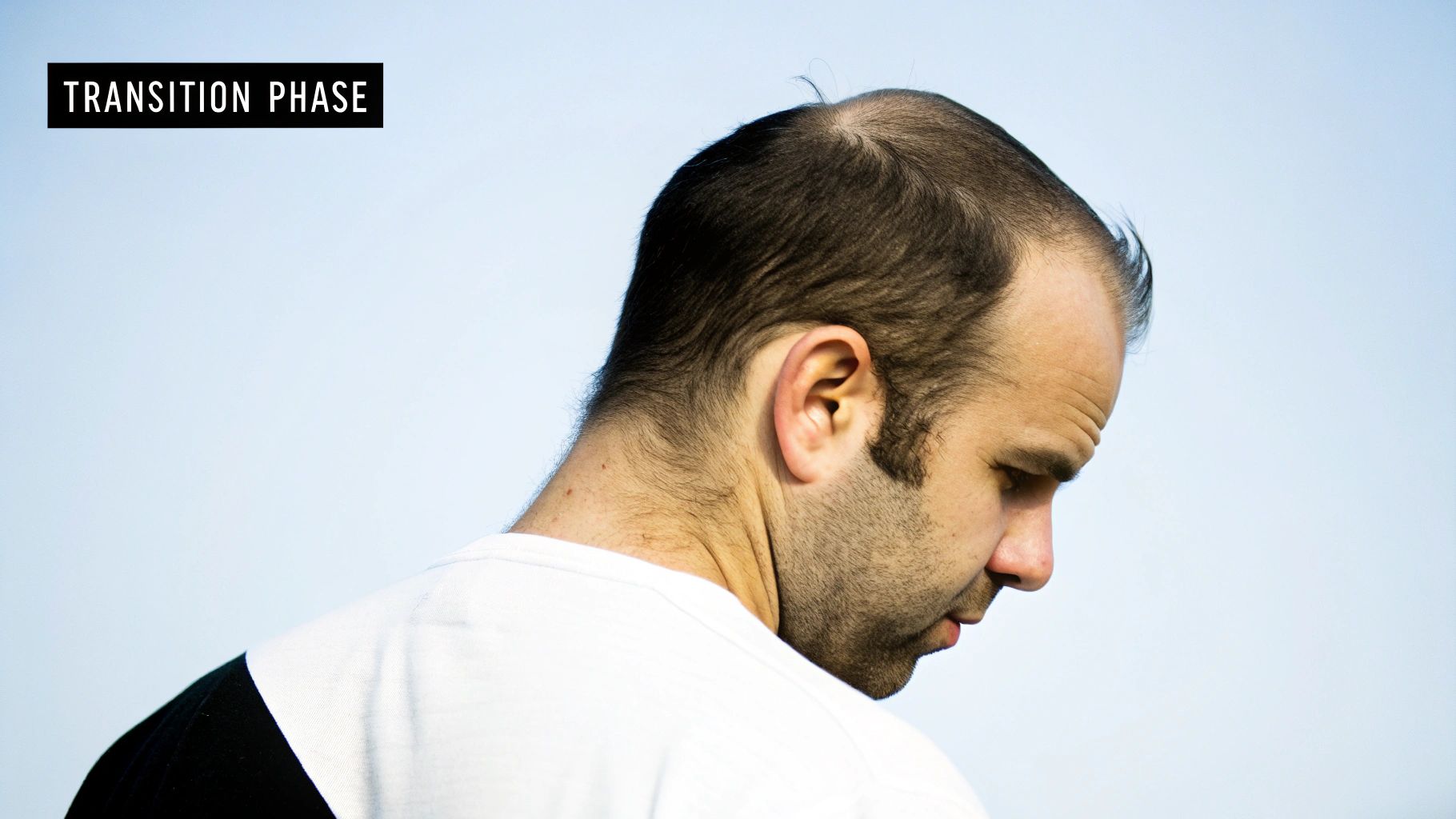
At any given time, only about 1-5% of your scalp hairs are in the catagen phase. This phase signals the end of active growth for that specific hair. The follicle shrinks quite a bit, getting ready to enter the resting telogen phase before the whole cycle starts over.
How Long Does Catagen Last?
Compared to the multi-year anagen phase, the catagen stage is incredibly brief. This rapid transition is intentional, making sure the follicle can efficiently reset for the next growth cycle.
- Average Healthy Hair: For a typical scalp hair, the catagen phase lasts for about 2 to 3 weeks. During this time, cell division grinds to a halt, and the follicle undergoes its programmed regression.
- Triggers for Transition: The switch from anagen to catagen is a complex biological process controlled by genetic and hormonal signals. Things like stress or illness can sometimes push a larger number of follicles into this phase prematurely, a condition known as telogen effluvium.
- Body Hair: Just like the anagen phase, the catagen phase duration is consistent across different types of body hair, serving its purpose as a quick transitional step no matter where the hair is located.
The Catagen Phase and Male Pattern Baldness
In the context of male pattern baldness, the catagen phase becomes a critical point of disruption. While DHT's main attack is on shortening the anagen phase, the transition into catagen is also affected. As follicles become miniaturized, they don't just spend less time growing; they also rush into this transition phase more quickly and more often.
This accelerated cycling process puts a ton of stress on the follicle. Instead of a long, productive anagen phase followed by a brief, orderly catagen transition, the follicle is forced into a rapid, inefficient loop of short growth and premature shutdown.
Key Insight: Male pattern baldness creates a domino effect. A shorter anagen phase forces an earlier entry into the catagen phase. This means more hairs are transitioning out of growth and toward shedding at any given time, contributing directly to the appearance of thinning.
This constant, sped-up cycle of entering catagen wears the follicle out. Each new cycle produces a weaker, thinner hair until the follicle eventually becomes dormant and stops producing visible hair altogether.
Practical Takeaways and Treatment Implications
Understanding that hair loss involves a premature shift into catagen is key to effective treatment. The goal isn't just to stimulate growth but to stop follicles from giving up and entering this transitional phase too early.
Actionable Tips for Managing the Catagen Phase:
- Prevent Premature Entry: The main goal of treatments like PRP is to keep follicles firmly in the anagen phase for as long as possible. The growth factors in PRP help to counteract the signals that tell a follicle to enter catagen, essentially reinforcing the "grow" signal and delaying the "shutdown" signal.
- Recognize the Signs of Disruption: If you notice a sudden, dramatic increase in shedding, it’s a classic sign that an unusually high number of your follicles have been prematurely pushed into the catagen and subsequent telogen phases. This could be triggered by stress, dietary deficiencies, or the progression of androgenetic alopecia.
- Minimize Follicular Stress: Chronic stress releases cortisol, a hormone that's been shown to negatively impact the hair cycle and can push more hairs into the catagen phase. Managing stress through exercise, mindfulness, or other techniques can help maintain a healthier hair cycle balance.
- Support the Follicle's Foundation: A healthy follicle is more resilient to the signals that trigger catagen. Make sure your diet is rich in biotin, zinc, and iron. These nutrients are the building blocks for a strong hair structure and a well-functioning follicle, making it less likely to transition prematurely.
3. Telogen Phase (Resting Phase)
The telogen phase is the final resting and shedding stage of the hair growth cycle. You can think of it as the quiet retirement period for a hair strand after its long growth and short transition. During this phase, the hair follicle is completely inactive. The hair shaft, now a "club hair" with a hard, white bulb at its root, is fully formed but is no longer growing or getting any nourishment. It just sits in the follicle until it's eventually shed to make way for a new anagen hair to begin its journey. This shedding is a normal and necessary part of the cycle, and it’s a key reason why understanding all 3 stages of hair growth is so important.
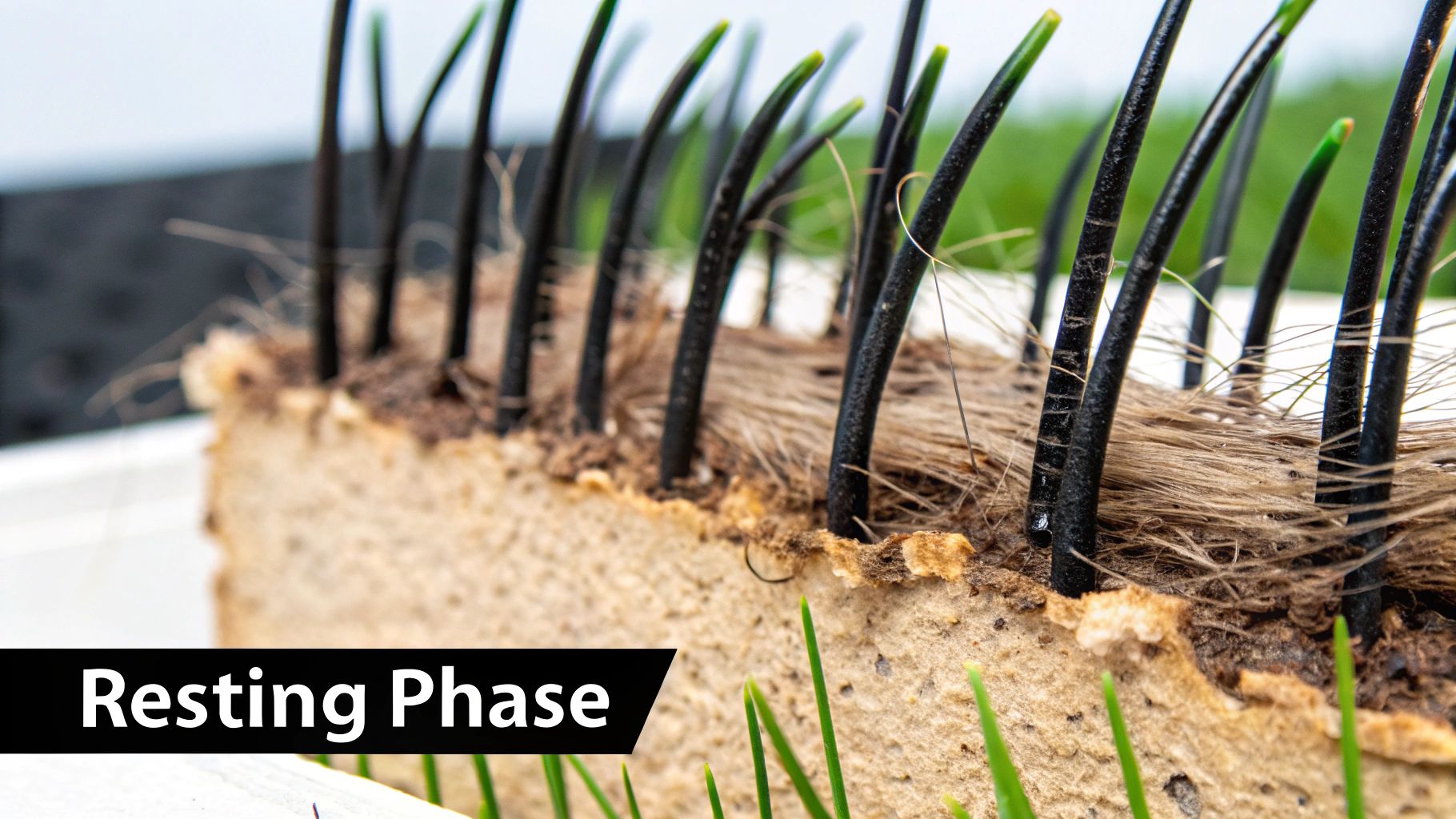
For a healthy scalp, about 10-15% of your hair follicles are in the telogen phase at any given moment. This phase is relatively short compared to the anagen phase, and a normal shedding rate is between 50 to 100 of these club hairs per day. Noticing these hairs on your brush or shower drain is typically nothing to worry about; it’s a sign your hair cycle is working as it should.
How Long Does Telogen Last?
The duration of the telogen phase is fairly consistent, but its balance with the other phases is what determines your scalp health and hair density.
- Average Healthy Hair: For scalp hair, the telogen phase typically lasts for about 2 to 4 months. After this period, the hair is shed, and the follicle re-enters the anagen phase to start producing a new hair.
- Abnormal Shedding (Telogen Effluvium): This condition happens when a major stressor (like surgery, severe illness, or extreme emotional distress) shocks a large number of follicles, pushing them prematurely from the anagen phase into the telogen phase. This results in a massive, noticeable shedding event about 2-4 months after the trigger.
- Body Hair: Just like the other phases, the telogen phase varies across the body. The cycle is regulated so that hair in different areas has different maximum lengths and shedding patterns.
The Telogen Phase and Male Pattern Baldness
The telogen phase becomes a critical battleground in the fight against male pattern baldness. While DHT's main attack is on shortening the anagen (growth) phase, its secondary effect is to prolong the telogen (resting) phase. This one-two punch is what accelerates visible hair loss.
As follicles miniaturize, they not only produce weaker hairs for shorter periods, but they also spend more and more time lying dormant. A healthy follicle might rest for 3 months before starting a new hair, but a miniaturized follicle might rest for 6 months, then 9, and then even longer.
Key Insight: In male pattern baldness, follicles become "lazy." The resting period between shedding an old hair and growing a new one gets progressively longer, increasing the amount of time the scalp has no hair in that follicle.
This extended downtime means fewer active, growing hairs on your head at any one time. The combination of shorter growth cycles and longer rest periods creates a gradual but relentless decline in hair density, leading to the classic patterns of thinning seen in androgenetic alopecia.
Practical Takeaways and Treatment Implications
Keeping an eye on your shedding is the best way to spot trouble in the telogen phase. An increase in shed hairs or noticing that your hair density is decreasing could mean too many follicles are entering or staying in the resting stage for too long.
Actionable Tips for Managing the Telogen Phase:
- Early Intervention is Key: The goal of treatments like Platelet-Rich Plasma (PRP) is to "wake up" these dormant follicles. By injecting growth factors directly into the scalp, PRP can signal follicles stuck in a prolonged telogen phase to get back into the anagen (growth) phase, effectively shortening their downtime.
- Count Your Shed Hairs: If you think there might be a problem, try counting the hairs you lose daily for a week. Consistently losing more than 100-150 hairs per day could point to telogen effluvium or an underlying issue that needs a professional diagnosis.
- Manage Stress and Nutrition: Chronic stress and nutritional deficiencies (especially in iron, zinc, and protein) are well-known triggers for pushing hair into the telogen phase. Prioritizing a balanced diet, regular exercise, and stress-reduction techniques like meditation can help keep your hair cycle balanced.
- Don't Wait for Dormancy to Become Permanent: In advanced male pattern baldness, follicles that stay in the telogen phase for too long can become scarred and permanently lose their ability to produce hair. Acting early with treatments like PRP helps prevent follicles from reaching this point of no return.
4. Kenogen Phase (Empty Phase)
The kenogen phase is a relatively new but crucial piece of the hair growth puzzle. Think of it as a period of dormancy after the hair has shed in the telogen phase but before a new anagen hair starts to grow. During this stage, the hair follicle is completely empty, like a vacant plot of land waiting for new construction. It's a pause in the cycle, a period where the follicle is inactive and there's no hair shaft present. While a brief kenogen period is normal, how long it lasts is critically important for hair density and is a key factor in the progression of hair loss.
In a healthy scalp, this empty phase is short, allowing the follicle to quickly jump back into the anagen phase and start making a new hair. However, in cases of hair loss, particularly male pattern baldness, this phase can become much longer. It's an important, yet often overlooked, part of the 3 stages of hair growth framework, representing a critical window for intervention.
How Long Does Kenogen Last?
The length of the kenogen phase is a direct indicator of follicle health and efficiency. A longer kenogen phase means less time spent in the active anagen growth phase, which results in lower overall hair density.
- Healthy Hair Cycle: For a healthy follicle, the kenogen phase is usually very short, lasting anywhere from 1 to 3 months. The follicle quickly reboots and kicks off a new anagen phase.
- Post-Procedure: After events like a hair transplant, donor sites can enter a temporary kenogen phase lasting 2-3 months before regrowth starts. This is a normal part of the healing and regeneration process.
- Hair Loss Conditions: In conditions like severe alopecia areata or advanced male pattern baldness, follicles can get "stuck" in the kenogen phase for 6 months or even longer. This extended dormancy is a sign of severe follicle distress.
The Kenogen Phase and Male Pattern Baldness
For men dealing with androgenetic alopecia, the kenogen phase is a battleground. While DHT's shortening of the anagen phase is well-known, its ability to prolong the kenogen phase is just as destructive. As follicles shrink under the influence of DHT, they become less efficient at re-entering the growth phase after shedding. They spend more and more time in this empty, dormant state.
This leads to a visible drop in hair density, even if the total number of follicles stays the same. You might notice areas where hair has shed but nothing seems to be growing back in its place. This is the classic sign of an extended kenogen phase.
Key Insight: Progressive hair loss isn't just about shorter hairs; it's about follicles staying empty for longer periods. An extended kenogen phase means fewer active, hair-producing follicles on your scalp at any given time, creating the appearance of thinning.
If this prolonged dormancy continues cycle after cycle, the follicle may eventually lose its ability to re-enter the anagen phase at all, leading to permanent hair loss in that spot.
Practical Takeaways and Treatment Implications
Identifying a prolonged kenogen phase is a critical signal that your follicles are struggling and need immediate support. Waiting for them to "wake up" on their own can be a losing strategy.
Actionable Tips for Managing the Kenogen Phase:
- Watch for "Empty" Zones: Pay close attention to areas where you've noticed shedding. If you see no signs of new, fine hairs emerging after 2-3 months, you are likely experiencing an extended kenogen phase. This is your cue to take action.
- Don't Wait, Stimulate: The kenogen phase is a crucial window for treatment. Therapies like Platelet-Rich Plasma (PRP) are designed to "wake up" these dormant follicles. The growth factors in PRP can provide the necessary signal to jolt a follicle out of kenogen and kickstart a new anagen phase before it becomes permanently inactive.
- Target Dormant Follicles: Applying PRP therapy to areas with a prolonged kenogen phase can be highly effective. The goal is to reactivate these sleeping follicles, encouraging them to get back into the growth cycle and start producing hair again, effectively shortening the empty period.
- Set a Timeline: If an area of your scalp has stayed in the kenogen phase (completely bare with no new growth) for over 6 months, the chances of reactivating that follicle drop significantly. This really highlights the urgency of early intervention to prevent permanent loss.
5. Hair Growth Cycle Dysfunction in Male Pattern Baldness
Hair growth cycle dysfunction is the engine driving male pattern baldness. It’s not simply about hair falling out; it’s a systemic breakdown of the healthy, predictable 3 stages of hair growth. In genetically susceptible men, this dysfunction is caused by DHT, which attacks the follicles and fundamentally rewrites their biological clock. This pathological disruption is what leads to the progressive thinning and eventual baldness that is characteristic of androgenetic alopecia.
Instead of a long, productive anagen phase followed by brief catagen and telogen phases, DHT-sensitive follicles are thrown into a downward spiral. The anagen phase is drastically shortened, the catagen phase gets triggered too early, and the telogen (shedding) phase can become prolonged. Over time, this corrupts the entire cycle, causing follicles to shrink and produce increasingly weaker hairs until they stop making visible hair altogether. Understanding this dysfunction is the first step toward finding a treatment that works.
For men with hair loss, this explains why simple "hair growth" shampoos often fall flat. The problem isn't a lack of growth, but a broken growth cycle. About 50-100 hairs are shed daily as part of a normal cycle, but with cycle dysfunction, this number increases significantly as more hairs are prematurely forced into the shedding phase.
What Does This Dysfunction Look Like?
The signs of cycle dysfunction are often mistaken for normal aging, but they represent a clear pathological process. The progression is often mapped using the Norwood Scale, where each advancing stage reflects a greater number of follicles succumbing to this dysfunctional cycling.
- Receding Hairline: This classic sign happens because follicles in the temple and frontal regions are often the first to become highly sensitive to DHT. Their anagen phases shorten first, leading to thinning in that specific area.
- Crown Baldness: Similarly, follicles at the vertex (crown) can be particularly vulnerable. They begin their dysfunctional cycle early, leading to the well-known bald spot, even while frontal hair remains relatively thick.
- Diffuse Thinning: In some men, the dysfunction isn't localized. Instead, it happens all over the scalp, causing a gradual but widespread reduction in hair density and quality without a distinct pattern.
The Cycle Dysfunction and Male Pattern Baldness
The biological mechanism of male pattern baldness is a direct assault on the hair growth cycle. The presence of DHT in sensitive follicles acts like a poison, systematically dismantling the very process designed to produce healthy hair. It’s a war of attrition fought one cycle at a time.
This dysfunction creates a destructive feedback loop. A shorter anagen phase means the hair produced is thinner and weaker. A longer telogen phase means the follicle stays dormant for longer periods. With each turn of this corrupted cycle, the follicle shrinks further, and the hair it produces becomes less significant.
Key Insight: Male pattern baldness is less about hair loss and more about hair replacement failure. The healthy, thick terminal hairs are slowly replaced by miniaturized, nearly invisible vellus hairs because the growth cycle no longer supports their development.
This process explains why thinning is gradual. It takes multiple dysfunctional cycles for a follicle to shrink to the point of inactivity. This slow progression is also why early intervention is so powerful; you're saving follicles before they've undergone too many damaging cycles.
Practical Takeaways and Treatment Implications
Recognizing that male pattern baldness is a cycle dysfunction reframes the entire approach to treatment. The goal isn't just to stop hair from falling out; it's to restore the normal rhythm of the 3 stages of hair growth.
Actionable Tips for Correcting Cycle Dysfunction:
- Recognize Early Signs: Don't ignore increased shedding, hair that seems thinner or "wispier," or a scalp that becomes more visible. These are the first red flags that your follicles' growth cycles are shortening.
- Seek Treatment Immediately: The earlier you intervene, the more follicles you can save from advanced miniaturization. Once a follicle is completely dormant, it is much harder to reactivate. Early action gives treatments like PRP a much higher chance of success.
- Target the Cycle with PRP: Platelet-Rich Plasma (PRP) therapy is designed to combat this very problem. The growth factors in PRP directly stimulate follicles, helping to push them back into a longer, healthier anagen phase and counteracting the miniaturizing effects of DHT.
- Consider a Combination Approach: For the best results, many specialists recommend combining PRP with other proven treatments. Minoxidil helps stimulate follicles and prolong the anagen phase, while finasteride works by systemically reducing DHT levels, tackling the root hormonal cause of the dysfunction.
- Maintain Your Results: Correcting cycle dysfunction is not a one-time fix. Regular follow-up PRP treatments (e.g., every 6-12 months) are often necessary to maintain the health of the follicles and keep the growth cycle normalized against the ongoing influence of DHT.
5-Point Comparison: Hair Growth Phases & Dysfunction
| Phase / Condition | Implementation complexity 🔄 | Resource requirements ⚡ | Expected outcomes ⭐📊 | Ideal use cases 💡 | Key advantages ⭐ |
|---|---|---|---|---|---|
| Anagen Phase (Growth Phase) | Moderate — timing-critical interventions during active growth | Moderate — clinic-based treatments (PRP), monitoring and follow‑ups | High — increased length/thickness when treated early (⭐⭐⭐) | Early-stage thinning with many active follicles | Maximizes treatment responsiveness; best window for regeneration |
| Catagen Phase (Transition Phase) | Low–Moderate — prevent/shorten premature transition with targeted therapy | Moderate — topical/systemic agents, PRP, lifestyle changes | Moderate — stabilizes shedding if caught early (⭐⭐) | Sudden/increased shedding or stress-induced transitions | Short intervention window to reduce immediate shedding |
| Telogen Phase (Resting Phase) | Moderate — identify triggers (telogen effluvium) and correct causes | Moderate–High — nutritional correction, medical evaluation, PRP | Variable — good recovery if trigger reversible; poorer if chronic (⭐–⭐⭐) | Post-illness/surgery shedding, seasonal shedding | Follicles can reset; interventions can restore normal cycling |
| Kenogen Phase (Empty Phase) | High — follicles empty and dormant; reactivation is challenging | High — intensive regenerative therapy (PRP), possible surgical options | Low–Moderate — early reactivation possible; prolonged kenogen has low success (⭐) | Early detection of non‑regrowing areas; pre‑transplant assessment | Identifies critical window before permanent miniaturization |
| Hair Growth Cycle Dysfunction (Male Pattern Baldness) | High — multifactorial; requires combined, long‑term management 🔄🔄 | High — ongoing meds (finasteride/minoxidil), PRP, possible surgery, monitoring ⚡⚡ | Variable — early treatment can halt/reverse partially; late stages less responsive (⭐–⭐⭐⭐) | Progressive androgenetic alopecia; patients needing stabilization and restoration | Mechanism-based approach enables targeted combination therapy to slow or partially reverse loss |
Taking Control: Your Next Steps in Managing the Hair Growth Cycle
Navigating the world of male hair loss can feel overwhelming, but understanding the biological blueprint behind it all is the first, most crucial step toward getting back in the driver's seat. We've walked through the intricate 3 stages of hair growth, from the productive anagen phase where your hair actively grows, to the brief catagen transition, and finally, the telogen resting period. Learning about the kenogen phase, or the empty follicle stage, further highlights the cyclical nature of hair health and why being proactive is so important.
The main thing to take away is this: male pattern baldness isn't a sudden event. It's a gradual, systemic disruption of this finely tuned cycle. The anagen phase shortens, the telogen phase lengthens, and the kenogen phase can drag on for longer. This results in hairs that are not only shed more frequently but also grow back thinner and weaker over time—a process known as miniaturization. Recognizing this process isn't about admitting defeat; it's about identifying the precise mechanism you need to target.
Your Actionable Path Forward
The knowledge you've gained about the hair growth cycle is your greatest asset. It changes you from a passive observer of your changing hairline into an informed decision-maker. Instead of just reacting to hair fall, you can now think strategically about how to support and extend the anagen phase while minimizing the dormant telogen and kenogen periods. This is the core principle behind effective, modern hair restoration treatments.
Here are your key takeaways and next steps, boiled down into an actionable plan:
- Become a Cycle Detective: Start actively observing your hair. Are you noticing more shedding than usual? Does your hair seem to lack the density it once had? These aren't just signs of "hair loss" but potential clues that your growth cycle is disrupted, specifically a shortening anagen phase.
- Acknowledge the Time Factor: The progression of androgenetic alopecia is directly tied to the health of your hair follicles. The longer a follicle stays in a dormant or miniaturized state, the harder it becomes to reactivate. Early intervention isn't just a recommendation; it's a strategic advantage that can dramatically improve your long-term results.
- Look Beyond the Scalp: Remember that your hair is a barometer of your overall health. The growth cycle can be influenced by a host of internal and external factors. Beyond understanding the inherent phases, it's crucial to address external factors that disrupt the cycle. For instance, sometimes hair growth issues can stem from underlying health problems. Recognizing the specific signs of vitamin deficiency is a key step in managing overall health, including that of your hair.
Key Insight: Effective hair loss management is not about finding a magic cure. It's about implementing targeted strategies that directly support the biological process of hair growth, primarily by extending the anagen phase and stimulating dormant follicles.
Ultimately, understanding the 3 stages of hair growth demystifies what's happening on your scalp. It provides a clear, biological reason why treatments like Platelet-Rich Plasma (PRP) are designed the way they are. By reintroducing a concentration of your body's own growth factors directly to the scalp, PRP aims to send a powerful signal to struggling follicles, encouraging them to re-enter and stay in the active anagen phase for longer.
You now have the knowledge to take meaningful, proactive steps. Don't let uncertainty lead to inaction. Your journey toward healthier, fuller hair begins with the understanding you've built today. Use it to consult with a professional, explore your options with confidence, and choose a path that directly addresses the root cause of the issue: the hair growth cycle itself.
Ready to intervene directly in your hair growth cycle? The treatments at PRP For HairLoss are specifically designed to stimulate dormant follicles and extend the crucial anagen growth phase. Explore how our targeted PRP For HairLoss therapies can help you take back control of your hair's future.
 PRP For Hairloss
Leave a comment