Getting your hair back takes a game plan. It’s not about finding some magic pill, but using a combination of proven medical treatments like Minoxidil, Finasteride, and PRP therapy, all working hand-in-hand with a healthy lifestyle and smart scalp care. Your first move, though, is to figure out what’s causing the thinning—and for most guys, the answer is androgenetic alopecia.
Understanding the First Signs of Hair Thinning
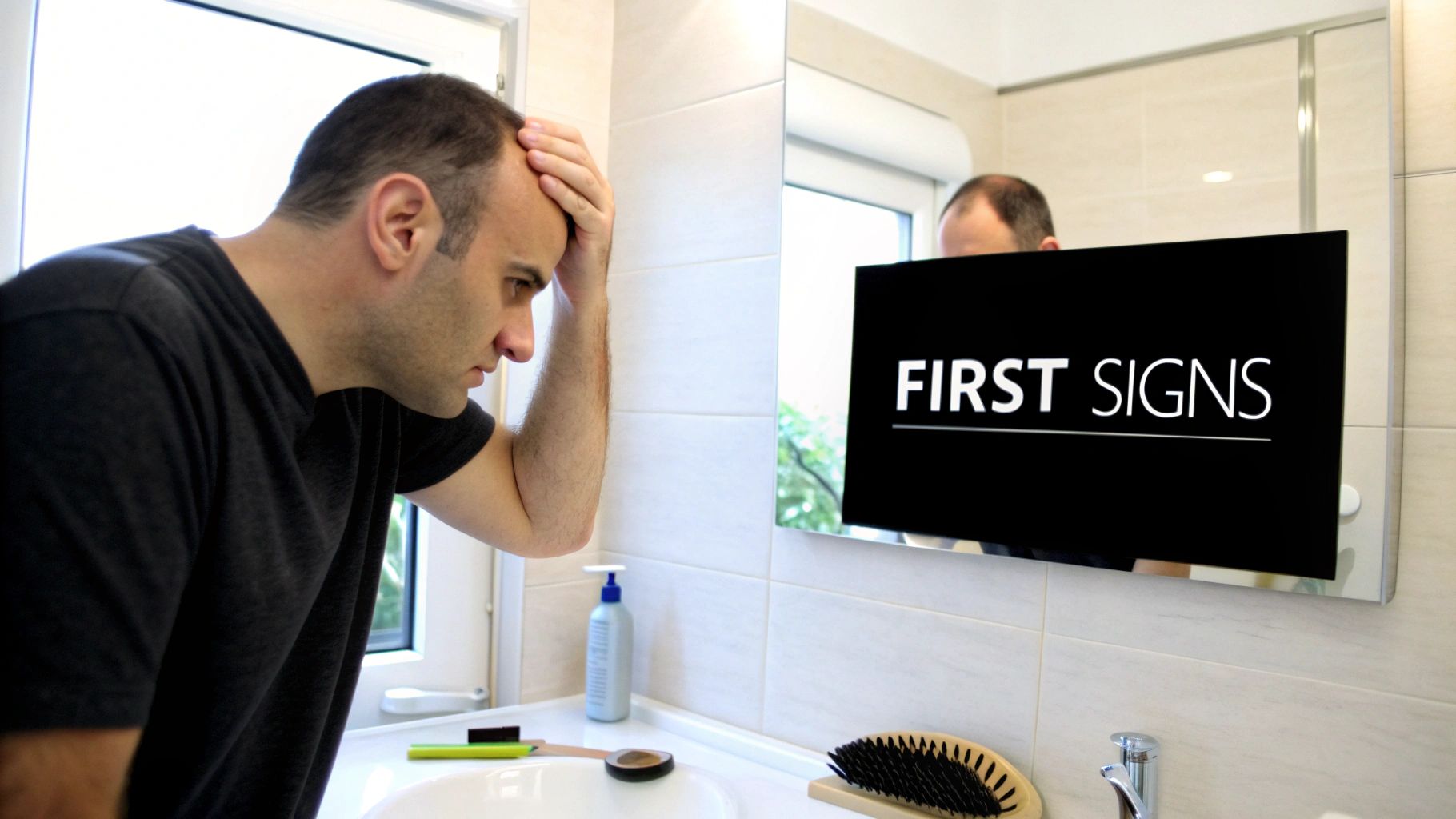
Catching hair loss early can feel unsettling. It’s rarely a sudden event. It's more of a slow creep—a few extra hairs on the pillowcase, a bigger clump in the shower drain, or your brush looking fuller than usual.
Maybe you've noticed your part widening, or that familiar dense feeling is gone when you run your hands through your hair. For the vast majority of men, these are the first signals of androgenetic alopecia, what everyone just calls male pattern baldness. This isn't your fault; it's almost always written in your genes.
The Role of DHT in Hair Thinning
The main culprit behind male pattern baldness is a hormone called dihydrotestosterone, or DHT. If your follicles are genetically sensitive to it, DHT latches on and kicks off a process called miniaturization.
This process systematically shrinks your hair follicles. With every growth cycle, the hair that comes back is a little finer, shorter, and weaker than the one before it. Eventually, the follicle gets so tiny it can’t produce a visible hair at all. This is what creates that classic receding hairline and the thinning spot on the crown.
Knowing the "why" behind your hair loss is incredibly empowering. It shifts the focus from worrying to taking action. Once you get the biological process, you can start looking at proven ways to fight DHT's effects and give your follicles the support they need.
And if you're going through this, you are far from alone. Picture a guy in his 20s noticing his hairline isn’t what it used to be—that’s a textbook case. According to the International Society of Hair Restoration Surgery, about 20% of men in their 20s are already seeing signs of male pattern baldness. That number climbs to 30% by their 30s and 40% in their 40s. The American Hair Loss Association reports that by age 50, a staggering 85% of men experience significant hair thinning.
Mapping Your Journey with the Norwood Scale
To get a handle on where you are in the process, professionals use the Norwood Scale. Think of it as a roadmap for male pattern baldness, breaking it down into distinct stages. It helps you pinpoint your current stage and track any changes over time.
Here's a quick look at the stages:
- Stage 1: No real hair loss. Your hairline is still full.
- Stage 2: You might see a slight recession at the temples. This is often just called a "mature" hairline.
- Stage 3: This is the first stage of what's considered clinically significant balding. The hairline pulls back more at the temples, creating an M, V, or U shape.
- Stage 4: The recession is deeper, and you might now have a noticeable bald spot on the crown (the vertex).
- Stage 5-7: The hair loss becomes much more extensive as the patch of hair separating your hairline and crown thins out and eventually disappears.
Knowing your Norwood stage is incredibly helpful. It gives you a clear baseline and helps a specialist recommend the treatments that will work best for you. The key is to take action early. If you catch it in the Norwood 2-4 range, you have a much better shot at not just stopping the loss but actually regrowing some of the hair you thought was gone.
If you’re just starting to see changes, it's worth taking a moment to learn how to tell if your hair is thinning. This isn't about panicking; it's about being proactive and taking control.
Creating Your Action Plan to Tackle Hair Loss
Seeing more hair in the drain can trigger a panic buy at the pharmacy. It's a totally normal reaction, but grabbing the first bottle you see isn't a real strategy. If you're serious about regrowing thinning hair, you need a smart, methodical plan that starts with figuring out what’s actually going on up there. It’s time to move from worrying to taking informed action.
Think of yourself as a detective investigating your own scalp. Your first move is to create a solid visual record so you can tell if things are getting better, worse, or staying the same. Trust me, your memory of what your hair looked like three months ago is not reliable. You need proof.
Document Your Starting Point
For a truly accurate picture, consistent photos are everything. Pull out your smartphone and snap a few pictures once a month, making sure you do it the same way every single time. Consistency is king here.
Here's a simple process that works:
- Use the same lighting: Bright overhead light, like in most bathrooms, is perfect because it reveals thinning spots. Skip the soft, flattering light—you want the truth.
- Keep the angles identical: Get shots from the front (to see the hairline), from above (for the crown), and from both sides (for the temples).
- Style your hair the same way: Always take the photos when your hair is dry and styled like you normally wear it. Wet hair always makes thinning look more dramatic than it really is.
Keep this up for 3 to 6 months. This gives you an undeniable baseline and helps you see the real trajectory of your hair loss. It's the only way to know for sure if a treatment is working later on. You can also get a more detailed look by doing a hair density test to get a better sense of your starting point.
When to See a Dermatologist
Tracking your hair loss is a great first step, but it's not the whole game. For anyone serious about regrowing hair, getting a professional diagnosis is non-negotiable. A dermatologist can officially confirm if it’s male pattern baldness and, more importantly, rule out other sneaky causes.
Honestly, booking that appointment is the most powerful move you can make. A dermatologist can spot underlying issues you'd never find on your own—things like thyroid problems, stress-induced shedding (telogen effluvium), or even nutritional gaps that are making the problem worse.
To make that visit count, show up prepared. You're there for more than just a diagnosis; you're there to build a battle plan.
Your Doctor Appointment Checklist
Don't just walk in and hope for the best. A short list of questions ensures you walk out with a concrete plan of action.
Try asking your dermatologist these questions:
- Looking at my hair, what do you think is the most likely cause?
- Should we run any blood tests to make sure nothing else is going on?
- For my specific situation, what are the most effective treatments available?
- What are the potential side effects I should know about for the options you recommend?
- Realistically, what kind of results should I expect, and how long will it take to see them?
This simple conversation turns your doctor into a true partner in this process. It ensures your plan is built on a rock-solid foundation of medical expertise, not just wishful thinking.
Exploring Treatments That Genuinely Work
Alright, you've taken a hard look at your hair and maybe even had a chat with a professional. Now for the part you’ve been waiting for—what can you actually do to fight back against thinning? This is where we shift from planning to action, diving into the science-backed treatments that have genuinely helped countless men.
We’re going to look at the heavy hitters: Minoxidil, Finasteride, and a powerful procedure called Platelet-Rich Plasma (PRP) therapy.
It's not enough to just know the names. To figure out what's right for you, you need to understand how each one works. This isn't about finding a magic bullet; it's about picking the right tools for your specific situation.
This simple flowchart can help you map out those first crucial steps before you land on a specific treatment.
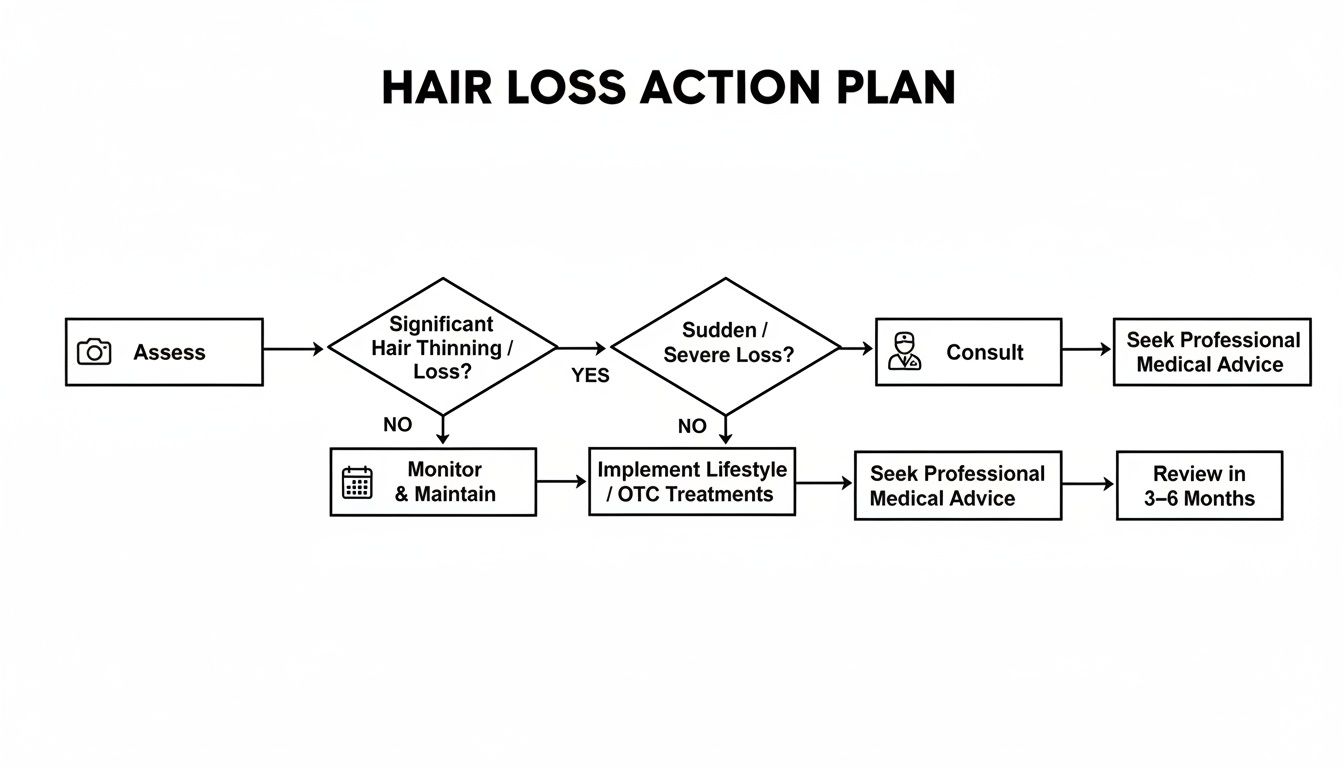
Think of this visual as your starting point. It breaks the process down into three manageable stages—assessment, tracking, and getting professional advice—which are the bedrock of any successful regrowth strategy.
Minoxidil: The Topical Stimulator
You’ve definitely seen Minoxidil, famously branded as Rogaine, lining pharmacy shelves. It’s an over-the-counter topical treatment, which just means you apply the foam or liquid directly to your scalp.
The story behind it is pretty fascinating. It was first developed as a pill for high blood pressure, but researchers noticed patients were experiencing an unexpected side effect: new hair growth.
As a vasodilator, Minoxidil widens blood vessels. On the scalp, this is thought to ramp up blood flow, bringing a fresh supply of oxygen and nutrients to starving hair follicles. It also helps extend the hair’s growth (anagen) phase, giving it more time to grow longer and stronger. It doesn't block DHT, but it helps create a healthier environment for your hair to thrive in.
Finasteride: The DHT Blocker
While Minoxidil works on the surface, Finasteride (brand name Propecia) gets to the root of the problem from the inside. This is a prescription-only pill that directly targets the primary hormonal trigger of male pattern baldness.
Finasteride works by inhibiting an enzyme called 5-alpha reductase, which is the culprit responsible for converting testosterone into the far more potent dihydrotestosterone (DHT). By putting the brakes on this conversion, Finasteride dramatically lowers DHT levels in your scalp, giving your follicles a real chance to recover from miniaturization.
It remains one of our most effective tools for stopping hair loss in its tracks and, for many guys, regrowing hair—especially at the crown. Since it works systemically, it requires a conversation with your doctor. To learn more, check out this guide on FDA-approved hair loss treatment.
Platelet-Rich Plasma: The Natural Regenerator
This is where treatment gets really interesting. Platelet-Rich Plasma (PRP) therapy is a medical procedure that harnesses your body’s own healing power to rejuvenate dormant hair follicles. It’s a completely different approach from daily pills or topicals.
The process itself is surprisingly straightforward:
- A small sample of your blood is drawn, just like a routine test.
- The blood is spun in a centrifuge to separate the platelets and concentrate them into a small amount of plasma.
- This creates a golden liquid—the PRP—which is loaded with powerful growth factors.
- Finally, this PRP is carefully injected into the areas of your scalp where you're experiencing thinning.
These growth factors act like a wake-up call for your follicles, stimulating cell repair and boosting blood supply. It's a way of directing your body's natural healing ability exactly where it's needed most.
Comparing Top Hair Regrowth Treatments
Navigating the world of hair loss treatments can be overwhelming. To make it clearer, here's a side-by-side look at how these evidence-backed options stack up against each other, helping you understand their mechanisms, application, and who they're best suited for.
| Treatment | How It Works | Best For | Potential Side Effects |
|---|---|---|---|
| Minoxidil | Increases blood flow to follicles and extends the hair's growth phase. | Men in the early to moderate stages of hair loss, particularly at the crown. | Scalp irritation, dryness, unwanted facial hair growth. |
| Finasteride | Blocks the enzyme that converts testosterone to DHT, reducing scalp DHT levels. | Men with mild to moderate male pattern baldness, effective at the crown and mid-scalp. | Sexual side effects (decreased libido, erectile dysfunction) in a small percentage of users. |
| PRP Therapy | Injects concentrated growth factors from your own blood to stimulate dormant follicles. | Individuals with thinning hair but still active follicles; often used with other treatments. | Minor pain, swelling, or redness at the injection site; very low risk of allergic reaction. |
Each of these treatments offers a unique pathway to combatting hair loss. The key is to match the right mechanism to your specific needs and comfort level, ideally with guidance from a medical professional.
Male pattern baldness is incredibly common. Globally, about 42% of men deal with noticeable hair loss, and in 95% of those cases, the cause is male pattern baldness. Treatments like PRP are showing real promise, with studies indicating it can increase hair density by 25-35% after just a few sessions.
What’s so compelling about PRP is that it's completely autologous—it comes from you. This means there's virtually no risk of an allergic reaction because you’re using your own biological material.
Often, the best strategy is a combined one. As you build your action plan, remember that things like diet and supplements can play a supporting role. This podcast on the Top Supplements for Hair Loss is a great resource. Ultimately, your best path forward—whether it's Minoxidil, Finasteride, PRP, or a combination—depends on your stage of hair loss, your lifestyle, and a frank discussion with a qualified expert.
Building a Hair-Healthy Lifestyle and Scalp Care Routine

While medical treatments are your frontline defense, your daily habits are the crucial support system. Think of it this way: Treatments like PRP and Minoxidil are the specialized fertilizer for your scalp, but your lifestyle is the soil, water, and sunlight.
Without a healthy foundation, even the best treatments can't live up to their full potential. This isn't about a massive life overhaul. It's about making small, smart changes that create the best possible environment for your hair follicles to wake up and get back to work.
When you combine powerful treatments with a hair-healthy lifestyle, you're giving yourself the best shot at seeing real results.
Fueling Your Follicles From the Inside
Your hair follicles are tiny factories that need a constant supply of raw materials to produce strong, healthy hair. If your diet is lacking, you're essentially starving those factories of what they need to function. Certain nutrients are non-negotiable for hair health.
Here are the heavy hitters:
- Iron: This is a must-have for producing hemoglobin, which carries oxygen to your cells—including the ones that stimulate hair growth. Low iron is a well-known cause of excess shedding.
- Zinc: Zinc is vital for hair tissue growth and repair. It also helps keep the oil glands around the follicles working properly.
- Biotin: Often hyped as a miracle cure, Biotin (a B vitamin) is genuinely essential for producing keratin, the protein that makes up your hair. A true deficiency can absolutely lead to hair loss.
- Protein: Since hair is made almost entirely of protein, a diet low in it can cause your body to ration protein by shutting down hair growth.
Making sure you get enough of these nutrients doesn’t require some complicated diet plan. It’s just about being mindful of what’s on your plate. To get more specific, you can learn more about the best foods for hair growth and build a better grocery list.
Master a Gentle Scalp Care Routine
How you handle your hair and scalp every day matters more than you might think. Thinning hair is fragile, and an aggressive routine can cause unnecessary breakage and shedding, completely undermining your regrowth efforts. The goal here is to be gentle and supportive.
One of the biggest mistakes I see is guys scrubbing their scalp with their fingernails like they're trying to remove a stain. Don't do that. Instead, use the pads of your fingers to gently massage shampoo into your scalp. This cleanses just as effectively without yanking out vulnerable hairs.
The right approach to scalp care isn't just about what you do, but also what you avoid. Harsh chemicals in some shampoos and styling products can strip your scalp of its natural oils, leading to dryness and irritation—an environment that is terrible for healthy hair growth.
When it comes to products, look for sulfate-free shampoos, as sulfates can be overly harsh. Try to dial back the high heat from blow dryers, too. Let your hair air dry when possible or at least use the lowest heat setting. It’s a simple change that reduces daily stress on your follicles. A holistic approach often means exploring a complete guide to the Best Vitamins for Hair, Skin, and Nails to understand which nutrients truly make a difference.
Managing the Impact of Stress
Stress is a huge player in the hair loss game. Chronic high stress can push a ton of hair follicles into the "resting" phase (telogen), leading to a noticeable increase in shedding a few months later. This condition is known as telogen effluvium.
You can't eliminate stress entirely, but you absolutely can manage your reaction to it. Finding a healthy outlet is key, whether that's regular exercise, meditation, or just making time for hobbies you enjoy.
Here are a few practical ways to keep stress in check:
- Prioritize Sleep: Aim for 7-8 hours of quality sleep a night. Sleep is when your body does most of its repair work.
- Move Your Body: Even a 20-minute walk can lower cortisol (the stress hormone) levels.
- Practice Mindfulness: Techniques like deep breathing or meditation can do wonders for calming your nervous system.
Managing stress won't reverse male pattern baldness on its own, but it will help prevent stress-related shedding from making things look worse. It's all about controlling every variable you can to support the medical treatments you're using.
Setting Realistic Expectations for Your Hair Regrowth Journey
So, you're ready to tackle your thinning hair. That's fantastic. But before you jump in, let's talk about the single most important tool in your arsenal: patience.
Regrowing hair is a marathon, not a sprint. Results don't pop up overnight, and understanding the typical timeline will keep you from getting discouraged and quitting just before you see real progress. Each treatment works according to its own biological clock, so let's break down what you can realistically expect.
Mapping Your Month-by-Month Progress
Every approach, from topical foams to clinical procedures, interacts with your hair's growth cycle in a unique way. This is why their timelines for visible results can be so different.
Here’s a general roadmap of what the journey often looks like:
- Months 1-3: This initial phase can feel like nothing is happening—or worse, like you're going backward. If you're using Minoxidil, you might notice some extra shedding at first. Don't panic. This is actually a good sign that the weaker hairs are being pushed out to make room for new, healthier ones. For PRP therapy, these first few months are all about healing and waking up dormant follicles beneath the surface, so you won't see much on top just yet.
- Months 4-6: This is when things start getting interesting. You’ll likely spot the first real evidence that your efforts are paying off. Minoxidil users often see fine, vellus hairs (think "peach fuzz") begin to emerge, which will thicken up over the next few months. With PRP, visible changes in hair density and texture usually start to appear after your second or third session, becoming more noticeable around the six-month mark.
- Months 6-12 and Beyond: Consistency is king. By the time you hit the one-year mark, you'll have a very clear picture of what the treatment can do for you. The hair that has grown in should be stronger and thicker. Just remember, for a chronic condition like male pattern baldness, these treatments aren't a one-and-done fix; they require an ongoing commitment to maintain your new growth.
The reality of hair loss hits most men squarely in the mirror. By age 50, stats show over 50% of men worldwide have visible thinning, a figure that climbs to 85% of American men, according to data from the American Hair Loss Association. For those facing these odds, regrowing hair isn't wishful thinking; it's backed by science. PRP therapy, for example, delivers concentrated growth factors directly to thinning areas, with some studies reporting a 30% average increase in hair count after just four months. To see how these numbers stack up for yourself, you can explore more insights on how common baldness is among men.
The Financial Side of Hair Regrowth
Beyond the time you'll put in, it's smart to be realistic about the financial investment. Budgeting for the cost from the start helps you build a sustainable, long-term strategy.
Here’s a quick breakdown of typical costs:
- Minoxidil: This is the most accessible option, usually costing $20-$40 per month over the counter.
- Finasteride: A prescription for this medication generally runs $30-$60 per month, though this can vary with insurance.
- PRP Therapy: As a clinical procedure, this requires a more significant investment. A single session can range from $500 to $1,500, with most specialists recommending an initial series of 3-4 treatments.
Try to think of these costs as an investment in your confidence. Knowing the numbers up front lets you pick a path that fits your budget without adding financial stress to the process.
If you're starting with Minoxidil, it helps to see what's possible. Check out our gallery of Minoxidil before and after photos to get some real-world motivation.
Answering Your Top Hair Regrowth Questions
If you're starting to look into ways to get your hair back, you've probably got a million questions. That's a good thing. It's smart to get a clear picture before you invest your time, money, and hope into any treatment plan.
Let’s get right into the questions that come up constantly in consultations and online forums. Getting straight answers here can be the difference between a plan that works and one you give up on.
Can I Combine Different Hair Loss Treatments Like PRP and Minoxidil?
Yes, and honestly, you probably should. Attacking hair loss from multiple angles is almost always more effective than relying on just one thing. When you combine treatments, you're creating a powerful synergy that gives you a much better shot at real results.
Here’s a simple way to think about how they work together as a team:
- Finasteride gets to the root of the problem internally by blocking the DHT that’s choking out your follicles.
- Minoxidil works topically on the scalp's surface, acting like a fertilizer to wake up follicles and boost blood flow.
- PRP therapy is like bringing in a special forces team, using your own body’s powerful growth factors to heal and energize follicles directly.
Putting them together covers all your bases. The key, of course, is to work with your doctor to build this multi-step plan. They'll make sure the combination is right—and safe—for you.
How Long Do I Need to Continue Treatment to Keep My Hair?
This is the big one, and it's crucial to set the right expectations from day one: for a genetic issue like male pattern baldness, treatment is for the long haul. It's a progressive condition, meaning the underlying cause doesn't just disappear.
Think of it like managing fitness or diet. You can't just work out for six months, get in great shape, and then stop completely, expecting the results to stick around forever. It takes consistent effort.
If you stop using treatments like Minoxidil or Finasteride, any hair you've held onto or regrown will likely be lost within a few months to a year. It's just the nature of the condition. Similarly, PRP isn't a one-and-done fix; you'll need maintenance sessions, usually once or twice a year, to protect your results. It's best to see it as an ongoing part of your self-care routine.
Are Natural Remedies Like Essential Oils Actually Effective?
It's really important to distinguish between improving scalp health and promoting actual hair regrowth. While some natural remedies can make your scalp a healthier place, they aren't a replacement for medically-proven treatments when you're fighting male pattern baldness.
Sure, a good scalp massage feels great and can boost circulation. There have even been some small-scale studies on things like rosemary oil that showed a little promise. But their impact is nowhere near what you get from FDA-approved medications or therapies like PRP.
Think of natural remedies as supportive players, not the stars of the show. They can help create a better environment for hair to grow, but they won't stop the hormonal process that causes follicles to shrink and disappear.
Ready to move from asking questions to taking action? At PRP For HairLoss, we break down the most effective treatments available today. Explore our site to see how PRP therapy could become a cornerstone of your own hair regrowth plan.

 PRP For Hairloss
Leave a comment