Staring at a receding hairline in the mirror day after day is a tough experience. So, what is a hair transplant, really? In simple terms, it's a permanent and incredibly natural-looking solution that moves your own healthy hair from a place where you have plenty—usually the back of your head—to the areas where you need it most.
The Definitive Answer to Hair Loss
A good way to understand a hair transplant is to think of it not as creating new hair, but as smart redistribution. A surgeon isn't magically growing new follicles. What they're actually doing is carefully relocating your existing, genetically-resilient hair follicles from a dense "donor area" to a thinning or bald "recipient area." This is the real secret to why the results look so natural—it’s your own hair, just growing from a new address.
Modern procedures have evolved light-years beyond the unnatural "hair plugs" you might picture from decades ago. Today’s techniques are so refined that the final result is virtually seamless, designed to blend perfectly with the hair you already have. The goal is simple: restore your hairline and build up density in a way that’s completely undetectable.
A Common Journey for Many Men
If this procedure is on your mind, you're definitely not alone. Male pattern baldness is the culprit behind 95% of hair loss in men, affecting guys as early as their 20s. In fact, the average age for a man getting a transplant is just 37. This shows a clear trend of men taking control of their appearance and confidence sooner rather than later. Understanding what causes this common condition is the first step toward finding the right solution.
A hair transplant is more than a cosmetic procedure; it's a strategic investment in restoring not just your hairline, but also your self-image. It’s about feeling like yourself again when you look in the mirror.
For anyone just starting their research, a quick, high-level summary of what a hair transplant is all about can be a huge help.
Hair Transplant At a Glance
| Aspect | Quick Summary |
|---|---|
| What It Is | A surgical procedure that moves your own hair follicles from a donor area to a thinning or bald area. |
| Main Goal | To permanently restore hair in areas affected by male pattern baldness, such as the hairline or crown. |
| Permanence | The transplanted hair is genetically resistant to balding and will continue to grow for a lifetime. |
| Best Candidates | Men with stable hair loss and a healthy, dense donor area on the back and sides of their scalp. |
| Typical Recovery | Initial recovery takes about a week, with final, mature results visible after 12-18 months. |
This table covers the basics, but there's a lot more to explore when it comes to the techniques, costs, and results you can realistically expect.
How Hair Transplants Actually Work
The best way to wrap your head around a hair transplant is to think of it like expert-level gardening for your scalp. A surgeon isn't creating new hair out of thin air; they're simply moving healthy, thriving hair follicles from a dense area (usually the back of your head) to a spot where the hair is thinning out.
This whole process is possible because of a key biological principle called donor dominance. The hair on the back and sides of your head is genetically tough—it’s built to resist the hormones that cause male pattern baldness. When a surgeon moves these follicles to the balding areas on top, they bring that resilience with them. They just keep on growing as if they never left their original spot.
Ultimately, every hair transplant boils down to harvesting healthy follicles and then carefully implanting them where they're needed most. This diagram shows the basic journey.
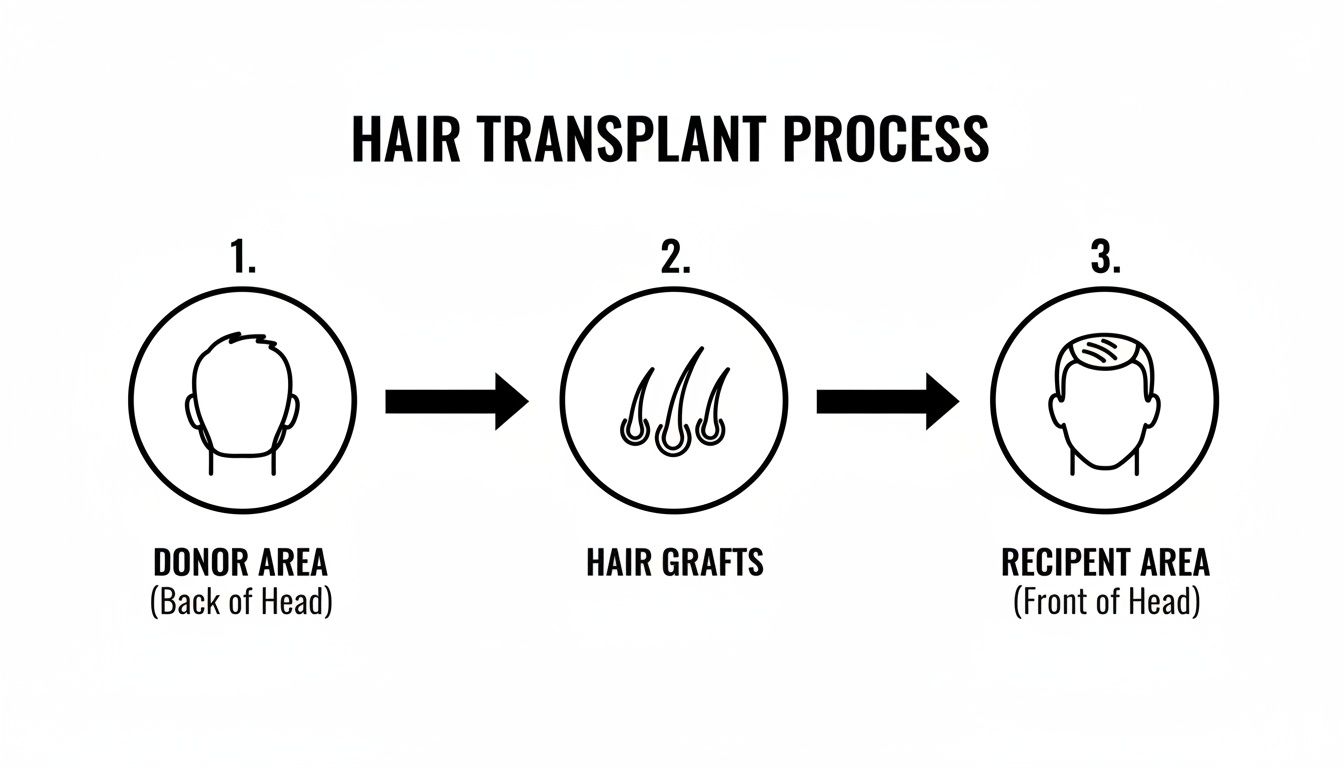
It’s a straightforward concept: source the good hair, prepare the grafts, and then strategically place them to build a new hairline or add density. The real difference between the types of procedures comes down to how the surgeon collects those donor follicles in the first place.
The Two Main Harvesting Techniques
Surgeons mostly use two methods to gather donor hair: Follicular Unit Extraction (FUE) and Follicular Unit Transplantation (FUT). The end goal is the same—get healthy hair grafts—but the way they get there is quite different.
1. Follicular Unit Extraction (FUE)
You can think of FUE as a precision harvest, one follicle at a time. The surgeon uses a tiny, specialized punch tool to extract individual follicular units—which are just natural groupings of 1-4 hairs—directly from the donor area.
- No Linear Scar: Since follicles are removed one by one, FUE leaves behind tiny, dot-like scars that are practically invisible, even if you like to wear your hair buzzed short.
- Great for Precision Work: This approach is fantastic for smaller sessions or for fine-tuning a hairline with absolute accuracy.
This technique demands a ton of skill and patience. If you're curious about the specifics, you can learn more about what Follicular Unit Extraction involves and see why it’s become such a popular choice.
2. Follicular Unit Transplantation (FUT)
The FUT method is often called the "strip method," and it's more like relocating a small patch of perfectly healthy lawn to a bare spot.
With FUT, the surgeon removes a thin strip of hair-bearing skin from the donor area. A skilled technical team then takes that strip and, under powerful microscopes, meticulously dissects it into thousands of individual follicular units for implantation.
FUT does leave a fine linear scar, but it’s easily hidden by the surrounding hair (as long as it’s not cut extremely short). Its biggest advantage is efficiency. A surgeon can harvest a huge number of grafts in a single procedure, making it an excellent choice for men dealing with more advanced hair loss.
Both FUE and FUT are proven, effective techniques. Choosing the right one for you really just comes down to your level of hair loss, your hairstyle preferences, and what your surgeon recommends.
FUE vs. FUT: Choosing the Right Hair Transplant Method
So, you've decided a hair transplant is the way to go. That's a huge first step. But now comes the real decision: which technique is right for you? The two heavyweights in the ring are FUE and FUT.
Think of it less as a technical choice and more as a personal one. The path you choose will affect your recovery, your hairstyle options, and even the final cost. They both lead to the same destination—a fuller, natural-looking head of hair—but they take very different routes to get there.
Let's break down exactly what sets them apart so you can make an informed decision.
Scarring and Hairstyle Flexibility
For most guys, this is the big one. The type of scarring left behind directly impacts how you can wear your hair in the future, and this is where the two methods really diverge.
-
FUE (Follicular Unit Extraction): With FUE, the surgeon extracts each hair follicle one by one. This leaves behind a pattern of tiny, dot-like scars scattered across the donor area. These scars are typically less than a millimeter wide, making them almost impossible to see, even if you like to rock a buzz cut or a high fade. It offers maximum freedom.
-
FUT (Follicular Unit Transplantation): This method, often called the "strip method," involves removing a thin strip of scalp from the donor area. The result is a single, fine linear scar. A talented surgeon can place it strategically so it’s easily hidden under hair that’s even a half-inch long. But, it does mean that very short hairstyles are pretty much off the table.
This isn't a small detail. If you value the flexibility to change your hairstyle and go short, FUE has a serious edge. Thankfully, modern techniques have come a long way from the unnatural look of older procedures. It’s worth understanding the difference between today's advanced methods and outdated hair plugs vs hair transplant technology.
Recovery and Downtime
How quickly you can get back to your life is another key factor. FUE is generally known for being the less invasive option, and that plays out in the recovery.
Because FUE avoids a linear incision and stitches, the healing process is typically faster and more comfortable. Most men feel fine returning to work and light activities within just a couple of days.
FUT, on the other hand, requires a bit more patience during recovery. The incision needs time to heal properly, and you'll have to be mindful of stretching your neck or back. Heavy lifting and intense exercise are usually off-limits for several weeks to protect the incision line and ensure the scar heals as cleanly as possible.
It's no surprise that Follicular Unit Extraction (FUE) is the most popular method today, making up 66% of all hair restoration surgeries. Its minimally invasive nature and lack of a linear scar are huge draws for most men.
FUE vs FUT A Head-to-Head Comparison
To put it all in perspective, here's a straightforward breakdown of how the two methods stack up against each other. This table should help clarify which approach aligns best with your goals and lifestyle.
| Feature | FUE (Follicular Unit Extraction) | FUT (Follicular Unit Transplantation) |
|---|---|---|
| Scarring | Tiny, scattered dot scars that are virtually invisible. | A single, fine linear scar in the donor area. |
| Best For | Men who want to wear their hair short and prefer minimal scarring. | Men who need a large number of grafts in a single session. |
| Recovery | Quicker and more comfortable; you can get back to your routine sooner. | Longer recovery period; requires more careful management of the incision. |
| Cost | Tends to be more expensive per graft due to the detailed labor. | Often more cost-effective for achieving a high graft count. |
| Graft Yield | The total number of grafts is limited by the donor area's surface. | Maximizes the graft count by taking from the densest part of the donor zone. |
Ultimately, the best technique is the one that fits you. Consider what matters most—is it the scar, the recovery time, the number of grafts, or the cost? A good surgeon will walk you through these pros and cons to find the perfect match for your hair restoration journey.
Are You a Good Candidate for a Hair Transplant?
A hair transplant can be a game-changer, but it isn't the right move for everyone. So, how do you figure out if you're a strong candidate? It really boils down to a few key factors that an experienced surgeon will carefully check to make sure you get the best possible results.
The first thing they’ll look at—and by far the most important—is your donor area. This is that patch of dense hair on the back and sides of your head that’s genetically built to resist balding. Think of it like a "hair bank." You can only work with what you have in reserve, and once those follicles are moved, they're gone from that spot for good. A healthy, thick donor area is the bedrock of a great transplant.
Key Factors for Candidacy
Having enough donor hair is just the start. A few other things play a massive role in deciding if a transplant is the right step for you, and just as importantly, if now is the right time.
-
Age and Hair Loss Stability: There's no perfect age, but most reputable clinics will advise younger guys, especially those in their early 20s, to hold off. Why? Your hair loss pattern needs to settle down first. If you jump into surgery too early, you could keep losing the original hair behind your newly transplanted hairline, which can look pretty strange down the road. You can dive deeper into finding the best age for a hair transplant and see why patience really pays off.
-
Type of Hair Loss: The ideal candidate has androgenetic alopecia, which you probably know as male pattern baldness. This condition follows predictable patterns (often tracked on the Norwood scale), making it perfect for surgical planning. Other hair loss conditions might not be treatable with a transplant.
Having realistic expectations is non-negotiable. A transplant moves hair; it doesn't create new hair or stop the progression of male pattern baldness. Success requires a long-term plan to maintain the hair you still have.
Your Motivation and Overall Health
Finally, your general health and your personal reasons for wanting the procedure are huge. You need to be in good overall health to ensure you can handle the surgery safely and heal up properly afterward.
Understanding why you want it is also key. For most men, this is a deeply personal decision. When it comes to a receding hairline, 37% point to their dating and social life as the top reason, while 34.7% are concerned about how it affects their career. With an incredible 95.2% of patients reporting very positive emotional outcomes after surgery, it's clear the benefits run much deeper than just looks. You can read more about the emotional and statistical impact of hair restoration to get the full picture.
What's the Investment? A Breakdown of Hair Transplant Costs
Let's get right to it: what does a hair transplant actually cost? The price tag isn't a simple, one-size-fits-all number. It really comes down to how much hair you've lost and, therefore, how many grafts you need to achieve the look you want.
Think of it this way: the more ground you need to cover, the more resources it takes. The number of grafts is the foundation of your quote, but it's not the only piece of the puzzle. The surgical technique your doctor recommends—either FUE or FUT—also makes a big difference. Since FUE involves painstakingly removing each graft one by one, it's more time-consuming for the surgical team and usually costs a bit more per graft than the FUT strip method.
The Factors That Shape Your Final Quote
Beyond the basics of graft count and technique, a few other key elements will influence the final number you see on the invoice.
- The Surgeon's Skill and Reputation: You're not just paying for a procedure; you're investing in an artist. A surgeon with years of experience, a gallery of fantastic results, and a top-notch reputation will naturally command a higher fee. It's the price of proven expertise.
- Location, Location, Location: Geography plays a massive role. A top clinic in a major U.S. city will have very different pricing than one in a country that's become a hub for medical tourism.
Remember, a quality quote isn't just for the surgery itself. A good clinic will package everything together—the initial consultation, the procedure day, and all your post-op care, including follow-up visits and any necessary medications.
To get a really detailed look at the numbers, our guide on how much hair restoration costs breaks it all down.
A Quick Look at Global Price Differences
The cost variation around the world is genuinely staggering. For instance, a procedure in Turkey might average around $2,675, which is why it's such a popular destination. Compare that to the UK, where the average is about £8,050, or the USA, which comes in at around $13,610.
What's really interesting, though, is that for the 45.81% of men who are open to traveling for their procedure, it's not just about finding the cheapest option. They're often prioritizing the quality of the clinic and the level of service just as much as the price. It goes to show that finding the right balance between cost and quality is key to making a smart investment in yourself.
Exploring Alternatives to Surgery
So, is surgery your only path forward? Not necessarily. Before you commit to a hair transplant, it’s smart to look at some powerful non-surgical options. These can help you fight hair loss without the downtime or cost of a full-blown procedure.
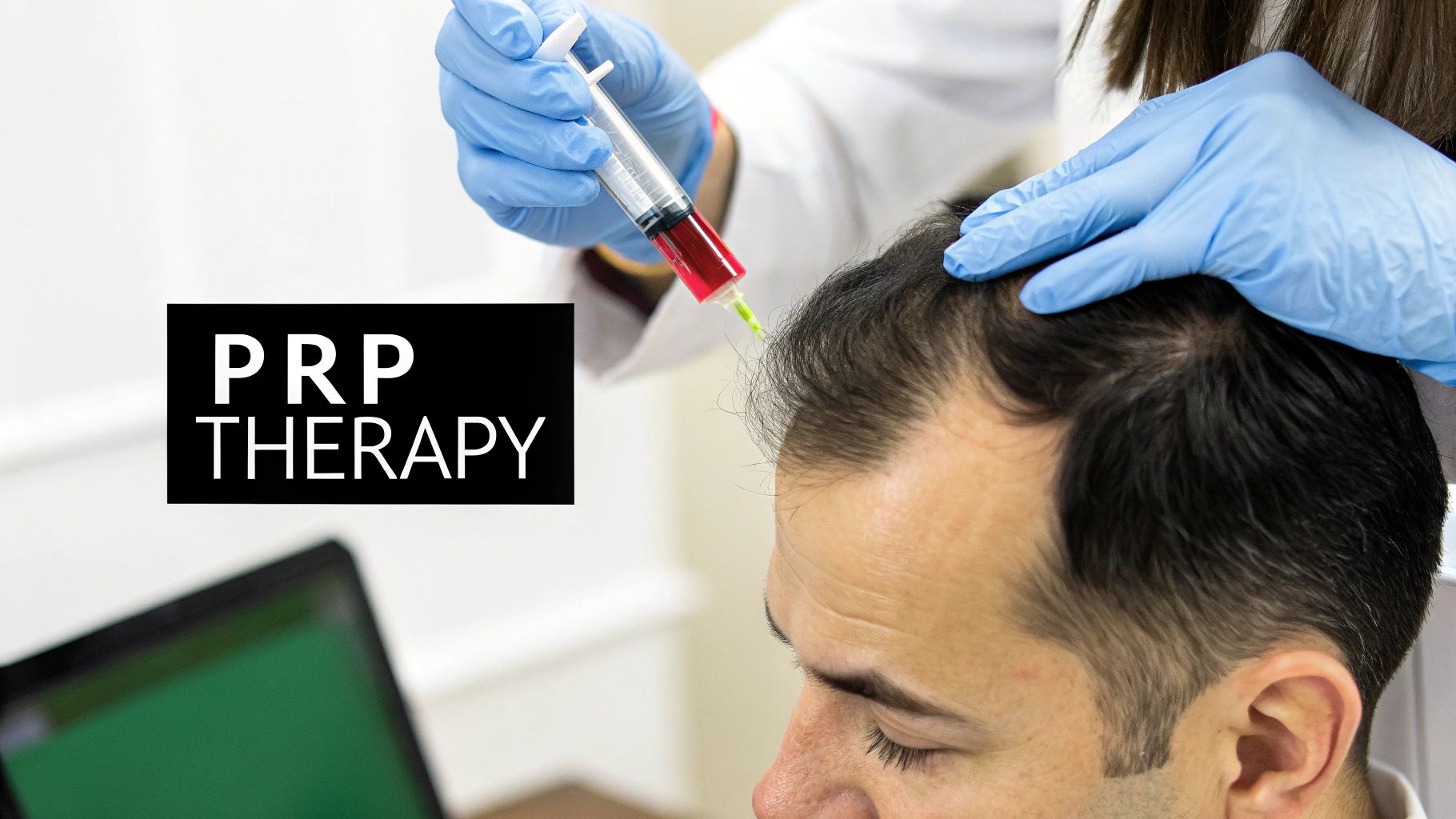
One of the most interesting options out there right now is Platelet-Rich Plasma (PRP) therapy. This treatment uses your body's own healing power to give your scalp and hair a serious boost.
How PRP Therapy Works
Think of PRP as a direct shot of high-octane fertilizer for your hair follicles. The process is pretty straightforward: a small amount of your blood is drawn and placed in a centrifuge, which spins it at high speed. This separates out the platelets, creating a concentrated serum that is loaded with growth factors.
This "liquid gold" is then carefully injected into the areas of your scalp where hair is thinning. The growth factors get to work right away, waking up dormant follicles, thickening existing hair, and helping to slow down shedding.
If a hair transplant is like planting new seeds in a garden, PRP therapy is like enriching the soil and fertilizing the plants you already have. It’s all about strengthening and preserving the hair you’ve got.
The demand for real solutions is massive. The hair transplant market is projected to hit around $9-10 billion in 2025 and is expected to rocket toward $49 billion by 2034, growing at an incredible 20.47% each year. This boom shows just how seriously men are looking for answers, but alternatives like PRP offer a much less invasive place to start. You can read more about the trends driving hair restoration growth to see the full picture.
Other Proven Non-Surgical Options
PRP is a fantastic, natural approach, but it's not the only tool in the shed. Two other FDA-approved treatments have stood the test of time and have a long track record of success:
- Minoxidil (Rogaine): This is a topical solution or foam you apply directly to your scalp. It works by increasing blood flow to the follicles and is believed to extend the hair's growth phase. The best part? It’s widely available over the counter.
- Finasteride (Propecia): This is a daily pill that tackles hair loss at the hormonal source. It works by blocking the conversion of testosterone into DHT, the hormone that's the main culprit behind follicle shrinkage in male pattern baldness.
For a lot of guys, the real magic happens when you combine treatments. Using PRP therapy alongside a daily minoxidil routine, for example, can create a powerful, multi-front defense against hair loss. These alternatives can work great on their own or act as the perfect partner to a hair transplant by helping you hold on to your non-transplanted hair for years to come.
Common Questions About Hair Transplants
Even after digging into the details, you probably have a few practical questions bouncing around in your head. That's completely normal. Let's wrap things up by tackling the real-world concerns most guys have when they start seriously considering a hair transplant.
Getting straightforward answers is the best way to feel confident about whatever you decide to do next. The goal here is to clear up any lingering doubts about the procedure, the results timeline, and what life is like on the other side.
Is a Hair Transplant Painful?
This is usually the first question on everyone's mind, and the answer is thankfully pretty simple. The actual procedure is done under local anesthesia. While you might feel some pressure or a bit of tugging, you won't feel any pain during the surgery itself.
The initial numbing injections can sting for a moment—think of a trip to the dentist. After that, any soreness in the donor and recipient areas is usually mild and easily managed with the pain medication your surgeon prescribes for the first few days.
How Long Until I See the Final Results?
Patience is key here. A hair transplant is a marathon, not a sprint, and knowing the timeline helps keep your expectations realistic and your spirits up.
Here’s a typical progression:
- First Month: The newly transplanted hairs will actually fall out. Don't panic! This shedding phase is a normal, expected part of the process.
- Months 3-4: You'll start seeing the first signs of new, fine hairs beginning to sprout from the scalp.
- Months 6-9: This is when things get exciting. You’ll notice significant new growth and a real improvement in density and coverage.
- Months 12-18: The hair will continue to thicken and mature, revealing the full, final results of your procedure.
Will I Need Another Transplant in the Future?
It’s a definite possibility. It's crucial to remember that a hair transplant moves DHT-resistant hair around, but it doesn't stop the progression of male pattern baldness. Your original, non-transplanted hair can still thin out over time.
For some guys, one procedure gives them a result they're happy with for life. Others might decide to have a second session years down the road to address new thinning spots or to simply add more density. This is exactly why a long-term plan, often including non-surgical treatments, is so important for maintaining your look.
Ready to explore a powerful, non-surgical way to support your hair? At PRP For HairLoss, we provide the in-depth information you need on treatments like Platelet-Rich Plasma to help you make the most informed decision on your hair restoration journey. Learn more about PRP for hair loss.
 PRP For Hairloss
Leave a comment