Let's cut right to the chase: can hair regrow after thinning?
The short answer is yes, absolutely. But—and this is a big but—your success really hangs on one crucial thing: taking action before your hair follicles decide to close up shop for good.
Understanding Your Potential For Hair Regrowth
Think of your hair follicles as tiny engines on your scalp, each one responsible for churning out a single strand of hair. When hair thins out (a process called miniaturization), it's like that engine is starting to sputter. It’s still running, but maybe it's not getting enough fuel or the right signals, so it produces a weaker, finer hair.
If you step in at this stage with the right tune-up, you can often get that engine humming again. But if you wait too long, the engine can seize up completely, and the follicle can scar over and die. This is why timing is everything. The sooner you tackle whatever's causing your thinning, the better your odds of getting your hair back.
Your Follicles Are Dormant, Not Dead
It’s a common myth that once hair starts thinning, the follicles are gone forever. The truth is, especially with conditions like male pattern baldness, the follicles are usually just dormant. They've shrunk and are producing wimpy, almost invisible hairs, but they haven't completely given up the ghost.
The whole point of effective hair loss treatments is to jolt these sleeping follicles awake and get them back to their normal, healthy cycle.
The key here is realistic optimism. While you can't bring a completely dead follicle back to life, a huge amount of thinning is treatable, especially when you catch it in the early to moderate stages.
For the millions of men dealing with male pattern baldness, also known as androgenetic alopecia (AGA), this distinction is a game-changer. This condition affects up to 50% of men by age 50, but the data shows that regrowth is more than just a pipe dream.
For instance, a major five-year study on the prescription treatment finasteride found that after just one year, a whopping 48% of men saw noticeable hair regrowth, compared to a tiny 7% who were taking a placebo. By the second year, that number climbed to 66%. These aren't small figures; they prove that the right intervention can powerfully reverse the thinning process. You can dig deeper into hair loss statistics and what they mean for you to get the full picture.
Ultimately, your journey back to a fuller head of hair starts with figuring out two things:
- The Cause: What's actually triggering the thinning? Is it genetics, stress, a nutritional issue, or something else entirely?
- The Stage: How far along is the process? Are the follicles just sleeping, or are they starting to shut down for good?
Answering these questions is your first real step toward taking back control. We’ll dive into exactly how to do that next, moving you from a place of worrying to a place of confident, effective action.
Decoding The Reasons Behind Your Thinning Hair
To figure out if your thinning hair can grow back, you first have to play detective and find the root cause. For most guys, the answer is surprisingly straightforward: androgenetic alopecia, which is the clinical term for male pattern baldness. This isn't a disease; it's a predictable pattern of hair loss passed down through your genes and kicked into gear by hormones.
The main player in this process is a hormone called dihydrotestosterone, or DHT. Your body naturally converts some of your testosterone into DHT. If your hair follicles are genetically sensitive to it, this conversion sets off a slow, gradual shutdown process.
The Miniaturization Effect: How DHT Shrinks Hair
Think of a healthy hair follicle as a big, thriving tree that produces a thick, strong branch (your hair). DHT is like a slow-acting poison to the root system of that tree.
Over months and years, DHT causes the follicle to shrink—a process known as miniaturization. Each new hair that grows from it comes in a little thinner, shorter, and weaker than the one before. Eventually, all the follicle can produce is a tiny, wispy vellus hair, like a faint fuzz. If left unchecked, the follicle eventually goes dormant and stops producing hair altogether.
This diagram illustrates that crucial journey from thinning to regrowth, showing how the right intervention can turn things around.
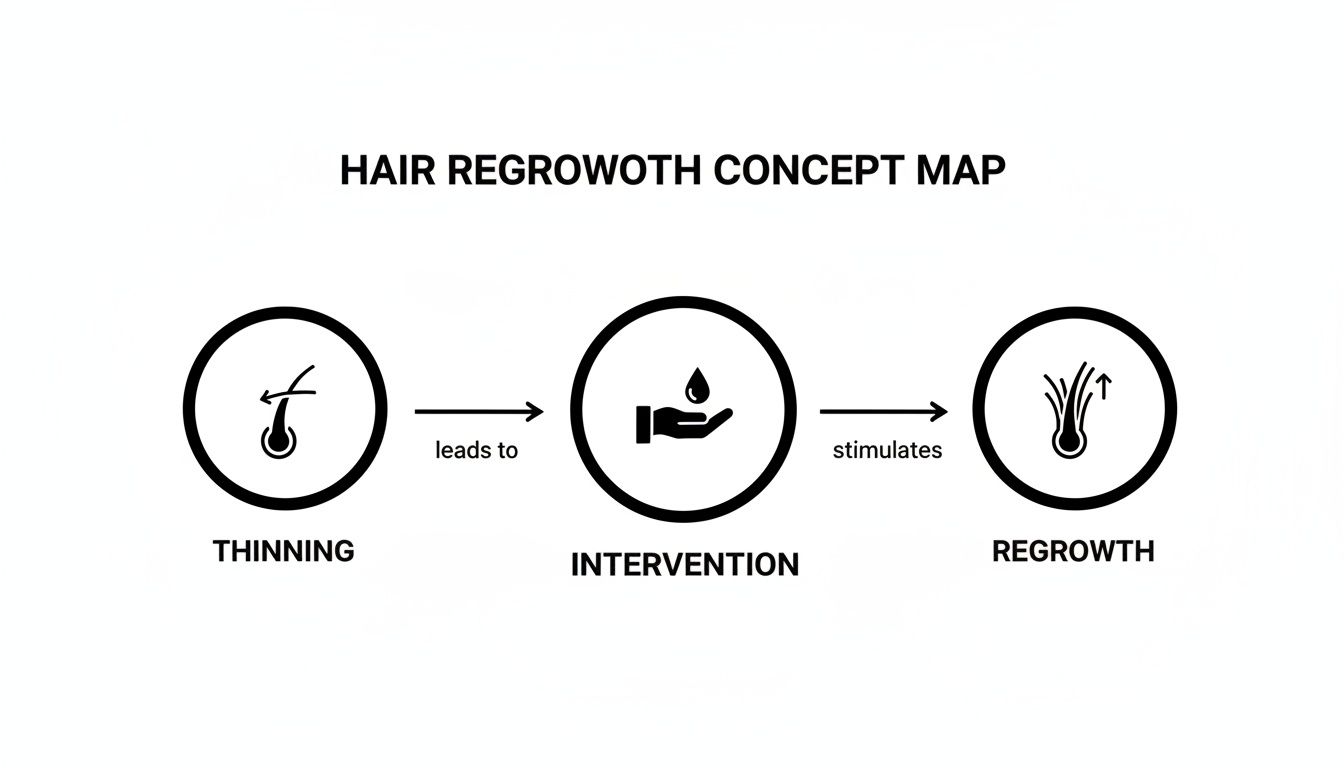
As the visual shows, tackling the cause of the thinning is the essential first step toward waking those follicles back up. The key is to act while the follicle is still alive, even if it's struggling. To get a deeper dive into the science, this guide on what causes hair loss explains how all these factors work together.
Beyond Genetics: Other Common Triggers
While genetics are the usual suspect for thinning hair in men, they're not the only possibility. It’s important to understand these other potential causes, because the hair loss they trigger is often completely reversible once you solve the underlying issue.
If your hair loss came on suddenly, appears in patches, or doesn't follow the typical pattern of a receding hairline or thinning crown, you might be dealing with something else entirely.
Your hair is often a barometer for your overall health. Sudden changes can be a signal that something else is going on internally, making it important to look beyond just your scalp.
Some of the most common non-genetic factors include:
- Intense Stress (Telogen Effluvium): A major shock to your system—think surgery, a bad illness, or a period of extreme emotional stress—can shove a huge number of your hair follicles into the "resting" phase all at once. A few months later, you might notice a startling amount of shedding. The good news? This is almost always temporary. The hair usually grows back once the stressor is gone.
- Nutritional Deficiencies: Your hair follicles are hungry. They need a constant supply of key vitamins and minerals to do their job. If you're running low on nutrients like iron, zinc, or Vitamin B, it can throw your hair growth cycle out of whack and lead to thinning.
- Medical Conditions: Certain health issues have a direct line to your hair. Thyroid problems, for instance, are notorious for causing hair thinning when the gland is overactive or underactive. Autoimmune disorders like alopecia areata can also lead to distinct patches of hair loss.
Figuring out whether you're dealing with genetic thinning or one of these other causes is the first real step toward a solution. Male pattern baldness requires a targeted strategy to fight back against miniaturization, whereas other types of hair loss might just fix themselves once you address the root problem. This knowledge is what moves you from feeling uncertain to taking informed, effective action.
Understanding The Natural Rhythm of Your Hair Growth
To get a real handle on whether your hair can bounce back from thinning, you first have to understand how healthy hair works. Your scalp isn't just churning out hair 24/7. Instead, every single hair follicle on your head follows a sophisticated, repeating cycle of growth, transition, and rest.
Think of it like a garden. You don't have every plant blooming all at once. Some are in full growth, some are getting ready to shed their petals, and others are dormant, waiting for the right time to sprout again. This staggered process keeps the garden looking full and healthy year-round. Your scalp operates on a very similar principle.
The Three Main Phases of Growth
This cycle is broken down into three main stages. At any given time, each of the roughly 100,000 follicles on your scalp is in one of these phases. This is how you maintain a full head of hair, even though you're naturally shedding hairs every single day.
-
Anagen Phase (The Growth Phase): This is the main event. It's when your hair is actively growing, and it can last for 2 to 7 years. The vast majority of your hair—around 85-90% of it—is in this phase right now.
-
Catagen Phase (The Transition Phase): This is a very short pit stop, lasting only a couple of weeks. The hair follicle shrinks and detaches from its blood supply, effectively ending the growth period.
-
Telogen Phase (The Resting Phase): Finally, the follicle takes a well-deserved break for about three months. The old hair sits in place until it's eventually shed, often when you're washing or brushing it. As the old hair falls out, the follicle is already gearing up to start the anagen phase all over again with a new strand.
It's completely normal to shed between 50 and 100 hairs a day. This isn't a sign of hair loss; it's just the natural result of follicles finishing their cycle and making room for new growth.
How Thinning Disrupts This Natural Rhythm
So, where does hair loss fit into this picture? Conditions like male pattern baldness essentially sabotage this beautifully timed cycle. The hormone DHT, the primary culprit, directly attacks the anagen (growth) phase, cutting it short.
Instead of a follicle spending several years growing a thick, healthy hair, DHT forces it to spend less time growing and more time resting. With each new cycle, the anagen phase gets shorter and shorter. The hair that comes out is progressively weaker, thinner, and less pigmented—that miniaturization process we talked about.
Eventually, the growth phase becomes so brief that the new hair can't even break through the skin's surface before the cycle ends. That's when the follicle effectively goes dormant.
Understanding this disruption is everything. The goal of effective hair loss treatments isn't to magically create new follicles. It’s about restoring the natural balance of the hair growth cycle. By either blocking DHT or stimulating the follicles directly, these treatments aim to lengthen that critical anagen phase, giving your hair a fighting chance to grow back thicker and stronger.
Exploring Proven Treatments To Stimulate Regrowth
Alright, let's get to the part you’ve been waiting for—the solutions that can actually make a difference. When you're trying to figure out if your hair can grow back after thinning, knowing which treatments are backed by real science is your biggest advantage. Think of this as your playbook for turning the tide.
We'll start with the heavy hitters, the treatments with a long history of success, before jumping into some exciting regenerative approaches that use your body's own healing power.

FDA-Approved Cornerstones: Minoxidil and Finasteride
When it comes to treating male pattern baldness, two names always come up, and for good reason: Minoxidil and Finasteride. These aren't just hopeful remedies; they are scientifically validated options with a long track record of success.
Minoxidil, which most people know as Rogaine, is a topical solution you apply right to your scalp. Think of it as a wake-up call for tired, dormant hair follicles. It works by widening the blood vessels around the follicles, improving blood flow and delivering a fresh supply of oxygen and nutrients. This nudge helps push more follicles into their active growth phase and keeps them there longer.
Finasteride, on the other hand, tackles the problem from the inside out. It's an oral medication that goes straight to the hormonal root of male pattern baldness. Finasteride works by blocking the enzyme that converts testosterone into dihydrotestosterone (DHT)—the very hormone that shrinks follicles and causes them to stop producing healthy hair.
By lowering the DHT levels in your scalp, Finasteride essentially shields your follicles from further damage, giving them a chance to recover and start producing thicker, healthier hair again. If you're considering this route, you can dive deeper into the different types of FDA-approved hair loss treatments and see how they stack up.
For many people, getting started with prescription treatments can feel like a hurdle. Using services like an online doctor prescription consultation can be a practical, convenient, and private way to discuss your options with a medical professional.
Harnessing Your Body’s Healing Power with PRP
Beyond traditional medications, the field of regenerative medicine offers a powerful way to kickstart hair regrowth by tapping into your body's own natural healing systems. One of the most promising treatments here is Platelet-Rich Plasma (PRP) therapy.
Let's go back to our garden analogy. If your scalp is the soil, think of PRP as a super-concentrated, organic fertilizer made specifically for you. The process is surprisingly straightforward. It starts with a simple blood draw, no different than one you'd get at a routine check-up.
Your blood is then placed in a centrifuge, a machine that spins it at an incredibly high speed to separate its core components. This isolates the platelets and plasma, creating a golden, nutrient-dense liquid that is packed with growth factors—the natural proteins that tell your cells it's time to repair and regenerate.
This platelet-rich plasma is then meticulously injected into the areas of your scalp where hair is thinning. Those growth factors get to work right away, waking up dormant follicles and promoting cellular repair. It’s a direct delivery of the healing ingredients your follicles have been missing.
PRP therapy essentially kickstarts your scalp’s natural regeneration process. It’s not introducing a foreign substance; it’s concentrating and redirecting your body’s own powerful healing abilities right where they are needed most.
The potential here is remarkable. Thinning hair doesn't have to be a one-way street. Clinical trials on treatments designed to boost follicle health show dramatic regrowth potential. One study found that after 180 days of treatment, participants saw a 125% increase in the number of healthy, terminal hairs in the target area.
For men, this translates to hope via regenerative therapies like PRP, which delivers those crucial growth factors directly to the follicles for focused results. This isn't just hype; it's biology at work, helping dormant follicles reawaken to produce visible, tangible regrowth.
Ultimately, choosing the right treatment depends on the cause and extent of your hair thinning. Sometimes, combining therapies—like using Minoxidil at home while undergoing a course of PRP treatments—can deliver even better results. The key is to find a strategy that addresses your specific situation and gets you on the path to reclaiming your hair.
Setting Realistic Expectations For Your Regrowth Journey
Getting started on a plan to regrow your hair is an exciting step, but it's critical to go in with the right mindset. This is a marathon, not a sprint. Patience isn't just a virtue here; it's probably the most important tool you have. The good news is that hair often can regrow after thinning, but it simply won't happen overnight.
Think of it like getting in shape. You wouldn't hit the gym once and expect to see a six-pack the next morning. Real, lasting change takes time and consistency. Your hair regrowth journey is no different.
The First Few Months: What to Really Expect
The first one to three months of any new treatment can feel a bit strange. In fact, you might even notice a little more shedding than usual. Before you panic, know this: it's often a good sign!
This initial shed, which is common with treatments like Minoxidil, is actually a sign that the product is working. It’s waking up your follicles and pushing out the old, weaker hairs to make room for new, stronger ones to come in. It’s the scalp’s version of “out with the old, in with the new.”
Remember, hair grows in cycles. The new, healthy hair has to physically push the old, resting hair out of the way to emerge. This temporary shedding phase means the treatment is successfully resetting your growth cycle.
During this early stage, you won't see much new growth. The real magic is happening under the surface as your follicles get the signal to kick back into their active growth phase.
Months Three to Six: The First Signs of Progress
This is where your patience really starts to pay off. Between months three and six, you should begin to see the first real, tangible signs of regrowth. Don't expect thick, long strands right away, though.
Instead, look closely for fine, soft, and often lighter-colored hairs popping up in thinning areas. People often call this "peach fuzz." This is your new growth taking root! As the weeks pass, these tiny hairs should gradually become thicker, darker, and longer as the follicles regain their strength. Many guys document their progress, and checking out Minoxidil before and after photos can give you a great visual of what this early-stage progress looks like.
Six Months and Beyond: Building on Your Success
By the time you hit the six-month mark, you should be seeing more noticeable improvements in hair density and overall coverage. The new hairs have had time to mature, and more follicles have hopefully joined the regrowth party. But the journey isn't over yet.
For most hair loss treatments, the most significant results appear between 9 and 12 months of consistent use. That's the real benchmark for judging how well your routine is working for you.
Comparing Hair Regrowth Treatment Timelines
Different treatments work at different paces. Understanding these timelines can help you set realistic goals and choose the right approach for your needs.
| Treatment Type | Initial Results (Timeline) | Peak Results (Timeline) | Maintenance Required |
|---|---|---|---|
| Topical Minoxidil | 3-6 months | 9-12 months | Yes, ongoing daily use |
| Oral Finasteride | 3-6 months | 12-18 months | Yes, ongoing daily use |
| PRP Therapy | 3-4 months | 6-9 months | Yes, periodic sessions |
| LLLT (Laser Therapy) | 4-6 months | 9-12 months | Yes, ongoing regular use |
As you can see, consistency is the common thread. No matter which path you choose, sticking with it is the only way to see—and keep—your results.
The single most important factor in all of this is consistency. Skipping days or stopping your treatment early will halt your progress and can quickly reverse any gains you've made. Just like maintaining fitness, maintaining your hair requires an ongoing commitment. Frame your progress in a healthy, realistic way, and you'll be much more likely to stay motivated for the long haul.
Lifestyle Habits That Support Fuller, Healthier Hair
While medical treatments can be incredibly effective, they don't work in a vacuum. Your daily habits are the bedrock of healthy hair. So, when we ask, "can hair regrow after thinning?" the answer has to include a look at your lifestyle.
Think of it like this: treatments are the skilled construction crew you hire to build a house, but your daily habits are the quality of the foundation, wood, and wiring. For a strong, lasting result, you absolutely need both.
Making small, consistent changes in your routine creates the perfect environment for your hair follicles to thrive. This isn't about overhauling your entire life overnight. It’s about being mindful of the things you can control, which will support any treatment you're undergoing and boost your overall wellness—something your hair will definitely reflect.

Fueling Your Follicles From the Inside
Your hair follicles are like tiny, high-output factories, and they need a steady stream of raw materials to produce strong, healthy hair. Cut off the supply chain, and production is going to slow down or even stop.
A balanced diet is simply non-negotiable for anyone serious about hair growth. Certain nutrients are critical players in the hair cycle, and a deficiency in any one of them can be a direct cause of thinning. The big ones to focus on include:
- Iron: This mineral is essential for helping red blood cells deliver oxygen. Your hair follicles are hungry for that oxygen to function properly.
- Zinc: A zinc deficiency is a known culprit behind hair shedding, as it plays a huge role in hair tissue growth and repair.
- Biotin: Famous for its role in hair health, this B-vitamin helps your body produce keratin—the very protein your hair is made of.
Making sure your diet is rich in these nutrients isn't just a "good for you" platitude. It's about directly feeding your scalp what it needs to build strong hair. In a very real way, your hair is made from what you eat.
It’s as simple as adding more lean meats, leafy greens, nuts, and seeds to your plate. To dive deeper, you can check out this guide on the best foods for hair growth and see exactly how they support your journey back to thicker hair.
Managing Stress and Scalp Health
Chronic stress is another major villain in the hair loss story. When you’re under constant stress, your body pumps out the hormone cortisol. High cortisol levels can prematurely shove a large number of hair follicles into the "resting" phase, triggering a massive shed known as telogen effluvium.
Finding ways to decompress that actually work for you is key. Whether it’s a daily walk, a few minutes of meditation, or just setting aside time for a hobby, the goal is to break that stress cycle before it wreaks havoc on your hair.
Finally, let's talk about the scalp itself. A healthy scalp is clean and clear. If it’s excessively oily or inflamed, it can clog follicles and physically block new hairs from breaking through. Simple things, like using a gentle clarifying shampoo and steering clear of harsh chemical styling products, can make all the difference.
These lifestyle tweaks are powerful because they work in concert with any treatments you're using, giving you the absolute best chance at regaining the fuller, healthier hair you want.
Tying Up Loose Ends: Your Hair Regrowth Questions
As we get close to wrapping up, let's address a few common questions that are probably still floating around in your head. Getting straight answers is the best way to feel confident about your next steps.
Is Regrown Hair Here to Stay?
This is the million-dollar question, isn't it? For hair loss triggered by temporary issues—think stress, a bad diet, or a recent illness—the answer is usually yes. Once you correct the root cause, the hair that comes back is your own natural hair, and it will stick around.
But when it comes to genetic hair loss, like male or female pattern baldness, the story changes a bit. Treatments like Minoxidil, Finasteride, and PRP work wonders for regrowing hair and halting further thinning, but they aren't a one-and-done cure. They don't change your DNA.
Think of it like managing any other chronic condition. You have to keep up with the treatment to keep the results. If you stop, the genetic process that causes thinning will kick back in, and you'll eventually lose that hard-earned hair.
Can I Mix and Match Different Hair Loss Treatments?
Not only can you, but you probably should. This is a strategy many experts recommend, often called "stacking," because it creates a powerful, multi-pronged attack on hair loss.
For instance, you might use Finasteride to block the DHT hormone from the inside while using a topical like Minoxidil to directly stimulate the follicles on your scalp. Throw in some PRP sessions every few months, and you're also giving your follicles a major regenerative boost to wake them up. It's about hitting the problem from every possible angle.
The best hair restoration plans are never one-size-fits-all. Combining therapies lets you build a routine that targets your specific type of hair loss, leading to much more comprehensive and satisfying results.
When Is It Actually "Too Late" to Do Something?
It's almost never truly "too late" unless the scalp is completely slick and shiny. That look often means the follicles have scarred over and can't be revived.
But if you can still see any of those fine, wispy, "peach fuzz" hairs in the thinning spots, you're in business. Those are a great sign. It means the follicles are still alive, just dormant and waiting for a wake-up call.
Even with significant thinning, treatments can often beef up the hair you still have, which dramatically improves the look of fullness and coverage. The best time to start was the day you first noticed things were changing, but the second-best time is today.
At PRP For HairLoss, we know that knowledge is power. Our whole mission is to give you clear, honest, evidence-based information so you can make the right call for your hair and your confidence. To start your journey toward thicker, fuller hair, learn more at https://prpforhairloss.com.
 PRP For Hairloss
Leave a comment