When you hear the term "dormant hair follicles," it's easy to picture something complex, but the idea is actually pretty simple. Think of them as tiny hair-producing factories that are still fully equipped and operational but have temporarily shut down production. They're not gone, they're just resting, and with the right signal, they can often be brought back online.
This state of rest is the central issue in most common types of hair loss, especially male pattern baldness.
What Are Dormant Hair Follicles?
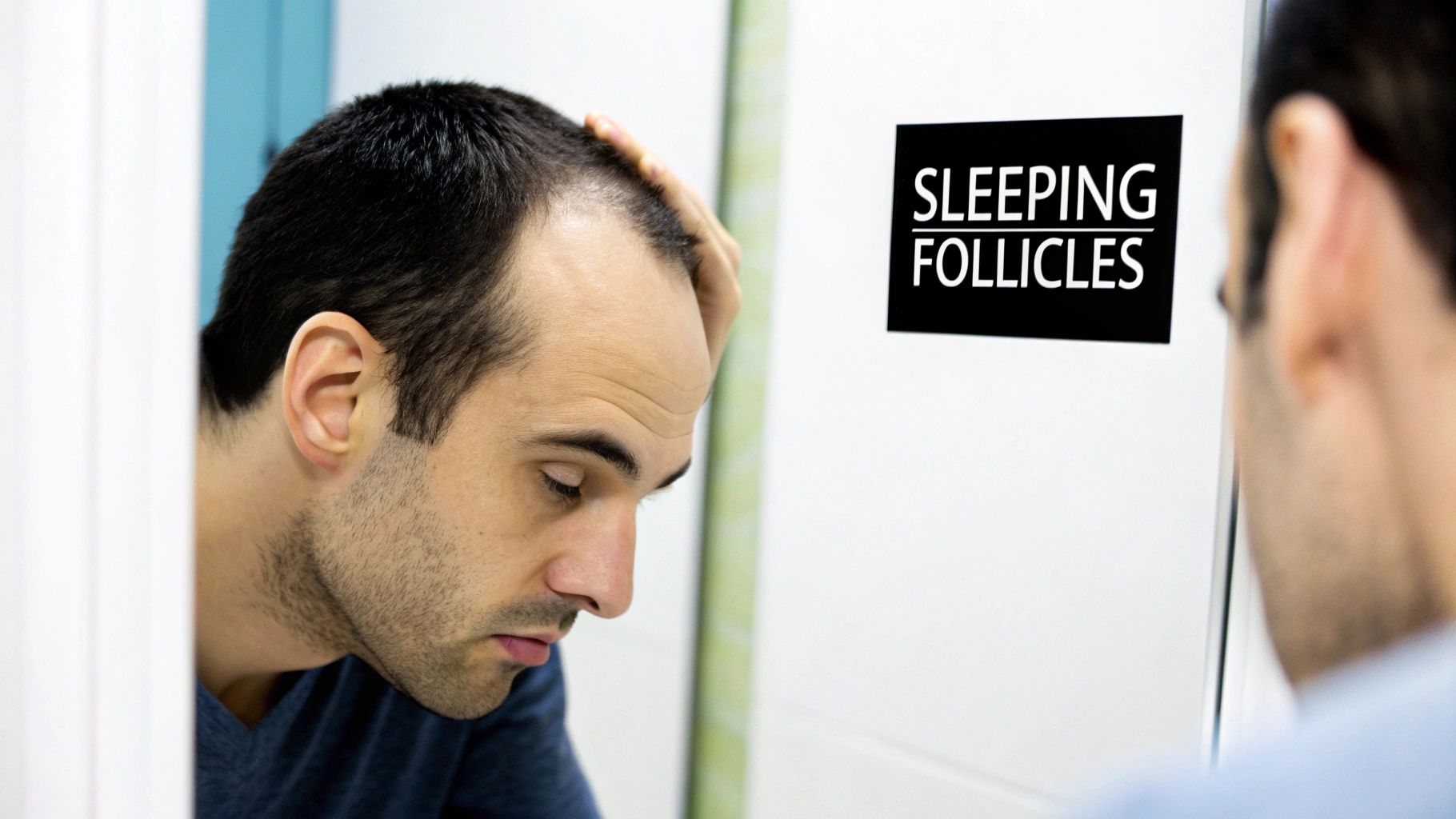
If you've noticed your hairline creeping back or the hair on your crown looking a little less dense, what you're seeing is the result of these sleeping follicles. This is the hallmark of male pattern baldness, a condition that affects over 50% of men by age 50, slowly but surely thinning out what was once a full head of hair.
But here’s the crucial part: these follicles aren't dead. They’re just in a prolonged resting state, which means they can potentially be revived.
On a healthy scalp, which has around 100,000 hair follicles, it's perfectly normal for about 10-15% of them to be resting at any given moment. The problem starts when external or internal factors push more and more follicles into this "sleeping" state for longer than they should, leading to noticeable hair loss. You can dive deeper into this process in our guide on the stages of the hair growth cycle.
The Cycle of Hair Growth and Rest
To really get a handle on follicle dormancy, you first need to understand the hair growth cycle itself. Every single hair on your head goes through a continuous, multi-stage cycle of growth, transition, and rest.
It breaks down like this:
- Anagen (The Growth Phase): This is the "on" switch. The follicle is actively growing a hair strand, a process that can last for several years.
- Catagen (The Transition Phase): A very short period, usually just a couple of weeks, where hair growth stops and the follicle starts to shrink.
- Telogen (The Resting Phase): The follicle takes a break for about three months. At the end of this phase, the old hair is shed, making room for a new one to start its growth phase.
In a balanced system, as one hair is shed, another is already gearing up to take its place. This is what keeps your hair looking full and healthy.
The trouble begins when too many follicles get stuck in the Telogen phase or when the active Anagen phase gets shorter and shorter. This throws the whole cycle out of whack, leaving you with fewer active follicles and more that are just sitting idle.
This extended nap is what we mean by dormancy. Instead of kicking back into gear after three months, the follicle stays inactive. The entire goal of modern hair loss treatments is to send a powerful "wake-up call" to these sleeping follicles, encouraging them to jump back into the productive Anagen phase.
What Puts Hair Follicles to Sleep?
So, what exactly tells a perfectly healthy hair follicle to just… stop working? It’s not like flipping a switch. Instead, a complex mix of signals can throw that delicate growth cycle completely off track. For the vast majority of men dealing with thinning hair, one main culprit is responsible.
We're talking about androgenetic alopecia, which is the clinical term for what most of us know as male pattern baldness. At its core, this is a genetic sensitivity to a very specific hormone that tells certain follicles to shut down over time.
The DHT Connection: How Hormones Cause Dormancy
The primary driver behind male pattern baldness is a powerful hormone called Dihydrotestosterone, or DHT. Testosterone gets all the attention, but DHT is its more potent byproduct—and it's the real mastermind behind the slow, steady shrinking of hair follicles on the scalp.
Here’s the breakdown: A specific enzyme in your body converts a small percentage of testosterone into DHT. If you're genetically predisposed to hair loss, the follicles at your hairline, crown, and on top of your head are highly sensitive to its influence.
When DHT latches onto these follicles, it kicks off a process called miniaturization. This is a systematic attack that shortens the anagen (growth) phase and causes the follicle itself to shrink with every new hair cycle. The hair that emerges becomes progressively weaker, finer, and shorter, until eventually, the follicle goes dormant and gives up on producing hair at all.
You can think of DHT as slowly strangling the follicle. The follicle is still there and technically alive, but it can no longer produce a visible, healthy strand of hair.
Beyond Genetics: Other Triggers That Can Induce Dormancy
While DHT is the undisputed king of male pattern hair loss, it's not the only factor that can push follicles into a resting state. It's crucial to understand these other potential causes, as they can sometimes compound the effects of genetic thinning or be the primary issue themselves. For a deeper dive, feel free to explore our guide on the common causes of hair loss.
Let's look at a few of the most common triggers that can make hair follicles go dormant.
Common Triggers for Hair Follicle Dormancy in Men
While genetics often take center stage, a variety of internal and external factors can disrupt the hair growth cycle and force follicles into a premature resting state. The table below outlines some of the primary triggers, how they operate, and who they typically affect.
| Trigger | How It Causes Dormancy | Primary Group Affected |
|---|---|---|
| Genetic Predisposition | Follicles become sensitive to DHT, leading to miniaturization and eventual shutdown. | Men with a family history of male pattern baldness. |
| Severe Stress | A major shock (physical or emotional) forces many follicles into the telogen (resting) phase at once. | Anyone experiencing a traumatic event, surgery, or extreme psychological stress. |
| Hormonal Imbalances | Fluctuations in thyroid hormones or other key hormones can disrupt the growth cycle. | Men with thyroid conditions or other endocrine disorders. |
| Nutritional Deficiencies | Lack of essential nutrients like iron, zinc, or protein starves follicles of needed fuel. | Individuals with poor diets or malabsorption issues. |
| Chronic Inflammation | Scalp conditions (e.g., severe dandruff, psoriasis) create a hostile environment for follicles. | Men with persistent inflammatory scalp issues. |
| Certain Medications | Some drugs can interfere with hair growth as a side effect. | Patients undergoing treatments like chemotherapy or taking specific medications. |
Understanding these different pathways to dormancy is the first step in identifying the right strategy to address your specific type of hair loss. Now, let’s explore some of the other common, non-genetic causes in a bit more detail.
-
Intense Stress (Telogen Effluvium): A major shock to your system—think surgery, a serious illness, or a period of extreme emotional stress—can signal a huge number of hair follicles to enter the telogen (resting) phase simultaneously. This leads to noticeable, widespread shedding a few months down the line. The good news? It's usually temporary.
-
Nutritional Gaps: Your hair follicles are like tiny, high-energy factories, and they need a constant supply of raw materials to function. Deficiencies in crucial nutrients like iron, zinc, and biotin can disrupt hair production and convince follicles to take a break.
-
Scalp Inflammation: Conditions like folliculitis (infected hair follicles) or even severe dandruff can create a chronically inflamed environment on your scalp. This persistent inflammation can damage the follicles and interfere with their ability to grow hair, eventually leading them to become inactive.
How to Spot Dormant Follicles
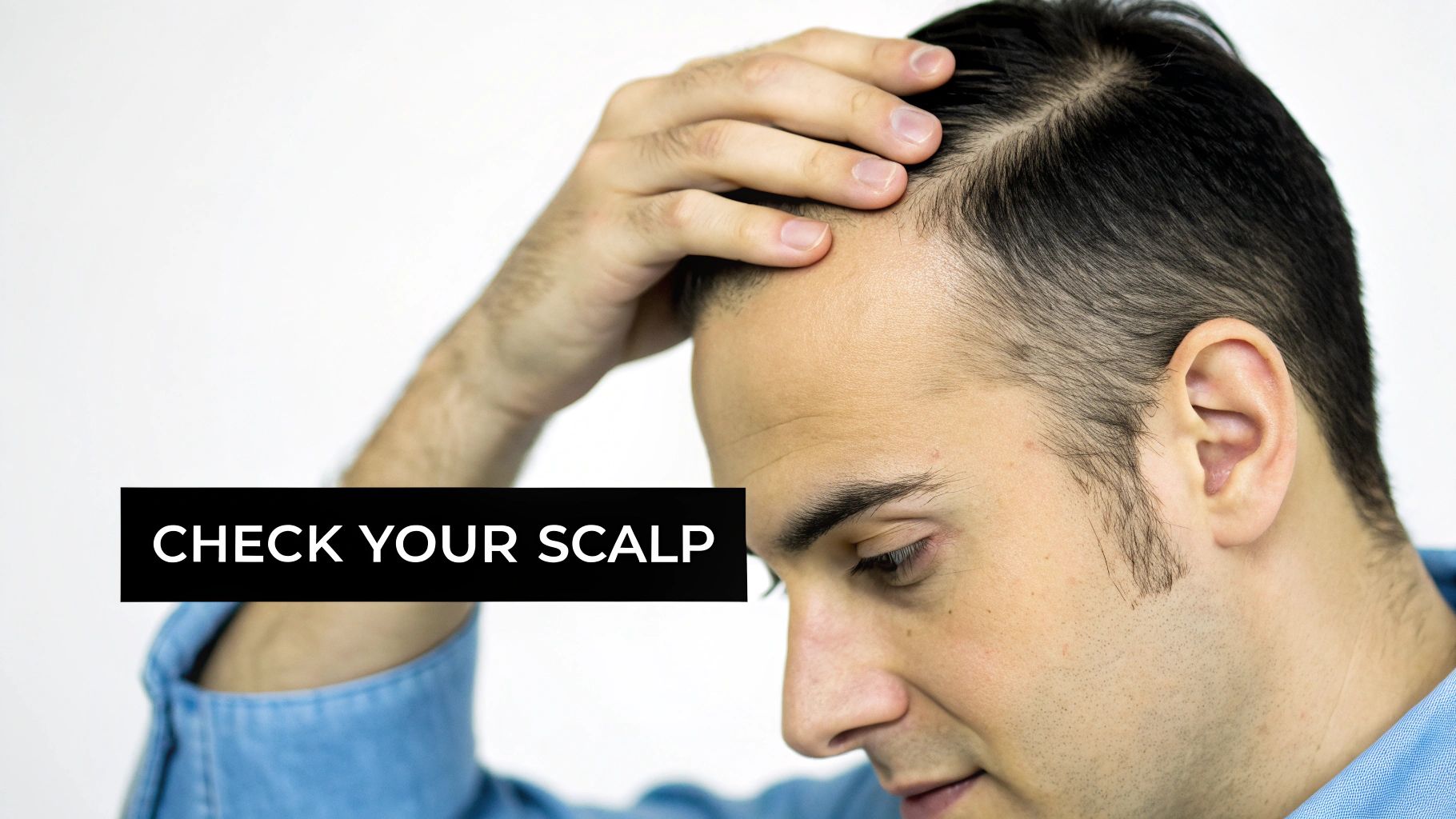
Spotting dormant hair follicles isn't as simple as finding an "off" switch on your head. Instead, it’s about recognizing the subtle, collective result of many follicles entering that resting state over time. These signs often creep up on you, making them easy to ignore until the thinning becomes much more obvious.
One of the very first clues is a shift in your hair's overall volume. You might notice your ponytail feels thinner or your hair just doesn't have the same body and life it once did. This feeling of "lighter" hair is often the initial sign that fewer follicles are actively growing.
Key Visual Signs of Dormancy
As more follicles enter this dormant state, the visual proof starts to build. Paying close attention to what you see in the mirror is your first real step toward doing something about it. The most common signs are tied directly to hair miniaturization—the process where healthy follicles start producing weaker and weaker strands before eventually giving up.
Keep an eye out for these tell-tale indicators:
- A Widening Part: When you part your hair, does the line look wider? Seeing more scalp peeking through than you used to is a classic sign.
- Receding Hairline: For many men, the retreat begins at the temples, slowly carving out that familiar "M" shape.
- Increased Scalp Visibility: Thinning often appears on the crown (the vertex) of the head, making your scalp much more noticeable, especially under bright lights.
It’s important to remember this is different from normal daily shedding, where you lose full, healthy-looking hairs. When dormancy is the issue, the problem isn't just loss—it's the lack of strong replacement growth, coupled with the appearance of finer, almost invisible hairs.
Miniaturization: The Final Warning Sign
Before a follicle goes completely dormant, it sends out a very clear distress signal: miniaturization. This is the critical stage where a once-productive follicle begins to create thinner, shorter, and less colorful hairs. You might spot these fine, wispy strands along your hairline; they look and feel totally different from the rest of your hair.
Think of it like a factory's production line grinding to a halt. It’s still technically running, but the products coming off the line are getting smaller and weaker. This is a clear signal that a full shutdown is just around the corner unless something changes.
A professional can use a special magnifying tool called a dermatoscope to get a close-up look at your scalp. This allows them to clearly see these tiny, miniaturized hairs right next to your healthy ones, confirming that follicles are on their way to becoming dormant. For a quick check at home, you can perform a basic hair density test to get a baseline and monitor any changes yourself.
Is It Possible to Reactivate Hair Follicles?
This is the big question, isn't it? The good news is a resounding yes. In many cases, dormant hair follicles can absolutely be nudged back into their active growth phase.
Success really boils down to two things: what put the follicle to sleep in the first place, and how long it's been inactive. The key is to intervene before the follicle shuts down for good.
Think of your scalp like a garden. Just because the plants on the surface have withered doesn't mean the soil has gone bad. As long as the roots are still intact, the right combination of nutrients and care can bring forth new life. That’s a great way to visualize how hair follicle reactivation works.
The Point of No Return
It's important to be realistic here. There is a point where a dormant follicle simply can't be revived. If a follicle is destroyed by scarring from an injury or certain inflammatory scalp conditions—a condition called cicatricial alopecia—it's unfortunately gone forever.
Likewise, a follicle that has been miniaturized by hormones for many, many years can eventually atrophy and die off completely. Our guide on whether dead follicles can be revived dives deeper into this crucial difference.
But for the vast majority of people dealing with male pattern baldness or temporary, stress-induced shedding, the follicles are just sleeping. They haven't disappeared. They're just waiting for the right signal to get back to work.
The most optimistic takeaway is this: for hair loss caused by hormones (DHT) or stress (telogen effluvium), there is a very strong chance of revival. The structures needed to produce hair are still present and viable.
Viable but Inactive: A Key Distinction
Here’s a fascinating twist: dormant hair follicles can look perfectly healthy under a microscope, even while producing no hair at all. This is a critical distinction—a follicle that isn't growing isn't necessarily dead.
This was beautifully illustrated in a 16-year scalp study. Researchers observed that grafted follicles went dormant after three years but remained completely viable. A remarkable 60% of these sleeping follicles survived, maintaining their original size without producing a single hair until they were actively stimulated. You can read more about this groundbreaking research into follicle behavior.
This discovery shows that a follicle's diameter doesn't always tell the whole story. Many of your dormant follicles are simply waiting for the right wake-up call.
This scientific optimism is the very foundation of modern hair loss treatments. The goal isn’t to create new follicles from thin air, but to awaken the thousands you already have, getting them ready to re-enter the growth phase.
Proven Treatments to Wake Up Your Follicles
So, you know your follicles are just sleeping. That’s the good news. But how do you actually wake them up?
It turns out we have several powerful, science-backed ways to send that crucial wake-up call. These treatments work by getting to the root cause of the dormancy, essentially nudging the follicles back into their active growth (anagen) phase.
The real aim here is to do more than just halt hair loss—it's about actively reversing it. We want to stimulate the thousands of viable follicles resting just under your scalp. Think of it like flipping the switch to get a factory back online.
Platelet-Rich Plasma (PRP) Therapy
One of the most exciting and effective treatments available right now is Platelet-Rich Plasma (PRP) therapy. What makes it so compelling is that it uses the powerful healing and growth factors already inside your own blood. It’s a completely natural approach that gives your body’s regenerative abilities a massive boost, directly where you need it most—your hair follicles.
The procedure itself is surprisingly simple:
- We start by drawing a small amount of your blood, just like a routine lab test.
- That blood is then spun in a special machine called a centrifuge, which separates the platelets from everything else.
- This creates a highly concentrated, "liquid gold" plasma that we carefully inject into the areas of your scalp that are thinning.
Why platelets? Because they are loaded with potent growth factors. These act like messengers, signaling dormant follicles that it’s time to get back to work.
By delivering a rich cocktail of your body's own growth signals directly to the scalp, PRP helps shorten the follicle's resting phase. It essentially jump-starts new growth, leading to visibly better hair density and thickness over time.
What makes PRP therapy so effective is that we're injecting platelets concentrated to 5-8 times their normal levels right at the target. This flood of growth factors, like VEGF and PDGF, is incredibly good at kicking dormant follicles back into the anagen phase.
The results speak for themselves. Some studies on tough cases of androgenetic alopecia have shown improved hair density of 25-40% across all patients, and the treatment is extremely well-tolerated. If you want to dive deeper into stimulating your follicles, you can check out our detailed guide on the topic.
This simple diagram shows exactly how this reactivation cycle works.
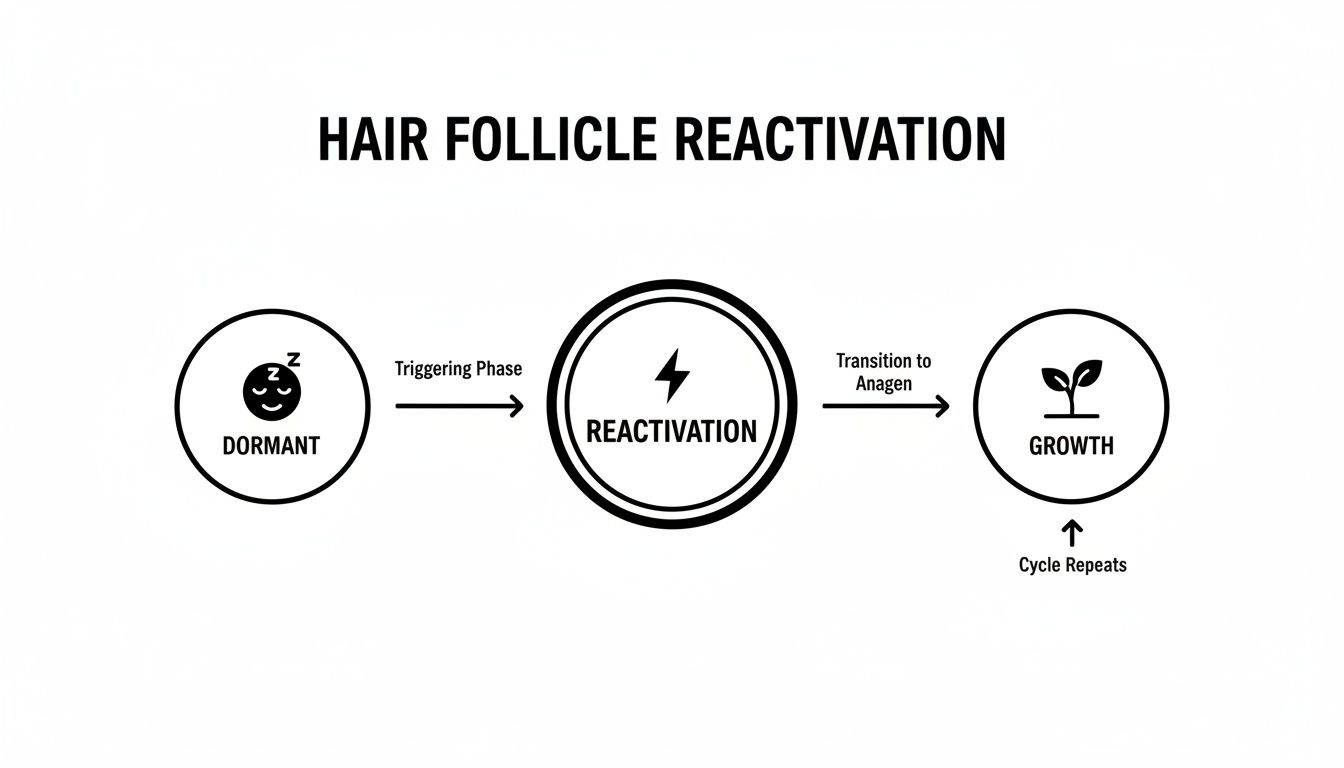
As you can see, reactivation is that key middle step that turns a sleeping follicle into one that's actively producing hair again.
Other Clinically Proven Options
While PRP is a fantastic tool, it's not the only one in our toolkit. Two other FDA-approved treatments have a long and successful track record in fighting male pattern baldness by waking up sleeping follicles. In many cases, using them together delivers the best outcome.
Minoxidil (Rogaine)
This is a topical foam or solution you apply right to your scalp. Minoxidil is a vasodilator, which is a fancy way of saying it widens blood vessels. This simple action boosts blood flow, bringing more oxygen and vital nutrients directly to your follicles. It also helps to extend the anagen phase, giving each hair more time to grow longer and stronger before it sheds.
Finasteride (Propecia)
Finasteride is a daily pill that tackles male pattern baldness at its hormonal source. It works by blocking the enzyme that turns testosterone into DHT—the very hormone that shrinks and suffocates hair follicles. By drastically lowering DHT levels in the scalp, Finasteride not only protects healthy follicles but also gives those shrunken, dormant ones a chance to recover and start producing healthy hair again.
Your Questions About Dormant Follicles Answered
Even with all the science laid out, you probably still have a few questions rolling around in your head. That's completely normal. When you're dealing with something as personal as hair loss, you want to be sure you have all the facts.
Let’s tackle some of the most common questions guys ask about this whole process. The goal here is to give you clear, practical answers so you can feel confident about what comes next.
How Long Does It Take to See Results from PRP?
This is the big one, and the honest answer is that you have to be patient. Waking up dormant hair follicles isn't an overnight fix. With a treatment like PRP therapy, the very first thing most men notice is less hair shedding, which usually happens within 3 to 4 months.
That's the sign that the treatment is getting to work, calming things down and nudging those sleepy follicles back into action. As for more noticeable results—like visibly thicker hair and better scalp coverage—you’re typically looking at the 6-month mark. The great news is that the improvements often keep building for up to a year as new, stronger hairs grow in.
Can a Dormant Follicle Eventually Die Permanently?
Yes, unfortunately, it can. A dormant follicle is alive, but it's in a fragile state. If the underlying problem causing it to go dormant isn't dealt with, that follicle can eventually give up and shut down for good.
Think about male pattern baldness. The constant exposure to DHT slowly strangles the follicle, making it smaller and weaker with every hair cycle. If that goes on for years without any intervention, the follicle can become so tiny and scarred that it physically loses the ability to produce a hair. At that point, it’s effectively dead and can't be brought back.
This is exactly why acting sooner rather than later is so important. The longer a follicle stays dormant and under attack, the lower the odds of saving it. Early intervention gives you the best possible shot at real, lasting regrowth.
Can Diet and Exercise Alone Reactivate Dormant Follicles?
A healthy lifestyle is fantastic for your hair, but it's rarely enough to single-handedly reverse genetic hair loss. Think of it like this: diet and exercise prepare the soil, making it rich and fertile for growth. A healthy body is a better environment for everything, including your hair.
But if DHT is the weed choking your garden, you still need something to specifically target and remove it. That's where treatments like PRP come in—they're the direct signal telling the follicles it's time to grow again. So while a healthy lifestyle will absolutely amplify your results from any treatment, it’s not a substitute for one.
Are There Any Side Effects with PRP for Hair Loss?
One of the best things about PRP is how safe it is. Since the treatment is created from your own blood, the risk of an allergic reaction or any serious side effects is practically nonexistent.
The side effects people do experience are minor and temporary, stemming directly from the injections. You might have some mild soreness, a bit of swelling, or maybe some light bruising on your scalp right after the procedure.
These things usually clear up on their own in a day or two. There's no real downtime, so you can walk out of your appointment and get right back to your life.
At PRP For HairLoss, we know that understanding the "why" behind your hair loss is the key to finding a solution that works. If you're ready to wake up those dormant follicles and take back control, we’re here to help. To learn more about how PRP could be the answer you've been looking for, explore our resources at https://prpforhairloss.com.
 PRP For Hairloss
Leave a comment