It’s a moment most men dread—seeing a little too much hair in the comb or noticing your scalp peeking through under the bright bathroom lights. It’s a moment most men dread—seeing a little too much hair in the comb or noticing your scalp peeking through under the bright bathroom lights. While there’s no magic number for when hair loss starts, the timeline is more common than you might think. For a lot of guys, the first signs of thinning pop up sometime in their 20s or 30s, though it can start even earlier for some, creeping in during their late teens.
The Common Timelines for Male Hair Loss

If you're starting to worry about thinning hair, the most important thing to know is that you're in good company. This isn't a sign that you're unhealthy or doing something wrong; for the vast majority of men, it's just genetics at work.
The official term is androgenetic alopecia, but most of us know it as male pattern baldness. It all comes down to your DNA, which dictates how sensitive your hair follicles are to a hormone called dihydrotestosterone (DHT). If you have the genetic trait, DHT slowly shrinks your hair follicles over the years. This makes the hair that grows out thinner and shorter, until eventually, the follicle stops producing hair altogether.
This genetic lottery explains why your buddy might have a perfect hairline at 40 while you started noticing a receding one at 22. It's a natural process, and understanding the root of it is key. You can dive deeper into the specific triggers by exploring the various causes of hair loss in our detailed guide.
When Do Most Men Notice Changes?
So, how common is it, really? The statistics paint a very clear picture, showing that hair loss is a normal part of life for a huge percentage of men, often starting much earlier than people assume.
Male pattern baldness doesn’t wait for you to hit middle age. In fact, about 25% of men who have it will see the first signs of thinning before they even turn 21. This just goes to show that androgenetic alopecia—which accounts for over 95% of all male hair loss—is not an "old man's" problem.
Seeing changes this early can feel isolating, but the data proves it's incredibly common. And as you'd expect, the likelihood only goes up with age.
Male Hair Loss Prevalence by Age
Here's a quick look at the statistical likelihood of experiencing noticeable hair loss at different stages of life, according to the American Hair Loss Association.
| Age Group | Percentage of Men with Noticeable Hair Loss |
|---|---|
| By Age 35 | Approximately 66% (two-thirds) |
| By Age 50 | Approximately 85% |
These numbers drive the point home: if you're seeing changes in your 20s or 30s, you're right on track with the majority of men. Recognizing that you’re not alone is the first step toward figuring out what to do next.
Understanding the Genetic Blueprint for Hair Loss
To really get a handle on hair loss, we need to look past the when and dig into the why. It's easy to get lost in the science, but the root cause is surprisingly simple and it's written directly into your DNA.
Think of your hair follicles as tiny, pre-programmed factories. Your unique genetic code dictates how these factories operate. For most of their lives, they run smoothly, churning out healthy strands of hair. But for guys with a genetic tendency for balding, a specific hormone starts to gum up the machinery.
That hormone is dihydrotestosterone (DHT), which your body naturally makes from testosterone. It’s a common misconception that balding men have more testosterone. The real issue isn't the amount, but the sensitivity. Your genes dictate just how sensitive those little hair follicle factories are to DHT.
The Role of DHT in Hair Thinning
If your follicles are genetically wired to be sensitive, DHT essentially acts like a saboteur. It latches onto receptors in your hair follicles and starts a slow, methodical process of shutting them down.
This gradual shrinking process is called follicular miniaturization. As the follicle gets smaller, the hair it produces becomes finer, shorter, and weaker with each growth cycle. It's like a mighty oak tree slowly being replaced by a delicate sapling, and then just a sprout. Eventually, the factory sputters out completely and stops producing hair for good.
This entire sequence is a completely natural, inherited trait passed down through your family tree. It's not a sign of poor health or something you did wrong—it's just biology. You can learn more about how male pattern baldness genetics work and influence what happens on your head.
The key takeaway is this: Male pattern baldness isn’t caused by a hormonal imbalance. It's an inherited condition where your follicles are over-sensitive to normal levels of hormones that have been in your body all along.
Why Genetics Matter More Than Myths
Getting this genetic link is the most important step. It saves you from chasing down ineffective "cures" and frees you from the guilt of popular myths that simply don't address the biological root of the problem.
Let's clear up a few common misconceptions right now:
- Wearing hats: Nope. Your favorite baseball cap isn't suffocating your follicles or causing your hair to fall out.
- Frequent shampooing: Keeping your scalp clean is good for it. Shampooing doesn't pull out hairs that weren't already on their way out.
- Poor circulation: While blood flow is important for everything, it’s not the primary driver of male pattern baldness. DHT sensitivity is the real culprit.
When you accept that the issue is a predetermined genetic sensitivity, you can focus your energy on strategies that are actually proven to counteract DHT's effects. This clarity is the real first step toward taking back control.
A Decade-by-Decade Look at the Hair Loss Timeline
Male pattern baldness follows a surprisingly predictable path, but how it unfolds is different for everyone. The journey often starts so subtly that it’s easy to miss until the changes are hard to ignore. Getting a handle on this timeline is the first step toward knowing when to take action.
This diagram shows you the core biological process at play. It all boils down to how your genetic blueprint triggers follicular miniaturization—the real culprit behind male pattern baldness.
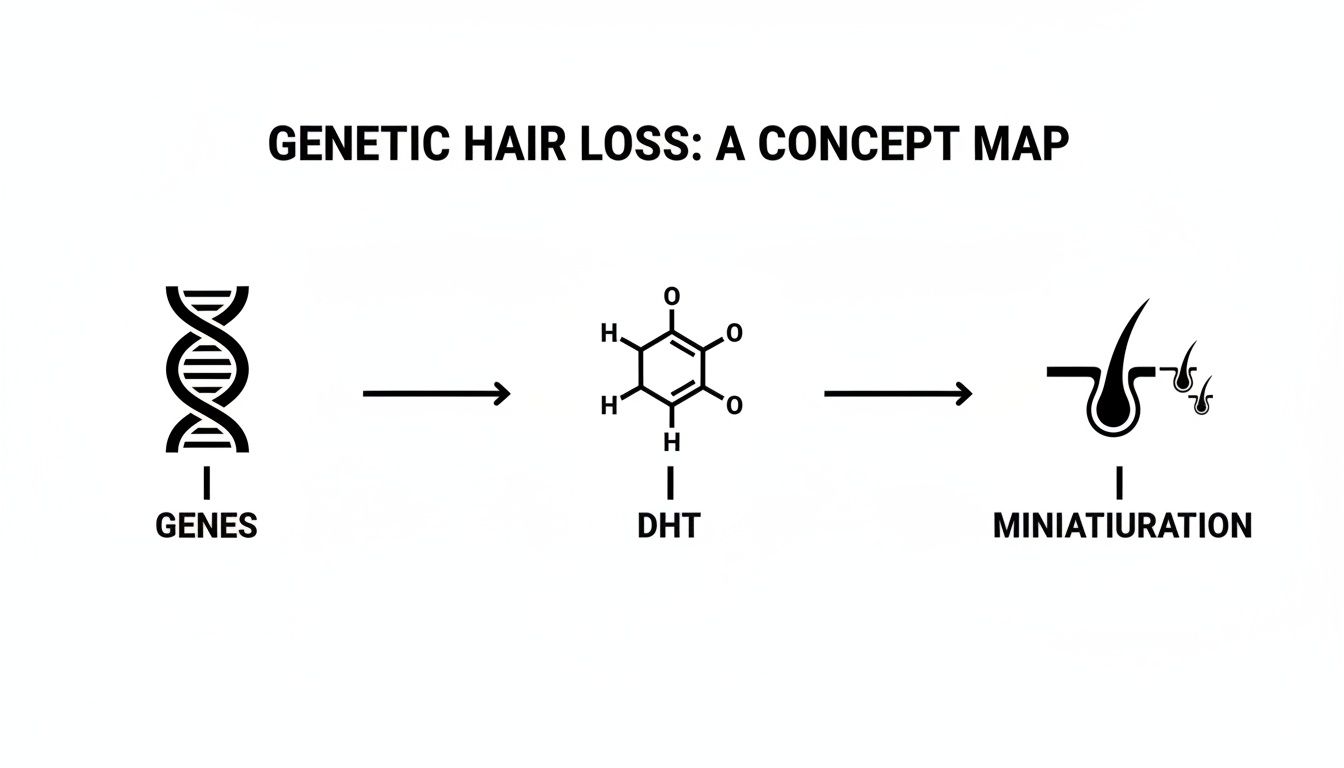
It’s a simple but powerful chain reaction: inherited genes make your hair follicles sensitive to a hormone called DHT, which then causes them to shrink and weaken over time.
The Twenties: The Subtle Start
For a lot of guys, the 20s are when the first hints of hair loss show up. It's rarely a sudden, dramatic change. More often, it starts as a slight recession at the temples, creating a more "mature" hairline that's easy to write off as just part of getting older.
Life is busy and the changes are gradual, so most guys don't even notice it's happening. You might see that your forehead looks a little higher in photos or that your hair just doesn't style the way it used to, but the real pattern doesn't become obvious until later.
The Thirties: The Critical Decade
The 30s are often a major turning point. What began as a subtle shift can speed up, leading to more noticeable thinning, especially at the crown (the vertex of the scalp). This is the decade when a lot of men go from wondering if they're losing hair to knowing they are.
By age 30, a solid 25% of men are already dealing with some degree of balding. This makes the early 30s the most common starting point for male pattern baldness. As men move through their 30s, that figure climbs to between 25-33%. It's during this busy time of career building and family life that thinning at the hairline or crown really becomes apparent.
This stage is crucial because the follicles are often still active, just miniaturized. Taking proactive steps during this time offers the best chance to preserve hair density and slow further progression.
The Forties and Beyond: Stabilization and Progression
Once you hit your 40s and 50s, your pattern of hair loss is usually well-established. For some, the rate of thinning slows down significantly, and they might keep their current look for years. For others, the process continues, eventually leading to more widespread baldness.
This progression is so common that it’s been mapped out visually. To see how it works, you can learn more about the Norwood Scale for hair loss and get an idea of where you might be on the timeline. Understanding these stages helps you see what could be next and shows why the timing of your response really matters.
Spotting the Early Warning Signs of Balding
Are you actually losing your hair, or is it just paranoia? That's a question that can keep a guy up at night. The good news is, you don't have to guess. Male pattern baldness almost never happens overnight. It sends out subtle signals long before any obvious bald spot appears.
The trick is learning to spot these early clues that most men either miss or dismiss. This isn't about panicking over a few hairs in the shower drain; it's about recognizing consistent patterns of change over time.
The First Clues You're Starting to Thin
The earliest signs often get brushed off as just part of getting older. But they're actually the first indicators that your hair follicles are beginning to shrink—a process called miniaturization. Paying attention now gives you a massive head start.
Three specific changes tend to show up first:
- Your Part Looks Wider: If you part your hair, you might notice the line of your scalp seems a bit wider than it used to. This is a classic sign of thinning across the top of your head.
- The "M" Shape Takes Form: This is the tell-tale sign of a receding hairline. The corners near your temples start to creep back faster than the hair in the center, gradually carving out a more defined 'M' shape.
- More Hair on Your Pillow and in the Drain: Losing 50-100 hairs a day is totally normal. The real warning sign is when you see a noticeable uptick in that number—on your pillow in the morning, clogging the shower, or tangled in your comb.
One of the best ways to check is to pull up your camera roll. Find a clear photo from a year or two ago and compare it to one you take today in the same lighting. The difference in your hairline or the density on your crown can be surprisingly clear. For a deeper dive, check out our full guide on the symptoms of male pattern baldness.
Early Warning Signs of Hair Loss Checklist
It’s easy to second-guess what you’re seeing. This simple checklist can help you objectively track the subtle changes that often signal the start of male pattern baldness.
| Sign | What to Look For | Check If You See This |
|---|---|---|
| Receding Temples | The hairline at the corners of your forehead is moving back, creating a more pronounced "M" shape. | ☐ |
| Increased Shedding | You notice significantly more hair on your pillow, in the shower drain, or on your brush than usual. | ☐ |
| Slower Hair Growth | Your hair just doesn't seem to grow as fast or as long as it used to in certain areas, like the crown. | ☐ |
| Thinner Crown | The hair on the vertex (the top-back of your head) feels less dense, and you might see more scalp. | ☐ |
| "See-Through" Hair | When your hair is wet or under bright lights, you can see your scalp more easily than before. | ☐ |
| Itchy or Flaky Scalp | Persistent itchiness can sometimes be linked to the inflammation associated with DHT's effects on follicles. | ☐ |
If you find yourself checking off a few of these boxes, it doesn't mean you're doomed, but it's a clear signal that it's time to start paying closer attention and consider your next steps.
Using the Norwood Scale as Your Roadmap
Once you start looking into hair loss, you’ll quickly run into something called the Norwood Scale. At first glance, it can look a little intimidating, like a medical chart plotting a future you don't want.
But it’s much more helpful to think of it as a roadmap. It’s the standard system professionals use to classify and track how male pattern baldness progresses.
The Norwood Scale isn't a crystal ball predicting your future. It's simply a standardized tool that categorizes the stages of hair loss, from a mature hairline (Stage 2) all the way to extensive balding (Stage 7).
Getting familiar with the stages helps you figure out where you are on the map right now. This knowledge turns vague worry into a structured understanding of what's happening, empowering you to track your own situation with more clarity and confidence. It also gives you a shared language to use when you eventually talk to a specialist.
How PRP Therapy Can Reboot Your Hair Follicles

It's one thing to understand the signs of hair loss, but it's another to know you can actually fight back. Instead of just accepting it or turning to harsh chemicals and surgery, many are looking to a powerful, natural source of help: their own bodies.
That's the entire idea behind Platelet-Rich Plasma (PRP) therapy. It’s a non-surgical treatment that taps into the healing factors already present in your blood to give struggling hair follicles a serious boost.
Think of it this way: your thinning hair follicles are like plants trying to grow in depleted soil. PRP is like a shot of super-concentrated, organic fertilizer, delivering a rush of nutrients right where they're needed most. It’s a direct response to follicular miniaturization, aiming to reverse the shrinking process caused by DHT.
The Science Behind PRP
The process itself is surprisingly straightforward. It starts with a small blood draw, just like you’d have at a regular check-up. That blood sample is then spun in a centrifuge, which separates it into its core components.
The goal is to isolate the platelet-rich plasma, a golden-hued liquid packed with platelets. These platelets are your body's natural emergency response team, loaded with powerful growth factors that signal cells to repair and regenerate.
Once we have this "liquid gold," it’s carefully injected into the areas of your scalp experiencing thinning. The growth factors get to work right away, kickstarting cellular activity and fostering a healthier environment for hair growth. The main objectives are to:
- Reawaken dormant follicles that have stopped producing new hairs.
- Strengthen existing hairs that have become fine, weak, and wispy.
- Boost blood supply to the scalp, ensuring follicles get the oxygen and nutrients they need.
By giving weakened follicles this targeted support, PRP can slow down the progression of male pattern baldness. To really get into the specifics, you can dig into this detailed explanation of how PRP for hair loss works.
Why Early Action Matters with PRP
Like with most things in health, timing is everything. PRP delivers its best results when the hair follicles are still alive, even if they're weak and shrunken.
The ideal candidate for PRP is someone who has noticed thinning but still has a good amount of hair coverage. It's much easier to save a struggling follicle than it is to revive one that has been completely dormant for years.
This is exactly why catching those first signs of thinning in your 20s or 30s is so important. Starting PRP during the earlier stages of the Norwood Scale gives you a much better shot at not only stopping further loss but also regaining some of the thickness you've lost. It’s about being proactive to preserve the hair you have for the long haul.
Alright, let's move from knowing to doing.
Figuring out when hair loss might start is one thing. Actually doing something about it is where you'll see a real difference. It’s time to stop worrying about what your hairline is doing and start actively managing it.
This is about taking back control, not just letting your genetics call all the shots. The simple truth I've seen over and over is that acting early and decisively gives you the best chance for success. It puts you in charge of what happens next.
Your Game Plan for Taking Action
Feeling overwhelmed is normal, but the best way to fight that is with a clear, simple plan. Let's break it down so you can turn that background worry into a forward-thinking strategy.
Here’s a practical, three-step approach that I recommend to get started:
-
Get an Honest Look at Where You Stand: Use the signs we talked about—the widening part, the thinning at the crown, the extra hair on your pillow. Take a hard, honest look. Better yet, pull up a photo from a year or two ago and compare it to one you take today. The camera doesn't lie, and it will show you the real pace of change.
-
Talk to a Pro: Guessing what's going on will only get you so far, and it can lead you down the wrong path. A real consultation with a hair loss specialist is crucial. They can confirm if it's male pattern baldness and, just as importantly, rule out any other sneaky causes.
-
Investigate Real, Proven Solutions: Once you have a firm diagnosis, you can start looking at treatments that actually work. There are fantastic, modern, non-surgical options out there, like PRP therapy, that are designed to help you keep and even strengthen the hair you've got.
If you take away just one thing from this guide, let it be this: the sooner you act, the more power you have. Early, informed action gives you more options and dramatically improves your chances of getting the results you want.
Following this simple framework shifts you out of that uncertain, anxious headspace and into one of confident, focused action. You'll be ready to tackle this head-on.
A Few More Questions We Hear All the Time
Even after you get a handle on the basics of hair loss, some questions always seem to pop up. Let's tackle a couple of the most common ones we hear from guys who are just starting to notice changes.
If I'm Losing Hair in My 20s, Does That Mean I'm Going to Go Completely Bald?
Not necessarily, but it's a definite wake-up call. Starting to thin out early often means you have a strong genetic tendency for hair loss, but it's not a crystal ball that predicts you'll hit the most advanced stages on the Norwood scale. The speed at which hair loss moves is different for everyone.
Think of it this way: noticing hair loss in your 20s is a signal to get proactive. Treatments like PRP are far more effective at hitting the brakes and protecting the hair you still have, which puts you in a much better position to manage the outcome.
Could Stress or My Diet Be the Real Cause, Not Genetics?
It's possible, but not very likely. It's true that major stress or a serious lack of nutrients can trigger a temporary shedding condition called telogen effluvium. However, a staggering 95% of hair loss in men is classic male pattern baldness, which is all about genetics.
Lifestyle factors can sometimes pour fuel on the fire and accelerate the genetic process, but they're almost never the root cause on their own. If the thinning is starting at your temples or on the crown of your head, the odds are overwhelmingly in favor of it being genetic. A quick chat with a professional can clear things up for you.
The best time to start PRP is as soon as you notice significant thinning. It’s most effective for men in the earlier stages of hair loss (Norwood stages 2-4) because the goal is to rejuvenate follicles that are weak but still viable.
Waiting until an area is completely slick and shiny makes any treatment an uphill battle. That’s why men in their 20s and 30s who take action early often get the best results—they're able to stop the clock on progression and even improve their hair density.
At PRP For HairLoss, we believe that understanding your options is the first step toward taking control. To learn more about how PRP can fit into your hair preservation strategy, explore our comprehensive resources at https://prpforhairloss.com.
 PRP For Hairloss
Leave a comment