When we talk about growing our hair, what we’re really getting at is the anagen phase. This is the powerhouse stage, the active "growing" period where your hair follicles are working nonstop to build the strands you see on your head. This phase is easily the most critical part of the entire hair cycle for one simple reason: how long it lasts determines the maximum length your hair can ever reach.
Think of it as the main production run for your hair. On a healthy scalp, this phase can last anywhere from a couple of years to as long as 2 to 7 years.
A Closer Look at Your Hair's Natural Rhythm
Ever wonder why the hair on your head can grow so long, while the hair on your arms stays pretty short? It all comes down to the hair growth cycle. Every single one of the 100,000 or so follicles on your scalp isn't just growing all the time; it's following its own unique schedule, cycling through distinct phases of growth, transition, and rest.
Picture each follicle as a tiny, biological factory. For most of its life, this factory is in full swing, churning out a strong, healthy hair strand. That’s the anagen phase in action. Getting to know this phase is the first step toward understanding what’s happening with hair loss and figuring out how to encourage healthier, fuller hair.
The Three Main Stages of the Hair Growth Cycle
The life of a single strand of hair is broken down into three main stages. Each one has a specific job and timeline, creating a system of continuous renewal all across your scalp.
For a quick overview, here's a simple breakdown of what's happening at each stage.
A Simple Guide to The Hair Growth Cycle
| Phase Name | What's Happening | Average Duration |
|---|---|---|
| Anagen | The "growth" phase. Cells are rapidly dividing to form a new hair. The follicle is deeply rooted and nourished by the blood supply. | 2-7 years |
| Catagen | The "transition" phase. Hair growth stops, and the follicle begins to shrink and detach from the blood supply. | 2-3 weeks |
| Telogen | The "resting" phase. The old hair sits dormant in the follicle while a new hair begins to form underneath. | 3-4 months |
This constant, repeating cycle is what keeps your head full of hair. You can dive deeper into the complete process in our detailed guide on the hair growth cycle.
The timeline below really helps to visualize just how dominant the anagen phase is compared to the others.
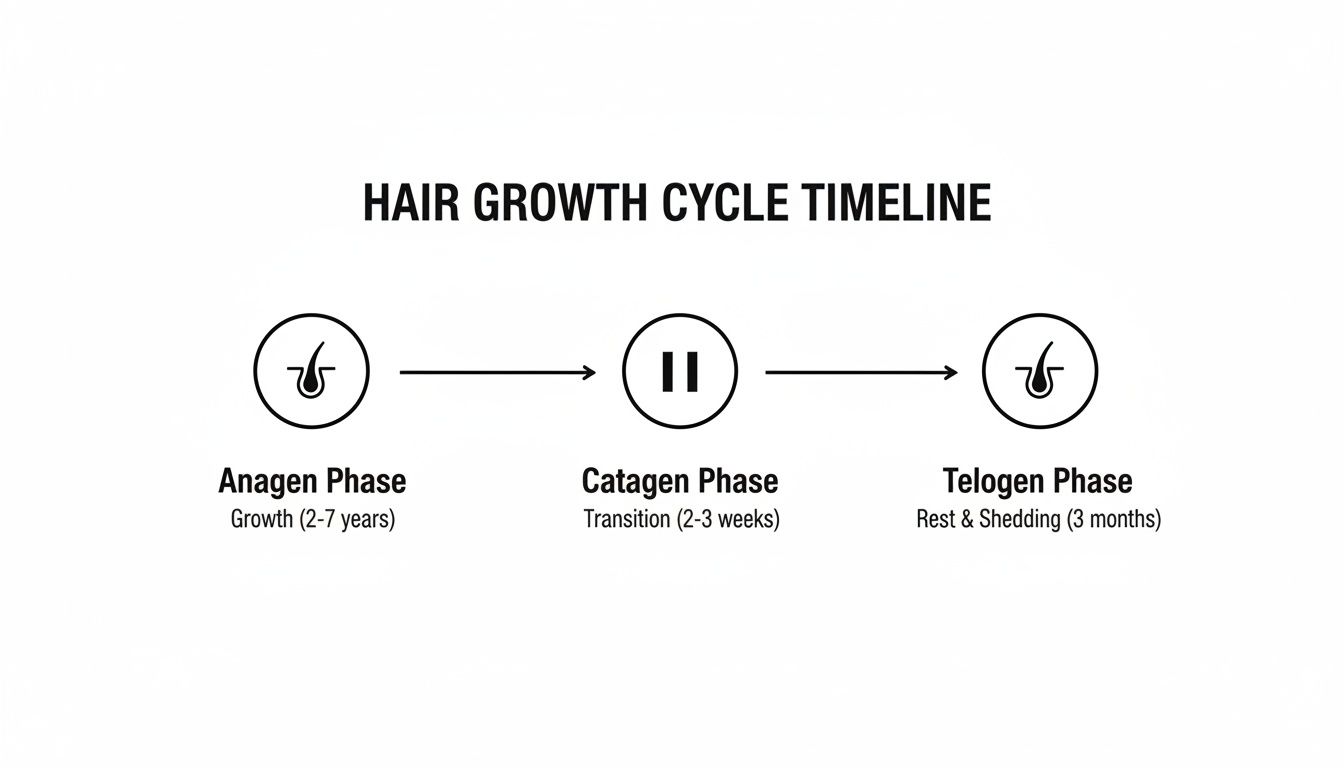
As you can see, the anagen phase isn't just one part of the cycle—for all intents and purposes, it is the cycle. This long runway for growth is what allows for long, healthy hair.
Why Is The Anagen Phase So Critical?
The length of your personal anagen phase is written in your DNA, which explains why some people can grow hair down to their waist while others struggle to get it past their shoulders. On a healthy scalp, about 85-90% of all hairs are in this active growth stage at any given time.
This high percentage is exactly why a healthy head of hair looks dense and full—the vast majority of follicles are always on the job. A longer anagen phase gives hair more time to grow before it's shed, which translates directly to greater potential length and volume.
How Hair Loss Hijacks The Anagen Phase
Imagine a healthy hair follicle as a busy factory, humming along for years to produce a single, strong strand of hair. It stays in the anagen phase, its dedicated growth period, without any major interruptions. But what happens when something throws a wrench in the works, the way it does with common hair loss?
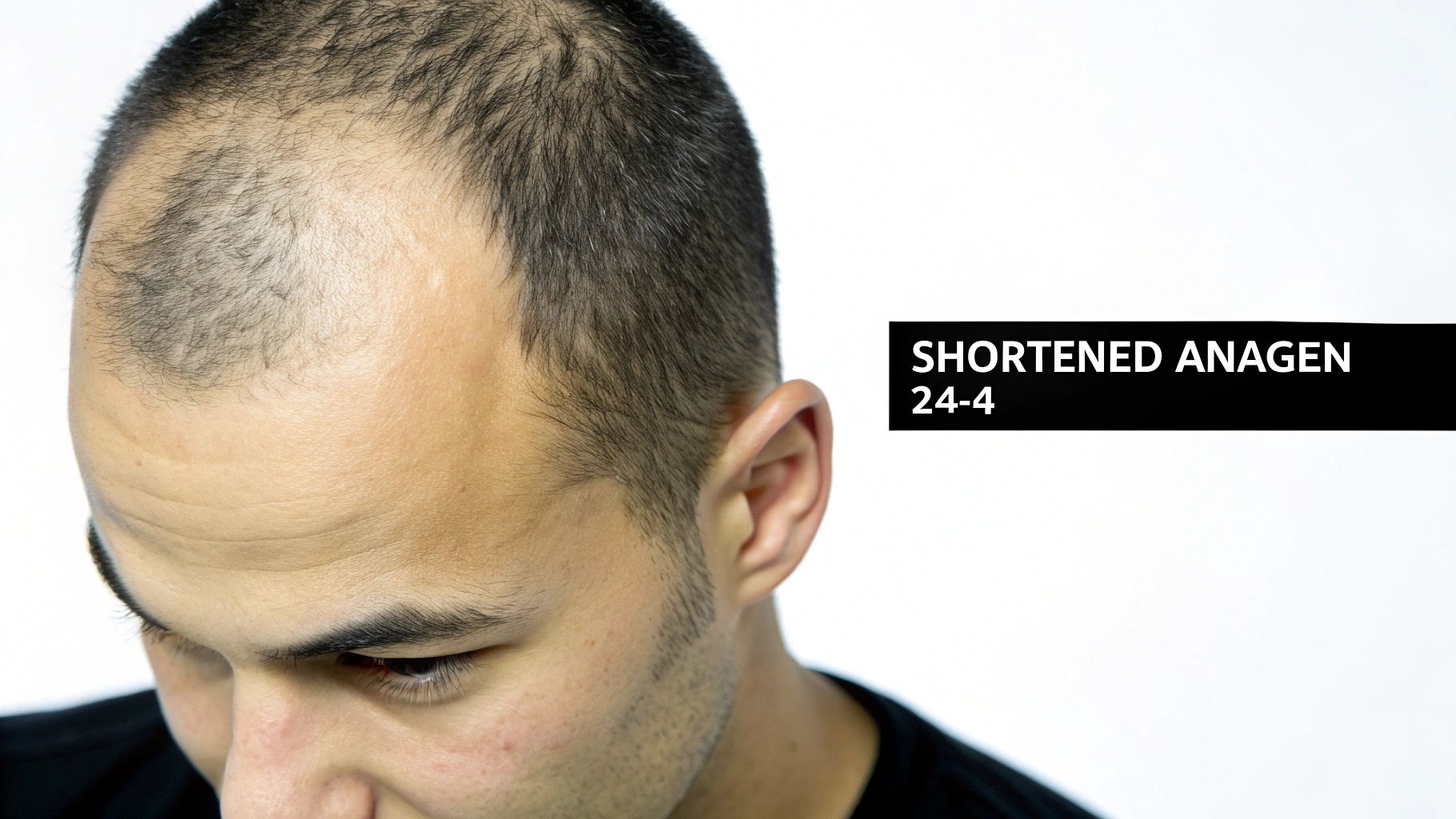
Simply put, the factory’s production schedule gets slashed. Conditions like androgenetic alopecia (your classic pattern hair loss) directly attack the anagen phase, forcing follicles to shut down far too early.
This single disruption is enough to throw the entire hair growth cycle into chaos, leading directly to the thinning and shedding so many of us see in the mirror.
The Science Behind a Shortened Growth Phase
In both male and female pattern hair loss, the main culprit is a hormone called dihydrotestosterone, or DHT. If you have a genetic sensitivity to it, DHT latches onto receptors in your scalp's hair follicles.
This connection acts like a "stop" signal for the follicle, ordering it to cut the anagen phase short. All of a sudden, a hair that should have grown for several years might only get a year, or in more advanced cases, just a few months.
The result is what you'd expect: the hair simply runs out of time. It can't grow long or thick before the follicle prematurely shoves it into the next phase.
With each new cycle, the anagen phase gets progressively shorter. This forces the follicle to produce a hair that is weaker, finer, and less pigmented than the one before it.
This process has a name: miniaturization. Over time, those once-strong follicles start churning out tiny, wispy, almost invisible hairs instead of the robust ones you're used to.
It's this slow, steady weakening of each hair strand that creates the appearance of thinning and receding hairlines.
Androgenetic Alopecia: A Closer Look
Androgenetic alopecia (AGA) is by far the most common reason people lose their hair, and its entire game plan revolves around disrupting the anagen phase. The numbers really drive home how widespread it is.
AGA affects up to 80% of men and 50% of women by the time they reach 70. For those individuals, the anagen phase can plummet from a healthy 4-6 years to less than one. This dramatic reduction not only causes the miniaturization we talked about but also means a higher percentage of hairs are in the resting (telogen) phase at any given time—which is why shedding often becomes more obvious.
Here’s a side-by-side look at what’s happening on the scalp:
| Feature | Healthy Scalp | Scalp with Androgenetic Alopecia |
|---|---|---|
| Anagen Phase Duration | Typically 2-7 years | Often shrinks to 1 year or less |
| Follicles in Anagen | Roughly 85-90% | Percentage steadily declines |
| Hair Shaft Diameter | Thick, terminal hair | Progressively thinner, miniaturized hair |
| Visible Result | Dense, full coverage | Noticeable thinning, less scalp coverage |
This comparison makes it clear: hair loss isn't just about hair falling out. It's fundamentally about hair not being given the chance to grow properly in the first place.
The Domino Effect on Your Scalp
Once the anagen phase is compromised, it sets off a chain reaction across your scalp. This is what it looks like in practice:
- Increased Shedding: Because the growth cycles are so short, more hairs are pushed into the telogen (shedding) phase much more frequently.
- Reduced Density: As strong terminal hairs are replaced by wispy, miniaturized ones, the overall volume of your hair noticeably decreases.
- Slower, Weaker Regrowth: The new hairs that do manage to grow back are weaker and finer, contributing less and less to a full look.
Ultimately, attacking the anagen phase doesn't just stop growth in its tracks—it actively dismantles the foundation of a healthy head of hair, one cycle at a time.
The Role of Genetics and Lifestyle in Your Hair Growth
Have you ever wondered why some people seem to grow hair down to their waist effortlessly, while for others, it’s a struggle to get it past their shoulders? The answer starts deep within your cells, written in your DNA. Your genes essentially draw up the blueprint for your hair, setting the maximum possible length of your anagen phase hair growth.
This genetic programming is what creates the incredible diversity we see in hair around the world—not just how long it can grow, but its color, texture, and even how thick it is. But here's the thing: your genes only set the stage. They don't run the entire show.
Your daily habits and overall health have a massive impact, ultimately deciding whether your hair ever lives up to its full genetic potential.
Genetics Sets the Baseline
Your DNA is the ultimate director of your hair’s growth cycle, and nowhere is this more obvious than in ethnic and gender differences. When researchers look at hair patterns across the globe, they find some truly fascinating variations.
For example, studies have found that Caucasian and North African men tend to have a higher percentage of hairs in the anagen phase on their scalps and faces compared to other groups. Growth rates also vary wildly. Koreans show hair growth that's 7.43% faster than the global average, while South Africans see a rate over 22% slower.
This genetic hardwiring also helps explain why certain hair loss conditions, like androgenetic alopecia, are so common in families. If baldness runs in your family, you might have inherited a genetic sensitivity that shortens your anagen phase.
How Lifestyle Choices Steer Your Hair's Destiny
While you can't rewrite your genetic code, you have a surprising amount of control over how it expresses itself. Think of your lifestyle as the fuel and maintenance crew for the hair-growth factory your DNA designed.
Things like a poor diet, constant stress, and not getting enough sleep can sabotage the whole operation. They can actively shorten your anagen phase and stop your hair from truly thriving.
Your daily choices directly shape the cellular environment where your hair follicles live and work. A healthy lifestyle creates the perfect conditions for a long, robust anagen phase, giving you the best shot at reaching your hair's maximum genetic potential.
Making conscious, healthy choices is one of the most powerful things you can do to support your hair’s growth cycle from the inside out. For a bigger picture on this, you can explore health and lifestyle articles that connect overall wellness to specific results, including healthier hair.
Powering Your Follicles Through Nutrition and Wellness
The cells in your hair follicles are some of the fastest-dividing cells in your entire body. To keep up that incredible pace, they need a constant, reliable supply of very specific nutrients.
If those building blocks are missing, the anagen phase gets cut short. The result? Weaker hair that breaks easily and sheds more than it should. These are the key players:
- Iron and Zinc: These minerals are absolutely essential for creating DNA within the follicle. An iron deficiency, for instance, is a classic cause of hair shedding because it can literally push follicles out of the anagen phase too early.
- Protein (Keratin): Hair is almost entirely made of protein. It stands to reason that if your diet is low in protein, your body just can't build strong, resilient hair strands.
- Vitamins: Key vitamins like the B-vitamin biotin, along with vitamins D and E, are crucial for healthy cell growth and for protecting follicles from damage caused by oxidative stress.
Beyond what you eat, how you feel matters just as much. High levels of cortisol—the stress hormone—can throw your entire system out of whack, forcing a huge number of hairs to shift from the anagen (growth) phase into the telogen (resting) phase all at once. This is what causes that noticeable shedding you might see a few months after a stressful event. Your journey to better hair is deeply tied to your overall well-being.
How Modern Treatments Target The Anagen Phase
When you begin a hair loss treatment, it can feel like you're just hoping for the best. But the science behind leading options like Minoxidil, Finasteride, and PRP isn't a shot in the dark—it's about strategically working with your body's natural hair growth cycle. The main objective isn't just to sprout new hairs, but to keep your existing hair follicles locked in their productive anagen phase for as long as possible.

You can think of it as giving your hair follicles a pep talk and a powerful reason to keep working. These treatments operate at a cellular level, pushing back against the biological signals that tell the growth cycle to shut down early. They essentially extend the factory's hours so it can produce thicker, stronger hair.
This direct influence on the anagen phase hair growth cycle is precisely why sticking with a routine is non-negotiable if you want to see real, lasting results.
Extending The Growth Window
At its core, the mission of most modern hair loss treatments is to prolong the anagen phase. They do this by making the scalp a much friendlier place for hair follicles, whether that means improving blood flow, blocking damaging hormones, or delivering a potent cocktail of growth factors right to the source.
Let's look at how some of the most trusted treatments get the job done.
-
Minoxidil (Rogaine): As a vasodilator, this topical solution works by widening the blood vessels in your scalp. This simple action boosts the flow of oxygen-rich blood and vital nutrients to the follicles, which can help nudge dormant ones back into action and keep active ones growing longer.
-
Finasteride (Propecia): This is an oral medication that gets to the root of the problem in androgenetic alopecia. Finasteride blocks the enzyme that turns testosterone into DHT—the hormone notorious for shrinking follicles and cutting the anagen phase short. By dialing down DHT levels, it shields follicles from damage and gives them a chance to complete a full, healthy growth cycle.
-
Platelet-Rich Plasma (PRP) Therapy: With PRP, we use your body's own healing power. The treatment involves injecting a concentrated dose of your blood platelets directly into the scalp. These platelets are packed with growth factors that essentially act as messengers, signaling to your follicles that it's time to grow and repair. If you want to dive deeper, you can explore our guide on how PRP for hair loss works to see the science firsthand.
Each of these therapies uses a different strategy, but they all share the same ultimate goal: a longer, healthier, and more productive anagen phase.
Why Patience Is Part Of The Process
One of the first questions people ask when starting treatment is, "Why isn't anything happening yet?" The answer is simple: you're working on your body's schedule, not the other way around. The hair growth cycle is a slow, methodical process, and you can't rush biology.
First, the treatment has to start influencing the follicle. Next, that follicle needs to enter a new anagen phase. And finally, the new, healthier hair has to grow long enough to actually break through the scalp and become visible.
Setting realistic expectations is critical for success. Noticeable changes from treatments targeting the anagen phase often take at least 3 to 6 months to appear, with more significant results typically visible after a year of consistent use.
This timeline isn't a red flag. On the contrary, it's proof that the treatment is working exactly as it should—in harmony with your body.
A Cellular-Level Intervention
Zooming in to the microscopic level, these treatments are making profound changes. For example, therapies like PRP don't just supply growth factors; they can also trigger angiogenesis, which is the formation of new blood vessels. This builds a more robust supply chain to your follicles, ensuring they have all the resources they need to sustain a long and healthy anagen phase.
In the same way, Finasteride's ability to block DHT helps reverse the miniaturization process over time. With less hormonal interference, follicles can gradually recover with each new cycle, producing hairs that are progressively thicker and stronger.
It's a slow but steady reversal of the damage that led to hair loss in the first place. You aren't just growing hair; you're rebuilding the biological foundation needed to support a healthy anagen phase hair growth cycle for years to come.
Practical Ways to Naturally Support Your Anagen Phase
Knowing the science behind the anagen phase hair growth cycle is great, but what really counts is turning that knowledge into action. While you can't rewrite your genetic code, you absolutely can create an environment where your hair follicles don't just survive—they thrive. It all comes down to a smart, consistent approach that focuses on what you eat, how you treat your scalp, and how you live your life.

Forget about searching for a single miracle cure. The real secret is building simple, sustainable habits that nourish your hair from the inside and shield it from the outside. Think of these steps as your hands-on guide to giving your follicles the best possible chance to reach their full growth potential.
Fuel Your Follicles with an Anagen-Boosting Diet
The tiny cells inside your hair follicles are some of the hardest-working in your entire body. They're constantly dividing and building, which means they have a huge appetite for specific nutrients. If you don't give them the right fuel, the anagen phase will stall out. It's like trying to build a skyscraper without any steel beams.
To keep that growth phase going strong, make sure your plate is packed with these essentials:
- Lean Protein: Hair is literally made of a protein called keratin. Without enough protein from sources like chicken, fish, eggs, and beans, your body simply can't produce strong, healthy hair.
- Iron and Zinc: These minerals are the unsung heroes of hair growth, playing a key role in cell production within the follicle. Low iron is a notorious culprit for triggering hair shedding by pushing follicles out of anagen prematurely.
- Biotin and B Vitamins: You've probably heard of biotin for hair health—it's essential for producing keratin. Other B vitamins help create the red blood cells that deliver oxygen and all those other nutrients right to your scalp.
- Healthy Fats: Think salmon, avocados, and nuts. The Omega-3 fatty acids in these foods help nourish the follicles and calm inflammation, making your scalp a much friendlier place for hair to grow.
Making these foods a regular part of your diet gives your body the exact raw materials it needs to sustain a long and productive anagen phase.
Master Your Scalp Care Routine
A healthy scalp is the bedrock of healthy hair. Period. If your scalp is clogged with product buildup, inflamed, or has poor circulation, it directly interferes with your follicles' ability to stay in the growth phase. A gentle, consistent scalp care routine isn't a luxury—it's a necessity.
The easiest place to start? A daily scalp massage. Just a few minutes of using your fingertips to gently massage your scalp stimulates blood flow, bringing a fresh supply of oxygen and nutrients right to the roots. It’s like a wake-up call for your follicles.
A clean and well-circulated scalp is non-negotiable for optimal anagen phase longevity. By removing buildup and boosting blood flow, you give your hair follicles the clear, nutrient-rich environment they need to function at their best.
Also, be kind to your scalp in the shower. Switch to a gentle, sulfate-free shampoo that cleanses without stripping away all the natural oils. A balanced, non-irritated scalp is far less likely to suffer from the kind of inflammation that can throw the hair cycle off track. You can explore even more ideas by looking into the different ways to increase hair growth naturally.
Manage Stress and Prioritize Rest
What’s going on in your head has a direct and surprisingly powerful impact on your hair. Chronic stress is a major enemy of the anagen phase. When you're constantly stressed, your body pumps out cortisol, a hormone that can signal a huge number of follicles to abort their growth mission and jump straight into the telogen (resting) phase.
This is exactly what happens in a condition called telogen effluvium, which is why you might notice a scary amount of shedding a few months after a really stressful event. Protecting your hair means protecting your peace of mind.
Try weaving these habits into your daily life:
- Regular Exercise: Moving your body is a fantastic way to burn off stress, and it has the added benefit of boosting circulation everywhere, including your scalp.
- Mindfulness or Meditation: You don't have to be a guru. Even just five minutes of quiet time can help bring those cortisol levels back down to earth.
- Adequate Sleep: This one is non-negotiable. Aim for 7-9 hours of quality sleep a night. Your body does its most important repair work while you sleep, and that includes your hair follicles.
By getting a handle on stress and giving your body the rest it needs, you help maintain the delicate hormonal balance required for a long, healthy anagen phase. You’re telling your body it’s safe to focus on growth.
To make this even easier, here's a quick checklist to help you build these habits into your routine.
Your Anagen Phase Support Checklist
This simple table is a quick-reference guide to help you build and maintain daily and weekly habits for a long and healthy anagen growth phase.
| Area of Focus | Your Daily Habit | Your Weekly Habit |
|---|---|---|
| Diet & Nutrition | Include a source of lean protein and leafy greens in at least one meal. | Plan meals to include iron-rich foods (like red meat or lentils) 2-3 times. |
| Scalp Care | Gently massage your scalp for 3-5 minutes while shampooing or relaxing. | Use a clarifying shampoo or gentle scalp scrub to remove any product buildup. |
| Stress & Rest | Take 10 minutes for a non-screen activity (walk, meditate, read). | Ensure you get at least one fully restful night of 7-9 hours of sleep. |
Think of this checklist not as a chore, but as a simple act of self-care. Small, consistent efforts are what compound over time to create a truly supportive environment for your hair to flourish.
Your Anagen Phase Questions, Answered
After digging into the science of how hair grows, it's natural to have some real-world questions pop up. How does this biology actually apply to my hair?
This section is all about bridging that gap. Let's tackle the most common questions and clear up any lingering confusion so you can feel confident about your hair health journey.
How Can I Tell If My Hair Is in the Anagen Phase?
This is a great practical question. While you can't point to a single strand and know for sure, your hair's overall behavior gives you some pretty strong clues.
The most obvious sign? It's growing. If you're seeing more length month after month, you can be sure that the vast majority of your hair—somewhere between 85% and 90% of it—is doing its job in the anagen phase.
Another sign, which might seem strange at first, is normal shedding. Finding 50 to 100 hairs in your brush or the shower drain each day is actually a good thing. It means the entire hair cycle is working as it should, with old hairs making way for new ones to start their own anagen journey.
The real red flags are a sudden jump in shedding or a gradual feeling that your hair is getting finer or less dense. This often points to the anagen phase being cut short, resulting in weaker hairs that fall out too soon. For a definitive answer, a dermatologist can use a special magnifying tool in a process called trichoscopy to see exactly what’s happening on your scalp.
Does Shedding Mean My Anagen Phase Is Over?
Not at all. In fact, shedding is the final, necessary step of a healthy hair cycle. The hairs you see falling out are almost always telogen hairs.
Think of it this way: these hairs have already done all their growing (anagen) and have gone through their short transition period (catagen). They were just resting in the follicle, waiting for a new anagen hair to push them out. It’s a natural system of renewal, like old leaves falling off a tree to make room for new growth.
The key is to distinguish between normal, everyday shedding and a sudden, alarming amount of hair fall. A dramatic increase could signal an issue like telogen effluvium, where a major stressor pushes a large chunk of hair out of the anagen phase all at once.
But in a healthy cycle, shedding isn't a problem to be solved. It’s just the final page in that hair's life story.
How Long Until I See Results From Anagen-Boosting Treatments?
When it comes to seeing real changes in your hair, patience is your best friend. You're working with your body's own biological clock, and there’s no fast-forward button. Whether you're overhauling your diet or starting a clinical treatment, the timeline is measured in months, not days.
As a general rule, you should wait at least 3 to 6 months before looking for the very first signs of progress. That's the bare minimum time needed for any strategy to start influencing the follicle, for that follicle to kick off a new anagen phase, and for that new, healthier hair to grow long enough to even be visible.
For more substantial changes in thickness and overall density, you should be prepared for a year or more of consistent effort. Remember, you're nurturing a very slow, methodical process. Sticking with your routine is everything.
Can I Actually Make My Anagen Phase Longer Than My Genetics Allow?
This question gets right to the heart of what's possible. The simple truth is that your genetics set the ultimate potential for how long your anagen phase can last. It’s the biological blueprint that explains why some people can grow hair to their waist with ease, while others struggle to get it past their shoulders.
But—and this is a very important "but"—most of us aren't reaching our full genetic potential. Many things in our lives can get in the way.
- What Shortens Anagen: Chronic stress, nutritional gaps, hormonal shifts, and rough treatment of your hair can all cut the growth phase short, preventing your hair from reaching the length it's capable of.
- What Supports Anagen: On the flip side, by eating well, managing stress, and protecting your hair and scalp, you create the perfect environment for your follicles to run their full, programmed course without interruption.
So, while you can't rewrite your genetic code to add years to your anagen phase, you can absolutely stop it from being cut short. The goal is to give your hair every possible advantage to fulfill its natural destiny.
At PRP For HairLoss, we're dedicated to providing you with the most accurate and practical information on managing hair loss. If you're exploring advanced treatment options, our resources can help guide you. Learn more at prpforhairloss.com.

 PRP For Hairloss
Leave a comment