It’s a question that pops up more often than you'd think: can being dehydrated actually make you lose your hair? The short answer is yes, there's a very real connection between dehydration and hair loss. While it won't single-handedly trigger something like male pattern baldness, being chronically dehydrated creates a hostile environment for your hair. It can lead to brittle strands, weakness, and a frustrating increase in shedding.
Think of hydration as the foundation of a house. If that foundation is shaky, everything built on top of it becomes unstable. Your hair is no different.
The Unseen Link Between Hydration and Hair Health
Have you ever considered that the secret to healthier, more resilient hair might be as simple as what’s in your water bottle? We get so caught up in pricey shampoos, conditioners, and topical treatments that we often overlook the most fundamental building block for healthy hair: good old-fashioned water.
Your body is an incredibly smart machine. When it runs low on water, it has to make some tough calls, rerouting resources to keep vital organs humming along. In this triage system, your hair follicles are often one of the first things to have their supply cut.
It’s a lot like taking care of a houseplant. When you water it consistently, the leaves are lush, green, and strong. But when you forget, they become dry, brittle, and start to fall off. Your hair follicles behave in a surprisingly similar way. Good hydration is what keeps your scalp healthy and ensures that all the crucial nutrients actually make it to the hair roots.
Why Your Hair Needs Water to Thrive
It's easy to forget just how much of your hair is made of water. In fact, each individual hair strand is composed of about 25% water. This is what gives it flexibility and strength. When you're constantly running on empty, your body starts to conserve that precious moisture for more critical functions, and your hair pays the price.
This internal drought can set off a chain reaction of problems:
- Dry and Brittle Hair: Without enough moisture, hair strands lose their elasticity. They become fragile and much more likely to snap or develop split ends.
- Reduced Nutrient Flow: Water is the superhighway that transports vitamins and minerals through your bloodstream to your scalp. Less water means traffic jams and fewer nutrients getting delivered to the follicles.
- An Unhealthy Scalp: Dehydration can quickly lead to a dry, itchy, and flaky scalp. This creates a poor foundation for any new hair to grow.
To make this crystal clear, here’s a quick breakdown of how your hair fares with and without proper hydration.
Quick Guide: How Dehydration Affects Your Hair
This table shows the direct and indirect effects of poor hydration on hair health, making it easy to see the contrast between a well-hydrated state and a dehydrated one.
| Symptom | Hydrated State (Healthy) | Dehydrated State (At Risk) |
|---|---|---|
| Hair Texture | Flexible, elastic, and smooth | Brittle, straw-like, and rough |
| Nutrient Delivery | Optimal blood flow delivers key vitamins and minerals to follicles | Restricted blood flow starves follicles of essential nutrients |
| Scalp Condition | Moist, supple, and balanced | Dry, itchy, and prone to flaking or dandruff |
| Growth Cycle | Follicles are active and produce healthy hair | Growth cycle may be disrupted, leading to increased shedding |
| Hair Strength | Strong strands that resist breakage | Weak strands that snap and split easily |
Seeing the comparison side-by-side really highlights just how crucial that daily water intake is for maintaining the look and feel of your hair.
The bottom line is that dehydration indirectly sabotages hair health by choking off blood flow to the scalp, which in turn restricts the delivery of essential nutrients to the hair follicles.
While there isn't direct scientific proof linking it to male pattern baldness—a genetic condition affecting about 85% of men by age 50—it absolutely weakens existing hair and can make thinning more pronounced.
Ultimately, while dehydration isn't the root cause of every case of hair loss, it's a major stressor that can worsen existing conditions and speed up thinning. It’s just one piece of a larger puzzle, which is why we’ve created a full guide on what causes hair loss. Recognizing this link is the first step you can take toward building stronger, healthier hair from the inside out.
How Dehydration Starves Your Hair at the Root
To really get why dehydration and hair loss go hand-in-hand, we have to look deeper than the surface of the scalp. It helps to think of each hair follicle as a tiny, highly specialized factory. Its main job is to crank out strong, healthy hair, and it's a job it takes seriously. But like any factory, it needs a steady supply line to keep production running smoothly.
Water is the most critical part of that supply line. It’s the current that carries essential nutrients and oxygen through your bloodstream to every single cell, including those in your scalp. When you're properly hydrated, these deliveries are right on schedule, giving your "hair factories" all the raw materials they need to thrive.
But the moment dehydration kicks in, that entire delivery system starts to sputter and fail.
The Bloodstream Slowdown Effect
When you don't drink enough water, one of the first things that happens is a drop in your blood volume. This makes your blood thicker and more sluggish. Your heart has to work much harder to pump this thicker fluid around, especially to the furthest points of your body—and that includes your scalp.
The blood vessels feeding your scalp are tiny capillaries. Forcing thick, slow-moving blood through these narrow passages is a real challenge. This drop in circulation means your hair follicles are effectively starved of the vitamins, minerals, and oxygen they need to function.
It's a classic supply and demand problem. Your follicles are demanding nutrients to grow hair, but a dehydrated system simply can't supply them fast enough. This nutrient deficit is a huge reason for dehydration-related hair thinning.
As this internal drought goes on, the effects start to show on the outside. The follicles, deprived of their essential building blocks, just can't produce hair at their normal pace.
How Follicles React to a Nutrient Shortage
When follicles aren't getting the nourishment they need, they switch into survival mode. They don't just shut down completely; instead, they dramatically scale back their operations. This shows up in a few key ways:
- Weaker Hair Strands: Any hair that does grow is often thinner and more fragile because the follicle lacks the protein and minerals to construct a strong strand.
- Slower Growth: The whole growth process grinds to a near halt. You might notice your hair just isn't getting longer at its usual rate.
- Premature Shedding: A stressed follicle can prematurely push a hair from its growth phase into the resting (or shedding) phase, leading to more hair in your brush or the shower drain.
Over time, this constant disruption can seriously impact your hair's density and health. You can learn more about the different stages by reading up on the complete hair growth cycle. The end result is hair that isn't just dry on the outside—it's being built with a moisture deficit from the inside, making it brittle and prone to breaking from the moment it leaves your scalp.
Recognizing the Warning Signs in Your Hair and Scalp
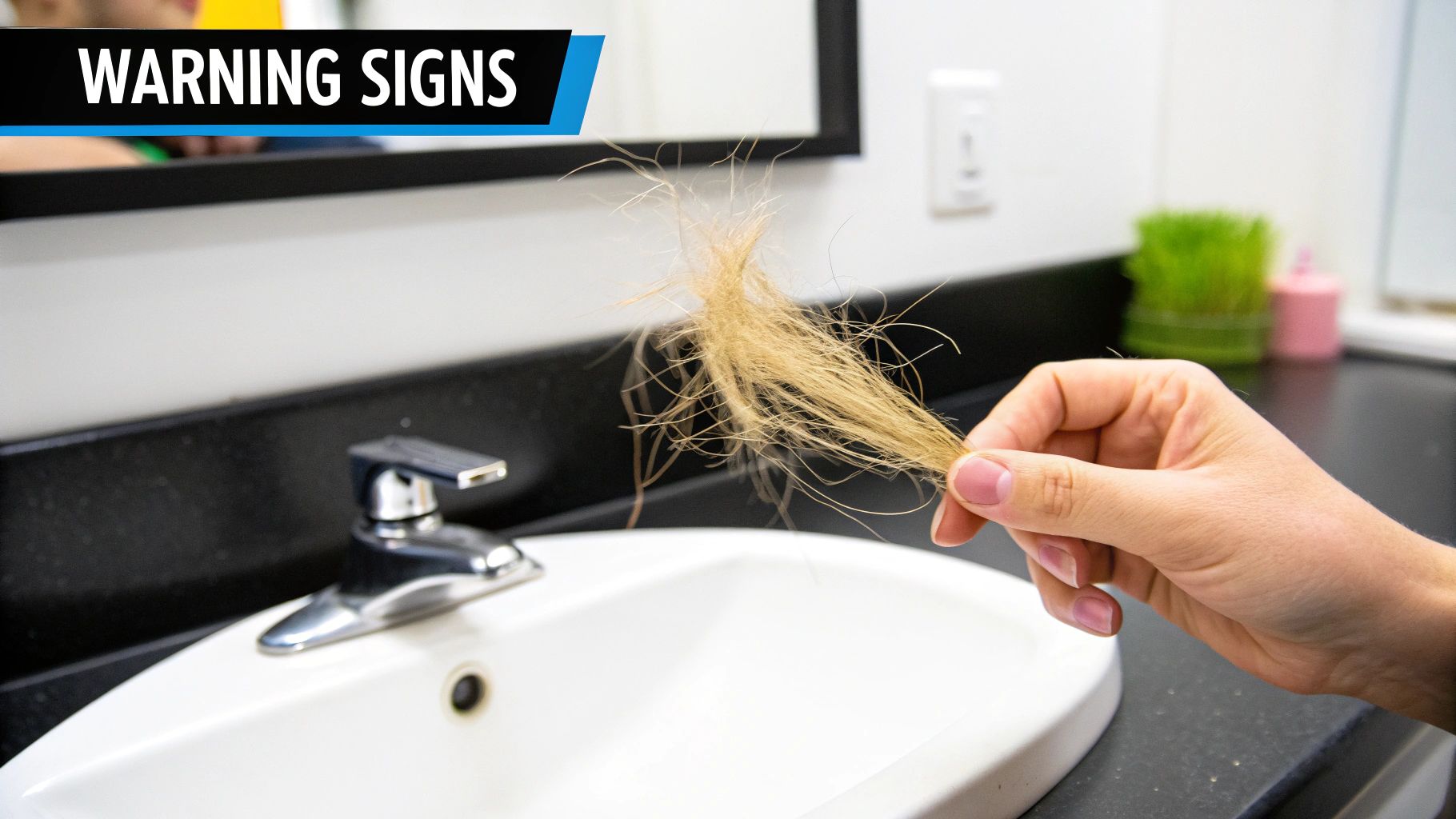
Your body is surprisingly good at sending out distress signals when it needs more water, and your hair and scalp are often the first to wave a red flag. Long before you even feel thirsty, the consequences of dehydration can start showing up in your hair's texture, appearance, and overall strength. Learning to spot these early warnings is the best way to tackle the problem before it gets worse.
The trouble is, it's easy to write off these symptoms. We blame them on humidity, a new shampoo, or just a "bad hair day." But when several of these signs show up at once, they often point to a much deeper, systemic issue like chronic dehydration. Connecting these dots is the first real step toward getting your hair back to its healthy, vibrant state.
Hair That Lacks Life and Strength
Healthy hair has a certain bounce and shine to it—it feels alive. When you're not drinking enough water, one of the first things to go is that vitality. The moisture inside the hair shaft plummets, leaving it looking dull, flat, and lifeless.
This internal dryness makes every single strand incredibly fragile. You might notice your hair feels coarse and straw-like when you run your fingers through it, or that it gets tangled way more easily than it used to. This isn't just a surface problem; it’s a clear sign that the fundamental structure of your hair is compromised from the inside out.
Here's a quick test: Gently pull on a single strand of hair. If it snaps almost immediately with very little give, that’s a telltale sign it lacks the moisture it needs to be resilient. Hydrated hair will stretch a bit first.
This kind of brittleness is a direct link between dehydration and hair loss, because constant breakage eventually leads to less volume and visible thinning. It's crucial to know what you're looking for, and our guide on how to tell if your hair is thinning can help you distinguish the signs.
An Unhappy and Irritated Scalp
Let’s not forget—your scalp is skin. Just like the skin on your face or arms, it needs plenty of water to stay healthy and do its job. A dehydrated scalp quickly becomes dry, tight, and flaky, creating a stressful environment that’s terrible for hair growth.
The most common signs of a dehydrated scalp include:
- Persistent Itchiness: If your scalp is constantly itchy and you can't blame it on a product reaction, it’s often just crying out for moisture.
- Noticeable Flaking: You might see small, white flakes that look like dandruff. But unlike dandruff from an oily scalp, these are dry flakes from the top layer of skin shedding.
- A Feeling of Tightness: Your scalp might literally feel tight, almost like it's being stretched uncomfortably over your skull.
When your scalp is in this stressed-out state, it simply can't provide the healthy foundation your hair follicles need to thrive. This irritation can even kick off inflammation, which is known to disrupt the hair growth cycle and speed up shedding.
Your Action Plan for Optimal Hair Hydration
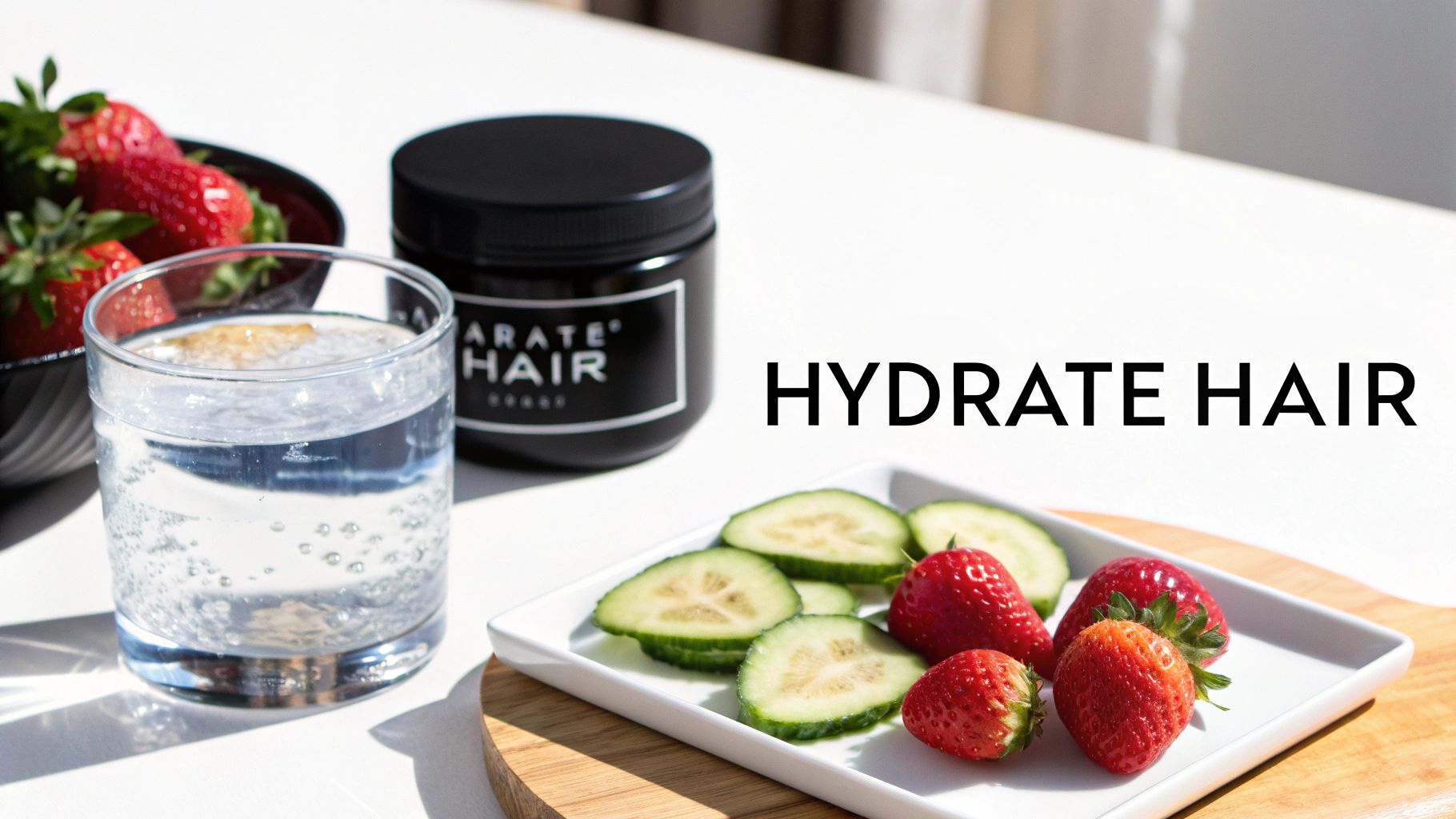
Knowing the connection between dehydration and hair loss is one thing, but putting that knowledge into practice is what really counts. A solid hydration plan is more than just forcing yourself to drink water; it’s a two-pronged attack. You need to hydrate your body from the inside while protecting your hair from the outside.
Think of it as building a routine that benefits your whole body, with great hair being a fantastic side effect. By bringing together smart internal hydration with deliberate external care, you’re creating the perfect environment for your hair to flourish.
Hydrating Your Body From the Inside
We’ve all heard the “eight glasses of water a day” rule, and it's not a bad place to start. But your real needs can be completely different depending on your lifestyle, the climate you live in, and even your body weight. A better rule of thumb is to drink half your body weight in ounces of water each day. So, if you weigh 180 pounds, you should be aiming for about 90 ounces.
If you lead an active lifestyle or live somewhere hot, you're losing critical electrolytes through sweat. Simply chugging water might not be enough to replenish them. It's worth it to compare different electrolyte powders to enhance your hydration strategy and find one that fits your needs.
Don't forget, you can also eat your water. Many delicious foods are loaded with H2O and can give you a major hydration boost.
- Cucumbers and Celery: These are basically water in a crunchy, snackable form—both are over 95% water.
- Watermelon and Strawberries: Besides being incredibly hydrating, these fruits are full of antioxidants that help keep your scalp healthy.
- Lettuce and Zucchini: Sneak these into your meals, and you'll increase your fluid intake without even noticing.
Of course, these hydrating foods work best as part of a well-rounded diet. To learn more about what you should be eating, check out our guide on the best foods for hair growth.
Protecting Your Hair From the Outside
While what you put inside your body lays the groundwork, your hair care routine can either build on that foundation or completely undermine it. It’s shocking how many common products contain harsh chemicals that literally suck the moisture out of your hair and scalp, leaving them brittle and thirsty.
A healthy hair care routine should focus on adding and sealing in moisture, not stripping it away. This protects the hair you have and creates a healthier environment for new growth.
Take a hard look at your shampoo bottle. You'll want to find a moisturizing formula that is free from sulfates and drying alcohols (like isopropyl alcohol). Instead, look for powerhouse hydrators like aloe vera, glycerin, or hyaluronic acid.
Next, make a weekly deep-conditioning mask a non-negotiable part of your schedule. These treatments are formulated to dive deep into the hair shaft, replenish lost moisture, and restore elasticity and shine. This one simple habit can make a world of difference in preventing the kind of breakage that dry, dehydrated hair is so prone to.
When to Consider Professional Hair Loss Treatments
Getting your hydration right and sticking to a solid hair care routine is a huge first step. For many people, just shoring up these fundamentals can bring a noticeable improvement to hair strength and scalp vitality. But what happens when that’s not enough?
Sometimes, even with the best at-home care, you might not see the kind of turnaround you were hoping for with your thinning hair. This is often a clue that while chronic dehydration was a problem, it wasn't the only problem—it was just pouring fuel on the fire. It can make underlying issues like male pattern baldness or other follicle stressors significantly worse.
When lifestyle tweaks alone aren't moving the needle, it’s a strong sign that a more direct approach is needed to kickstart real regrowth.
Introducing Platelet-Rich Plasma Therapy
If you’ve nailed your hydration and still feel stuck, it might be the right time to look into professional treatments like Platelet-Rich Plasma (PRP) therapy. This isn't a miracle cure, but rather a compelling procedure that uses your body's own powerful healing abilities to wake up dormant hair follicles. It gets right to the heart of the nutrient delivery problem that dehydration and hair loss make so much worse.
The process itself is surprisingly straightforward:
- A small sample of your own blood is drawn, just like a standard blood test.
- That sample is spun in a centrifuge, which separates and concentrates the platelets—creating a potent "liquid gold" packed with growth factors.
- This platelet-rich plasma is then meticulously injected back into your scalp in the areas where thinning is most visible.
Essentially, these growth factors send a powerful signal to sluggish follicles, encouraging them to get back to work and re-enter their active growth phase.
Think of PRP as a targeted super-boost for your scalp. While hydration keeps the supply lines open, PRP delivers a concentrated dose of the essential signals needed to kickstart the hair-building process right at the root.
Amplifying Your Efforts for Maximum Results
Here's the key: PRP therapy works best when it builds on a healthy lifestyle, not replaces it. You still need good hydration and nutrition. What PRP does is amplify all your good efforts.
By improving circulation and directly nourishing the follicles, PRP creates a much more fertile ground for hair to grow. All the vitamins and minerals you’re consuming can now be put to better use by follicles that are active and ready to build strong hair. It’s a powerful one-two punch.
This combined approach is a serious strategy for anyone looking to restore hair density. If you've corrected your hydration but your hair loss isn't improving, getting a professional opinion is a smart next move. You can learn more about what to look for when making this decision in our guide on when to see a dermatologist for hair loss. An expert can help you figure out if PRP is the logical next step to build on your healthy foundation and achieve the results you're looking for.
Common Questions About Hydration and Hair
When you're trying to connect the dots between your daily habits and the health of your hair, a lot of questions can pop up. Let's tackle some of the most common ones we hear about hydration and hair loss to clear up any confusion.
Think of this as a quick-reference guide to help you build a smarter hair care routine, starting from the inside out.
How Long Until I See Hair Improvements From Drinking More Water?
This is a great question, and the answer really comes down to patience. While you might notice your skin and scalp feeling less parched within a week or so of upping your water intake, your hair itself is on a much longer timeline. Think of it like watering a plant—you're improving the "soil" (your scalp) so new, healthier growth can emerge.
Hair grows about half an inch a month, on average. That means you'll likely start to see stronger, shinier new hair coming in at the roots within two to three months. Consistency is everything here. You're not fixing the hair that's already grown out; you're building the foundation for the fantastic hair of the future.
Can Drinking Too Much Water Harm My Hair?
It's a fair question, but honestly, it's incredibly difficult for a healthy person to overdo it with water. The medical term for water intoxication is hyponatremia, and it's something usually only seen in extreme situations, like during ultra-marathons or due to specific medical issues.
There's absolutely zero evidence suggesting that drinking a healthy amount of water will hurt your hair. It’s all about finding a good balance. The best strategy? Listen to your body. Drink when you're thirsty and aim for a steady intake throughout the day instead of trying to chug a gallon all at once.
The link between water and healthy hair is about balance, not excess. Your body needs enough water to keep everything running smoothly, including nourishing your hair follicles. Forcing down extra water won't provide any extra benefits.
Are Sports Drinks Better Than Water for Hair Health?
For everyday life, plain old water is the champion of hydration and more than enough to support healthy hair. Sports drinks have a specific job: they're designed with electrolytes like sodium and potassium to help replace what you lose during long, intense workouts where you're sweating a lot.
While those electrolytes are important for your cells—including the ones in your hair follicles—you almost certainly get plenty from a balanced diet. Unless you're a serious athlete or losing a ton of fluids, sticking with water is the way to go. The high sugar content in many sports drinks can cause more problems than it solves.
Does the Type of Water I Wash My Hair With Matter?
Yes, it absolutely does! The water you use on the outside of your hair can make a huge difference. Many of us live in areas with "hard water," which just means it's high in minerals like calcium and magnesium.
Over time, these minerals build up on your hair strands, creating a film that can leave your hair looking dull, feeling dry, and even becoming brittle. It can completely undermine all the good work you're doing by hydrating internally. If you suspect you have hard water, grabbing a showerhead filter or using a good clarifying shampoo once a week can be a total game-changer for your hair's texture and shine.
At PRP For HairLoss, we believe that understanding the science behind hair health is the first step toward finding a lasting solution. If you've optimized your hydration and nutrition but are still seeking to restore hair density, exploring advanced treatments may be your next step. Learn more about your options by visiting us at https://prpforhairloss.com.

 PRP For Hairloss
Leave a comment