Catching hair loss early isn't about being paranoid; it's about being smart. A lot of guys brush off the first little clues, blaming stress or just a bad hair day. But what if that extra bit of hair in the shower drain or the part in your hair looking a tad wider is your body's way of sending up a flare? Recognizing the early signs of male balding gives you a massive advantage: the chance to do something about it. The sooner you figure out what's going on, the better your odds are with any treatments or steps you decide to take.
This guide is meant to cut through the generic advice. We're going to break down the seven most common signs, giving you practical ways to figure out what you're actually seeing in the mirror. You'll learn how to tell the difference between normal, everyday shedding and a real pattern of hair loss kicking in.
By understanding these specific signals, from a shifting hairline to a subtle change in how your hair feels, you can get ahead of the game. Instead of just guessing or worrying, you can gather some real observations. This isn't just a list of symptoms; think of it as a detailed manual to help you read the signs, understand the changes, and make smart decisions about your hair's future. Let's dive in so you can spot them with confidence.
1. The Receding Hairline: More Than Just a Mature Look
The receding hairline is probably the first thing that pops into your head when you think of male pattern baldness, and for good reason. It’s one of the most common and visible early signs of male balding. What's happening is a gradual backward creep of your hairline, especially at the temples. This carves out that classic 'M' or 'V' shape that's a signature of androgenetic alopecia.
This isn't just happening randomly; it's written in your genes. The hair follicles around your temples are extra sensitive to Dihydrotestosterone (DHT), a powerful offshoot of testosterone. DHT basically bullies these follicles, shrinking them and shortening their growth cycle until they just give up producing hair. It's really important, though, to know the difference between this and a maturing hairline. Most guys' hairlines move back a little bit—maybe a half-inch to an inch—as they leave their teens. Male pattern baldness is when it just keeps going, pushing further back over time.
How to Track Your Hairline Accurately
The only way to know if your hairline is truly receding is to watch it methodically. Just feeling like you're losing hair isn't as helpful as having some cold, hard evidence. Here’s how to do it:
- Establish a Photographic Baseline: Start snapping clear, well-lit photos of your hairline once a month. Use the same angle, lighting, and distance every single time. Pull your hair back so you can see the whole hairline. This creates a visual diary you can actually trust.
- Compare with the Past: Go dig up some old photos from five, or even ten, years ago. Putting an old picture next to a new one can reveal slow-and-steady changes that are otherwise impossible to spot day-to-day. You can see this happen with celebrities like Elon Musk over the years; it’s a great example of a gradual but significant change.
- Use the Comb Test: Get your hair wet and use a fine-tooth comb to pull it straight back from your forehead. This gives you the clearest possible view of your hairline's current shape, making it much easier to see if the corners are creeping back.
By consistently keeping an eye on these changes, you can figure out if you're dealing with a simple maturing hairline or one of the first genuine early signs of male balding. If you confirm it's moving back, knowing what to do next is key. You can find detailed strategies and learn more about how to combat a receding hairline to make a smart decision about your options.
2. Increased Hair Shedding: The Numbers Don't Lie
Seeing more hair on your pillow, in the shower drain, or tangled in your comb can be pretty unsettling. This uptick in daily hair shedding is a subtle but important early sign of male balding, often showing up before more obvious things like a receding hairline or a thinning crown. While it's totally normal to lose 50-100 hairs a day as part of the natural hair growth cycle, a steady increase to 150 strands or more is a hint that something else is going on.
This faster shedding is a direct result of DHT messing with your hair follicles. The hormone cuts the anagen (growth) phase of the hair cycle short, shoving follicles into the telogen (shedding) phase way too early. This means more hairs are falling out faster than your body can replace them. You'll see this talked about all the time in hair loss communities like Reddit's r/tressless, where guys often say a big spike in shedding was their first clue. It’s also a key thing they track in clinical trials for treatments like finasteride.
How to Monitor Your Shedding Rate
Vague anxiety about hair fall won't get you anywhere; you need some real data to understand what's happening. A systematic approach will help you see if your shedding is normal or something to be concerned about.
- Establish a Baseline Count: For one full day, try to collect all the hairs you lose. Check your pillow in the morning, the shower drain after you wash your hair, and your comb or brush. Count them up to get a 24-hour total. This gives you a solid number to work with.
- Keep a Weekly Shedding Journal: You don't have to count every single day, but doing a count one day a week and writing it down can show you trends over time. Make a note of anything else going on, like high stress levels or big changes in your diet.
- Evaluate Your Diet and Lifestyle: Not getting the right nutrients can make shedding worse. Make sure you're eating plenty of protein, iron, zinc, and B vitamins. We all know chronic stress is bad news, and it can contribute to hair loss, so try working in some stress-busters like exercise or meditation.
By tracking your shedding, you can catch one of the most quantifiable early signs of male balding. If your numbers stay high week after week, that’s a strong signal that it's time to dig a little deeper. You can get a clearer picture of what's normal by learning about daily hair loss patterns and figuring out when you might need to talk to a pro.
3. Hair Thinning at the Crown: The Sneaky Second Front
While a receding hairline gets all the attention, thinning hair at the crown (the vertex) is just as big a deal and a super common early sign of male balding. This can happen at the same time as a receding hairline or it can start all on its own, which makes it a sneaky problem because it's literally out of sight and often out of mind. It doesn't start with hair falling out in clumps, but with a slow, gradual decrease in hair volume and density in that circular spot at the top back of your head.
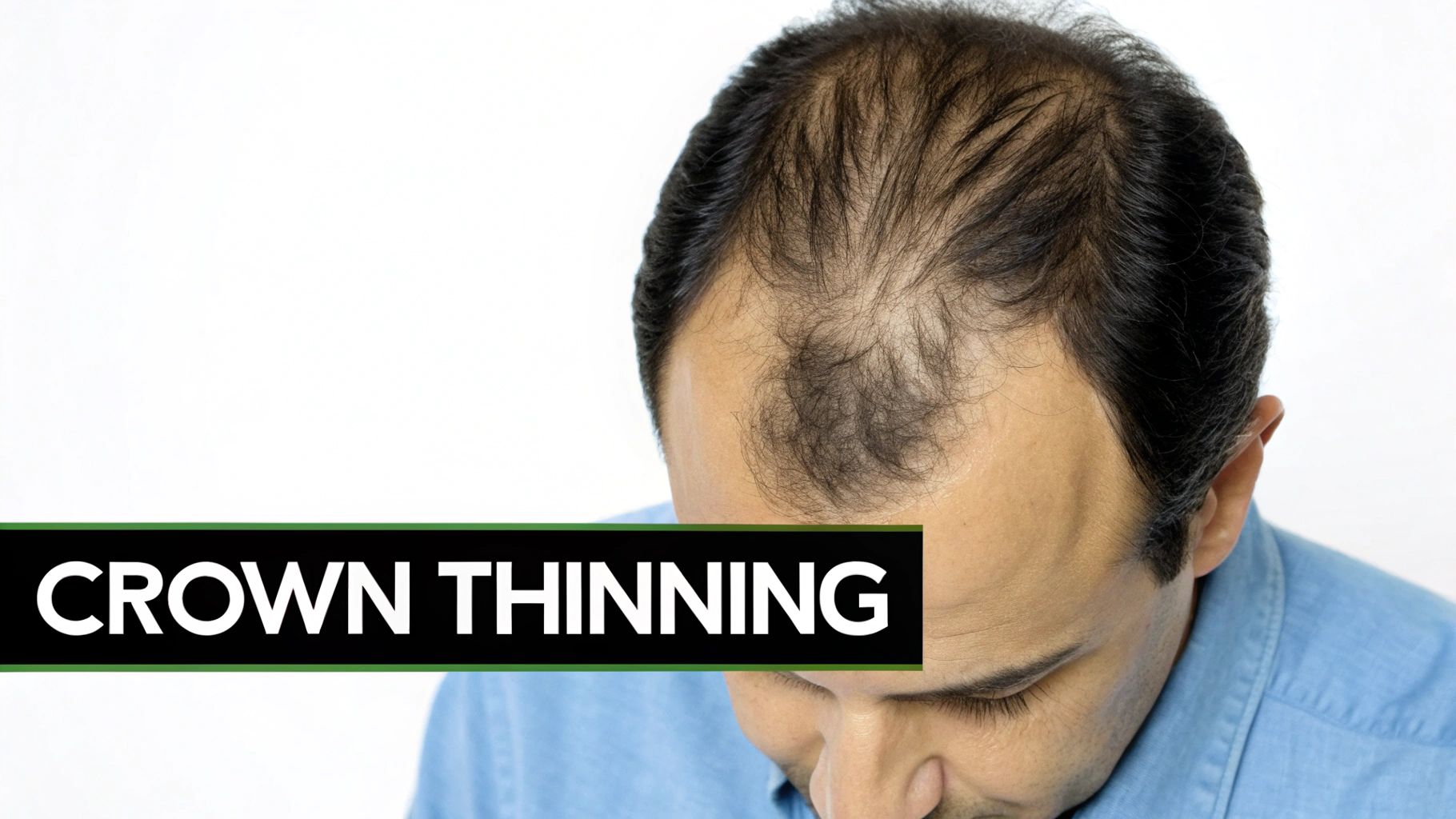
The cause is the exact same as with a receding hairline: follicles getting miniaturized by Dihydrotestosterone (DHT). The hair follicles on your crown become weaker and smaller over time, producing hairs that are finer, shorter, and lighter in color. Eventually, your scalp starts to show through, especially under bright lights or when your hair is wet. This specific pattern of loss was famously documented in the clinical trials for finasteride (Propecia), which helped cement crown thinning as a classic sign of androgenetic alopecia.
How to Monitor Your Crown for Thinning
Since you can't easily see the top of your own head, you have to be proactive to catch crown thinning early. Vague feelings won't cut it, but systematic checks will give you clear proof. Here are a few ways to do it:
- Create a Photographic Log: Use your phone and a second mirror (or just ask a friend for help) to take clear, well-lit pictures of your crown every month. Make sure the lighting and angle are the same every time. This visual diary is your best tool for tracking changes in density.
- Compare with Older Photos: Hunt for pictures of yourself from a few years ago where the top of your head is visible. Comparing those old shots to your new ones can reveal a slow, gradual loss of density you would have otherwise completely missed.
- The Part and Feel Test: In front of a mirror, use a comb to part your hair right down the middle of your crown. Take a good look at how much scalp you can see. You can also just feel the area with your fingers to check if the hair feels less dense or more "fluffy" than the hair on the sides of your head.
By actively keeping tabs on your crown, you can spot one of the key early signs of male balding before it gets too advanced. Catching it at this stage gives you the best shot at effective intervention. To understand your options, you can learn more about how to deal with crown thinning hair and make a plan that feels right for you.
4. The Widening Part Line: An Unmistakable Sign of Thinning
While a receding hairline might be the poster child for hair loss, a widening part line is an equally important—and often much sneakier—early sign of male balding. This shows up as a slow but steady expansion of the visible scalp along your natural hair part. It's a classic sign of diffuse thinning, where hair loss happens evenly across the top of the head instead of just at the temples or crown.
This widening is a direct result of hair follicle miniaturization, the main process behind male pattern baldness. As DHT shrinks your follicles, the hairs they produce get finer and shorter. Over time, this drop in hair density means less coverage, making the gap of your part line look wider and more obvious. For a lot of guys, it's one of the first things they notice when styling their hair or glancing in a well-lit mirror. Unlike temporary shedding, this change is progressive and sticks around.
How to Monitor Your Part Line Effectively
Tracking changes to your part line requires a consistent and objective eye. Guessing can be misleading, but systematic monitoring gives you clear proof of thinning. Here’s how to do it right:
- Create a Photographic Log: Stand under a bright, direct light and take a picture looking down at your part line once a month. Keeping the lighting and angle exactly the same is critical for accurate comparisons. This visual record is the best way to confirm gradual changes.
- The Ruler Test: In your monthly photos, you can even place a small, clear ruler next to your part line to measure the width of visible scalp. This kind of hard data, often used in clinical studies, gets rid of any doubt and helps you track the rate of change.
- Maintain a Consistent Part: To accurately check for thinning, try to part your hair in the same spot all the time. Constantly changing your part can make it tough to tell if the widening is real or just a result of different styling.
By methodically keeping an eye on your part line, you can catch diffuse thinning early on. If you confirm that it's progressively getting wider, it’s a clear sign of male pattern baldness. To better understand what's happening, you can find more details and learn how to tell if your hair is thinning to guide your next moves.
5. Visible Scalp Through Wet Hair
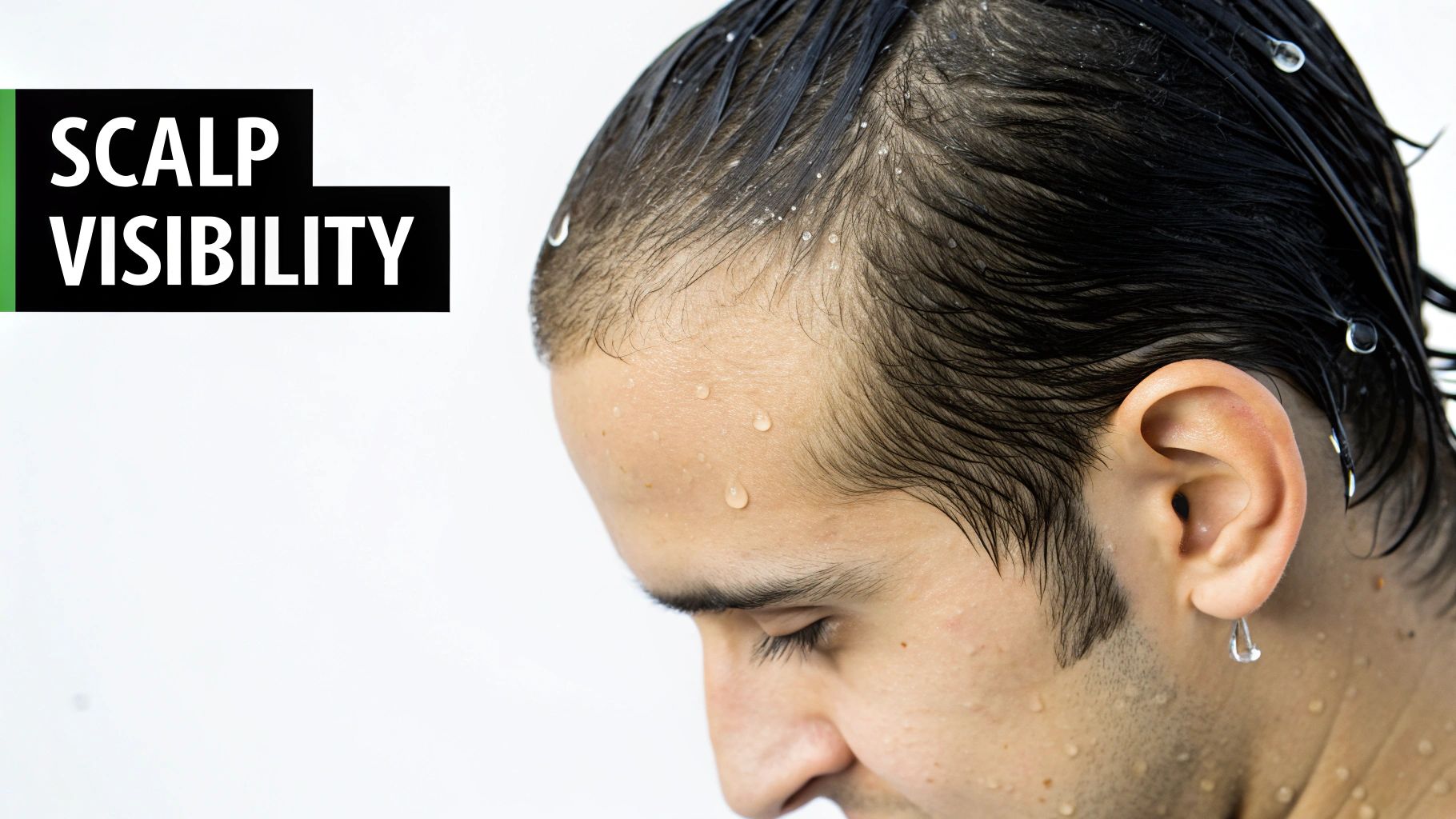
Noticing your scalp peeking through your hair after a shower can be a bit of a shock, but it’s a very effective way to spot thinning. When your hair is wet, it clumps together and loses all its volume, getting rid of the fluffiness that can hide reduced density. It's a moment of truth, revealing the real number of hairs per square inch. If you notice your scalp is way more visible now than it was a year ago, it's a strong sign that follicular miniaturization, a key part of male pattern baldness, has started.
This happens as a direct result of DHT shrinking your hair follicles. As hairs become finer and their growth cycles get shorter, they just don't provide as much coverage—a change that becomes crystal clear when water weighs them down. This method is so reliable that dermatologists often use it for their clinical photos to track the progression of hair loss. It cuts through all the day-to-day variations in styling and volume, giving you a clear, honest look at your hair's true density.
How to Use the Wet Hair Test Effectively
To turn this observation into a reliable tracking method, you need to be consistent and have a clear process. A random glance in the mirror won't cut it. Here’s how to do it properly:
- Create a Consistent Photo Routine: After showering, gently pat your hair but leave it damp. Take photos from the front, top (crown), and sides under the same bright, consistent lighting each month. Natural light from a window is usually best. This visual record is priceless for tracking change.
- Maintain Stable Variables: For your comparisons to be on point, try to keep your hair at a similar length between photo sessions. Also, use the same water temperature, since very hot water can temporarily change how your scalp looks.
- Analyze the Crown and Part Line: Pay close attention to the crown and your natural part. These areas are often where diffuse thinning kicks off. Seeing more scalp in these zones when your hair is wet is one of the classic early signs of male balding.
By systematically documenting how your hair looks when it's wet, you can catch thinning early and take proactive steps. This simple at-home check can be a powerful tool. You can learn more about how to accurately measure your hair's thickness and get a clearer picture of your situation.
6. Hair Loss at Specific Trigger Points (Temporal Recession)
Temporal recession, or hair loss specifically at the temples, is a classic early sign of male balding. It's the technical term for when the corners of your hairline, up in the temporal regions of your scalp, start to march backward. This process is one of the most common starting points for male pattern baldness and is what creates that well-known 'M' shape or a more pronounced widow's peak.
This targeted hair loss happens because the follicles in your temples are often genetically wired to be extra sensitive to Dihydrotestosterone (DHT). This hormone attacks and shrinks these specific follicles, causing the hair they produce to become finer and shorter until they eventually just stop growing altogether. The progression is laid out clearly in the early stages of the Norwood Scale, the main system for classifying male pattern baldness. It’s also worth noting that this recession can often start unevenly, with one temple pulling back faster than the other.
How to Monitor Your Temples for Changes
Keeping a close watch on your temples is key for early detection, as the changes can be so gradual they're easy to ignore. Here are a few precise ways to track temporal recession:
- Use a Landmark for Measurement: Stand in front of a mirror and find the outer corner of your eyebrow. Use a small ruler to measure the distance from that point to the edge of your hairline directly above it. Jot down this measurement monthly to spot any gradual increase in the distance.
- Create a Temple-Specific Photo Log: Really focus your documentation. Take close-up, high-resolution photos of both your left and right temples every month. Make sure the lighting and angle are identical each time. Compare these to older photos to see shifts that are invisible to the naked eye day-to-day.
- The Wet Hair Pull-Back: After a shower, while your hair is still wet, use a comb to pull all your hair straight back. This method gets rid of volume and gives you the clearest, most honest view of your hairline's true shape, making the depth and angle of any recession at the temples immediately obvious.
By systematically tracking these specific trigger points, you can catch one of the most definitive early signs of male balding before it gets advanced. This proactive approach gives you the huge advantage of time when you're thinking about potential interventions or treatments.
7. Change in Hair Texture and Quality
Long before you see a big drop in hair volume, you might actually feel it. A subtle change in the texture and overall quality of your hair is one of the sneakiest early signs of male balding. This isn't about your hair suddenly going from curly to straight; it’s about a process called follicular miniaturization. DHT-sensitive follicles don't just clock out overnight. First, they shrink, and a smaller follicle produces a weaker, thinner, and often lighter-colored strand of hair. This leaves your hair feeling softer, wispier, and more fragile than you're used to.
This change in texture is a direct result of the hair's growth cycle (the anagen phase) being cut short by DHT. As the follicles miniaturize, the hair they produce gets progressively finer and shorter, often called "vellus" hair, which is similar to peach fuzz. Many guys notice this change before significant thinning or a receding hairline becomes obvious. They'll describe their hair as feeling "less substantial" or "limp." As countless dermatology studies and patient stories confirm, this loss of individual hair shaft diameter is a critical first step before you see visible hair loss.
How to Monitor Hair Texture and Quality
Detecting a gradual change in something you touch every day can be tough. Your brain just gets used to the sensation over time. That's why you need a more objective way to confirm if your hair quality is actually going downhill.
- Create a Hair Sample Library: Every three months, snip a small cluster of hairs (about 10-15) from the same spot on your scalp, like the crown or temple. Tape them to an index card and write the date on it. Over a year, this will create a physical record, letting you see and feel the difference in the thickness and strength of the hair shafts over time.
- Use Your Smartphone's Macro Mode: Modern phones have amazing close-up cameras. Once a month, take a well-lit macro photo of your hair, focusing on the individual strands in a specific area. This can help you visually track changes in the hair shaft's thickness that are too subtle to see otherwise.
- The Feel Test: Pay close attention to how your hair feels after you wash and dry it. Does it seem to have less body than it used to? Is it harder to style or does it fall flat more easily? While it's subjective, noticing a persistent change in how your hair behaves can be a strong clue that its texture is changing.
By methodically tracking these more qualitative changes, you can catch follicular miniaturization in its earliest stages. Identifying this sign is so important because it confirms the balding process has started, even if visible thinning isn't a major issue yet. This early heads-up gives you the best window of opportunity to look into treatments aimed at keeping your follicles healthy and your hair dense.
7 Early Signs of Male Balding — Comparison
| Sign | Detection Complexity 🔄 | Resource Requirements ⚡ | Diagnostic Value ⭐📊 | Ideal Use Cases 💡 | Key Advantage 📊 |
|---|---|---|---|---|---|
| Receding Hairline | Low 🔄 — visibly progressive | Low ⚡ — photos/mirror | High ⭐⭐⭐ — early MPB indicator | Early self-screening; decide on medical therapy | Clear, trackable sign for intervention |
| Increased Hair Shedding | Medium 🔄 — needs quantification; confounders | Medium ⚡ — 24‑hr counts, journaling | Moderate ⭐⭐ — early but nonspecific | Distinguish telogen effluvium vs early MPB | Objective, measurable change |
| Hair Thinning at the Crown | Medium 🔄 — requires overhead photos/lighting | Low‑Med ⚡ — photography, parting | High ⭐⭐⭐ — strong vertex miniaturization signal | Monitor vertex progression and treatment response | Predictable progression; treatment‑responsive |
| Widening Part Line | Low 🔄 — easy mirror/combing check | Low ⚡ — photos, comb/ruler | Moderate ⭐⭐ — localized density loss | Track top‑of‑head density; prompt consult | Easy to self‑assess and document |
| Visible Scalp Through Wet Hair | Low 🔄 — reproducible wet‑test | Low ⚡ — shower photos under consistent conditions | Moderate ⭐⭐ — objective but influenced by variables | Baseline assessment for treatment decisions | Reproducible, photographic baseline |
| Temporal Recession (Trigger Points) | Low‑Med 🔄 — measure temples; may be asymmetric | Low ⚡ — photos, ruler | High ⭐⭐⭐ — strong genetic indicator | Early detection of androgenetic pattern | Highly specific to MPB; measurable |
| Change in Hair Texture & Quality | Medium 🔄 — subjective; needs close inspection | Medium ⚡ — microscope/macro photos, clippings | Moderate ⭐⭐ — early but nonspecific | Early‑stage detection; corroborate other signs | Tactile early warning before volume loss |
Your Next Steps: From Awareness to Action
Dealing with male pattern baldness doesn't start with a magic pill, but with clear-eyed awareness. By getting familiar with the subtle but important changes we've talked about—from the first hint of a receding hairline to seeing more hair in the drain—you've already taken the most important step. You are no longer guessing; you are observing. This shift from passively worrying to actively monitoring is the key to managing your hair's future.
Recognizing these early signs of male balding isn't meant to cause anxiety. It's about empowering you with information. Whether it’s the slowly thinning crown, a part line that seems a bit wider, or a change in how your hair feels, each sign is a piece of data. It tells a story about what’s going on up there and gives you a head start in seeking a professional opinion.
Transforming Knowledge into a Proactive Plan
You can't overstate the value of catching this early. The sooner you identify that male pattern baldness is starting, the more options you have and the better those treatments are likely to work. Think of it like taking care of a classic car; it's a lot easier to fix a small spot of rust than it is to restore a completely corroded frame. Your hair follicles work on a similar principle: it's much more possible to protect and strengthen weakened follicles than it is to bring back ones that have gone completely dormant.
Your next steps should be strategic and informed:
- Document Your Observations: Keep taking those photos of your hairline, crown, and part line every few months in consistent lighting. This visual diary is solid proof of change over time, which is incredibly helpful when you talk to a specialist.
- Seek Professional Diagnosis: Set up a consultation with a dermatologist or a trichologist (a hair and scalp specialist). A professional can properly diagnose the cause of your hair loss and rule out other potential issues. Male pattern baldness is just one possibility; for a broader look, you might check out this guide on the top 10 reasons for hair loss to see what other factors could be involved.
- Discuss Your Options: Based on their diagnosis, your specialist can walk you through a personalized treatment plan. This could include FDA-approved medications like finasteride and minoxidil, low-level laser therapy, or more advanced regenerative treatments.
Catching hair loss early changes the story from one of loss to one of proactive management. It puts you in the driver's seat, armed with the knowledge to make confident decisions about your health and appearance. Your awareness today is your best defense for the hair you want tomorrow.
Ready to take a proactive step with a science-backed, natural approach? Explore how Platelet-Rich Plasma (PRP) therapy at PRP For HairLoss uses your body's own growth factors to rejuvenate follicles and combat the early signs of male balding. Visit our website to learn more about this innovative treatment and schedule your consultation today. PRP For HairLoss
 PRP For Hairloss
Leave a comment