Getting your blood test results back can feel like you've been handed a document in a foreign language. It's just a sea of abbreviations, numbers, and ranges. But here's the good news: you don't need a medical degree to make sense of it.
The trick is learning how to spot the four key pieces of information for any given test. Once you can find the test name, your specific result, the standard reference range, and any flags (like 'High' or 'Low'), you've cracked the code. Let's walk through how to do that.
Your First Look at a Lab Report

When you first open your lab report, don't get bogged down by the medical jargon. Just take a second to look at the overall layout. It’s usually a grid or a table, and your goal is simply to get oriented.
Think of it less like a complex medical chart and more like a scorecard. We're just trying to find out what was measured, what your score was, and what the "normal" score is. This initial scan is all about building a little confidence before we dive into what the numbers actually mean.
Finding the Core Components
No matter which lab processed your bloodwork, from Quest to Labcorp, the report will contain the same basic elements. You just need to know where to look.
- Test Name: This is what was measured. Look for it in the far-left column. You'll see things like 'Hemoglobin,' 'Platelets,' or 'WBC Count.'
- Your Result: This is your number, the direct measurement from your blood sample. It's usually in the column right next to the test name.
- Reference Range: This column provides context. It shows the typical range of values that are considered normal for a healthy person.
- Flags: These are quick visual cues. If your result is outside the normal range, the lab will often flag it with an 'H' (High), an 'L' (Low), or maybe an asterisk (*) to make sure it stands out.
Key Takeaway: By simply locating these four items, you can immediately see which of your results fall within the expected range and which ones might need a closer look. You've gone from overwhelmed to informed in just a few seconds.
To make this even clearer, here’s a quick reference table that breaks down the main parts of a lab report.
Decoding Your Lab Report: A Quick Reference
This table summarizes the key components you'll find on any standard blood test report and what they mean in simple terms.
| Report Component | What It Means | Why It Matters |
|---|---|---|
| Test Name | The specific substance or cell type being measured (e.g., RBC, Platelets). | Identifies what part of your blood is being analyzed. |
| Your Result | The actual numerical value from your blood sample. | This is your personal data point, the core of the test. |
| Reference Range | The "normal" or expected range for a healthy adult. | Provides context to see if your result is high, low, or normal. |
| Units | The unit of measurement (e.g., M/uL, g/dL). | Ensures you're comparing your result to the correct scale. |
| Flags | A visual indicator (e.g., H, L, *) for out-of-range results. | Draws immediate attention to values that need further review. |
Having this basic structure down is the first, most important step. Now, let's put it into a real-world context.
A Real-World Example
Let’s say you're looking at a Complete Blood Count (CBC) panel. You scan down the list and see a line that looks something like this:
RBC Count……… 4.10 L (Ref: 4.20 – 5.80 M/uL)
Right away, you can see your Red Blood Cell (RBC) count is 4.10. The report helpfully tells you the reference range is 4.20 – 5.80 and even adds an 'L' flag to show your result is slightly low.
This single piece of data doesn't automatically mean something is wrong, but it's a starting point for a conversation with your doctor. Sometimes, low counts can be linked to nutritional factors; for example, it's worth knowing if a vitamin deficiency might be contributing to your overall health picture.
The precise structure of these reports isn't accidental. It's governed by strict medical documentation guidelines to ensure clarity and accuracy. Once you get a feel for this layout, you've mastered the foundation for understanding your own health data.
What Do 'Normal' Reference Ranges Really Mean?
That little column on your lab report labeled 'Reference Range' can be a huge source of anxiety. It’s so easy to see your number next to it and immediately think of it as a pass/fail grade. But it’s really not that black and white, and knowing why can save you a lot of unnecessary worry.
These ranges aren't some universal definition of "healthy." They're actually just a statistical average—a bell curve where most people's results tend to land. Being a little outside that range doesn't automatically mean something is wrong.
Where Do These Ranges Come From?
So, how does a lab even decide what's "normal"? The whole process is based on population data, not on some ideal standard of perfect health. Getting your head around this is the first step to reading your blood work with the right perspective.
Labs establish these ranges by testing big groups of people they consider healthy. The catch is, "healthy" can be a pretty broad and subjective term. This means the range is simply an average of what's typical for that specific group of people they tested.
It's crucial to remember that these ranges are statistical tools. They're designed to catch major deviations from the norm, not to flag every tiny, clinically insignificant blip. Your personal health baseline is what truly matters.
For example, your result for a certain marker might be flagged as 'Low,' but if it has been at that same level for years without causing you any problems, that might just be your normal. This is why comparing your current results to your own past tests is often far more revealing than stacking them up against a generic population average.
The 95% Rule and Why Outliers Exist
Statistically speaking, these reference ranges are usually set to include the middle 95% of results from the healthy sample population. This is standard practice, but it leads to a consequence that most people don't realize.
By its very definition, this model guarantees that 5% of perfectly healthy people will have results that fall outside the so-called 'normal' range. Two and a half percent will be a touch high, and two and a half percent will be a touch low—all without having any actual medical issue.
This infographic does a great job of showing the difference between these population-based ranges and your own individual fluctuations.
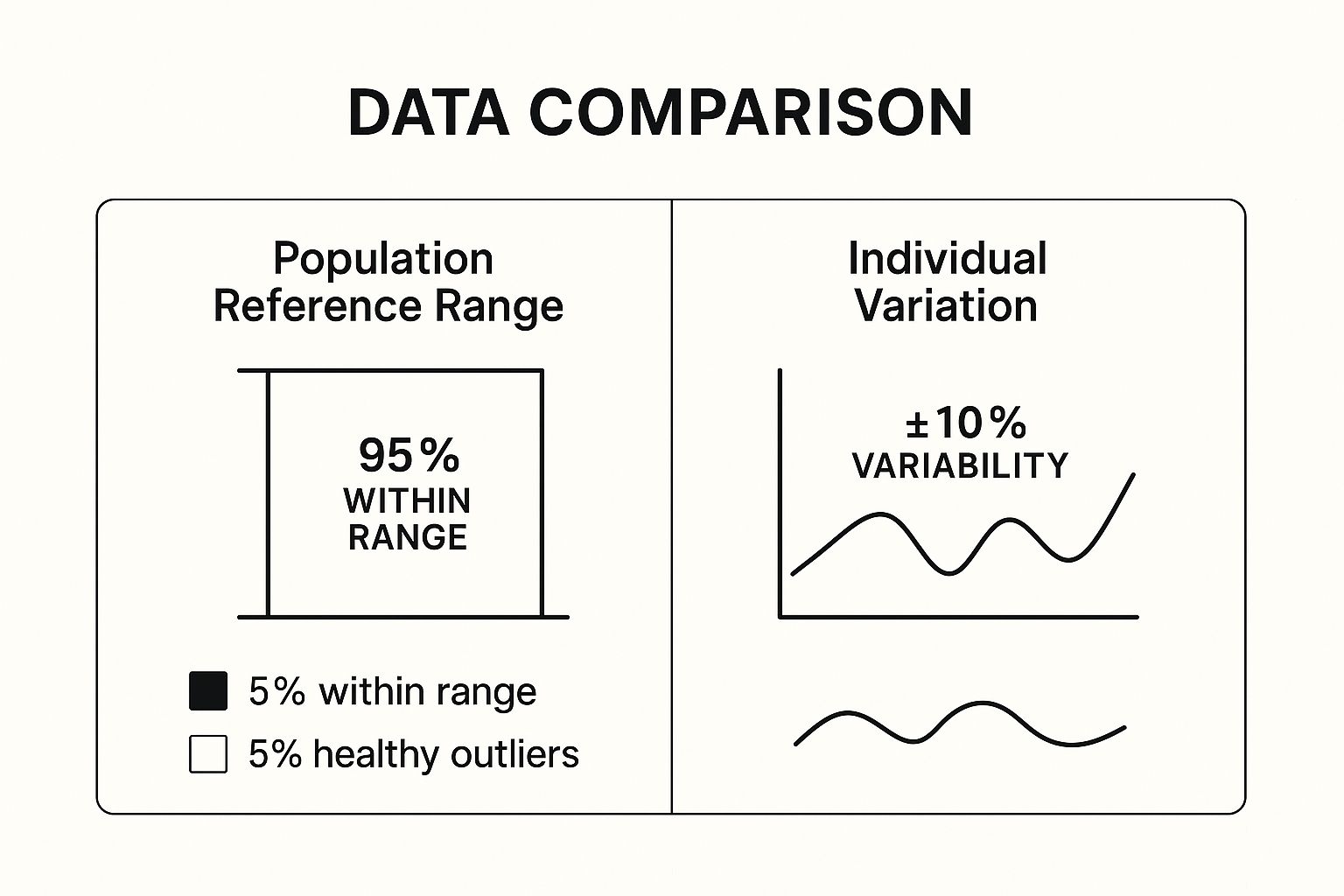
As you can see, while 95% of a healthy population fits neatly into a standard range, your own results can naturally bounce around from day to day.
Knowing this statistical background is key. Appreciating that these ranges come from testing at least 120 healthy people for each subgroup (like age and gender) helps put things into perspective. It's a balancing act to capture most healthy variations while still flagging potential issues, and as you can imagine, communicating that nuance is tricky. You can dive deeper into the statistical basis of these ranges in this detailed study on laboratory test interpretation.
Your Personal Context Is Key
Your individual health story is far more important than a single data point on a page. Plenty of things can temporarily nudge a result slightly out of the standard range.
- Hydration Levels: Being even a little dehydrated can concentrate things in your blood, which might raise markers like creatinine.
- Recent Diet: A big steak dinner the night before your test could easily affect your kidney function markers.
- Strenuous Exercise: A killer workout can temporarily spike muscle enzymes like creatine kinase (CK).
- Medications & Supplements: Countless common medications and even over-the-counter supplements can influence lab results.
For instance, certain mineral levels are critical for hair health. If you notice a borderline result for a nutrient like zinc, it's a perfect reason to start a conversation with your doctor. Our guide on the link between zinc deficiency and hair loss could be a helpful resource for that chat.
At the end of the day, your lab report is just a collection of data points, not a final judgment. Think of it as a tool meant to be used in a bigger conversation about your health, guided by a professional who knows your complete story.
Making Sense of Common Blood Test Panels
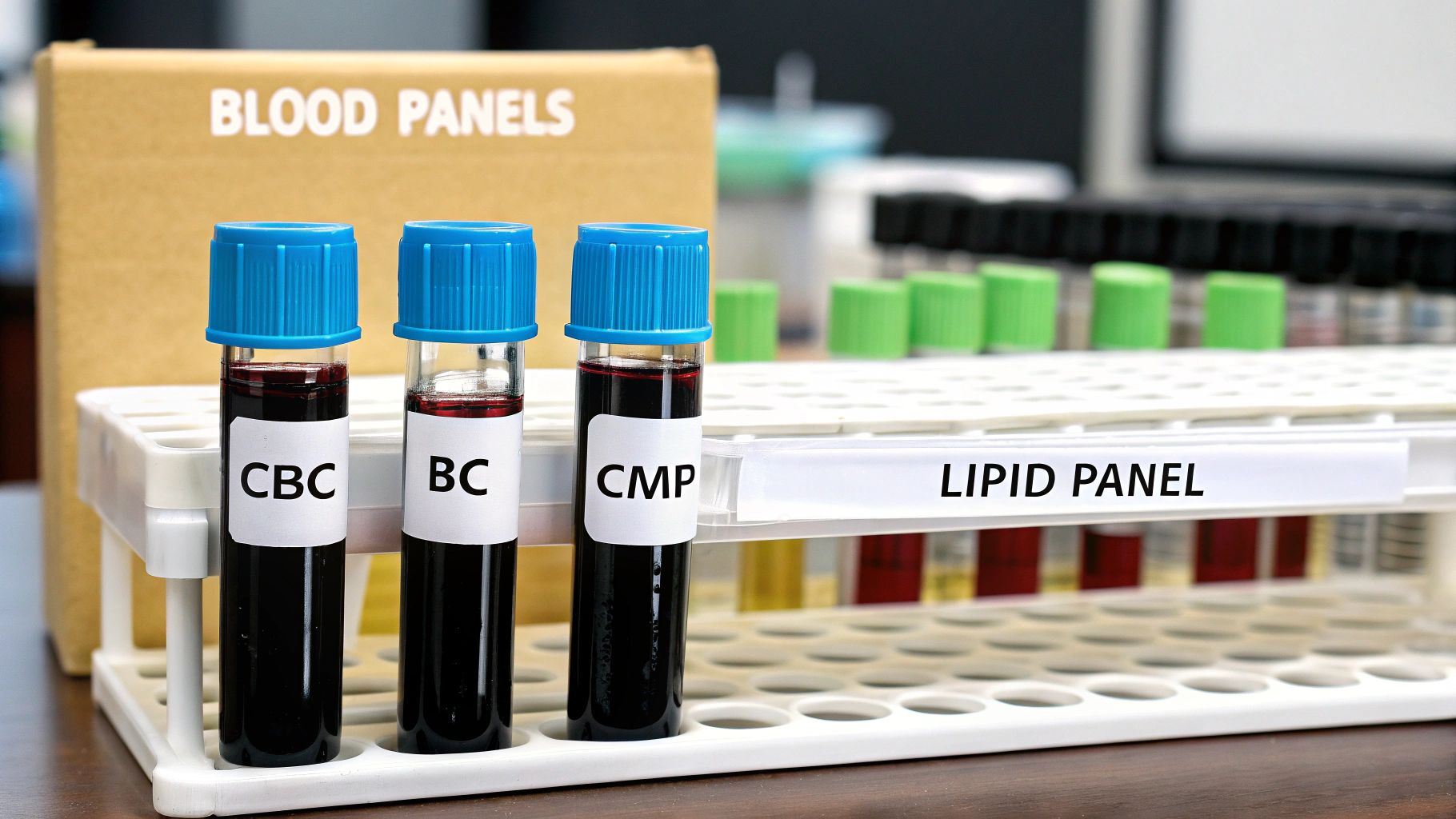
Alright, now that you've got a handle on how to read the report and what those reference ranges actually mean, let's get into the good stuff—the tests themselves. Your doctor will order specific panels tailored to you, but there are a few heavy hitters that show up on almost every routine check-up.
We're going to dive into the "big three" panels you’ll almost certainly encounter. Think of these as your doctor's primary toolkit for getting a bird's-eye view of your health. Once you know what each one is looking for, you're no longer just looking at numbers on a page; you're starting to understand the language of your own body.
The Complete Blood Count (CBC)
First up is the Complete Blood Count, or CBC. It’s one of the most common blood tests ordered, and for good reason. It’s a broad-spectrum screening that examines the actual cells floating around in your blood, giving us crucial clues about your overall health.
A CBC gives us a headcount of your red blood cells, white blood cells, and platelets. Each one tells a unique part of your health story.
- Red Blood Cells (RBCs): These are the oxygen taxis of your body. The key metrics here are hemoglobin and hematocrit. If these are low, it can point to anemia, which is often why you might feel drained and weak.
- White Blood Cells (WBCs): Think of these as your immune system's private army, fighting off invaders. A high count can mean your body is actively fighting an infection. A low count, on the other hand, might suggest a problem with your immune response.
- Platelets: These are tiny cell fragments that rush to the scene to form clots when you get a cut. If the count is too low, you might bruise or bleed easily. Too high, and it could raise the risk of unwanted blood clots.
Let's say you've been dragging yourself through the day, feeling completely wiped out for weeks. Your doctor will zoom in on the RBC and hemoglobin numbers in your CBC. A result flagged as 'Low' is often the first concrete sign of anemia, which then prompts a deeper investigation into why—is it an iron deficiency, for example?
The Comprehensive Metabolic Panel (CMP)
If the CBC is about your blood cells, the Comprehensive Metabolic Panel (CMP) is all about your blood chemistry. This panel is a real workhorse. It gives your doctor a detailed snapshot of your metabolism, how well your kidneys and liver are doing, your electrolyte balance, and your blood sugar.
The CMP packs in 14 different measurements, which sounds like a lot, but they fall into a few logical groups.
- Glucose: Plain and simple, this is your blood sugar. A high number, especially if you were fasting for the test, is a major red flag for prediabetes or diabetes.
- Kidney Function: Markers like creatinine and blood urea nitrogen (BUN) tell us how efficiently your kidneys are filtering waste. Sometimes even simple dehydration can throw these numbers off a bit.
- Liver Function: The CMP checks for liver enzymes like ALT and AST. If these are elevated, it can be a sign of liver inflammation or damage.
- Electrolytes: This group includes sodium, potassium, and chloride. They’re absolutely essential for everything from nerve signals to muscle contractions and staying properly hydrated.
The real power of the CMP is how it connects the dots between different body systems. An odd result in one area can often shed light on an issue somewhere else entirely.
The Lipid Panel
With heart disease being a leading health concern, the Lipid Panel is your go-to test for checking out your cardiovascular risk. It measures the different kinds of fats (lipids) in your blood, mainly focusing on cholesterol and triglycerides.
To really understand the results, you have to look beyond just the "total cholesterol" number. The devil is in the details.
- Total Cholesterol: This is just the sum of all cholesterol in your blood.
- LDL (Low-Density Lipoprotein): This is the infamous "bad" cholesterol. High LDL levels can lead to plaque buildup in your arteries, which is a major risk factor for heart attack and stroke.
- HDL (High-Density Lipoprotein): This is the "good" cholesterol. HDL acts like a scavenger, helping to clear excess cholesterol out of your arteries. For this one, a higher number is what you want to see.
- Triglycerides: This is another fat in your blood that the body uses for energy. High levels are often tied to diet and can also increase your risk for heart disease.
Your doctor isn't just looking at these numbers in isolation; they're looking at the ratios. For example, a high total cholesterol number is much less worrisome if your HDL ("good" cholesterol) is also very high.
When evaluating your health, it’s also smart to remember how interconnected everything is. Other factors can have a surprising impact on your body. For instance, knowing the link between thyroid issues and hair loss in men highlights how a problem in one area can manifest in another.
To help you keep these panels straight, here's a quick breakdown of what they cover.
Common Blood Panels and What They Check
This table gives a quick comparative look at the three most common blood test panels. It shows you the key markers in each and what part of your health they're designed to evaluate.
| Panel Name | Key Markers Included | What It Primarily Screens For |
|---|---|---|
| Complete Blood Count (CBC) | Red Blood Cells (RBC), White Blood Cells (WBC), Platelets, Hemoglobin, Hematocrit | Anemia, infection, inflammation, clotting problems, and certain cancers of the blood. |
| Comprehensive Metabolic Panel (CMP) | Glucose, Calcium, Sodium, Potassium, CO2, Chloride, BUN, Creatinine, Liver Enzymes (ALP, ALT, AST, Bilirubin) | Kidney and liver health, blood sugar levels, electrolyte and fluid balance, and overall metabolic function. |
| Lipid Panel | Total Cholesterol, LDL ("bad") Cholesterol, HDL ("good") Cholesterol, Triglycerides | Cardiovascular disease risk by measuring the fats (lipids) in your blood. |
Getting to know these core panels—the CBC, CMP, and Lipid Panel—is a game-changer. You'll move from just seeing a list of numbers to truly starting to understand the story your body is telling you.
Why Your Personal Health Context Is Crucial
When you get your lab report back, it’s easy to see it as a final verdict. But it's not. That piece of paper is just a snapshot in time—a collection of data points that mean very little without the most important piece of the puzzle: you.
Your personal health context is the lens through which every single result must be viewed. Too many people see a number flagged as 'High' or 'Low' and their minds immediately jump to the worst-case scenario. Your body isn't a machine, though, and these aren't simple pass/fail grades. Your results are profoundly influenced by your daily life, your genetics, and your unique physiology.
How Lifestyle Temporarily Skews Results
Before you even begin to worry about what a result might mean long-term, think about what was going on right before the test. Simple, everyday actions can cause temporary fluctuations that might look alarming on paper but are often completely harmless.
Dehydration is a classic example. If you didn't drink enough water before your blood draw, your blood naturally becomes more concentrated. This can artificially inflate markers like creatinine, making your kidney function look worse than it is. In reality, a few glasses of water could be all it takes to bring it right back to normal.
Exercise is another common one. Did you crush a really tough workout the day before your test? That kind of intense physical stress causes muscle fibers to break down slightly, releasing enzymes into your bloodstream and temporarily spiking markers like creatine kinase (CK). It’s not a sign of a chronic problem; it's just your body doing what it's supposed to do after you pushed it hard.
Your Unique Context Matters: Never look at a single blood test result in a vacuum. Always ask yourself what you were doing in the 24-48 hours before the test. It might just hold the simple explanation you need.
Beyond Lifestyle: Age, Gender, and Genetics
Your permanent traits play an even bigger role in defining what’s "normal" for you. Reference ranges on lab reports are often separated by age and gender for a reason—our bodies change over time. What’s considered a perfectly healthy testosterone level for a 70-year-old man would be a major red flag for a 25-year-old.
Even your ethnic background has a significant impact. It’s important to remember that most of the standard reference ranges used in Western medicine were established using data from predominantly White populations. This can create a lot of confusion when interpreting results for people from other backgrounds.
For instance, ethnic variations can substantially influence blood test results. Studies have shown that people of African origin may naturally have lower average hemoglobin and neutrophil counts compared to Caucasians, without it indicating any kind of disease. If you're interested in the data, you can read the full research about these ethnic variations in blood parameters to see just how much they can differ.
It’s all about understanding your personal baseline. Your unique health story is a combination of these factors:
- Age: Hormone levels, kidney function, and even blood cell counts naturally shift as we get older.
- Gender: Biological differences mean men and women have different reference ranges for things like iron and red blood cell counts.
- Medical History: Your existing conditions and even past illnesses shape what’s normal for you.
- Current Medications: Many common drugs can affect lab results. For example, our guide on medications that cause hair loss shows how prescriptions for one issue can have unintended effects elsewhere.
Thinking about your results this way completely shifts your perspective. You move from being a passive recipient of confusing numbers to an active, informed participant in your own health. This empowers you to have a much more productive conversation with your doctor, focusing on what the data means for you, not for some generic average person.
How to Prepare for Your Doctor Follow-Up

Alright, you’ve gone through your blood test report, circled the key numbers, and thought about how they fit into your life. Now what? The next step is turning that knowledge into a productive conversation with your doctor. The goal is to walk into that appointment feeling prepared and confident, not overwhelmed.
This isn't about questioning your doctor's expertise. Far from it. It’s about becoming a partner in your own healthcare. The best discussions happen when you can ask smart, specific questions that help you both understand what these numbers truly mean for you.
Turning Your Notes Into Questions
Before you head to your appointment, spend a few minutes organizing your thoughts. Look back at your lab report and make a quick list of any results that were flagged or that just made you curious. This simple bit of prep work can completely change the dynamic of your visit, shifting it from a one-way lecture to a two-way collaboration.
Think about how you frame your questions. Instead of just pointing at a number and asking, "Is this bad?", try to open up a real dialogue.
Pro Tip: I can't stress this enough—your doctor likely reviews dozens of lab reports every single day. When you come in with a few thoughtful questions, it helps them zero in on what's most important to you. You're far more likely to leave with real clarity instead of lingering confusion.
To get you started, here are a few questions I often suggest patients consider. Just pick the ones that feel right for your situation.
- Could any of my current medications or supplements be influencing this specific result?
- How does this number compare to my last test? Are we seeing a trend over time?
- Based on this result, are there any specific lifestyle or diet changes you'd recommend I start with?
- What's our plan from here? Do we need more tests, or is this something we'll just monitor?
- If a specific nutrient is low, asking about the best way to improve it is key. For example, our guide on essential vitamins for hair growth shows how targeted nutrition can make a difference in many areas.
The Power of Tracking Your Results Over Time
If there’s one habit I encourage everyone to adopt, it’s this: stop looking at a single blood test in isolation. Your health story is written in trends, not snapshots. A single result that’s a little off could be a total fluke. But a result that has been slowly creeping up over the past three years? That tells a much more important story.
This is exactly why holding onto your old lab reports is so crucial. When you can lay them out and compare them, you and your doctor can spot patterns that would otherwise be completely missed. Is your fasting glucose slowly inching higher each year? Is your "good" HDL cholesterol trending down? These are the kinds of insights that allow for early, effective action.
It’s not just a good idea; it's where modern medicine is headed. A 2022 study showed how predictive models can use a patient's past test results and vitals to estimate the likelihood of future issues. We're moving away from static analysis and toward a more dynamic, personalized view of health.
To make sure you're always ready for these conversations, it helps to know all your options, including conveniences like booking a blood test at home. By taking an active role—organizing your thoughts, prepping your questions, and thinking in terms of long-term trends—you empower yourself and become a true partner in managing your own health.
Got Questions? We've Got Answers
Once you start getting familiar with your lab reports, a few more questions always seem to pop up. It's one thing to know what the numbers mean, but the "what-ifs" and "what's next" can still feel a little murky. Let's dig into some of the most common questions that come up after reviewing the results.
This is your go-to guide for those moments of uncertainty. We'll talk about what to do if a number is just a hair outside the normal range, how often you should really be getting tested, and why your doctor is still your most valuable player in all of this.
What if One of My Results Is Slightly Out of Range?
Seeing a number flagged as "high" or "low" can definitely get your attention. But a single result that's just barely outside the standard range is rarely a cause for alarm. So many things can cause tiny, temporary fluctuations in your blood work—everything from what you ate yesterday to how much water you drank this morning.
Your best first move? Don't panic. Just make a note of it and get ready to discuss it with your doctor. They’re the ones who can put that number into the context of you—your overall health, your medical history, and any symptoms you might be experiencing.
Don't jump to conclusions. A single out-of-range number is just one data point. Your doctor will know if it's just a statistical blip or something that actually needs a closer look.
More often than not, their recommendation will be simple. They might suggest keeping an eye on it with another test in a few months, or they may see right away that for your particular health profile, that number is nothing to worry about.
How Often Should I Get My Blood Tested?
There’s no magic number here. The right testing schedule is completely unique to you. Your age, any chronic conditions you're managing, and specific health goals all play a major role in figuring out the ideal frequency.
For a healthy young adult with no ongoing medical issues, a comprehensive panel every couple of years might be perfectly fine. The main goal there is to establish a baseline and catch any big changes early on.
But the story is different if you're actively managing a health condition.
- If you're dealing with something like diabetes or high cholesterol, your doctor will likely want to check your levels more often—maybe every three to six months—to see how your treatment plan is working.
- For anyone with thyroid issues, regular TSH tests are essential for making sure medication doses are dialed in just right.
- If you're working to correct a specific nutrient deficiency, periodic testing is the only real way to know if your supplements or diet changes are actually moving the needle.
The bottom line is to follow the schedule your healthcare provider recommends. They'll create a plan that's tailored specifically for you.
Can I Just Interpret My Own Results and Skip the Doctor?
You can absolutely learn to understand what’s on your lab report—that’s what this guide is all about! But think of this knowledge as a tool to help you be a better partner in your own healthcare, not as a replacement for a doctor’s professional diagnosis.
A physician does something crucial that we can't do on our own: they connect all the dots. They look at your lab results, your physical exam, your symptoms, and your entire medical history to see the whole story.
Trying to self-diagnose from your patient portal can lead you down two bad roads. You might spiral into needless anxiety over a result that has no real clinical importance, or you could miss a subtle pattern that a trained expert would spot in a heartbeat.
Use what you learn here to have a smarter, more productive conversation with your doctor. Ask better questions. When you're an informed patient, you make it easier for them to give you the best possible care.
At PRP For HairLoss, we believe that understanding your overall health is a key part of addressing specific concerns like hair loss. By learning to read your blood tests, you take an active role in your wellness journey. To learn more about targeted treatments and the science behind them, visit us at https://prpforhairloss.com.

 PRP For Hairloss
Leave a comment