Is it really possible to restore your hair without going under the knife? Absolutely. In fact, pursuing hair restoration without surgery is more effective and accessible today than ever before. We now have a whole arsenal of powerful alternatives, from FDA-approved medications and advanced light therapies to cutting-edge treatments that use your body's own healing power to wake up dormant follicles.
For anyone who isn't ready for surgery or simply doesn't need it, these methods are a complete game-changer.
Exploring Hair Restoration Beyond the Operating Room
The thought of surgery is a big deal for anyone, so it's completely natural to look for other options first. The good news is that the world of hair restoration has expanded far beyond the operating room, shifting its focus toward science-backed, non-invasive solutions that genuinely work.
This isn’t just some niche trend; it’s a massive shift in how we're all tackling hair loss. The numbers tell the story: in 2021 alone, nearly 1.6 million people opted for non-surgical hair treatments. That figure has skyrocketed by an incredible 137% since 2010. It’s crystal clear that people want effective options that fit into their lives without major disruption.
You can dive into the full hair transplant statistics to see just how much the industry is evolving.
Why Consider Non-Surgical Options?
For most of us, the journey to a fuller head of hair starts long before a transplant is even on the table. Non-surgical treatments are all about intervening early, protecting the hair you still have, and in many cases, kickstarting new growth. They're the ideal first line of defense, especially if you're just starting to notice some thinning.
Here are a few of the biggest reasons people are turning to these methods:
- Early Intervention: These treatments pack the biggest punch when you catch hair loss early. They can seriously slow down its progression and help you hang onto your hair density for years.
- Minimal Downtime: Forget recovery time. Most non-invasive options let you get right back to your daily routine without missing a single beat.
- Lower Initial Cost: The financial commitment is typically much lower than surgery, making these powerful treatments accessible to a lot more people.
- A Holistic Approach: Many non-surgical paths work even better when you pair them with positive lifestyle changes. If you're looking for ways to support your hair from the inside out, there are many effective Natural Remedies for Hair Loss worth checking out.
Think of non-surgical hair restoration as a proactive game plan. It's not just about getting hair back; it's about strengthening and keeping the hair you have, giving you more control over your hair loss journey.
Ultimately, the goal is to find a solution that feels right for you. This guide will be your roadmap. We’ll break down the science behind today's leading treatments—from therapies that leverage your body’s own healing mechanisms to proven medications and advanced light technology—so you can make a confident, well-informed decision.
How PRP Therapy Uses Your Body's Own Healing Power
What if the secret to fighting hair loss was already flowing through your veins? That’s the simple but brilliant idea behind Platelet-Rich Plasma (PRP) therapy, one of the most trusted non-surgical approaches to hair restoration out there today.
The entire process works by tapping into the natural healing power in your own blood to reawaken dormant hair follicles.
It helps to think of it like this: your blood is filled with tiny cells called platelets, which are basically your body’s first responders. When you get a cut, platelets swarm the area to stop the bleeding and kickstart the repair process by releasing a flood of powerful growth factors.
PRP therapy isolates these platelets and concentrates them into a potent, golden serum. The result is a supercharged dose of your body's own regenerative ability, ready to be delivered right where you need it most—your scalp.
The PRP Treatment Process, Step by Step
The actual procedure is surprisingly quick and straightforward, usually taking less than an hour from start to finish. There's no major prep work or downtime, which is a huge bonus for anyone with a busy life.
Here’s a simple breakdown of what you can expect during a session:
- Simple Blood Draw: It all kicks off with drawing a small amount of blood, just like you would for a routine lab test.
- Centrifuge Separation: That blood sample is then placed into a centrifuge, a machine that spins at incredibly high speeds. This separates the blood into its core components, isolating the precious platelet-rich plasma from the other cells.
- Precise Injections: Finally, the concentrated PRP is meticulously injected into the areas of your scalp where you're seeing thinning. These are shallow injections designed to target the hair follicles directly.
This direct-to-the-source delivery gives your follicles a powerful cocktail of growth factors, essentially nudging them out of their dormant state and back into an active growth phase to produce stronger, thicker hair.
The core idea behind PRP is biostimulation. It’s not about introducing a foreign substance. It’s about concentrating your body's innate healing power and using it to give your hair follicles a much-needed wake-up call.
Who Is the Ideal Candidate for PRP Therapy?
PRP tends to deliver the best results for people in the earlier stages of androgenetic alopecia (better known as male or female pattern baldness). It's most effective on hair follicles that are weakened or dormant but not gone for good. That’s why jumping on it early makes such a big difference.
Platelet-Rich Plasma therapy has truly marked a major step forward in non-surgical hair restoration. Researchers are constantly refining the techniques, and the future likely holds personalized PRP systems that can tailor growth factor concentrations for even better, more predictable outcomes. New delivery devices are also in the works to make the process even more precise and comfortable.
But remember, success with PRP is all about consistency. This isn't a one-and-done kind of deal.
- Initial Phase: A typical plan kicks off with an initial series of treatments, usually three to four sessions spaced about a month apart. This is critical for building momentum and really getting those follicles going.
- Maintenance: After that, you’ll likely need maintenance sessions every four to six months to keep the results going strong and continue supporting healthy hair growth.
Most people begin to notice the first signs of improvement—like less shedding and some new growth—within three to six months. The most dramatic results, however, usually appear after the initial series of treatments is complete. If you want to dive deeper into the science and procedure, our detailed article explaining what PRP hair restoration is is a great place to start. It has become a go-to option for anyone looking to boost hair density without the commitment of surgery.
The Role of Medications in Preventing Hair Loss
For a lot of people, the first real step toward tackling hair loss doesn't involve a clinic or a special procedure at all. It often starts right in the pharmacy. Medications are a scientifically-backed and accessible way to manage thinning hair, and they form the bedrock of many successful hair restoration without surgery plans.
Two medications, in particular, have stood the test of time and earned FDA approval: Minoxidil and Finasteride. These aren't just wishful thinking in a bottle. They're powerful treatments that work in very different ways to help you keep the hair you have and sometimes, even regrow some of what you've lost. Knowing how each one operates is the key to understanding what they can realistically do for you.
Minoxidil: The Growth Promoter
Think of Minoxidil as a personal trainer for your hair follicles. It was originally a blood pressure medication, but doctors quickly noticed a very welcome side effect: patients were growing more hair. Now, it’s a staple topical treatment you can buy over-the-counter as a foam or liquid, probably best known by the brand name Rogaine®.
At its core, Minoxidil is a vasodilator. That’s just a technical way of saying it widens the blood vessels wherever you apply it. On the scalp, this simple action boosts the flow of blood, oxygen, and vital nutrients straight to your hair follicles. A well-nourished follicle is a productive follicle, meaning it's encouraged to stay in its active growth phase (the anagen phase) for longer.
This boost helps you produce thicker, healthier strands of hair over time. The important thing to remember is that Minoxidil doesn't stop the root cause of genetic hair loss; instead, it creates a much healthier and more supportive environment for your hair to thrive in.
Finasteride: The DHT Blocker
If Minoxidil is playing offense, Finasteride is all about defense. This is a prescription pill designed to go after the primary hormonal trigger for male pattern baldness. Its job is to block an enzyme in your body called 5-alpha-reductase.
This enzyme has one main function: it converts testosterone into a far more potent androgen called dihydrotestosterone (DHT). For guys genetically prone to hair loss, DHT is public enemy number one. It latches onto hair follicles, causing them to shrink, weaken, and eventually give up on producing hair—a process we call miniaturization.
By getting in the way of that conversion process, Finasteride essentially shields your follicles from DHT's damaging effects. This not only slows down or even stops hair loss in its tracks but can give those shrunken, miniaturized follicles a chance to recover and grow back stronger.
Setting Realistic Expectations for Treatment
It’s critical to go into this knowing that these medications are long-term treatments, not overnight cures. Real success comes down to two things: consistency and patience. Skipping doses can set you back, so making it a non-negotiable part of your daily routine is a must.
Here’s a rough timeline of what you can generally expect:
- Months 1-3: Don’t be discouraged if you see nothing—or even a bit more shedding at first. This is totally normal. It's often just the follicles pushing out the old, weaker hairs to make room for new, stronger ones to come in.
- Months 3-6: This is usually when the first glimmers of hope appear. Shedding should slow down, and you might start to spot some fine, new hairs sprouting.
- Months 6-12: By now, the results should be much more obvious. You'll likely see tangible improvements in hair density and overall coverage. The full, final effect of the medication typically takes about a year to become clear.
Of course, it's also essential to talk with your doctor about potential side effects, as they are a possibility with any medication. A medical professional can help you weigh the benefits against the risks to decide if this is the right move for you. To dig deeper into how the medication works, our guide explores in detail whether Finasteride can stop hair loss and what you should know before you start.
Using Light Therapy to Reawaken Hair Follicles
It might sound a little like something out of science fiction, but using specific kinds of light to stimulate hair growth is a real, scientifically-backed approach. The treatment is called Low-Level Laser Therapy (LLLT), and it’s a safe, non-invasive way to get your hair follicles back in business.
The science behind it is a process called photobiomodulation. That’s a mouthful, but the concept is surprisingly simple. Think of it like photosynthesis for your scalp. Just as a plant uses sunlight to create energy and grow, your hair follicles can absorb certain wavelengths of red light. This light essentially "wakes up" the cells inside the follicle, giving them an energy boost.
This stimulation gets the blood flowing, bringing more oxygen and vital nutrients directly to the hair roots. By ramping up this metabolic activity, LLLT can gently nudge dormant or "sleepy" hair follicles from their resting phase back into an active growth cycle.
How You Can Access LLLT
One of the best things about LLLT is how accessible it has become. You have options, whether you prefer treatments in a professional clinic or the convenience of doing it yourself at home.
Here are the two main ways people use light therapy:
- In-Office Treatments: These sessions involve large, powerful LLLT panels that cover your entire scalp at once. You'll have a clinician guiding the process, making sure everything is done correctly for the best results.
- At-Home Devices: FDA-cleared gadgets like laser caps, helmets, and even combs have brought this technology right into our living rooms. It's incredibly convenient—you can get your treatment in while you’re reading a book or catching up on emails.
Whichever path you choose, consistency is everything. LLLT isn't a one-and-done solution; it’s a gradual process that relies on steady, regular sessions to rejuvenate those follicles over time. If you want to get into the nitty-gritty, our guide on red light therapy for hair breaks down the technology even further.
Combining Treatments for Better Results
LLLT works quite well on its own, but it really shines when you pair it with other hair restoration strategies. Think of it as a powerful team player that makes your other treatments work even better.
Because LLLT improves blood flow and cellular health, it creates a much healthier and more receptive scalp environment. This can amplify the effects of other therapies, often leading to better, faster results.
Low-Level Laser Therapy is all about creating the perfect conditions for hair to grow. By improving the health of the follicle at a cellular level, you're laying a stronger foundation for any other treatments you're using.
For instance, specialists often recommend using LLLT alongside PRP therapy or Minoxidil. The increased circulation from the laser therapy can help deliver PRP's growth factors or Minoxidil's active ingredients more efficiently right where they’re needed—the hair follicle. This combined effort can create a much more robust defense against hair loss.
LLLT is typically best for people in the earlier stages of hair thinning, as it's most effective at reviving follicles that are weak but not gone completely. The best first step is always a chat with a hair loss expert to see if it’s the right fit for you.
Lifestyle and Cosmetic Touch-Ups for Fuller-Looking Hair
While dedicated treatments are fantastic, they're only one piece of the puzzle. The most successful hair restoration plans take a holistic approach, blending medical therapies with smart lifestyle choices and even a few clever cosmetic tricks.
Think of it this way: some strategies give you an immediate confidence boost, while others are all about building a solid foundation for long-term hair health. You really need both.
Scalp Micropigmentation: The Instant Illusion of Density
If you're looking for an immediate visual improvement, you need to know about Scalp Micropigmentation (SMP). This isn't a hair growth treatment at all—it’s more like an incredibly advanced and specialized form of cosmetic tattooing.
A trained technician uses micro-needles to deposit tiny dots of pigment onto the scalp, perfectly mimicking the look of real hair follicles. It’s a total game-changer. For a man with a receding hairline, it can create a sharp, clean-shaven buzz-cut look. For someone with diffuse thinning, it fills in the gaps, reducing the distracting contrast between their hair and scalp.
The result is a powerful illusion of more density and fullness. The best part? It's a great companion to other treatments. You can get SMP to feel more confident right away while you wait for things like PRP or medications to kick in and work their magic.
Building Stronger Hair From the Inside Out
Beyond the quick fixes, the choices you make every single day have a huge impact on your hair. Your follicles are living organs, and their health is directly tied to your diet, stress levels, and overall wellness.
Good nutrition is the absolute bedrock of healthy hair. Your hair strands are made almost entirely of a protein called keratin, so if you aren't eating enough of it, your body simply can't build strong hair. It's a non-negotiable.
Think of your hair as a barometer for your internal health. When your body is properly fed and your stress is under control, you're creating the perfect internal environment for your hair to truly thrive.
Simple lifestyle adjustments can make a world of difference. For instance, getting enough protein is critical; you can learn more about incorporating essential nutrients from plant-based protein sources. Other key players include iron, which helps get oxygen to your follicles, and biotin, which is crucial for producing that all-important keratin.
Key Nutrients and Habits for Hair Health
Making a few focused changes can create a much better environment for hair growth. You don't have to overhaul your entire life—just be mindful of what your body needs to function at its best.
Here are a few areas to zero in on:
- Protein is Priority: Make sure your meals include lean meats, fish, eggs, or plant-based powerhouses like lentils and beans. These are the literal building blocks of your hair.
- Boost Your Iron: Low iron is a well-known culprit behind hair shedding. Add iron-rich foods like spinach, red meat, and fortified cereals to your diet.
- Keep Stress in Check: Chronic stress can literally shock your hair follicles into a resting (and shedding) phase. Things like meditation, yoga, or even a brisk daily walk can make a significant difference.
This chart shows just how much impact these lifestyle changes can have on regrowth over six months.
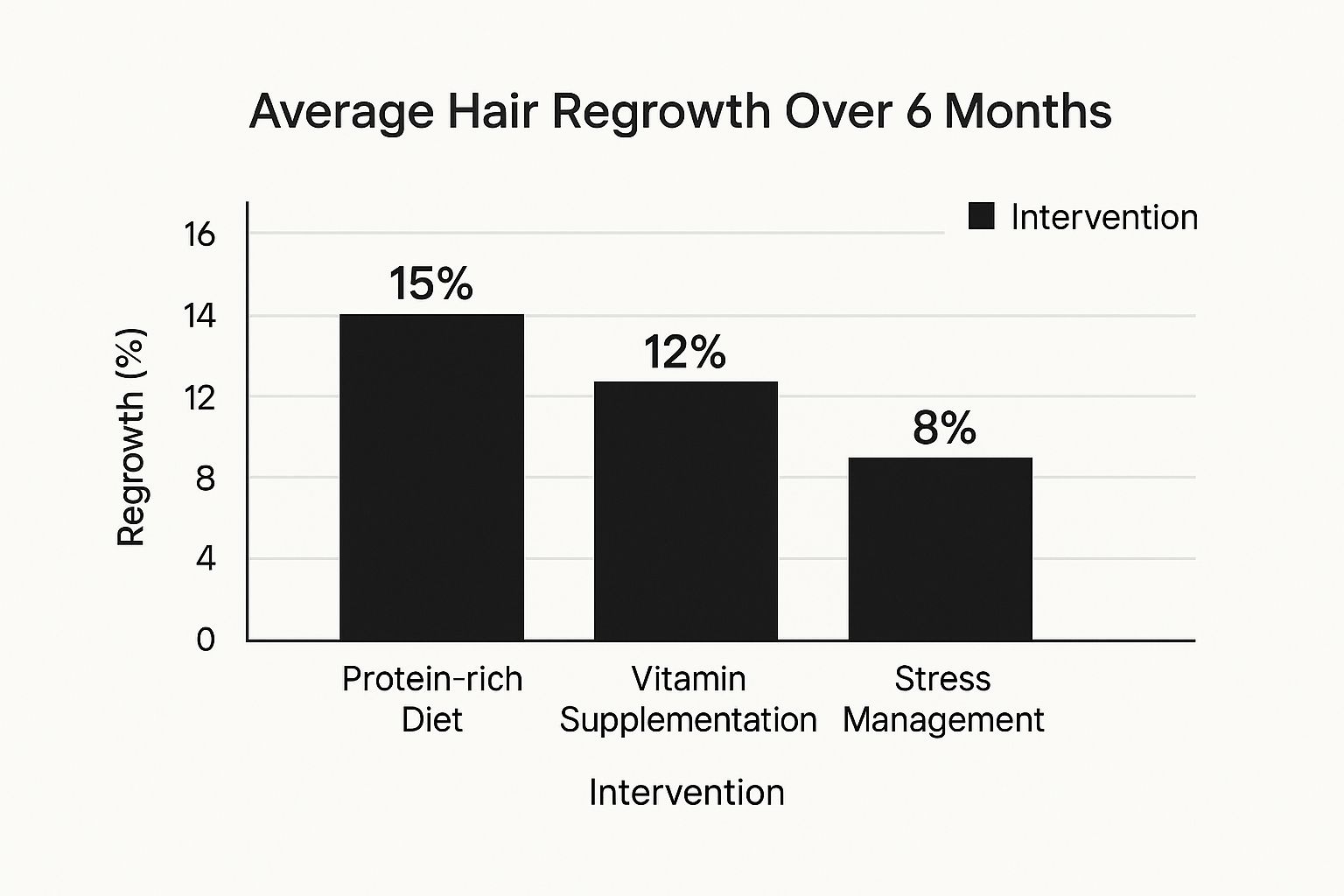
As you can see, a protein-rich diet delivered the most impressive improvement, really driving home the point about nutrition. While these habits support your overall progress, you might want to dive deeper into specific supplements. You can learn all about the essential vitamins for hair growth and how they fit into a restoration plan in our comprehensive guide.
How to Choose the Right Non-Surgical Treatment

With so many powerful options on the table, figuring out where to even begin your journey into hair restoration without surgery can feel like the hardest part. Here's the most important thing to remember: there's no single "best" treatment for everyone. The right path is deeply personal and has to be designed around the specific reason you're losing hair in the first place.
This is why your first step isn't choosing a treatment—it's getting a proper diagnosis. A consultation with a dermatologist or a dedicated hair loss specialist is non-negotiable. They have the expertise and the right tools to look past the symptoms, pinpoint the root cause, and make sure you're actually a good candidate for these methods.
Your Consultation Checklist
Walking into your appointment prepared can make a world of difference. Think of yourself as a partner in your own treatment plan, not just a patient. Arming yourself with a few key questions ensures you leave with the clarity and confidence you need to move forward.
Try to cover these points during your talk with the specialist:
- What is the specific cause of my hair loss? Knowing if it's genetic, stress-related, hormonal, or something else entirely is the foundation of any effective plan.
- Which non-surgical options are best for my situation, and why? A good specialist won't just give you a recommendation; they'll explain exactly how it connects to your diagnosis.
- What are the realistic results I can expect, and what's the typical timeline? This helps set clear, achievable goals right from the start.
- Can you show me before-and-after photos of your own patients with similar hair loss patterns? Nothing speaks louder than real-world evidence of their work.
The goal of a consultation is to build a partnership based on trust and clear communication. A specialist should empower you with knowledge, not pressure you into a decision.
The growing interest in these treatments is fueling massive market growth. In fact, the global hair restoration market is projected to skyrocket to USD 49.06 billion by 2034, with a huge part of that driven by non-surgical methods like PRP and medications. This boom makes finding a truly qualified expert more important than ever.
Ultimately, choosing the right treatment comes down to a combination of education and expert guidance. Start with that professional diagnosis, ask the right questions, and you'll be on your way to building a targeted, effective plan. For a broader look at different approaches, you might find our guide on the best alternatives to a hair transplant helpful.
Frequently Asked Questions
Even after going through all the options, you probably still have a few questions rolling around in your head. That's completely normal. Deciding on a hair restoration path is a big deal, and having all the facts helps you move forward with confidence.
Let's dig into some of the most common questions people ask when they're considering these treatments.
How Long Until I See Results?
This is the big one, isn't it? While the answer really depends on which treatment you choose and how your body responds, the one constant is that you'll need a bit of patience. These aren't quick fixes; they work by tapping into your hair's natural growth cycle.
Here’s a general timeline you can expect with most non-surgical methods:
- The First Stretch (1-3 months): Honestly, you probably won't see much. In fact, with treatments like minoxidil, you might even notice a bit more shedding at first. Don't panic—this is just the old, weaker hairs making way for new growth.
- Early Signs of Progress (3-6 months): This is where you can start getting a little excited. Shedding should slow down, and you may begin to spot the first new, fine hairs sprouting.
- Noticeable Improvement (6-12 months): By this point, the changes should be much more obvious to you and others. Your hair should start to feel and look thicker, with better coverage in those thinning spots.
Are the Results from These Treatments Permanent?
The results are best described as long-lasting, but not permanent. The reality is that for most people, the root cause of hair loss (like male or female pattern baldness) is an ongoing process. Because of this, the treatments need to be ongoing, too.
Think of it like managing any other chronic condition. If you stop the treatment, the hair loss will likely pick back up where it left off. Consistency is truly the secret to holding onto the hair you've regained.
Non-surgical treatments are a commitment to ongoing management, not a one-time cure. The goal is to continuously support the follicles and counteract the factors causing them to shrink.
Can I Combine Different Non-Surgical Treatments?
Yes, you can—and in many cases, you absolutely should! Combining treatments is often one of the smartest strategies because you're attacking the problem from multiple angles. This kind of multi-pronged approach usually gets you far better results than just sticking with one therapy.
For instance, a specialist might suggest a plan that includes Finasteride to block the DHT hormone from the inside, while you use Minoxidil on the scalp to directly stimulate the follicles. Throw in some Low-Level Laser Therapy (LLLT) to improve overall scalp health, and you've got a powerful, comprehensive plan for hair restoration without surgery.
At PRP For HairLoss, we believe that clear, honest information is the first step toward reclaiming your confidence. Our blog is dedicated to helping you understand the science behind treatments like Platelet-Rich Plasma and other effective non-surgical options. Explore our resources to learn more about your path forward at prpforhairloss.com.
 PRP For Hairloss
Leave a comment