So, you're trying to figure out the best age for a hair transplant. Let's be upfront: there isn't a single magic number. While many top surgeons find a "sweet spot" when a man's hair loss has settled down—usually from the late 20s into the 30s—the real key isn't the candles on your cake. It's all about how stable your hair loss pattern is.
Finding the Right Time for Your Hair Transplant
Think of your scalp as a piece of land you're landscaping. A surgeon needs to know where the permanent property lines are before they start planting trees. Otherwise, what looks great today might look completely out of place in a few years. The same principle applies to hair restoration.
Jumping into surgery while your hair loss is still a moving target is a recipe for an unnatural result down the road. The goal isn't a quick fix; it's to create a lasting, natural-looking hairline that suits you for life. This takes a bit of foresight and strategy. It's not just about where your hair is today, but where it’s headed. Understanding your genetic hand-of-cards can be a huge help here. You can get a clearer picture of your personal timeline by exploring genetic hair loss testing.
Success Rates Across Different Decades
Of course, your age does play a part in the process. Different decades bring different physiological factors to the table, and these can influence things like healing time and how well the new grafts take.
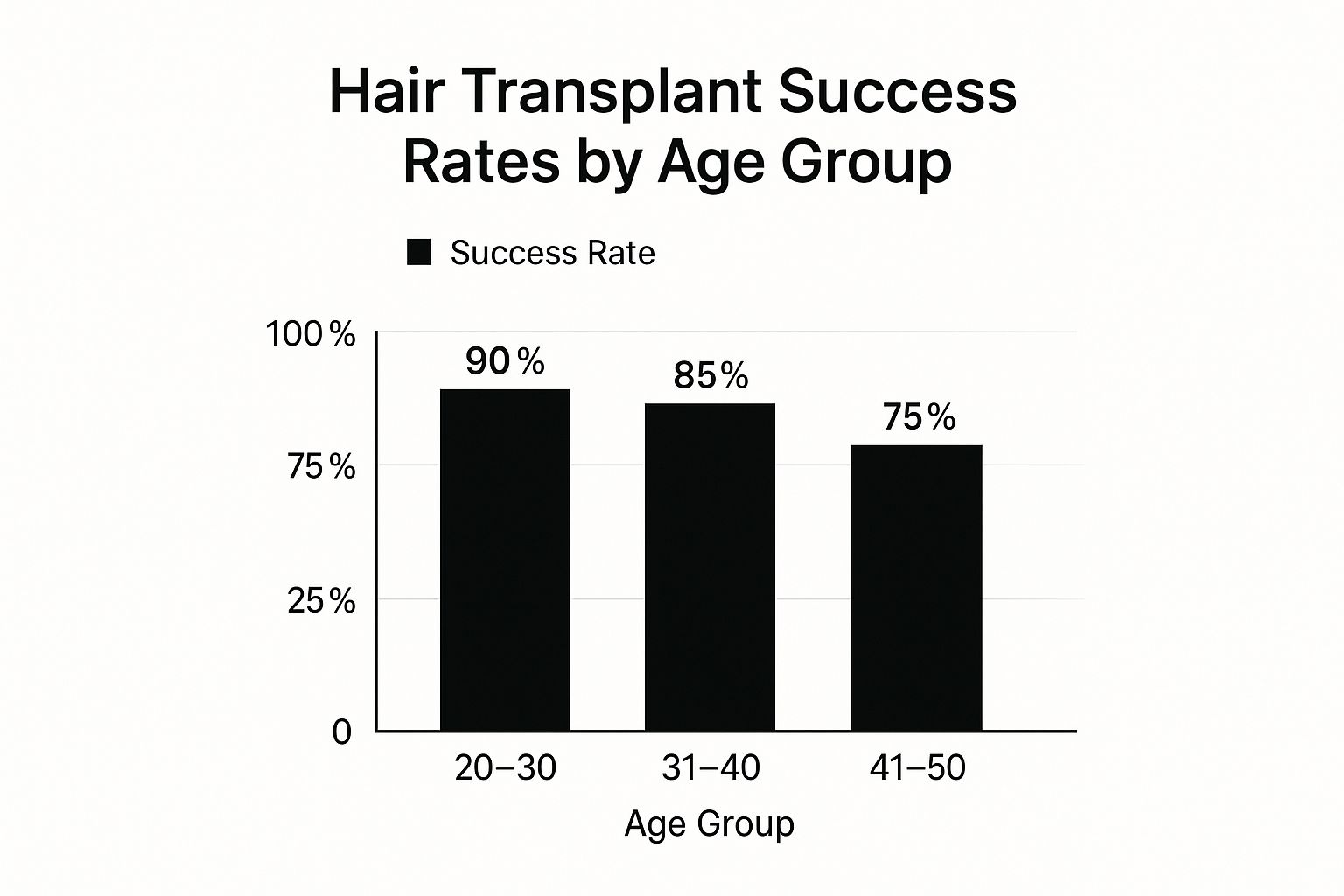
On paper, younger guys often show higher success rates. Why? They tend to have stronger donor hair and their bodies bounce back a little quicker. But those numbers don't tell the whole story. Stability is still the most crucial piece of the puzzle for long-term happiness with your results.
The most critical factor for a successful, lifelong result is ensuring the hair loss pattern has matured. A transplant performed on a stable foundation prevents the need for constant revisions and ensures the final look is both permanent and natural.
To give you a clearer idea of how this plays out, let's break down the pros and cons of getting a transplant at different stages of your life.
Hair Transplant Timing: A Decade by Decade Glance
Every age brings its own set of advantages and potential drawbacks. This table offers a quick summary to help you understand the trade-offs at each stage.
| Age Group | Pros | Cons |
|---|---|---|
| 20-29 | Strong donor hair, faster healing, and a significant psychological boost at a socially active time of life. | Hair loss pattern is often unstable, increasing the risk of an unnatural look later on or needing more surgeries. |
| 30-39 | Hair loss often stabilizes, allowing for more predictable and strategic planning. Donor hair is still robust. | May require a more extensive procedure if hair loss has progressed significantly by this point. |
| 40-49 | The hair loss pattern is almost always fully mature, making it easier to achieve a permanent, natural design. | Donor hair quality might begin to decline. Healing can be slightly slower compared to younger patients. |
| 50+ | Excellent predictability of the final outcome. The surgeon knows exactly what they are working with. | Reduced donor hair density and quality. Healing may take longer, and overall health becomes a more significant factor. |
Ultimately, this table drives home a central point: there's a trade-off between youthful healing and the wisdom of waiting for your hair loss to stabilize. Your individual circumstances, not just the decade you're in, will always determine the best path forward.
Why Patience Is Your Best Strategy

When you first notice your hair thinning, it's easy to feel a jolt of panic. The first instinct for most guys is to find the fastest fix possible. But when it comes to hair restoration, hitting the brakes is one of the smartest things you can do. Taking a moment to wait, watch, and plan for the long haul is almost always the winning move.
Think about it like this: performing a hair transplant on a young man with aggressive, active hair loss is like trying to landscape a yard while the surveyor is still moving the property stakes. You could plant a perfect row of hedges along what you think is the final boundary, only to have that line shift inward a few years later. Suddenly, your beautiful hedges are stranded in the middle of the lawn. That’s exactly what can happen when a surgeon creates a new hairline too early.
The Science of a Shifting Hairline
This isn't just a convenient analogy; it's based on the science of androgenetic alopecia—the clinical term for male pattern baldness. It's a progressive condition. The pattern of loss evolves over years, sometimes decades. A surgeon needs to see where your hair loss is going to design a result that looks great not just next year, but 20 or 30 years from now.
The real goal of a hair transplant isn’t to chase after thinning hair. It's to strategically restore hair where the loss has finally settled down. A good surgeon needs a predictable canvas to create a permanent result that lasts a lifetime.
Jumping in too early on an unstable pattern is a classic recipe for disappointment. You end up wasting your precious, finite donor hair—the healthy follicles on the back and sides of your head—on a temporary fix that will almost certainly need more work later.
The Dangers of an Early Transplant
Pulling the trigger too soon can lead to a host of bad outcomes that are both tough and costly to fix. A poorly timed procedure can easily create more problems than it solves, leaving you in a worse spot than when you started.
Here are the biggest risks you run:
- Creating an "Island" of Hair: If a surgeon builds you a new, lower hairline but your natural hair keeps receding behind it, you're left with an isolated patch of transplanted hair. It’s an unnatural look that demands more surgeries just to fill in the gaps.
- Wasting Limited Donor Hair: You only have so much donor hair to work with. Period. Using it up to chase a moving target is just poor resource management. It’s far better to save those grafts for one definitive procedure once the final pattern becomes clear.
- Unnatural Results: Without knowing the final "shape" of your baldness, it’s practically impossible for a surgeon to blend the transplanted hair seamlessly with your existing hair. The density, angle, and placement can all look "off."
For anyone weighing their choices, it’s crucial to understand all the tools in the toolbox. Our guide on the differences between a hair transplant vs. PRP is a great place to start, as it compares both surgical and non-surgical treatments.
Ultimately, being patient allows you and your surgeon to develop a true master plan. This strategic approach is what ensures your final result is something you'll be thrilled with for the rest of your life, not just for the next few years.
Hair Transplants in Your 20s: A Cautious Approach

For a lot of guys, seeing the first signs of hair loss in your 20s can feel like a genuine emergency. There's a ton of social pressure, and it’s natural to want a quick, permanent fix. But this is exactly the time when slowing down and thinking long-term is the smartest move you can make.
The biggest reason experienced surgeons are hesitant to operate on patients under 25 is simple: your hair loss pattern is still a moving target. It’s actively evolving, which makes it nearly impossible to know what the final picture will look like. A transplant that looks fantastic today could look strange and out of place in a few years as the non-transplanted hair around it continues to thin.
The Problem of an Unstable Pattern
Imagine your hair loss is like a shoreline being reshaped by the tide. In your early 20s, that tide is still coming in, and no one knows for sure where the final high-water mark will be. A surgeon operating on that shifting shoreline is basically guessing where to place a permanent structure, and that’s a recipe for an unnatural result down the road.
This is precisely why your first move shouldn't be surgery, but a solid medical plan. Non-surgical treatments are more than just a stop-gap; they're a strategic part of the overall game plan.
- Stabilize Your Hair Loss: Medically proven treatments like Finasteride and Minoxidil are your best bet for slowing, stopping, or even reversing the thinning. This buys you precious time.
- Preserve Donor Hair: Think of your donor hair as a savings account. It's a limited resource. By getting your hair loss under control with medication first, you save those valuable grafts for a future procedure when you'll get the most bang for your buck.
- Strengthen Existing Hair: These treatments can also improve the health and density of the hair you still have, which can make a huge difference in your appearance while you wait for the right surgical window.
Rushing into surgery in your 20s is like treating a symptom without addressing the cause. The key is to stabilize the progression with medicine first. This sets you up for a much more successful and natural-looking transplant later on.
Why Medical Management Comes First
For young men, hair loss can often be aggressive. This makes a medical approach not just important, but essential. You can get a better handle on your own situation by understanding when baldness typically starts and how it progresses.
By getting the situation under control, you create the best possible foundation for any future surgical work.
Let's be clear: using non-surgical options now isn't admitting defeat—it's playing the long game. It’s about stabilizing the field, protecting your most valuable asset (your finite donor supply), and planning for a far more satisfying result when the time is right.
Hitting the Sweet Spot in Your 30s and 40s
If your 20s are all about hitting the brakes and waiting, your 30s and 40s often represent the perfect time to step on the gas. By this point, the wild, unpredictable phase of your hair loss has usually run its course. The pattern has declared itself, giving a surgeon a stable and predictable canvas to work with.
Think of it like landscaping your yard. In your 20s, the sun's path is still shifting, and you're not sure which areas will get full sun or stay in the shade. But by your 30s, you know the lay of the land. You can plant that oak tree with total confidence, knowing exactly how it will grow and fit in with everything else for years to come.
This predictability is precisely why many surgeons consider this the best age for a hair transplant. They can look at your hair loss, see the full picture, and design a hairline that will suit your face not just today, but twenty or thirty years down the road.
The Power of a Predictable Pattern
Once your hair loss pattern is stable, the whole game changes. The procedure stops being a reactive guess and becomes a strategic work of art. Surgeons can map out a long-term plan, making every single graft from your precious donor area count. This is how you get a result that's not just impressive, but sustainable.
There are some solid advantages to getting a transplant during this window:
- Accurate Long-Term Planning: Your surgeon can create a definitive master plan, fixing what you've lost while accounting for the final, mature pattern of your hair loss.
- Optimal Use of Donor Hair: With a clear target, each graft is placed strategically to build density and frame your face with a hairline that will age gracefully with you.
- Strong Donor Supply: Most men in this age group still have a robust and healthy donor area on the back and sides of their head, which means plenty of high-quality grafts are available for the procedure.
This stability is what allows for a truly permanent solution. Instead of constantly chasing a receding hairline, the goal becomes a one-and-done restoration that harmonizes with your features for the rest of your life.
Confidence in Your Decision
Beyond the physical benefits, there's a huge psychological plus. When you're in your 30s or 40s, you've had time to research and come to terms with your hair loss. You're making a decision from a place of logic and confidence, not panic. That emotional maturity makes all the difference in having a positive experience.
The numbers back this up. According to 2023 statistics, the 30-39 and 40-49 age groups together make up a massive 57.2% of all male hair transplants. This is clearly the decade when most men feel ready to commit to a surgical solution. You can find more details in these hair transplant statistics.
This measured approach, combined with the biological stability of your hair, creates a true sweet spot. It dramatically increases the chances of a fantastic result you’ll be happy with for decades. Learning more about what drives a high hair transplant success rate will also help you feel even more empowered in your decision. When all these factors align, you can be sure the investment you're making in yourself is one that will truly last.
What About a Hair Transplant After 50?
A lot of guys think hair restoration is strictly for the younger crowd. They figure that by the time they hit 50, the ship has sailed. But that’s simply not true.
Truthfully, it’s never too late for a hair transplant, as long as two key conditions are met: you're in good overall health and you have enough donor hair to work with.
The Surprising Advantage of Waiting
In fact, waiting until you're a bit older comes with a massive, unique advantage that younger men just don't have. After 50, a man's hair loss pattern has almost always completely stabilized. This takes all the guesswork out of the equation.
When we treat younger patients, their hair loss is often still a moving target. But for the over-50 crowd, it's like looking at a finished map. The "coastline" of the hairline is clearly defined, which lets a surgeon design a restoration that will look great and last a lifetime.
This predictability is the secret sauce for a successful outcome. There's no risk of the surgeon creating an "island" of transplanted hair that gets left behind as native hair continues to fall out. Every single donor graft can be placed with total confidence.
For many men over 50, a hair transplant isn't just about looking younger. It's often part of a bigger picture—a renewed focus on their own well-being. It becomes a confident investment in themselves, made with the wisdom that comes with experience.
Health and Hair Matter More Than Age
Your age on the calendar is far less important than your physiological health and your donor supply. If you have a solid bank of healthy hair follicles on the back and sides of your head, age really is just a number.
Don't just take my word for it. Data from the International Society of Hair Restoration Surgery (ISHRS) shows that fantastic results are common, even in men over 70. Their research points out that patients who get their first transplant after 50 benefit hugely from having stable hair loss, which makes the surgical planning much simpler and leads to really high patient satisfaction. You can read more about their encouraging findings right here.
So, if you're over 50 and thinking about this, you might actually be in a better position than you think. The stability of your hair loss is a powerful asset that can lead to a natural, lasting result you'll be happy with for years to come.
The True Signs of a Good Candidate
We've talked a lot about age, but let's pivot to what really matters. A person's age is just one small piece of the puzzle. The real question isn't "how old are you?" but "are you a good candidate for this procedure?" Surgeons look at several key factors that have everything to do with your physiology and very little to do with your birthdate.
Forget the calendar for a moment. What truly determines if you're set up for a successful hair transplant is a specific blend of physical and mental readiness. Knowing what these signs are will help you size up your own situation and have a much more meaningful conversation with a specialist.
Stability Is Everything
If there's one golden rule, it's this: a good candidate must have stable hair loss. Think of it like painting a picture—you need the canvas to hold still. If your hair loss is still aggressively progressing, any work done now could look isolated and unnatural in a few years as the native hair around the transplant continues to fall out.
You really need to have a good sense of where your hair loss is headed. To get a handle on this, it helps to identify your pattern on a classification system. You can learn more by checking out our guide on the Norwood Scale for hair loss, which is the standard for understanding these stages.
The Quality of Your Donor Area
Your donor area—that permanent band of hair on the back and sides of your head—is your most precious resource. It's not an unlimited supply. A strong candidate comes to the table with a dense, healthy crop of donor hair that can be harvested to effectively cover the thinning spots.
A surgeon will be looking for a few key things:
- High Density: More hair follicles packed into each square centimeter simply means more grafts are available to work with.
- Good Caliber: Thicker, coarser hair shafts provide much better visual coverage and create a fuller appearance.
- Strong Follicles: Healthy, robust grafts are tough. They have a significantly higher chance of surviving the transplant process and thriving in their new location.
Your Overall Health and Scalp Condition
Your general health plays a massive part in how well you'll heal and how successful the new grafts will be. The best candidates are in good physical shape and don't have any uncontrolled medical conditions that could throw a wrench into the surgery or recovery.
A healthy body supports a successful procedure. But just as important is a healthy scalp, which provides the fertile ground necessary for new grafts to thrive.
Beyond just stable hair loss, a healthy scalp is non-negotiable. It's crucial to get any sensitivities or inflammation under control beforehand. Using the right scalp care products can go a long way in creating the perfect environment for new hair growth.
Realistic Expectations
Finally, and this one is huge, a good candidate gets what a hair transplant can and cannot do. This procedure isn't a time machine designed to give you back the hairline you had at 17. It's about creating a natural, flattering, and age-appropriate result that makes you feel great.
There's a reason the general consensus says the best age for a hair transplant is often between 30 and 60. It’s not just because the hair loss has likely stabilized, but also because expectations tend to be more grounded. A mature mindset is one of the most important ingredients for being happy with your final result.
Answering Your Top Questions About Timing

After digging into the details, you probably have a few specific "what if" scenarios running through your mind. Let's tackle some of the most common questions people ask about timing their hair transplant.
Can I Get a Hair Transplant at 21?
Technically, yes. But should you? That's a different story.
Virtually any experienced surgeon will pump the brakes on this one. At 21, your hair loss is still a moving target. It hasn't settled into a predictable pattern, which is crucial for planning a natural-looking, long-term result.
Jumping into surgery now could leave you with a patch of transplanted hair stranded in a sea of future baldness as the surrounding hair continues to fall out. The much smarter move is to get on a solid medical treatment plan to stabilize the loss and save that precious donor hair for when the time is right.
Is 60 Too Old for a Hair Transplant?
Absolutely not. When it comes to hair restoration, your birth certificate is far less important than your overall health and the condition of your donor area.
In fact, patients over 60 often have a major advantage: their hair loss has usually stabilized completely. This takes all the guesswork out of the procedure, allowing the surgeon to create a design that will look great for years to come. As long as you're in good health and have enough donor hair to work with, you can be a fantastic candidate.
A stable hair loss pattern is a surgeon's best friend. For older patients, the decision comes down to a proper medical check-up and a close look at the donor supply, not the number on a calendar.
My Hair Loss Started Early—Should I Act Faster?
It’s completely understandable to want to hit the panic button, but early and aggressive hair loss is a signal to be more patient, not more impulsive.
Rushing into surgery means you risk burning through your limited lifetime supply of donor grafts on areas that aren't the final priority. Think of it like a chess game—you don't want to use your most powerful pieces right at the start.
The best first move is to see a specialist and start a medical management program. This buys you valuable time, helps you keep the hair you have, and ensures that when you finally do have a transplant, the outcome is sustainable and looks completely natural.
At PRP For HairLoss, we know that a well-informed patient is a happy patient. We're here to help you understand every option for managing hair loss, no matter your age or stage. To learn more, visit us at https://prpforhairloss.com.
 PRP For Hairloss
Leave a comment