You've probably heard the buzz about Platelet-Rich Plasma (PRP) for hair loss, but what can it actually do? It's easy to get lost in a sea of clinical jargon, but the real proof is always in the pictures and the stories behind them. We're cutting through the noise to show you genuine prp hair loss before after results that come from real human experiences. This isn't about promoting a miracle cure; it's about taking a realistic look at what this innovative treatment can achieve for different kinds of hair loss, from thinning crowns to receding hairlines.
Let's set aside the sterile diagrams and complex explanations for a moment. Instead, we'll dive into six distinct scenarios where PRP has made a real, tangible difference. We'll break down each case, looking at the "why" behind the results and offering insights you can actually use. To really show how effective PRP can be, it's crucial to present results as well-structured narratives. In fact, you might find it helpful to explore tools designed to help structure compelling success stories to see just how powerful a clear story can be. Get ready to see the real, unvarnished potential of PRP therapy, based on real people and real outcomes.
1. Case Study 1: Reclaiming the Crown – Male Pattern Baldness
The thinning crown, or vertex, is one of the classic signs of androgenetic alopecia, more commonly known as male pattern baldness. For countless men, this expanding bald spot feels like an unavoidable reality that chips away at their confidence. This is exactly the kind of situation where Platelet-Rich Plasma (PRP) therapy often shines. We're looking at a classic case here: a man in his early 40s with significant thinning at the crown, falling into a Norwood Scale 4 category, to show what a well-executed PRP plan can really do.
Patient Profile & Initial Assessment
- Subject: Male, 42 years old.
- Condition: Androgenetic Alopecia (Male Pattern Baldness).
- Classification: Norwood Scale 4, marked by serious hair loss on the vertex and a receding hairline, though with a band of hair still separating the two areas.
- Primary Concern: The patient was clearly distressed about the rapidly thinning crown, which was getting harder and harder to hide. His goal wasn't just to stop the bleeding, so to speak, but to bring back some visible density.
The Strategic Treatment Plan
This patient's journey is a perfect example of how a structured approach is the secret to getting meaningful PRP hair loss before and after results. His treatment wasn't just a one-off shot; it was a carefully planned series designed to first kickstart and then maintain the activity of his hair follicles.
The plan kicked off with a "loading phase" of three PRP sessions, each spaced four weeks apart. This front-loaded approach aims to douse the scalp in growth factors, waking up dormant follicles and beefing up the ones he still had. After this initial push, a maintenance phase was put in place with follow-up treatments every four to six months to keep the results going strong.
Strategic Insight: The magic of PRP is really in consistency. A single session might give you a temporary boost, but it's the strategic series followed by regular maintenance that creates lasting change. Think of the initial treatments as the catalyst, and the later sessions as the insurance that protects your investment and builds on the gains.
Analysis of the "Before and After" Transformation
After finishing the first three sessions and one maintenance treatment—a total of seven months—the patient's results were pretty striking.
- Before: The photos clearly showed a wide, thinning area at the crown where you could easily see his scalp. The hairs that were left were fine and pale, a tell-tale sign of miniaturization.
- After: The "after" shots revealed a dramatic increase in hair density at the vertex. His scalp was far less visible, and the individual hair strands looked thicker and darker. This tells us that PRP didn't just spark new growth; it actually reversed the miniaturization process in the existing follicles.
This case study is a powerful testament to PRP's ability to tackle one of the toughest areas of hair loss. By delivering a high concentration of the body's own healing and growth agents directly to the follicles, the treatment effectively rebooted the scalp's ecosystem, leading to a visible and deeply satisfying restoration of his crown.
2. Female Pattern Hair Loss (FPHL) Diffuse Thinning Recovery
Unlike male pattern baldness that often shows up as a receding hairline or a spot on the crown, Female Pattern Hair Loss (FPHL) usually appears as diffuse thinning across the whole scalp. Women often notice this first as a widening part or just a general "see-through" quality to their hair. For women, this kind of hair loss can be especially tough, hitting hard at self-image and confidence. PRP therapy offers a hopeful, non-surgical path forward by targeting the entire scalp to give weakened follicles a much-needed boost.

Let's look at the case of a woman in her early 30s who was dealing with significant diffuse thinning, a common situation that can be triggered or made worse by hormonal shifts like those after pregnancy. Her journey is a great example of how PRP can bring back volume and scalp coverage.
Patient Profile & Initial Assessment
- Subject: Female, 32 years old.
- Condition: Female Pattern Hair Loss (FPHL) combined with post-pregnancy telogen effluvium.
- Classification: Ludwig Scale Type II, which means a significant widening of the central part line and noticeable thinning on top of the scalp.
- Primary Concern: The patient was distressed by the fast shedding and how visible her scalp had become, which all started about six months after having her baby. Her goal was to get her overall hair density back and make her scalp less visible through her hair.
The Strategic Treatment Plan
A key part of treating FPHL is tackling the widespread nature of the thinning. The treatment plan was designed for comprehensive scalp coverage to support the hair growth cycle, which had been thrown off by hormonal changes. The impressive prp hair loss before and after results we see in these cases really depend on this kind of holistic approach.
The protocol started with an initial series of four PRP sessions, each spaced one month apart. This intensive phase was vital for delivering a steady supply of growth factors to wake up dormant follicles all over the scalp. After that, a maintenance plan was set up, with treatments scheduled every six months to hold onto the new growth and density. For a deeper dive into this condition, you can check out the topic of diffuse thinning recovery on prpforhairloss.com.
Strategic Insight: When it comes to diffuse thinning, the injection technique is everything. The practitioner has to make sure the PRP is distributed evenly across the entire affected area, not just along the part line. This comprehensive coverage is what leads to a uniform improvement in volume and density, creating a much fuller look overall.
Analysis of the "Before and After" Transformation
After the initial four-month treatment phase, the patient's transformation was easy to see and was backed up by trichoscopy (scalp magnification).
- Before: The initial photos showed a very prominent, wide part line with a lot of scalp showing through. The hair density was clearly sparse across the top and crown, a classic sign of FPHL.
- After: The follow-up photos revealed a remarkable tightening of her part line and a substantial increase in hair volume. Her scalp was much less obvious, and the hair itself looked healthier and more robust. The patient reported a huge reduction in shedding and a noticeable improvement in overall fullness, achieving what was estimated to be a 40% improvement in perceived density.
This case really highlights how effective PRP can be in managing the unique challenges of female pattern hair loss. By stimulating follicles on a global scalp level, the treatment successfully restored not just her hair, but also her confidence.
3. Receding Hairline and Temporal Recession Improvement
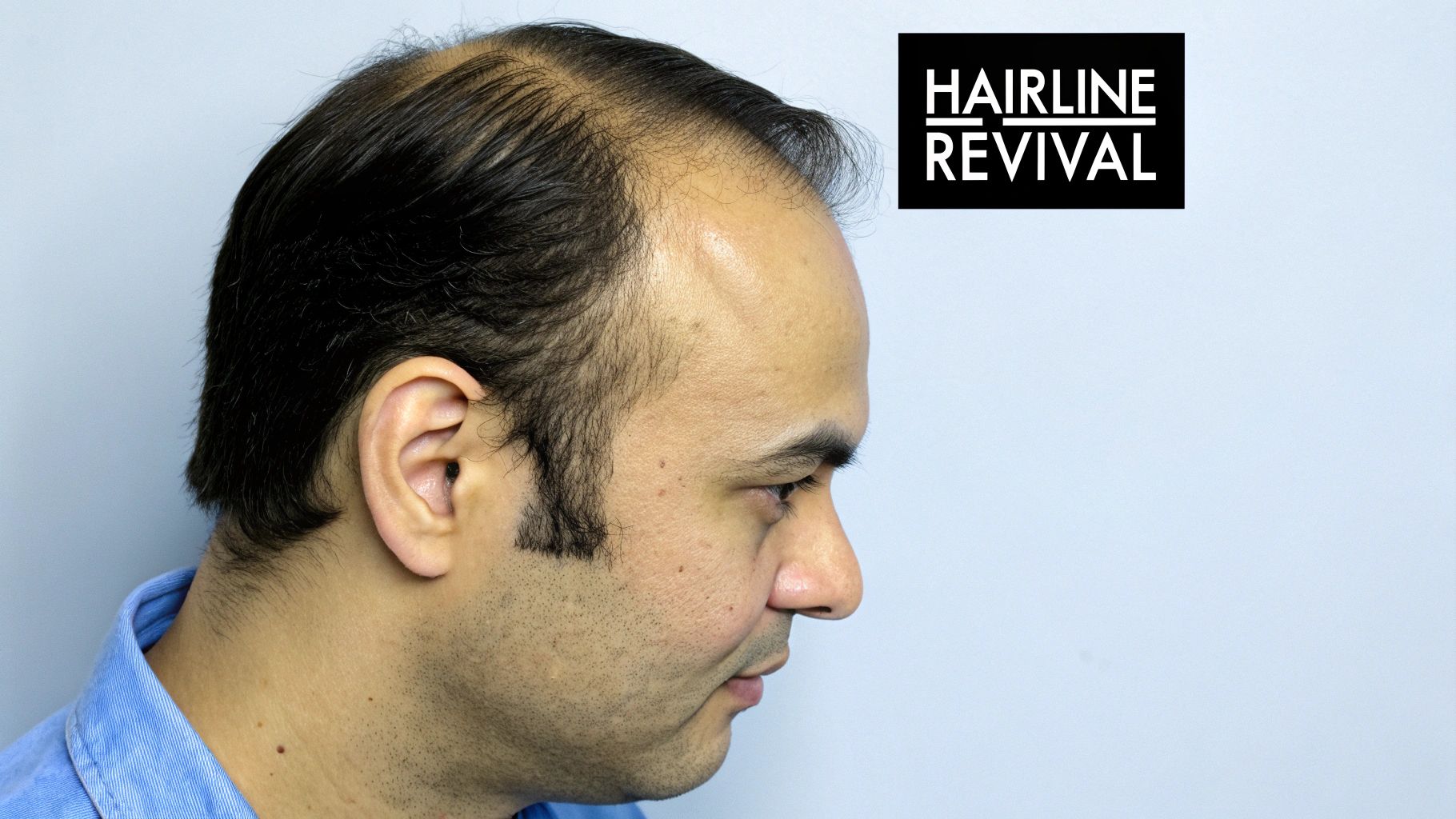
A receding hairline and thinning temples are often the first, and most dreaded, signs of male pattern hair loss, creating that classic "M" shape. This frontal area is famously hard to treat because the follicles there are extremely sensitive to the hormone DHT. Platelet-Rich Plasma (PRP) therapy offers a non-surgical way to fortify this critical area, aiming to slow down the recession and strengthen those vulnerable hairs. This case focuses on a younger man who decided to tackle his early-stage hairline recession head-on, which is the ideal time for PRP intervention.
Patient Profile & Initial Assessment
- Subject: Male, 29 years old.
- Condition: Androgenetic Alopecia (Male Pattern Baldness).
- Classification: Norwood Scale 2, showing a slight recession at the temples.
- Primary Concern: The patient was being proactive. He noticed his hairline was losing its sharp, youthful shape and wanted to stop the progression and thicken up the fine hairs at the temporal points before any major loss happened.
The Strategic Treatment Plan
For hairline restoration, the strategy has to be both precise and consistent. The patient's plan made early intervention a priority, aiming to protect and revive the follicles before they shut down completely. This is a huge factor in getting a positive prp hair loss before and after result in the frontal region.
The protocol involved an initial series of four PRP sessions, each scheduled one month apart. This was to be followed by a planned maintenance session every five months. The practitioner also suggested he incorporate at-home microneedling with a dermaroller between professional treatments to boost scalp circulation and help the PRP growth factors absorb better. This combined approach works to create a sustained, growth-friendly environment right along the hairline.
Strategic Insight: Think of the frontal hairline as a battlefield. Combining PRP with other synergistic therapies like microneedling or even DHT-blocking treatments (like finasteride) can create a powerful multi-pronged attack. PRP brings the growth factors, while other methods can tackle the underlying hormonal cause or improve the delivery mechanism.
Analysis of the "Before and After" Transformation
The results after the initial four sessions and one maintenance treatment (nine months in total) were very encouraging and really highlighted the value of taking action early.
- Before: The initial photos showed visible thinning right at the corners of his hairline. The hairs in the temporal regions were finer and lighter in color, a classic sign that miniaturization was in progress.
- After: The follow-up photos revealed a noticeable "softening" of the recession. While PRP rarely creates a brand-new, lower hairline out of thin air, it was very successful in thickening the existing miniaturized hairs. This led to a denser, stronger-looking hairline with less scalp showing at the temples. The overall look was of a hairline that had been fortified and strengthened.
This case shows that for people with early-stage recession, PRP can be a powerful tool to hold the line and seriously improve density. For more on tackling this common issue, you can learn more about fixing a receding hairline with advanced treatments here.
4. Post-Hair Transplant PRP Enhancement
A hair transplant is a major investment in getting your hairline back, but the final result all comes down to one critical thing: graft survival. This is where Platelet-Rich Plasma (PRP) therapy has become a true game-changer in modern hair restoration. Using PRP as a partner treatment alongside a transplant doesn't just support the process—it actively makes it better by improving the "take rate" of the grafts, speeding up healing, and boosting the final density.
Patient Profile & Initial Assessment
- Subject: Male, 38 years old.
- Condition: Androgenetic Alopecia (Male Pattern Baldness).
- Classification: Norwood Scale 5, with extensive hair loss on the frontal region and vertex, which called for a significant Follicular Unit Extraction (FUE) transplant.
- Primary Concern: The patient wanted to maximize the return on his surgical investment. His main goal was to get the highest possible survival rate for the transplanted grafts and achieve the densest result he could in the shortest amount of time.
The Strategic Treatment Plan
This case shows a synergistic approach, weaving PRP directly into the hair transplant protocol. The strategy was all about using PRP to create the perfect healing environment for the newly implanted follicles, giving them the best possible start for strong, healthy growth.
The plan had three key PRP applications: one session two weeks before the surgery to prep the scalp, a second application right during the FUE procedure where grafts were bathed in a PRP solution before being implanted, and a third session one month after the operation to stimulate healing and growth. This was followed up with maintenance sessions every six months. The phenomenal prp hair loss before after results really highlight the power of this combined method.
Strategic Insight: Integrating PRP with a hair transplant essentially turns the scalp into nutrient-rich "fertile ground" for the new grafts. The growth factors in PRP help reduce shock loss, minimize inflammation, and speed up the connection of the new follicles to the blood supply—which is absolutely crucial for their long-term survival and growth.
Analysis of the "Before and After" Transformation
The results at the 12-month mark, especially when compared to typical outcomes from a transplant alone, were exceptional.
- Before: The patient started with advanced balding across the top of his scalp, which needed a large number of grafts to get coverage.
- After: The "after" photos showed not just excellent coverage but truly remarkable density. The graft survival rate was estimated to be over 95%, which is significantly higher than the 80-90% average often seen without PRP. On top of that, the patient's recovery was faster, with less redness and scabbing, which let him get back to his social life sooner. The quality of the hair was also visibly healthier and thicker.
This integrated strategy proves that PRP is much more than just a standalone treatment; it’s a powerful amplifier for surgical hair restoration, making sure patients get the absolute most out of their procedure.
To get the best results, it's absolutely vital to follow all the post-treatment instructions from your clinic. You can learn more about post-treatment care on prpforhairloss.com to make sure you're supporting the healing process as effectively as possible.
5. Alopecia Areata Spot Treatment Recovery
Unlike androgenetic alopecia, which is a hormonal and genetic issue, alopecia areata is an autoimmune disease. This is where the body's own immune system gets confused and mistakenly attacks hair follicles, causing hair to fall out in small, often coin-sized, patches. While these patches can sometimes go away on their own, they can also be stubborn and distressing. PRP therapy offers a targeted approach, delivering growth factors directly to these affected spots to help calm the inflammatory response and coax the follicles back to life. Let's look at a case of an adult patient who had been struggling with several persistent patches.
Patient Profile & Initial Assessment
- Subject: Female, 34 years old.
- Condition: Alopecia Areata (Multiple Patches).
- Classification: The patient had three distinct, completely bald, circular patches on her scalp, ranging from the size of a quarter to a half-dollar. These patches had been there for over two years and hadn't responded to topical steroid treatments.
- Primary Concern: The patient felt a constant need to style her hair in specific ways to hide the bald spots. Her main goal was to get visible regrowth in these specific areas and hopefully prevent new patches from forming.
The Strategic Treatment Plan
For alopecia areata, the treatment strategy needs to be both targeted and consistent. The goal is to modulate the local immune response and give a powerful nudge for dormant follicles to re-enter the growth phase. This often calls for a more intensive approach than some other types of hair loss.
The patient’s plan involved an initial series of six PRP sessions, spaced just three weeks apart. This frequent application was designed to continuously supply the affected follicles with growth factors, aiming to interrupt the autoimmune attack and encourage regrowth. After this initial phase, a maintenance plan was set for one session every three months to keep the follicles healthy and monitor for any new trouble spots.
Strategic Insight: With autoimmune conditions like alopecia areata, consistency is king. The frequent initial sessions work to create a pro-growth environment that can override the inflammatory signals. It’s less about a single "kick-start" and more about providing sustained support to help the follicles win the battle against the immune attack.
Analysis of the "Before and After" Transformation
The patient’s prp hair loss before and after results were documented after the six-session initial phase, which took just over four months in total.
- Before: Clinical photos clearly showed three smooth, completely bald patches with no visible hair shafts. The skin wasn't scarred, but there was a total absence of follicular activity.
- After: The "after" photos showed incredible progress. Two of the three patches had achieved nearly 90% hair coverage, with fine, new hairs filling in the entire area. The largest patch showed about 70% regrowth, with significant new vellus (fine) and terminal (thicker) hairs.
This case really highlights PRP’s unique potential as a therapy for alopecia areata. By concentrating the body's natural healing mechanisms right at the site of the immune attack, PRP was able to stimulate regrowth where other treatments, like topical steroids, had failed. This offered a renewed sense of hope and normalcy for the patient.
6. Traction Alopecia Restoration from Tight Hairstyles
Unlike hormonal hair loss, traction alopecia is a mechanical type of hair loss. It's caused by chronic, prolonged tension on the hair follicles from things like tight braids, ponytails, weaves, or extensions. This constant pulling can lead to inflammation, scarring, and eventually, the permanent death of follicles, especially along the hairline and temples. PRP therapy offers a powerful restorative option, but only if the root cause—the tension—is dealt with first. Let's look at the case of a professional dancer whose career-required hairstyles led to significant traction alopecia.
Patient Profile & Initial Assessment
- Subject: Female, 28 years old.
- Condition: Traction Alopecia.
- Classification: Characterized by significant hairline recession and thinning at the temples, with visible inflammation and miniaturized "baby hairs."
- Primary Concern: The patient, a professional dancer, had to wear a severe, tight ponytail every day for performances and rehearsals. She noticed her hairline was creeping back and the hair at her temples was becoming alarmingly thin, which was affecting her confidence both on and off the stage.
The Strategic Treatment Plan
Success in treating traction alopecia really comes down to a two-part strategy: first, you have to eliminate the source of the tension, and second, you need to stimulate the follicles to recover. The patient's prp hair loss before and after results were completely dependent on this dual approach.
The treatment plan began with an absolute commitment from her to stop wearing the tight ponytails. She switched to looser styles for daily wear and used gentler techniques for performances. At the same time, she started a PRP regimen that involved four initial sessions, each spaced one month apart. This was designed to reduce inflammation and supply a concentrated dose of growth factors to damaged but still viable follicles. Her plan also included maintenance sessions every six months after that.
Strategic Insight: For traction alopecia, PRP isn't a standalone cure; it's a powerful recovery tool. The absolute first step has to be stopping the hairstyle that's causing the tension. Without this behavioral change, any gains you get from PRP will just be temporary and ultimately canceled out by the ongoing damage.
Analysis of the "Before and After" Transformation
After eight months, which included the first four PRP sessions and one maintenance treatment, the patient's hairline showed a truly remarkable recovery.
- Before: The initial photos documented a visibly receded hairline with sparse, fine hairs at the temples. Her scalp was noticeable, and the whole area looked stressed.
- After: The "after" photos revealed significant regrowth all along the hairline. The new hairs were thicker, darker, and much more robust. The temple areas, which were once nearly bare, had filled in, creating a softer, more natural-looking frame for her face. This really shows PRP's ability to heal inflamed tissue and wake up dormant follicles.
This case highlights that when you combine it with the crucial step of eliminating tension, PRP can effectively reverse the devastating effects of traction alopecia. By addressing the cause and supporting the recovery with targeted growth factors, patients can reclaim their hairline. For those looking for more information on this specific condition, you can learn more about traction alopecia restoration and the role PRP plays.
PRP Hair Loss Treatment Results Comparison
| Treatment Type | Implementation Complexity 🔄 | Resource Requirements ⚡ | Expected Outcomes 📊 | Ideal Use Cases 💡 | Key Advantages ⭐ |
|---|---|---|---|---|---|
| Male Pattern Baldness Crown Restoration | Moderate: 3-6 sessions over months | Moderate: PRP prep, outpatient setting | 20-30% hair density improvement after 3-4 months | Men with vertex thinning, Norwood scale 3-5 | Non-surgical, minimal downtime, autologous |
| Female Pattern Hair Loss Diffuse Thinning Recovery | Moderate: 4-6 initial + maintenance sessions | Moderate to high: repeated treatments | 30-50% density increase in early FPHL | Women with diffuse thinning, Ludwig scale 1-2 | Addresses hormonal causes, improves hair quality |
| Receding Hairline & Temporal Recession Improvement | Moderate: multiple sessions, micro-injection | Moderate: PRP with microneedling | Visible new growth in 4-8 months | Early male hairline recession, Norwood 1-3 | Less invasive than surgery, natural gradual improvement |
| Post-Hair Transplant PRP Enhancement | Low to Moderate: adjunct to surgery | High: requires surgical coordination | 15-20% better graft survival, faster healing | Post hair transplant patients | Improves graft survival, reduces swelling |
| Alopecia Areata Spot Treatment Recovery | Moderate: targeted injections | Moderate: multiple treatments | 60-80% regrowth in recent patches | Alopecia areata with patches < 2 years | Non-immunosuppressive, works where others fail |
| Traction Alopecia Restoration | Moderate: multiple sessions + lifestyle change | Moderate: ongoing treatments + counseling | Hairline/temple regrowth in 6-12 months | Hair loss from tight hairstyles, early scarring | Reverses early damage, culturally sensitive approach |
Your Next Steps: From 'Before' to Your 'After'
As we've journeyed through these six distinct case studies, one thing has become crystal clear: Platelet-Rich Plasma therapy isn't a one-size-fits-all fix, but a highly targeted, biological tool. The true power of PRP is in its strategic application. The "prp hair loss before after" transformations we've looked at really showcase this versatility, from tackling the hormonal march of male pattern baldness to healing the physical stress of traction alopecia.
The common thread that weaves through every success story is PRP's remarkable ability to kickstart the body's own healing and regenerative powers. It wakes up dormant follicles, improves blood flow, and delivers the essential growth factors needed for a healthier scalp environment. The 'before' photos we saw aren't just pictures of hair loss; they represent a specific starting point, a unique diagnostic puzzle. The 'after' photos are the exciting result of a dedicated, multi-faceted process.
Core Takeaways from the Transformations
The journey from 'before' to 'after' is built on several key pillars:
- Diagnosis is Paramount: Success always starts with accurately figuring out the root cause of your hair loss. Using PRP for androgenetic alopecia demands a different game plan than using it for alopecia areata.
- Consistency is Key: A single PRP session is almost never enough. As we saw in the examples, a carefully planned series of initial treatments followed by strategic maintenance sessions is what's needed to achieve and keep your results.
- Patience is a Virtue: Hair growth is a slow, cyclical process. Noticeable changes often take three to six months to really show up, with the best results becoming visible closer to the one-year mark. The most dramatic "prp hair loss before after" results come from those who stick with the plan.
- Combination Therapy Enhances Outcomes: PRP works exceptionally well on its own, but its effects can often be amplified when you combine it with other proven therapies like minoxidil, finasteride, or professional microneedling.
Charting Your Own Path to 'After'
If you see your own hair loss story reflected in these examples, your next step isn't just to hope for the same outcome, but to take informed, decisive action. The path to your own transformation starts with a professional consultation. An expert can properly diagnose your condition, check your scalp health, and determine if you're a strong candidate for PRP therapy.
Use the insights from this article to guide your conversation. Ask specific questions about the recommended treatment frequency, what you can realistically expect, and what other therapies might be helpful for you. For those looking to maximize their hair restoration efforts, understanding complementary treatments is key. Learn more about the differences between at-home and professional microneedling treatments, which are often paired with PRP for better scalp health and hair growth.
The value in seeing these "prp hair loss before after" examples is empowerment. You are now equipped with the knowledge to set realistic expectations and be an active participant in your own hair restoration journey. This isn't about chasing an overnight miracle; it's about committing to a proven medical process that leverages your body's own power to heal and regrow. The goal is a healthier, more confident you, and it all starts with that first, informed step.
Ready to write your own success story? At PRP For HairLoss, we specialize in connecting you with top-tier clinics that provide the advanced PRP treatments discussed in this article. Visit our website to find a qualified provider near you and begin your journey from 'before' to a remarkable 'after'.

 PRP For Hairloss
Leave a comment