Catching hair loss early can feel like trying to spot a specific raindrop in a storm. One day, your hair seems perfectly fine; the next, you’re noticing more strands in the sink and your hairline looks… well, different. This gradual process is a classic hallmark of male pattern baldness, or androgenetic alopecia. It doesn't announce its arrival with a trumpet blast; it creeps in with a series of small changes that are all too easy to dismiss or misinterpret.
This guide is here to cut through that confusion. I'm moving beyond generic advice and diving deep into the definitive first signs of male pattern baldness. Think of this as your personal field manual. For each of the seven key indicators, we'll break down exactly what to look for, from changes in your hairline and crown to shifts in hair texture you can literally feel between your fingers.
More importantly, this listicle gives you a clear roadmap. I’ll show you how to recognize each sign in the real world and outline practical, actionable steps you can take. Understanding these early warnings is the first, most crucial step. It empowers you to move past the anxiety of the unknown and build a proactive plan for managing your hair's future.
1. Receding Hairline (Temporal Recession)
When people think of male pattern baldness, the first image that usually pops into their head is a receding hairline. This classic sign, medically known as temporal recession, is probably the most common and recognizable indicator of androgenetic alopecia. It all starts when the hair follicles at your temples and along your forehead become overly sensitive to a hormone called dihydrotestosterone (DHT). This sensitivity causes the follicles to shrink, or "miniaturize," producing finer, shorter hairs until they eventually just give up producing hair altogether.
This process is typically gradual, unfolding over months or even years. It begins with a subtle thinning at the corners of your forehead, slowly carving out that distinctive 'M' or 'V' shape. Think of public figures like Prince William or actor Jude Law; their hairlines have visibly changed over time, giving us a clear real-world example of this progression. Spotting this change early is a vital first step in getting a handle on hair loss.
Recognizing and Tracking a Receding Hairline
The key to identifying a receding hairline is consistent observation. Because the change is so slow, you might not notice it day-to-day.
- Take Progress Photos: Use your phone to snap a photo of your hairline once a month. Make sure you stand in the same spot with the same lighting and pull your hair back. This creates a visual timeline that makes even subtle recession hard to deny.
- The Forehead Measurement: A more hands-on method involves measuring the distance between your eyebrows and the center of your hairline. If this measurement consistently increases over several months, it’s a strong sign of recession.
Key Insight: A mature hairline is a natural part of aging for most men and involves a slight, even recession. However, a rapidly changing or uneven hairline that creates a pronounced 'M' shape is one of the definitive first signs of male pattern baldness.
When to Take Action
If your tracking confirms that your hairline is actively pulling back, it’s time to talk to a professional. A dermatologist or a hair loss specialist can officially diagnose androgenetic alopecia and discuss a personalized treatment plan. Early intervention is critical for keeping the hair you still have. Options like topical minoxidil (Rogaine) can stimulate follicles, while oral finasteride can lower DHT levels, directly tackling the hormonal cause. For those looking for more advanced, non-surgical solutions, Platelet-Rich Plasma (PRP) therapy uses your own blood platelets to stimulate dormant hair follicles and encourage new growth in thinning areas like the temples.
To help you quickly identify the core characteristics of temporal recession, this summary box highlights the key signs.
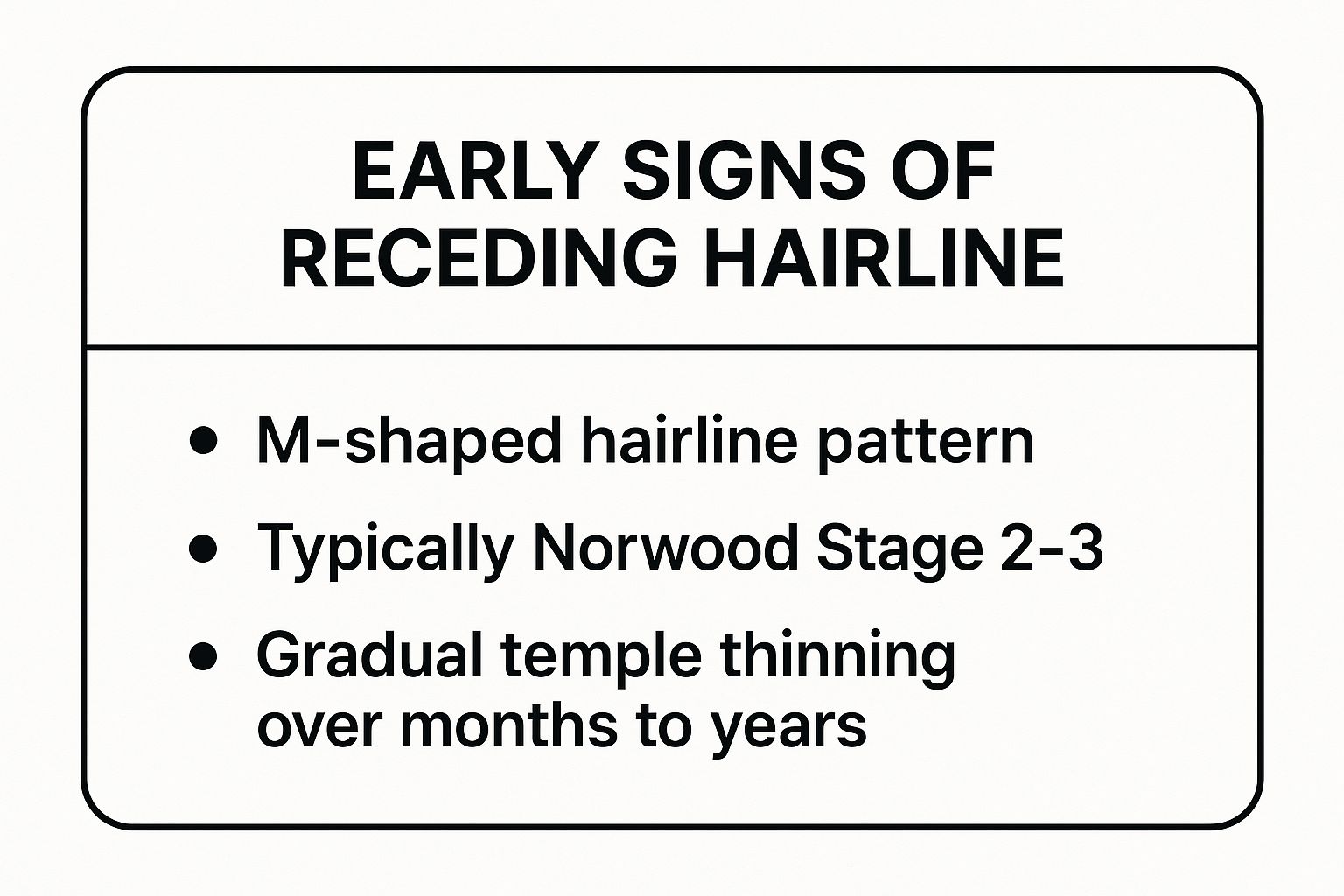
As the visualization shows, the gradual thinning at the temples that creates an 'M' shape is the defining feature, often marking the transition into the early stages (Norwood 2-3) of male pattern baldness.
2. Crown Thinning (Vertex Baldness)
While a receding hairline gets all the attention, hair loss that starts at the back of the head is an equally common sign of male pattern baldness. This is known as crown thinning or vertex baldness. It often starts as a subtle, circular patch of thinning hair right at the top, or vertex, of your scalp. Since it’s out of your direct line of sight, this kind of thinning can progress quite a bit before you even realize it’s happening.
Just like with temporal recession, the underlying cause is the hormone DHT shrinking hair follicles. But in this case, the follicles at the crown are the ones taking the hit. It can develop at the same time as a receding hairline or completely on its own. For many guys, the first clue comes from an unexpected source—a candid photo, a reflection in a store window, or a comment from their barber, who often has the best view of the top of your head.
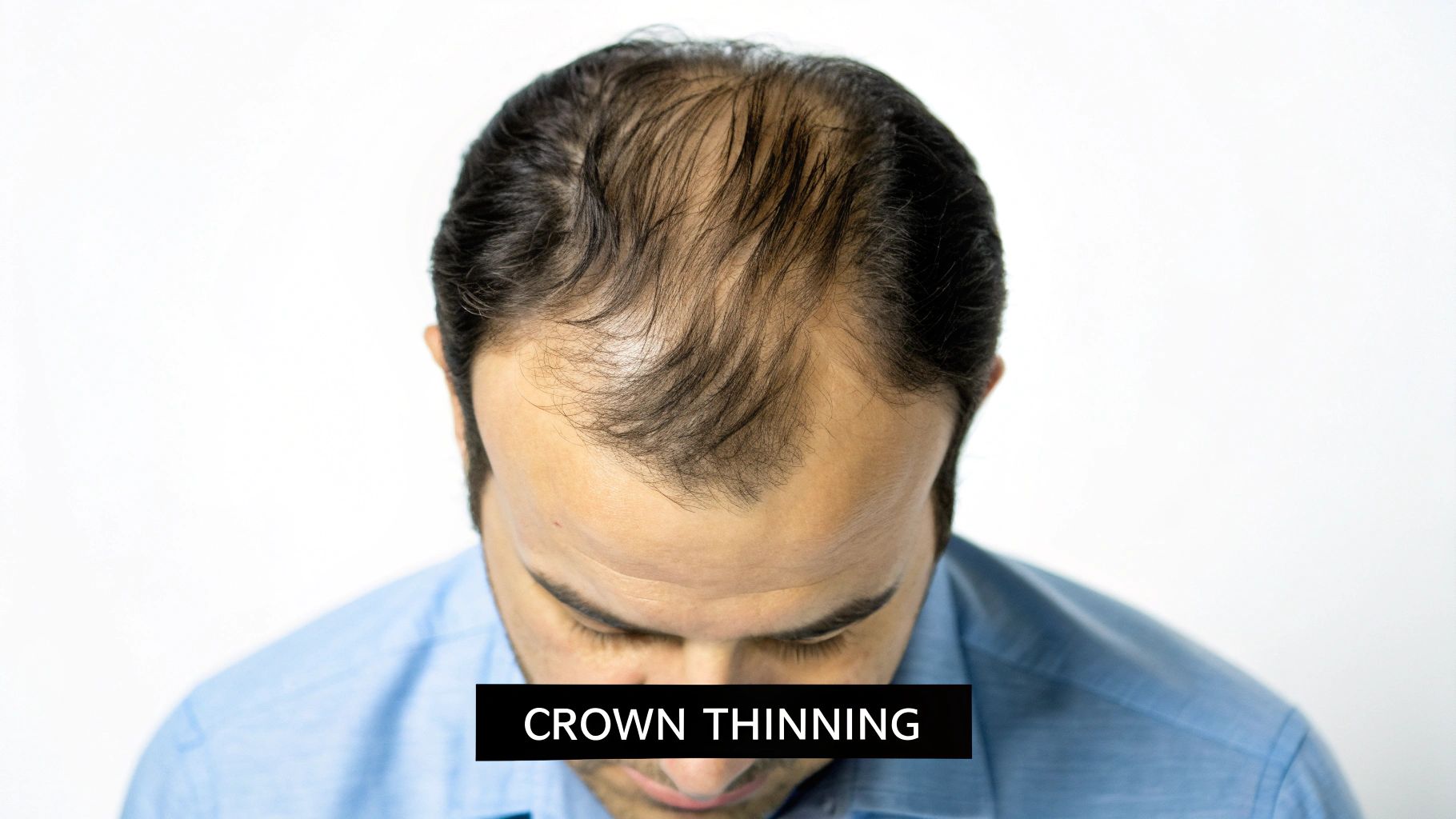
Recognizing and Tracking Crown Thinning
Figuring out if your crown is thinning requires a proactive approach, since you can't just see it in the mirror. Consistency is your best friend for catching it early.
- Use a Hand Mirror: Once a month, stand with your back to your bathroom mirror and use a handheld mirror to inspect your crown. This two-mirror trick gives you a clear view of what's going on.
- Ask for Help: Don't be afraid to ask a trusted partner, a friend, or your barber to check the area for you. Just ask, "Does it look any thinner up there?" Their unbiased opinion can be invaluable.
- Take Overhead Photos: The most reliable method is to take monthly photos. Stand under the same light source and have someone take a picture directly from above, or just prop up your phone's camera on a timer. Comparing these photos over time will reveal any slow expansion of the thinning area.
Key Insight: Crown thinning often feels more sudden than a receding hairline because it happens "behind your back." Many men report feeling that their bald spot appeared overnight, but it’s almost always a slow, progressive process that simply went unnoticed.
When to Take Action
If your tracking confirms a developing bald spot on your crown, it's a clear sign that androgenetic alopecia is at play. The sooner you talk to a professional, the better your chances are of stopping the progression and maybe even regrowing some hair. A dermatologist can confirm the diagnosis and rule out other, less common causes of hair loss.
Early intervention with topical minoxidil (Rogaine) is particularly effective for the vertex, as it can help revitalize dormant follicles there. For a more direct approach, Platelet-Rich Plasma (PRP) therapy is an excellent non-surgical option. By injecting a concentrate of your own platelets into the scalp, PRP can stimulate blood flow and cellular repair, waking up sluggish follicles to promote new growth and boost hair density in the thinning crown.
As this video explains, managing vertex balding involves understanding the unique challenges and treatment responses of this area. Combining proven therapies is often the most effective strategy for preserving and restoring hair on the crown.
3. Increased Hair Shedding
While a receding hairline or a thinning crown are visual markers, one of the earliest and often overlooked first signs of male pattern baldness is a noticeable increase in hair shedding. It’s totally normal to lose between 50 and 100 hairs a day as part of the natural hair growth cycle. But when androgenetic alopecia kicks in, the hormone DHT shortens the growth (anagen) phase of your hair follicles, pushing more hairs into the resting (telogen) phase way too early. This leads to an uptick in daily hair fall, often long before any bald spots become obvious.
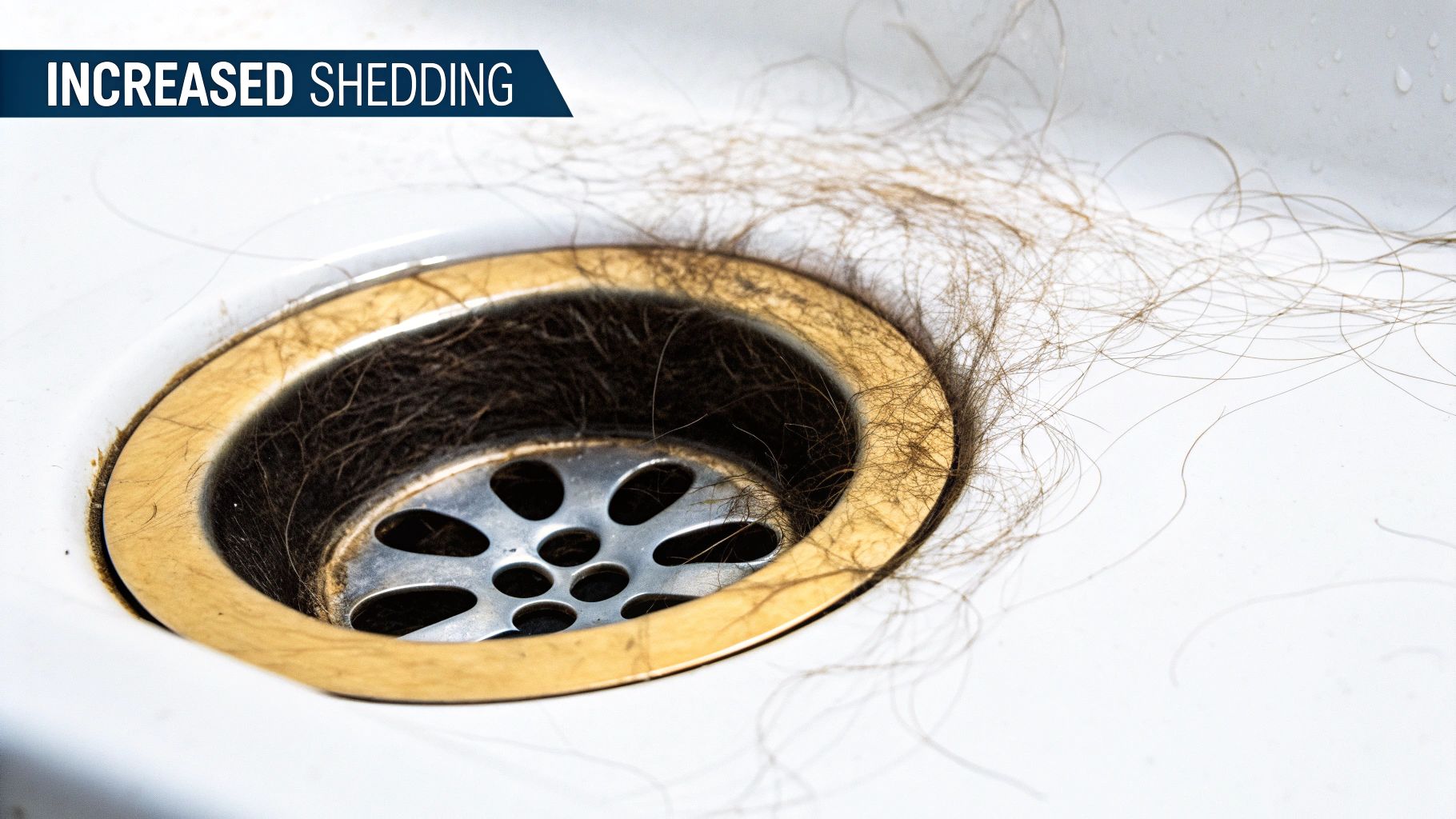
This increased shedding can show up in subtle but persistent ways. You might start noticing more hair than usual clogging the shower drain. Maybe your partner mentions finding more stray hairs on pillows and furniture, or you find yourself constantly picking hairs off your clothes. Even your barber might comment on seeing more hair fall during a haircut. These aren't just isolated incidents; they're signs that your hair follicles are starting to react to DHT—a crucial early warning.
Recognizing and Tracking Increased Shedding
Because shedding can fluctuate, you need to track it consistently to figure out if what you're seeing is a true sign of male pattern baldness or just a temporary phase.
- The Pillow Test: Place a light-colored towel or pillowcase on your pillow. In the morning, count the number of hairs you find. If you're consistently finding more than 10-15 hairs, that can indicate excessive shedding.
- Shower Drain Count: After you shower, collect the hair from the drain and count it. Do this for a week to get an average. A sustained number that's well above your baseline is a red flag.
- Keep a Hair Diary: Make a quick note each day about the amount of hair you notice you're losing. This log helps distinguish between normal fluctuations, seasonal shedding (which is common in the fall), and the persistent increase that comes with androgenetic alopecia.
Key Insight: Increased shedding is the engine that drives the visible changes of hair loss. It’s the process that leads to a receding hairline and a thinning crown. Paying attention to how much hair you’re losing daily gives you an early chance to intervene before the structural changes become significant.
When to Take Action
If your tracking confirms a consistent and significant increase in hair shedding for more than a couple of months, it's a strong signal to seek professional advice. A dermatologist can do tests, like a hair pull test, to quantify the shedding and confirm a diagnosis of male pattern baldness. Getting ahead of the problem at this stage is highly effective. Treatments like oral finasteride work by reducing the DHT that causes this accelerated shedding, while topical minoxidil can help extend the growth phase of your hair follicles. For a more targeted approach, Platelet-Rich Plasma (PRP) therapy can be particularly helpful, as it directly nourishes the scalp and follicles with growth factors, helping to counteract the miniaturization process and reduce excessive shedding.
4. Hair Texture Changes and Miniaturization
While changes to your hairline grab your attention, one of the more subtle yet definitive first signs of male pattern baldness happens to the hairs themselves. This process, known as follicular miniaturization, is the real mechanism behind androgenetic alopecia. It happens when hair follicles that are sensitive to dihydrotestosterone (DHT) start to shrink. As a follicle gets smaller, the hair it produces becomes progressively finer, shorter, and often lighter in color, eventually becoming so wispy it’s barely visible.
This change in texture is more of a gradual degradation than a sudden loss. The strong, thick terminal hairs you're used to are replaced by thin, vellus-like hairs, a lot like the "peach fuzz" you have elsewhere on your body. This is why you might notice your hair feels less dense or looks "see-through" under bright lights, even if the total number of hairs hasn't changed dramatically yet. The hair just becomes weaker, more prone to breaking, and loses its old volume and life.
Recognizing and Tracking Hair Miniaturization
Identifying miniaturization means you have to pay close attention to the quality, not just the quantity, of your hair. Since it's a slow transition, comparing it over time is key.
- The Touch Test: Run your fingers through different parts of your scalp. Do the hairs at your temples or on your crown feel noticeably softer, finer, or more brittle than the hair at the back or sides of your head? This difference in texture is a classic sign.
- Compare Shed Hairs: When you find hairs on your pillow or in the shower, don't just toss them. Collect a few and compare how thick they are. If you see a mix of thick, healthy hairs alongside very fine, almost translucent ones, it’s a strong indicator that miniaturization is happening.
- Examine Old Photos: Look at high-resolution photos from a few years back. Pay attention to the thickness and color of your hair in the areas you now think are thinning. A visible loss of richness and pigment is often because of this process.
Key Insight: Male pattern baldness isn't just about hair falling out; it's about hair being replaced by weaker, thinner versions of itself. This change in texture is a direct result of DHT's effect on your follicles and is a clear, early warning sign.
When to Take Action
If you can confirm that your hair's texture is changing and getting finer in specific patterns (like the hairline or crown), it's a crucial time to get professional advice. A dermatologist can use a special magnifying tool called a dermatoscope to look at your scalp and see the miniaturized hairs directly, giving you a solid diagnosis of androgenetic alopecia. Acting at this stage is vital because the follicles are still producing hair, even if it's weak. Treatments like topical minoxidil can help reinvigorate these follicles, while oral finasteride works to lower the DHT levels causing the shrinkage. For a more direct approach, Platelet-Rich Plasma (PRP) therapy can be particularly effective. It uses growth factors from your own blood to counteract miniaturization, helping to thicken existing fine hairs and support healthier, more robust growth cycles.
5. Scalp Visibility and Reduced Hair Density
While a receding hairline or a thinning crown are dramatic signs, one of the most insidious first signs of male pattern baldness is a gradual drop in overall hair density. This isn't about a specific bald spot but rather a widespread thinning that makes your scalp more visible, especially under certain conditions. The change is so subtle that you might brush it off at first, only noticing it when your hair is wet or under the harsh overhead lights of an office or bathroom.
This loss of density is a direct result of hair follicle miniaturization happening all over the scalp. As DHT shrinks the follicles, the hair shafts they produce get finer and shorter. Over time, you have the same number of follicles, but the hair they grow provides a lot less coverage. This is why a camera flash can suddenly reveal a shiny scalp you didn't know was there, or why your hair looks so much thinner after a swim. It’s this slow decline in volume that catches so many men by surprise.
Recognizing and Tracking Reduced Hair Density
Identifying a decrease in density means you need to pay attention to how your hair looks and feels in different situations. It’s less about lines and shapes and more about overall fullness.
- The Lighting Test: Make a point to check your hair in different kinds of light. Stand under a bright bathroom light or go outside on a sunny day. If you can see a lot more scalp than you used to, it's a clear sign of thinning.
- The Wet Hair Check: After a shower, look at your hair in the mirror while it's still wet. Water clumps hairs together, temporarily getting rid of their volume and showing your true density. If large areas of scalp are showing, it points to reduced coverage.
- Flash Photography: Take a photo of the top of your head with your phone's flash on. The direct, bright light will cut through the hair and expose any areas where density has faded, often creating a reflective sheen on the scalp.
Key Insight: Reduced hair density is often the true "first sign" of male pattern baldness, coming before any noticeable recession or crown thinning. It represents a widespread weakening of follicles, not just a localized loss, making early detection vital for keeping your overall volume.
When to Take Action
If you confirm that your hair is losing its density, the time to act is now. This widespread thinning is a classic sign of androgenetic alopecia, and tackling it early can protect thousands of follicles from shrinking further. A consultation with a dermatologist is the best first step for an accurate diagnosis and to rule out other potential causes of hair loss.
For treating diffuse thinning, a multi-pronged approach is often the most effective. Topical minoxidil can help reinvigorate weakened follicles all over the scalp, while oral finasteride works systemically to lower DHT. For those looking for a treatment that directly targets follicle health and density, Platelet-Rich Plasma (PRP) therapy is an excellent choice. By injecting a concentration of your own growth factors into the scalp, PRP can help reverse miniaturization, improve the thickness of existing hair shafts, and stimulate dormant follicles, leading to a visible increase in overall density and coverage.
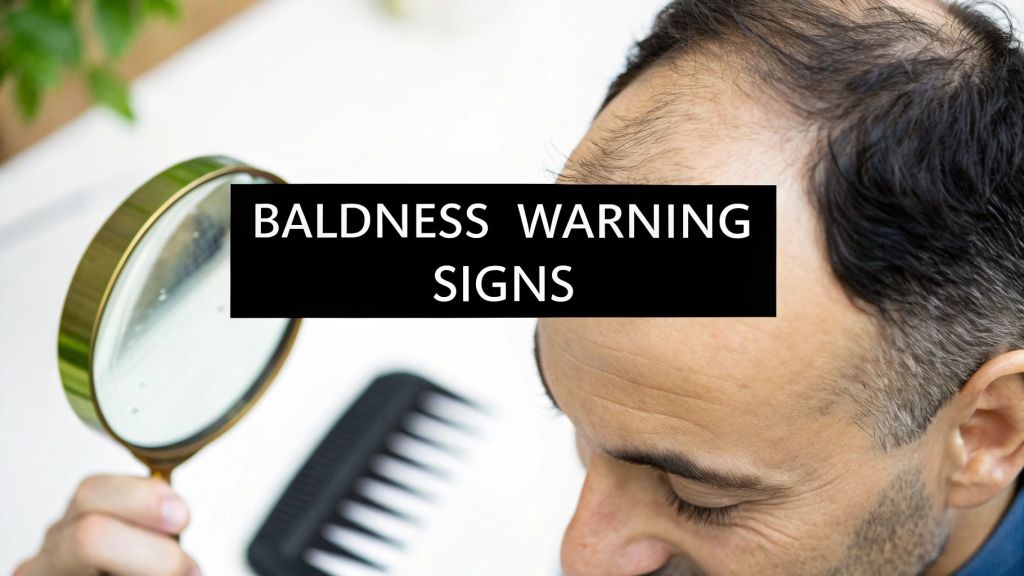
6. Widening Hair Part
While a receding hairline gets most of the press, a widening part is an equally significant and often overlooked early sign of male pattern baldness. This sign shows up as a gradual decrease in hair density right along the line where you naturally part your hair. The hair follicles in this area, just like the ones at the temples and crown, start to miniaturize under the influence of DHT. This causes the hair to thin out and the scalp to become more visible.
This change is often subtle and can easily be chalked up to a "bad hair day" or a new haircut. You might find it harder to style your hair, or your hairstylist might be the first one to point it out. What used to be a tight, clean line can slowly become a broader, more diffused path, revealing more scalp than before. This is a classic sign of diffuse thinning, a common pattern of androgenetic alopecia.
Recognizing and Tracking a Widening Part
Since this sign develops slowly, objective tracking is the best way to confirm what you suspect. It takes a little consistency, but the clarity you get is invaluable.
- Monthly Part Photos: Stand under the same direct light source each month and take a picture looking down at your part. This creates an undeniable visual record of any changes in width and density.
- The Ruler Test: Carefully place a small ruler across the widest point of your part and write down the measurement. Tracking this number monthly can reveal a slow but steady increase—one of the clearest first signs of male pattern baldness.
- Styling Difficulties: Pay attention to how your hair behaves. If you suddenly find it impossible to keep your usual hairstyle because your part won’t stay put or looks flat, it’s often because of reduced hair density in that area.
Key Insight: A widening part isn't just about how your hair falls; it’s a direct visual measurement of decreasing hair density. Unlike general thinning which can be hard to quantify, a widening part provides a clear, measurable line that exposes the progression of hair loss.
When to Take Action
If your photos and measurements confirm that your part is widening, this is a clear signal to get professional advice. A consultation with a hair loss specialist or dermatologist can give you a formal diagnosis and lay out your options. Early intervention is the best strategy for managing hair loss and preserving density along your part line. Treatments like topical minoxidil can help reinvigorate the follicles in the area. For a more targeted approach, non-surgical therapies like Platelet-Rich Plasma (PRP) can be particularly effective. PRP uses growth factors from your own blood to stimulate dormant follicles, helping to increase hair thickness and density directly along the part, making it a powerful tool for reversing this specific sign.
7. Family History Manifestation
While it's not a physical symptom you can see in the mirror today, looking at your family tree is one of the most powerful predictive tools for understanding your own potential hair loss journey. Androgenetic alopecia is, as its name suggests, primarily genetic. This sign involves recognizing that your hair loss is starting to follow the patterns and timelines of your male relatives, confirming that your genetic predisposition is now becoming a reality.
The genes responsible for male pattern baldness can be inherited from either side of your family, debunking the old myth that it only comes from your mother's side. If your father, grandfather, older brothers, or uncles on your mom's side experienced significant thinning or a receding hairline, your chances of following a similar path go up dramatically. For example, you might notice your hairline starting to recede around the same age your father's did, or the thinning on your crown might mimic your maternal grandfather's pattern. This genetic roadmap is a crucial, though indirect, first sign of male pattern baldness.
Recognizing and Tracking Family Patterns
Identifying your genetic risk takes a bit of detective work, but it provides priceless insight into what you might be in for.
- Study Old Family Photos: Look at pictures of your father, grandfathers, and uncles from when they were in their 20s, 30s, and 40s. Compare their hairlines and hair density to where you are now. This visual comparison can reveal some surprisingly similar progression patterns.
- Have an Open Conversation: Ask your male relatives directly about their hair loss. Good questions to ask are: At what age did you first notice thinning? Did it start at the temples or the crown? How quickly did it progress? This firsthand information is more reliable than just looking at photos.
Key Insight: Your family's hair loss history isn't a guarantee, but it is the strongest predictor we have for your own susceptibility to androgenetic alopecia. If a strong pattern of baldness runs in your family, proactive monitoring becomes essential.
When to Take Action
If you have a strong family history of hair loss and you're starting to notice even the slightest changes in your own hair, this is the perfect time for a preventive consultation. You don't need to wait for significant loss to happen. Talking with a dermatologist or a hair loss expert lets you get ahead of the curve. They can assess your current hair status and discuss preventive strategies based on your high genetic risk.
Proactive treatments like oral finasteride can be particularly effective in these early stages by blocking the DHT that your follicles are genetically programmed to be sensitive to. For those who want a non-drug-based approach to fortify their hair against what might feel like a genetic inevitability, Platelet-Rich Plasma (PRP) therapy can be a powerful preventive measure. By stimulating and nourishing follicles, PRP helps strengthen existing hair and can delay the onset or slow the progression of genetically driven hair loss.
First Signs of Male Pattern Baldness: 7-Point Comparison
| Sign/Indicator | Implementation Complexity 🔄 | Resource Requirements ⚡ | Expected Outcomes 📊 | Ideal Use Cases 💡 | Key Advantages ⭐ |
|---|---|---|---|---|---|
| Receding Hairline (Temporal Recession) | Moderate – requires regular tracking & dermatologist consult | Low – photo documentation, possible meds | Gradual hairline recession, visible M-shape | Early detection of male pattern baldness | Easily recognizable, allows early intervention |
| Crown Thinning (Vertex Baldness) | Moderate to High – needs external observation & photo checks | Moderate – mirrors, photos, topical treatments | Circular thinning at crown, may join frontal loss | Monitoring less visible balding areas | Less visible, responds well to treatment |
| Increased Hair Shedding | Low – simple home monitoring via observation | Minimal – counting hairs, diary | Early sign preceding visible thinning | Very early detection before obvious thinning | Easiest to detect early, reversible if treated |
| Hair Texture Changes and Miniaturization | Moderate – requires careful comparison & tactile monitoring | Low to Moderate – photo comparison, hair sampling | Thinner, lighter, fragile hair over years | Tracking progression before visible loss | Detectable before hair loss, guides focused treatment |
| Scalp Visibility and Reduced Hair Density | Low to Moderate – photography under various light conditions | Low – photography, lighting | Scalp increasingly visible, wider partings | Early to mid-stage thinning detection | Noticeable early, helps treatment planning |
| Widening Hair Part | Low – simple monthly measurement & photos | Minimal – ruler, camera | Wider parting line, styling difficulties | Detecting diffuse thinning in frontal scalp | Easily self-monitored, early diffuse thinning sign |
| Family History Manifestation | Low – research on family patterns, no physical procedure | Minimal – family history gathering | Predicts likelihood, onset, and progression | Genetic risk assessment and early planning | Enables predictive monitoring and realistic expectations |
From Signs to Solutions: What Are Your Next Steps?
Recognizing the first signs of male pattern baldness is more than just noticing something new; it's the critical first step toward taking control of your hair's future. Throughout this guide, we've moved beyond vague ideas about hair loss and gotten into specific, identifiable markers. You now have a practical toolkit to tell the difference between normal shedding and the start of androgenetic alopecia.
From noticing a subtle M-shape forming at your temples to feeling a change in your hair's texture, each sign is a piece of the puzzle. You're no longer just guessing. You can now confidently assess your hairline, check your crown in the mirror, and even understand why your family photos might hold clues to your own genetic destiny. This knowledge turns you from a passive worrier into an active participant in your own hair health journey.
Turning Knowledge into Actionable Strategy
The most important takeaway is not to panic, but to act. The effectiveness of any treatment, from topical creams to advanced therapies, is almost always better when you start early. Waiting until hair loss is advanced really narrows your options and can make getting the results you want much more challenging. Acting now, when you first spot these signs, puts you in the driver's seat.
So, what are your immediate, actionable next steps?
- Document Your Starting Point: Take clear, well-lit photos of your hairline, crown, and overall hair density today. This creates an objective baseline that you and a specialist can use to track changes over time.
- Schedule a Professional Consultation: Self-diagnosis is a great start, but getting a real diagnosis is essential. Book an appointment with a dermatologist or a hair restoration specialist. They can confirm if what you're seeing are indeed the first signs of male pattern baldness and rule out other potential causes.
- Discuss Your Goals and Options: During your consultation, be ready to talk about what you hope to achieve. This is your chance to learn about the full spectrum of proven treatments, including FDA-approved options like finasteride and minoxidil, as well as innovative, non-surgical approaches.
Embracing Modern Solutions Like PRP
One of the most promising modern treatments, especially for those in the early stages, is Platelet-Rich Plasma (PRP) therapy. PRP harnesses the powerful healing and growth factors found right in your own blood. By concentrating these platelets and injecting them into the scalp, PRP therapy can help reawaken dormant hair follicles, improve hair thickness, and increase overall hair density.
Key Insight: PRP therapy isn't about creating new follicles, but about revitalizing existing ones that have been weakened by the miniaturization process. This is why it is particularly effective when started at the first signs of thinning.
Ultimately, identifying the early signals of hair loss is empowering. It gives you a crucial window of opportunity to make informed, proactive decisions. You have the knowledge to see the signs and the tools to chart a course forward. Don't let uncertainty dictate your path; let decisive action shape your future.
Ready to explore a scientifically-backed solution tailored to combat the first signs of male pattern baldness? Discover how PRP For HairLoss uses your body's own regenerative power to help you regain hair density and confidence. Learn more about our advanced PRP treatments and schedule your consultation by visiting PRP For HairLoss today.
 PRP For Hairloss
Leave a comment