Let's be honest—the first hints of male pattern baldness are rarely dramatic. They're subtle, almost sneaky. You might notice your hairline seems a bit higher at the temples, or maybe you catch a glimpse of more scalp than you're used to seeing at the crown. It often starts with a general feeling that your hair just isn't as full as it used to be. Spotting these early clues is the crucial first step toward taking control of your hair's future.
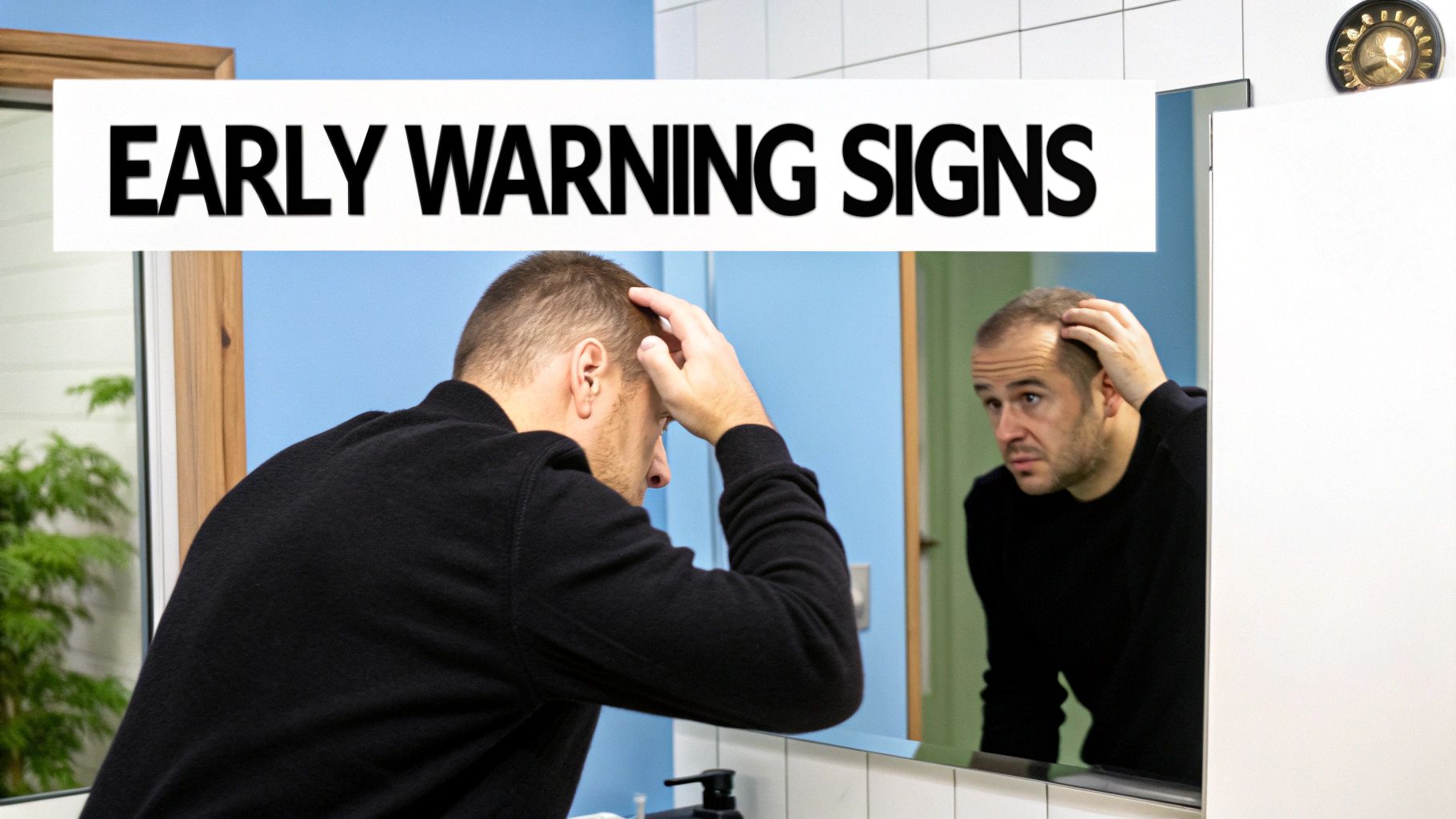
Spotting the First Clues of Hair Thinning
Trying to pinpoint the start of male pattern baldness can feel a bit like trying to notice a shoreline receding during low tide. The change is so gradual that it's easy to second-guess yourself or brush it off. But being aware of what to look for isn't about causing panic; it's about being proactive.
This process can kick off much sooner than most guys think. While we often picture hair loss as a middle-aged concern, research shows that around 20% of men notice significant thinning while still in their 20s. We're not talking about a few extra hairs on your brush. This is about observing a consistent pattern developing over several months.
The Most Common Early Indicators
The beginning stages of androgenetic alopecia (the clinical term for male pattern baldness) don't happen overnight. It’s a slow burn. The changes are progressive, and once you know the signs, they're much easier to track.
For a quick reference, here are the key things to look out for.
Key Early Indicators of Male Pattern Baldness
| Sign | Common Location | What to Look For |
|---|---|---|
| Receding Hairline | Temples & Forehead | The hairline starts moving back, often creating a more defined "M" shape. |
| Crown Thinning | Top/Back of Head (Vertex) | A circular area of thinning hair that can be hard to spot yourself. |
| Lower Hair Density | All Over | Your part looks wider, or you can see more scalp, especially under direct light. |
| Longer Shedding Periods | Shower, Pillow, Brush | Noticing more hair shedding than usual for an extended period of time. |
These signs are the most common starting points. Let's dig a little deeper into what they actually look like.
H3: A Closer Look at the Signs
The "classic" sign most people recognize is a changing hairline. You'll typically see the hair around your temples start to thin out and recede, which slowly carves out that M-shaped pattern.
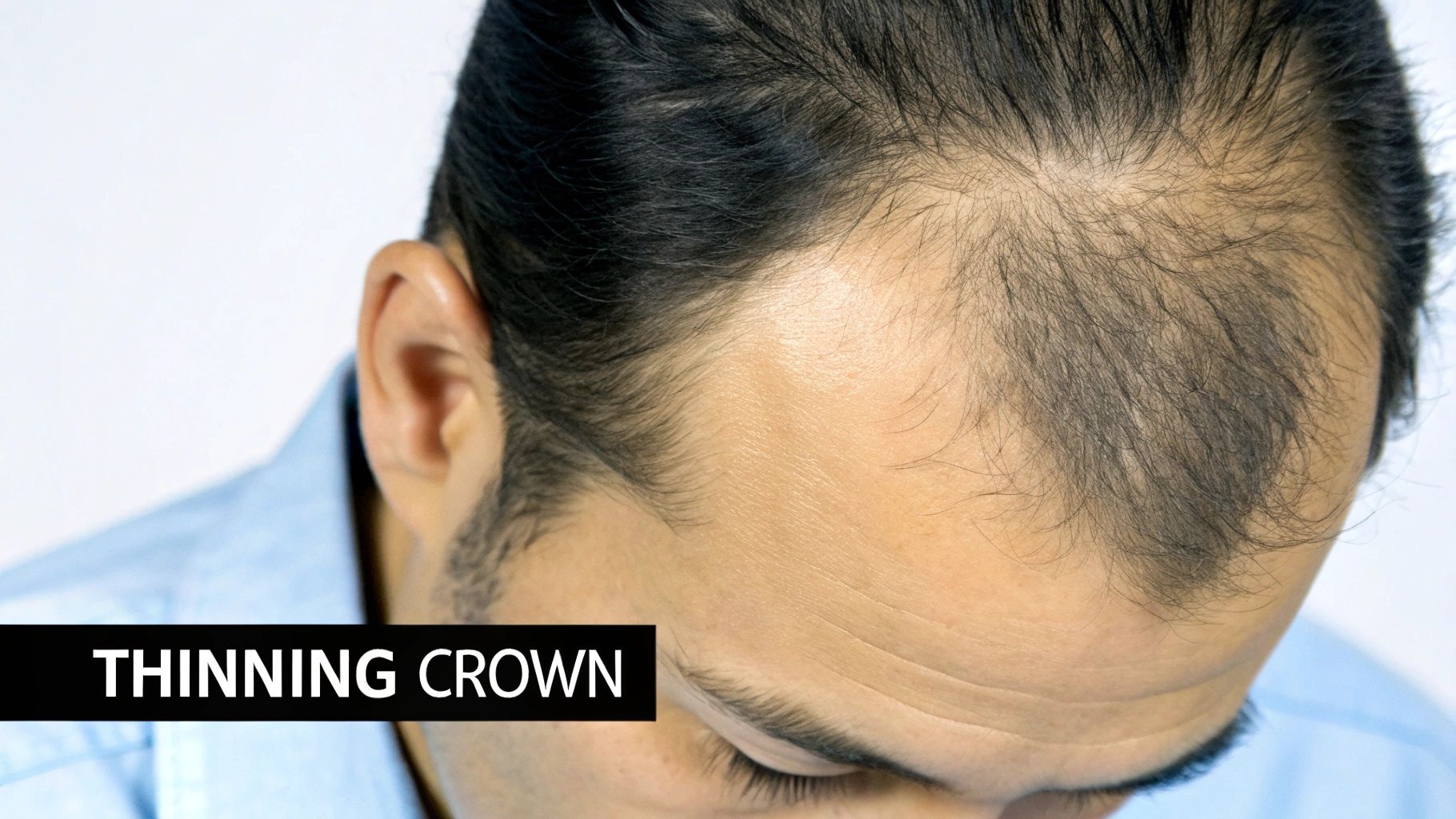
Another major hotspot is the crown, or the vertex at the top-back of your head. Because it's out of your direct line of sight, this thinning can progress quite a bit before you even notice it. Often, a friend or family member is the first to point it out, or you might spot it in a photograph.
Finally, there's an overall decrease in hair density. This one is less about a specific pattern and more about a general feeling. Your hair might just feel lighter or less substantial. When you part your hair, the line might appear wider and more scalp is visible. This loss of volume is a tell-tale sign that follicles are beginning to shrink.
Pro Tip: Your best tool for tracking these changes is your phone's camera. A single photo doesn't tell you much, but comparing pictures taken three to six months apart will give you an objective look at what's really going on. It cuts through the guesswork.
Recognizing any of this isn't a reason to despair. Quite the opposite, actually. It's the first and most powerful step you can take. It moves you from a place of worry and uncertainty into a position of knowledge, empowering you to explore effective solutions like PRP therapy for hair loss and make confident decisions for your health.
The Real Reasons Your Hair Is Thinning
To figure out why you might be seeing those first signs of male pattern baldness, you have to look past the mirror and get into your own biology. This isn't a random process; it's a predictable story written mostly by your genes and hormones. The main character in this story is a powerful hormone called Dihydrotestosterone (DHT).
Think of your hair follicles as tiny factories that produce hair. If you have a genetic tendency for baldness, these factories have a specific weakness. DHT acts like a key that fits perfectly into the receptors of these sensitive follicles. Once it binds to them, it kicks off a process called miniaturization.
This image breaks down how your genetic predisposition, sensitivity to DHT, and the hair thinning you see are all connected.
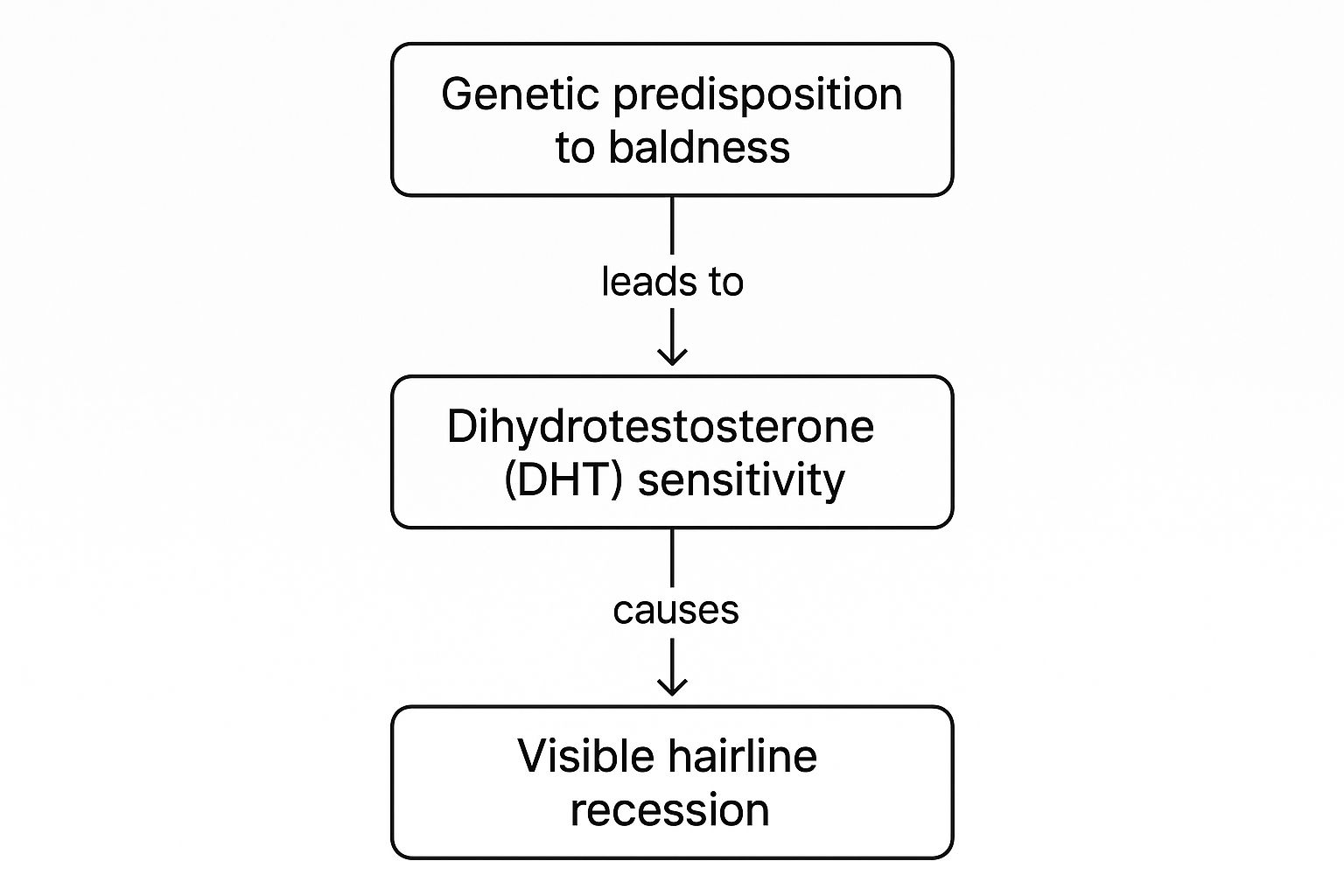
As you can see, your genes create the underlying sensitivity. This allows DHT to shrink the follicles, which leads directly to the hair loss you notice. It's a classic chain reaction.
The Science of Shrinking Follicles
Miniaturization is a slow-motion process. It doesn't happen all at once. Instead, with each new hair growth cycle, DHT gradually signals the follicle to get smaller and smaller. Every new hair that grows from that follicle is a little finer, shorter, and weaker than the one before it. It’s like watching a mighty oak tree get replaced by a tiny, fragile sapling in the very same spot.
Eventually, the follicle shrinks so much that it can no longer produce a visible hair at all. This is what creates the thinning patches and receding hairlines we associate with male pattern baldness. That genetic sensitivity is precisely why some men experience significant hair loss in their 20s while their friends don't. And it's more common than you might think.
According to data from the International Society of Hair Restoration Surgery, about 20 percent of men start to see noticeable hair loss in their 20s. That number jumps to 30 percent for men in their 30s, which really shows how progressive this condition is.
Are There Other Factors?
While genetics and DHT are definitely the main culprits, other things can accelerate the process. Think of these factors as pouring gasoline on a fire—they don't start it, but they can certainly make it burn a lot faster.
These accelerators can include:
- Chronic Stress: High levels of the stress hormone, cortisol, can throw your natural hair growth cycle out of whack.
- Poor Nutrition: Lacking key nutrients like iron, zinc, and biotin can seriously compromise your hair's strength and health.
- Lifestyle Habits: Things like smoking and not getting enough quality sleep have also been linked to making hair loss worse.
At the end of the day, though, the root cause of male pattern baldness is written into your genetic blueprint. Getting a handle on this fundamental reason is the most important first step toward finding effective treatments that actually target the biological process at its source.
Understanding Your Changing Hairline
It usually starts with a glance in the mirror. You might catch a glimpse of your hairline and wonder, "Has it always looked like that?" It's easy to second-guess yourself, but learning to spot the difference between normal changes and genuine hair loss is the first step toward taking control.
First off, it's important to know that most guys see their hairline shift as they get older. This is often just a maturing hairline, a completely normal process that happens as you move out of your teens. Your hairline might move up slightly, maybe half an inch to an inch, creating a more defined, less boyish look. This change is usually even and eventually stops.
What we're looking for with early male pattern baldness signs is something else entirely. It's a much more distinct and often aggressive pattern of thinning.
The Classic "M" Shape Recession
Instead of a subtle, even shift, male pattern baldness usually attacks the corners first. Think of your temples as ground zero. The hair in these areas starts to thin out and pull back, carving out a deeper curve that gets more pronounced over time.
This uneven retreat leaves a central patch of hair on your forehead, creating the classic "M" shape that is a dead giveaway for androgenetic alopecia. While some guys have a natural widow's peak, a deepening "M" is a pretty reliable sign that genetic hair loss has begun. It’s one of the clearest visual cues you can monitor.
Don't let worry cloud your judgment. The best way to know for sure is to turn that vague feeling into hard evidence. Taking regular photos creates a timeline, giving you an objective look at what's really going on.
How to Track Your Hairline Like a Pro
Our memories play tricks on us, but photos don't lie. Using your phone to document your hairline is the single best way to get an honest assessment of the situation.
Here's a simple, effective way to do it:
- Snap a Baseline Photo: Start today. Pull your hair back so your hairline is completely exposed. Take a few clear, well-lit pictures from the front and both sides to capture your temples.
- Set a Calendar Reminder: Don't obsess over it daily. Just set a reminder to do it again in three months. Try to use the same lighting and angles for an accurate comparison.
- Compare the Evidence: Put the old and new photos next to each other on your screen. You’ll see right away if your hairline has held steady or if the recession has gotten worse.
This simple habit takes you from a place of anxious guessing to a position of informed awareness. You'll have solid proof of any changes, which is incredibly useful if you decide to talk to a hair loss specialist. You’re no longer just wondering—you’re actively tracking the early male pattern baldness signs.
Spotting Thinning on the Crown and Top
While we tend to obsess over our hairlines, some of the most telling early male pattern baldness signs pop up where we can’t even see them. The crown of your head, that spot at the very top and back known as the vertex, is another prime area where thinning begins. Because it's completely out of your daily line of sight, this thinning can sneak up on you, often becoming quite noticeable before you even realize it's happening.
You might first become aware of it when a friend makes a comment, or you catch an unflattering angle in a photo. Maybe you'll see a reflection in a store's security camera monitor and do a double-take. This is exactly why you need to be proactive. Don't wait for someone else to point it out—start monitoring it yourself.
How to Check the Crown for Thinning
Keeping an eye on this hard-to-see spot is actually pretty simple. You've already got everything you need.
- The Two-Mirror Method: This is the old-school classic. Stand with your back to a large mirror (like your bathroom mirror) and hold a smaller hand mirror. Just angle the hand mirror until you get a clear view of your crown's reflection.
- Use Your Smartphone: Honestly, this is the easiest way. Just hold your phone over your head as if you're taking a selfie from above. You can snap a picture or record a quick video to get a good, clear look.
The best approach is to take a clear, well-lit photo of your crown every few months. Just like tracking your hairline, comparing these pictures over time gives you concrete proof of any changes, taking all the guesswork out of the equation.
Understanding Diffuse Thinning
Sometimes, it’s not about one distinct bald spot. You might be experiencing what's called diffuse thinning. It’s a more general, all-over reduction in hair density across the top of your scalp.
Think of it like a lawn. Before you see big, barren patches of dirt, you might just notice the grass looks a bit sparse and you can see more of the soil between the blades. With your hair, this means your part might look wider, or more of your scalp becomes visible under bright lights or when your hair is wet. It might just feel less substantial when you run your fingers through it. This gradual loss of volume is a classic sign of follicle miniaturization.
If this sounds familiar, you're in good company. This is incredibly common for men, especially as they head into their late 20s and 30s. The numbers back it up. In Mexico, for example, about 50% of men between 20 and 30 deal with androgenetic alopecia. This isn't just a local trend; it’s a global phenomenon, with roughly one in four men starting to see some hair loss by age 25. You can dig into more global hair loss statistics to see the bigger picture.
Key Takeaway: A thinning crown is just as important as a receding hairline. Learning to spot these less obvious signs gives you the full story of what's happening on your scalp, empowering you to take action much sooner.
Exploring PRP as a Modern Hair Loss Solution
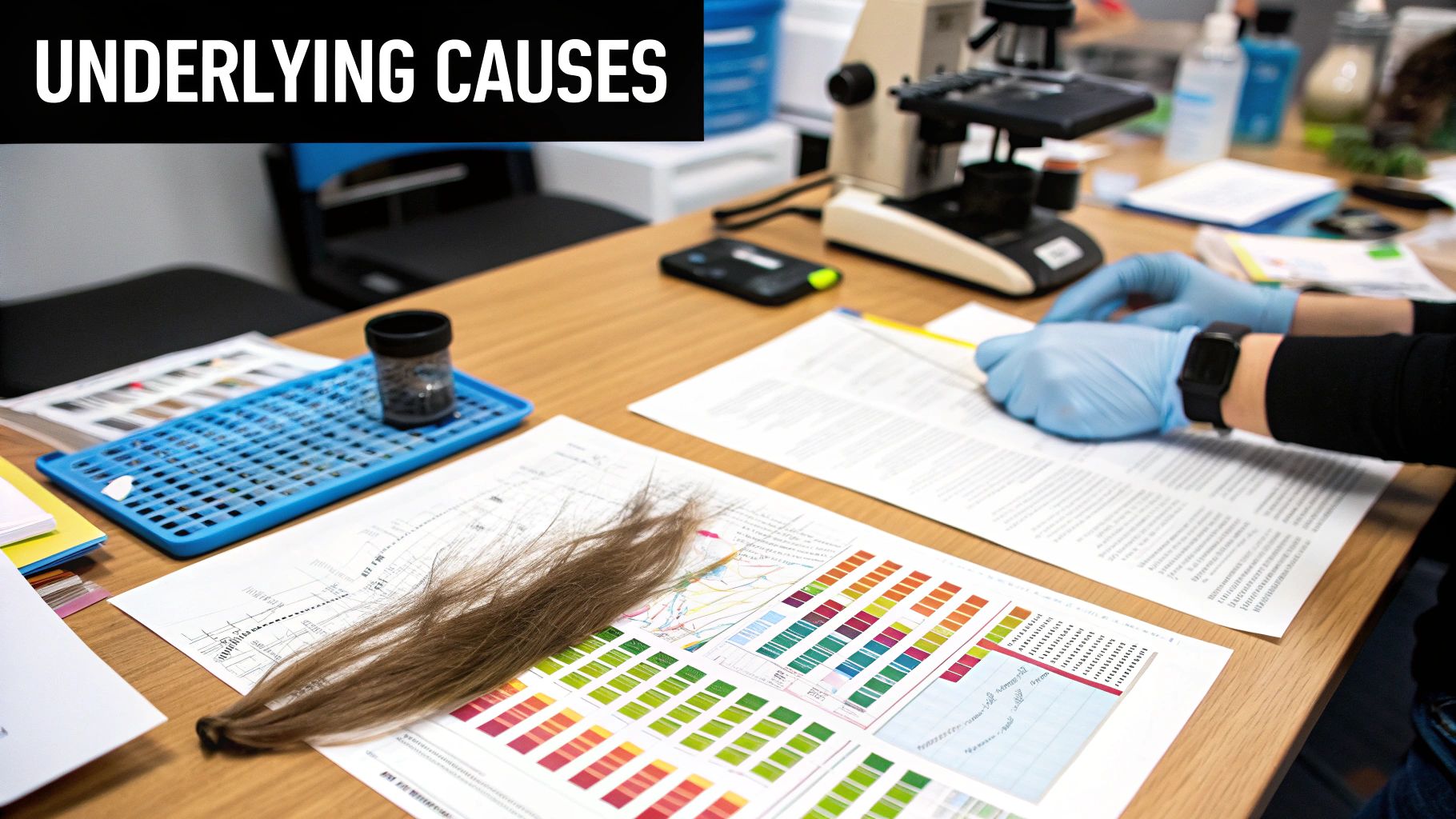
Once you’ve started noticing the first signs of thinning, the big question becomes, "Okay, so what can I actually do about this?" While there are plenty of traditional options out there, regenerative medicine has given us a genuinely proactive approach: Platelet-Rich Plasma (PRP) therapy. It’s getting a lot of buzz because it tackles hair loss right at the source.
What makes PRP different is that it doesn't rely on outside chemicals. Instead, it taps into your body's own incredible healing power. The process itself is surprisingly simple. It starts with a small blood draw, just like you’d have during a routine physical. That sample goes into a centrifuge—a machine that spins it at high speed to separate all the different components of your blood. The goal is to isolate the platelet-rich plasma, which ends up as a golden-hued, concentrated serum loaded with growth factors.
And let's be clear, this is a massive issue. Data from 2024 shows that male pattern baldness rates vary a lot across the globe, with some of the highest numbers found in Western countries. Spain is currently at the top of the list, with about 44.5% of men affected. Italy and France aren't far behind, and the United States comes in at 42.68%. It’s a common experience for millions. For a deeper dive, check out these global hair loss rates to see the full picture.
How PRP Awakens Dormant Hair Follicles
So, how does this "liquid gold" actually work? Think of PRP as a powerful, all-natural fertilizer for your scalp. After the plasma is separated and prepared, it’s carefully injected into the specific areas of your scalp where the hair is thinning. This technique delivers a super-concentrated dose of your own growth factors directly to the hair follicles that are struggling.
The aim here isn't to magically create new hair follicles from scratch. It's about waking up the ones that have gone dormant or have been shrunk by DHT.
This targeted approach essentially gives weakened follicles a direct wake-up call, nudging them to get back into their active growth phase. It’s a bit like giving a struggling garden a direct infusion of nutrient-rich compost to help dormant seeds finally sprout.
By nourishing the follicles from the inside out, PRP therapy can give your natural hair growth cycle the jumpstart it needs.
The Tangible Benefits of PRP Therapy
The results from PRP aren't just about hitting the pause button on hair loss; it’s about actively making your hair healthier. People who go through the treatment often see real improvements that directly counter those early signs of male pattern baldness.
Some of the key advantages include:
- Increased Hair Thickness: PRP helps reverse that miniaturization process we talked about, allowing your existing hair strands to grow back thicker and feel more robust.
- Improved Hair Density: By stimulating those sleepy follicles, PRP can increase the number of active hairs on your scalp, which helps create a fuller, denser appearance.
- Reduced Hair Shedding: The treatment reinforces the hair shaft and the follicle itself, which can dramatically cut down on the excessive shedding you might see in your brush or shower drain.
Because PRP is derived from your own biological material, it's a fantastic option for anyone looking for a solution that works with their body, not against it. It zeroes in on the follicular miniaturization at the heart of male pattern baldness, making it one of the most promising therapies available for taking back control of your hair's future.
Your Next Steps After Noticing Hair Loss
Spotting the first signs of male pattern baldness is one thing. Figuring out what to do about it is a whole different ball game. This is your moment to move from worrying to acting, taking back control of your hair's future.
Without a doubt, the most important step you can take right now is to see a professional. Self-diagnosing based on what you see in the mirror or find online can lead to a lot of unnecessary anxiety. A dermatologist or a dedicated hair loss specialist is the only one who can give you a definitive answer, confirming whether you're dealing with androgenetic alopecia or something else.
Preparing for Your Consultation
To get the most out of your appointment, you'll want to go in prepared. The goal here is to walk out with a clear, actionable plan. Think about when you first noticed the thinning, where it’s happening, and how quickly it seems to be progressing.
Here are a few essential questions to have in your back pocket when you meet with the specialist:
- Looking at my hair, what do you believe is the main cause?
- What stage of hair loss would you say I'm in right now?
- Given my current stage, what are the most effective treatment options for me?
- For a treatment like PRP, what kind of results can I realistically expect?
- Are there any lifestyle adjustments you'd recommend to support my treatment?
Having these questions ready helps ensure you get personalized advice that actually applies to you. It's a simple, proactive step that can make a huge difference.
Seeking a diagnosis isn't admitting defeat—it's your first strategic move. The sooner you get a professional opinion, the more effective your chosen treatment will be, as early intervention provides the best opportunity to preserve your hair.
Don't put this off. Taking this step shifts your entire mindset from feeling anxious and helpless to feeling empowered and in control. Once you know exactly what you're up against, you can make smart, informed decisions, whether that means looking into advanced treatments like PRP therapy or exploring other proven solutions.
A Few Common Questions About Hair Loss
When you first spot what might be the early signs of male pattern baldness, it’s easy to get lost in a sea of questions and myths. Let's cut through that confusion with some clear, straight-to-the-point answers to help you figure out your next steps.
Can High Stress Levels Cause Permanent Baldness?
It's true that high stress can make your hair fall out. This condition, called telogen effluvium, essentially shocks a large number of your hair follicles into a resting phase all at once. A few months later, you might notice a surprising amount of shedding.
But here's the good news: this kind of hair loss is almost always temporary. Once you get the stress under control, your hair growth cycle usually gets back on track. It's a completely different beast from genetic male pattern baldness, which is a permanent and progressive condition.
Does Wearing a Hat Too Often Accelerate Hair Loss?
This is probably one of the most stubborn myths out there, but let's put it to rest: wearing a hat will not cause you to go bald. Your hair follicles get everything they need—oxygen and nutrients—from your bloodstream, not from the air.
The only scenario where a hat could cause an issue is if it's so tight that it's constantly pulling on your hair, which can lead to a condition called traction alopecia. For the vast majority of guys who just wear a normal-fitting hat, this is a total non-issue. The real culprits behind your hair loss are your genetics and hormones.
Male pattern baldness affects a huge portion of the population. Studies show that roughly 50% of men will experience some degree of androgenetic alopecia by the age of 50. It’s a shared experience, not a personal failing.
At What Age Is It Normal to Start Balding?
There really is no "normal" age to start balding. It all comes down to your individual genetic sensitivity to DHT. Some guys notice the first signs in their late teens or early 20s, while others might not see any significant thinning until they're well into their 40s or even later.
What we do know is that about 25% of men with hereditary baldness start seeing the signs before they hit 30. If it starts early, it doesn't mean you've done anything wrong—it just means your follicles are more sensitive to those hormonal changes.
Are Over-the-Counter Hair Loss Shampoos Effective?
Most of the "hair loss" shampoos you find on the shelf can definitely help with the look and feel of your hair. They often work by adding volume and strengthening the hair shaft to reduce breakage, which can make your hair appear fuller.
However, they can't actually stop male pattern baldness. Shampoos simply can't halt the hormonal process where DHT shrinks the hair follicles. Think of them as a great supporting cast—they help your hair look its best, but they don't tackle the root cause. For that, you need to look at clinically proven treatments that address the underlying biology.
Ready to move from asking questions to finding real solutions? The team at PRP For HairLoss is dedicated to providing you with the most current information on effective treatments. Explore our resources to understand how you can proactively manage your hair health. Learn more about your options for hair restoration.
 PRP For Hairloss
Leave a comment