When you start looking into PRP for hair loss, one of the first questions is always about the price. So, let's get right to it: the average PRP hair loss treatment cost can be anywhere from $500 to $2,500 per session. Since you'll need more than one visit to really see a difference, a full initial round of treatments usually ends up in the $1,500 to $9,000 range.
What Is the Real Cost of PRP Hair Loss Treatment
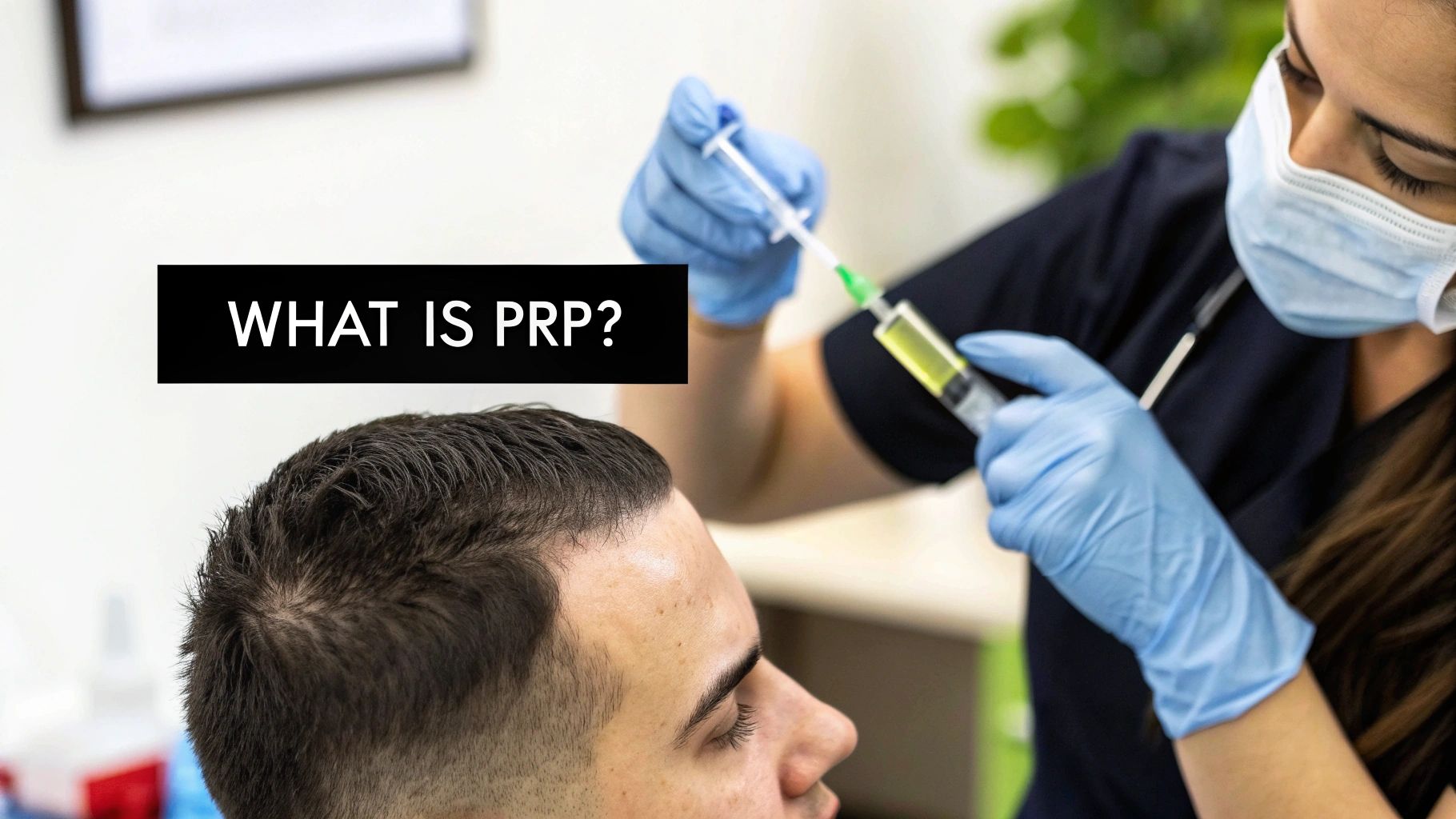
Figuring out the exact cost of PRP therapy isn't as simple as checking a price tag. It's more of a personalized investment, and the final bill is shaped by a few key things. This is why you see such a wide range of prices from one clinic to the next.
Your total financial commitment isn't just about one appointment. It’s a complete plan that starts with a series of treatments to get the hair follicles growing again, followed by occasional touch-ups to keep those results. Think of it like getting a garden to flourish—you need an initial burst of effort to get things growing, then ongoing care to keep it vibrant.
To give you a clearer picture, here's a quick breakdown of what you can generally expect to budget for PRP hair treatments.
PRP Hair Loss Treatment Cost At a Glance
| Treatment Phase | Average Cost Per Session | Typical Full Course Cost |
|---|---|---|
| Initial Series | $600 – $2,500 | $1,800 – $10,000 (for 3-4 sessions) |
| Maintenance | $600 – $1,500 | $1,200 – $3,000 (annually) |
This table provides a general idea, but remember that your specific costs will depend on the factors we'll discuss below.
Breaking Down the Numbers
Two of the biggest factors influencing the price are your location and the provider's level of experience. A top-tier clinic in a major city like New York or Los Angeles will naturally have higher overhead and will likely charge more than a practice in a smaller town. That's just a reality of business costs.
A typical plan kicks off with a series of injections to wake up the hair follicles. For example, a common protocol is an initial round of four PRP sessions, which could average around $2,400. After that initial phase, you’ll likely need maintenance treatments, maybe once or twice a year, which might run about $600 each to keep your hair growth going. You can find more detailed cost information from established practices like Krauss Dermatology.
What's Included in the Price
When you get a quote for the PRP hair loss treatment cost, it's smart to ask exactly what's covered. A good, transparent price should bundle everything together.
Here’s what you're usually paying for:
- Initial Consultation: A lot of clinics will apply the consultation fee toward your treatment package if you decide to move forward.
- The PRP Procedure: This is the core of the service—it includes the blood draw, spinning it in a centrifuge to get the platelet-rich plasma, and the meticulous injections into your scalp.
- Practitioner’s Time: You're paying for the skill, training, and experience of the doctor or nurse performing your treatment. This is where expertise really counts.
How PRP Therapy Works for Hair Regrowth
Before we get into the numbers, it helps to understand what you're actually paying for when you invest in PRP hair loss treatment. The concept is pretty fascinating: the therapy uses your body's own healing power to give your hair a serious jumpstart.
Think of it like creating a super-potent, all-natural fertilizer for your scalp, made from a small sample of your own blood. It’s a way of concentrating your body’s best regenerative tools and putting them exactly where they’re needed most.
The whole process is surprisingly straightforward and happens in three simple steps, feeling much like a regular doctor's visit.
The Three-Step PRP Process
- The Blood Draw: First things first, a medical professional will draw a small amount of your blood. It's no different than what you’d experience during a routine physical.
- The Separation: Next, that blood sample goes into a special machine called a centrifuge. This device spins the blood at an incredibly high speed, which neatly separates it into different layers. We’re after the platelet-rich plasma (PRP)—a golden-hued liquid that's absolutely packed with growth factors. This is the "liquid gold" that makes the whole treatment work.
- The Injection: Finally, your provider carefully injects this concentrated PRP into the specific areas of your scalp experiencing thinning or hair loss. The process is precise, targeting the follicles that need the most help.
By isolating and concentrating these platelets, PRP therapy delivers a powerful dose of growth factors directly to dormant or shrinking hair follicles. This essentially sends a signal for them to wake up, re-enter the growth phase, and start producing thicker, healthier hair.
This visual guide gives you a clear picture of how the costs typically add up over the course of a full treatment plan.
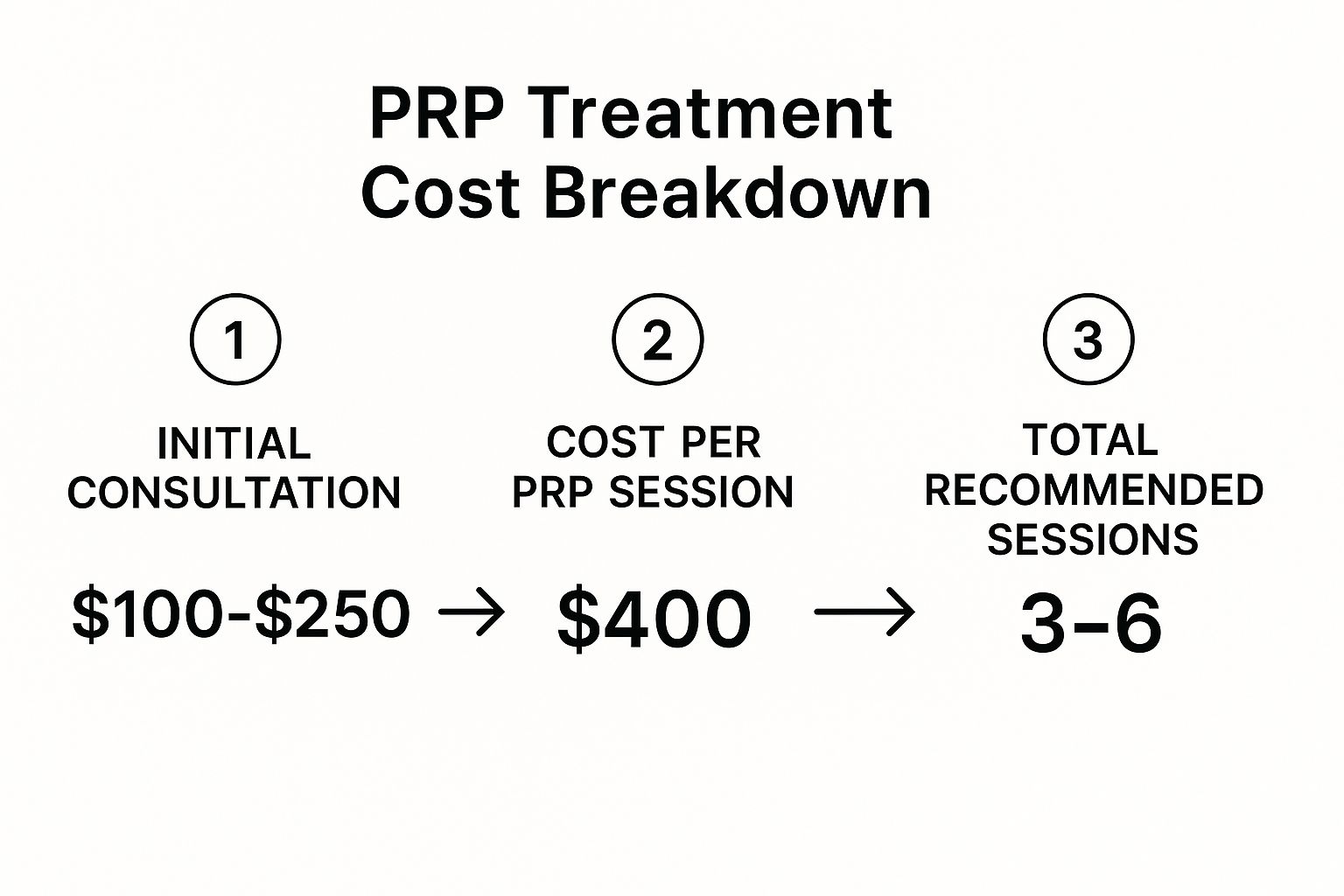
As you can see, the final price tag is a combination of your initial consultation fee, the cost of each individual session, and the total number of sessions you'll need to achieve your goals.
Awakening Dormant Follicles
So, what exactly are these growth factors doing once they're in your scalp? They act like tiny messengers, telling your tired hair follicles to get back to work.
These powerful proteins kick off a cascade of activity, increasing blood flow and bringing a fresh supply of oxygen and nutrients to the scalp. This creates a much healthier environment for your existing hair while encouraging those sleepy, dormant follicles to start producing new strands again.
This is the biological boost you're investing in with each session. When you understand the science behind it, you start to see the true value of the treatment, looking beyond just the initial price. It's a proactive strategy that taps into your body's own remarkable systems to combat hair loss.
Key Factors That Influence Your Total PRP Cost
When you start researching PRP therapy, you’ll immediately notice that the prices can be all over the map. This isn't just random pricing; several key factors determine the final cost, directly influencing the quality and, ultimately, the success of your treatment. Getting a handle on these variables is the first step to making an informed decision.
Think of it like buying a car. The basic model will get you from point A to B, sure. But once you start adding a more powerful engine, advanced safety features, or a premium interior, the price tag naturally goes up. The PRP hair loss treatment cost works much the same way—it's shaped by the specific details and quality of the service you choose.
So, let's break down the main elements that go into that final number on your quote.
Geographic Location and Clinic Overhead
One of the biggest and most straightforward factors is simply where the clinic is located. A practice in a high-cost urban center like New York City or Miami has to cover much higher rent, staff salaries, and general operating costs than a clinic in a smaller suburban town. Those expenses are inevitably reflected in the price you pay.
For example, it's common for clinics in a state like Illinois to quote PRP injections between $1,000 and $1,500 per session. This pricing is a direct result of their regional market conditions and the level of expertise available. To get a better sense of how your own area compares, you can dig into how local markets influence PRP pricing.
Practitioner Expertise and Credentials
You're not just paying for a vial of PRP; you're paying for the steady hand and deep knowledge of the person administering the treatment. The provider's qualifications play a huge part in the cost.
A procedure done by a board-certified dermatologist or a specialist who focuses exclusively on hair restoration will almost always be more expensive than one performed by a general technician. You're paying a premium for their years of advanced training, nuanced understanding of what causes hair loss, and precise injection techniques that lead to safer, better outcomes.
Technology and Treatment Quality
Here’s a crucial point: not all PRP is created equal. The technology used to spin your blood and prepare the concentrate has a massive impact on the final product—specifically, the concentration of platelets and powerful growth factors.
Several things can affect the quality and, therefore, the cost:
- Centrifuge Quality: A top-of-the-line, double-spin centrifuge is far more effective at separating and concentrating a high number of platelets. This equipment is a major investment for any clinic, which drives up the per-session cost.
- PRP Kits: Clinics use specific, sterile kits to draw and process your blood. The quality, and thus the price, of these kits can vary, impacting the purity and potency of your PRP.
- Combined Therapies: To get the best possible results, many leading clinics will suggest combining PRP with other treatments like microneedling or low-level laser therapy. While these add-on services will increase the overall price of your package, they often work together to boost the treatment's effectiveness.
Comparing PRP Costs to Other Hair Loss Solutions
When you're trying to figure out if the cost of PRP hair treatment is worth it, it helps to put it into context. How does it stack up against everything else out there? This isn't just about the sticker price; it's about what you get for your money in the long run, how invasive the treatment is, and where it fits into your life.
https://www.youtube.com/embed/iFak6yZE6yI
Think of hair loss treatments as being on a spectrum. At one end, you have the easy-to-grab, over-the-counter stuff. A bottle of minoxidil (you probably know it as Rogaine) or a finasteride (Propecia) prescription has a low entry fee. The catch? You're signing up for a lifelong commitment, and those monthly costs really start to pile up over the years.
At-Home vs. In-Clinic Treatments
A step up from that are the at-home gadgets, like Low-Level Laser Therapy (LLLT) caps and combs. These are usually a one-time purchase, but that one time can set you back anywhere from a few hundred to several thousand dollars. They're convenient, sure, but the results are often more subtle and you have to use them religiously to see and maintain any benefit.
This is where PRP finds its sweet spot—right in the middle.
PRP is a much more hands-on approach than a daily foam or pill because it uses your body's own healing power. It's done in a clinic, which is more involved than at-home care, but it’s nowhere near as intense or invasive as surgery.
At the very top end of the scale, you have hair transplants. This is a full-blown surgical procedure, and the price reflects that, easily running from $4,000 to over $15,000. While a transplant can deliver the most dramatic and permanent change, it's a major decision for both your wallet and your body.
From a pure value perspective, it turns out that mixing and matching treatments often gives you the most bang for your buck. For example, some economic studies have found that while minoxidil on its own is a good deal, pairing it with PRP can be a smarter financial strategy for managing hair loss long-term. In fact, for people who are willing to invest more for better results, the combo of PRP and minoxidil often provides more value than just doing PRP alone.
If you're interested in the numbers behind this, you can dig into the full economic analysis of hair loss treatments to see how the data breaks down.
How to Budget and Find the Right PRP Provider

Alright, now that you have a handle on what drives the cost of PRP, let's talk about putting a practical plan together. Choosing the right provider is just as crucial as the treatment itself—think of it as a smart investment in both your wallet and your final results.
First up, budgeting. PRP isn't a one-and-done deal; you'll need an initial round of sessions to kickstart growth. Because of this, you should always ask about package deals. Many clinics will offer a better per-session price if you commit to three or four treatments upfront, which can really help manage the overall expense.
Don't forget about the long game, either. After your initial series, you’ll likely need a touch-up session every six to twelve months to maintain your results. It's wise to plan for this from the start by setting aside $600 to $1,500 for annual maintenance. This keeps you from being surprised by future costs.
Vetting Your Potential Provider
We've all been tempted by a low price, but when it comes to medical procedures, an unusually cheap offer can be a major red flag. It might mean the clinic is using subpar equipment or that the staff lacks the necessary experience. Your safety and results are on the line, so choosing a qualified professional is non-negotiable.
A provider's experience is paramount. You aren't just paying for the PRP; you're paying for their skill in diagnosing your specific hair loss and their precision with every single injection. That expertise is what leads to successful, natural-looking regrowth.
When you book a consultation, treat it like an interview. This is your opportunity to dig deep and make sure they’re the right partner for you. Arm yourself with questions.
Here’s a quick checklist to get you started:
- Experience: "How many PRP hair treatments do you perform each month?" A busy practice usually signals a team that has honed its technique and knows what it's doing.
- Technology: "What kind of PRP system or centrifuge do you use?" Top-tier clinics often use double-spin systems, which are known for creating a richer, more concentrated PRP.
- Proof: "Can I see before-and-after photos of your actual patients?" A reputable provider will be eager to share their portfolio. You want to see real results from patients with hair loss patterns similar to yours.
Your Top Questions About PRP Costs Answered
Even with all the details, you probably still have a few lingering questions about the financial side of things. It's completely normal. Let's walk through some of the most common concerns people have so you can feel confident about the prp hair loss treatment cost.
Is PRP Hair Treatment Covered by Insurance?
I get this question all the time, and the straightforward answer is almost always no. Insurance companies classify PRP for hair loss as a cosmetic procedure, which means it doesn't fall under standard health coverage. It's best to think of this as a personal investment in your own confidence and appearance.
But don't let that stop you. Most reputable clinics know this is an out-of-pocket expense and have options to help. They often partner with third-party financing companies or offer their own flexible payment plans to spread the cost out. Make sure you ask what's available during your consultation.
How Many Sessions Affect the Total Cost?
This is a big one. The total price tag for your PRP journey is tied directly to how many sessions you'll need. Getting your hair back isn't a one-and-done deal; it’s a process where each treatment builds on the last to get you the best results.
Most people start with an initial series of 3-4 treatments. These are usually scheduled about four to six weeks apart. This kick-starter phase is what really gets the hair follicles stimulated, and it's where the bulk of your initial investment will go.
After that initial push, it's all about maintenance. To keep those results and ensure your hair follicles stay active, you'll likely need a follow-up session every 6-12 months. It's really important to factor these ongoing treatments into your long-term budget from the start.
Why Do PRP Prices Vary So Much?
The sticker shock from one clinic to the next is real, and it usually boils down to three things: location, the expert's experience, and the quality of the equipment. A clinic in a pricey downtown high-rise will naturally have higher costs than one in a smaller town, and that gets passed on to the patient.
Even more important is who is performing the procedure. A board-certified dermatologist who lives and breathes hair restoration has a level of skill that justifies a higher fee. They've also likely invested in top-of-the-line gear, like a double-spin centrifuge that yields a much richer, more effective platelet concentration. You're not just paying for the procedure; you're paying for their expertise and the quality of the technology they use, which often leads to better, safer results.
Are There Any Hidden Costs I Should Know About?
A good, trustworthy clinic will be upfront about every penny. There shouldn't be any "gotcha" fees, but it's on you to ask the right questions to make sure you have the full financial picture. When you go in for your consultation, always ask for a written quote that breaks everything down.
Be sure to ask if the price includes:
- The initial consultation fee itself.
- All the sessions in the recommended initial package.
- Any special shampoos, supplements, or take-home products they recommend.
If a provider seems cagey or vague about the total investment, including maintenance, take that as a red flag. Clear, honest communication about cost is a hallmark of a practice you can trust.
Ready to learn more about how PRP can help you? At PRP For HairLoss, we provide the in-depth information you need to make a confident decision. Explore our resources today at https://prpforhairloss.com.

 PRP For Hairloss
Leave a comment