PRP, which stands for Platelet-Rich Plasma, is a non-surgical treatment that taps into your body's own healing abilities to help regrow hair. It’s all about using a concentrated dose of your own blood platelets to rejuvenate sluggish or dormant hair follicles.
Think of it like this: if your scalp is a garden, PRP is a super-concentrated, all-natural fertilizer. The goal isn't to plant new seeds but to enrich the soil, giving your existing follicles the powerful boost they need to grow thicker, stronger, and healthier hair.
Understanding PRP and How It Regrows Hair
At its core, Platelet-Rich Plasma therapy is a straightforward three-step process. First, we draw a small amount of your blood, just like you would for a routine lab test. Next, that blood is processed to isolate the platelets. Finally, this concentrated, platelet-rich plasma is carefully injected back into the areas of your scalp where hair is thinning.
The magic here is that we're not introducing any foreign substances. We're simply harnessing the regenerative components already present in your blood. Your platelets, which are famous for clotting blood and healing wounds, are also packed with powerful proteins called growth factors. These are the key players that can wake up hair follicles and kickstart growth.
The process starts with a standard blood draw. That blood sample goes into a centrifuge—a machine that spins at incredibly high speeds. After about 10 minutes of spinning, the blood separates into three distinct layers: red blood cells, platelet-poor plasma, and the highly-coveted platelet-rich plasma.
This PRP layer is often called "liquid gold" for good reason. It contains 5 to 10 times the concentration of growth factors found in normal, circulating blood. This is the substance we use for the treatment.
The Science Behind the Syringe
So, what actually happens when this "liquid gold" is injected into your scalp? Think of the growth factors as tiny messengers. When they're delivered directly to the areas of thinning hair, they send signals to the surrounding cells and follicles.
These signals essentially tell dormant or weakening follicles to shift back into an active growth phase. The process revitalizes the follicles, boosts blood flow to the area, and can even increase the thickness of the hair shaft itself.
PRP therapy isn't just a hopeful theory; it's a scientifically-backed procedure for specific types of hair loss. It works by creating a nutrient-rich environment that gives your hair follicles the support they need to thrive again.
To get even better results, many modern treatment plans combine PRP with other therapies like micro-needling. This combination helps to further stimulate the scalp and improve how well the skin absorbs all those valuable growth factors.
To give you a quick overview, here's a simple breakdown of the treatment.
PRP Hair Treatment At a Glance
| Aspect | Description |
|---|---|
| Treatment Type | Non-surgical, injectable therapy. |
| Core Ingredient | Platelet-Rich Plasma derived from your own blood. |
| Mechanism | Growth factors in PRP stimulate dormant or weak hair follicles. |
| The Goal | Increase hair density, thicken hair shafts, and slow hair loss. |
| The Process | A simple 3-step procedure: blood draw, processing, and injection. |
This table neatly sums up what PRP is all about: using your body’s own resources to naturally encourage hair regrowth.
Is PRP Therapy Effective?
The big question is always, "Does it actually work?" For the right person, the answer is a resounding yes. PRP therapy has become a go-to non-surgical option, especially for treating the early stages of androgenetic alopecia (male and female pattern baldness).
Success rates reported across the globe typically fall between 70% and 80%. Some clinical studies have even seen rates as high as 90% when patients are carefully selected.
The effectiveness really hinges on the procedure's ability to concentrate those growth-factor-rich platelets and deliver them precisely where they’re needed. When done correctly, the injections stimulate dormant follicles, improve scalp health, and lead to visibly fuller hair.
The Science of How PRP Awakens Hair Follicles
So, how does a small amount of your own blood actually convince your hair follicles to start growing again? It’s not magic. The secret lies in the fascinating biology happening just beneath your scalp, and it all starts with the humble platelet.
While most of us know platelets for their role in stopping bleeding, that’s only half the story. In the context of hair restoration, they are so much more.
Think of each platelet as a tiny, biological repair kit. When you get a cut, they rush to the scene. But their job doesn't stop at plugging the hole. Once they arrive at an injury site—or in this case, a site where they’ve been carefully injected—they release a powerful cocktail of proteins called growth factors.
These growth factors are the real workhorses of PRP therapy. They are signaling molecules that communicate directly with your hair follicles, essentially acting as biological messengers with one clear instruction: repair and regenerate.
The Role of Key Growth Factors
While there are many different growth factors in the mix, a few are absolutely critical for reviving hair follicles. They work in concert to create an environment where hair can not only grow but thrive.
-
Platelet-Derived Growth Factor (PDGF): This is a major player. It kickstarts cell growth, helps form new blood vessels, and promotes overall tissue regeneration. It’s the one telling your follicles to get back to work.
-
Vascular Endothelial Growth Factor (VEGF): As the name implies, this growth factor is all about blood supply. It's vital for creating new blood vessels, a process known as angiogenesis. Better blood flow means more oxygen and nutrients can reach the hair follicle, strengthening it from the root up.
-
Epidermal Growth Factor (EGF): This protein stimulates the growth and division of cells. This is essential for repairing the follicle itself and encouraging a longer, healthier growth cycle.
These growth factors don't just send a single, simple message. They trigger a complex healing cascade. They can wake up dormant follicles, push active follicles into a longer growth phase (the anagen phase), and even help increase the thickness of the hair shaft itself. It's a full-scale revitalization project, orchestrated entirely by your body's own materials.
Why Concentration Is Crucial
The entire premise of PRP therapy hinges on one simple but powerful principle: concentration matters. Your everyday blood has platelets, but not in a high enough concentration to produce a significant regenerative effect on their own. That's where the centrifuge comes in.
By separating and concentrating the platelets, we create a solution that is 5 to 10 times richer in growth factors than what’s normally circulating in your bloodstream. This super-concentrated dose is what gives your follicles the overwhelming "wake-up call" they need to spring back to life.
This isn't just a theory; it's a measurable science. The biological power of the treatment is directly tied to the final platelet count in the plasma that gets injected into your scalp.
In fact, the preparation method and final platelet concentration are two of the biggest factors determining success. Scientific studies have repeatedly shown that higher platelet counts lead to better results. For example, one six-month study found that PRP with over 1,000,000 platelets per microliter led to a hair density increase of about 42%. This highlights just how important a potent dose is. You can dig into the complete findings by reviewing this evaluation of PRP effectiveness.
This data reinforces that a quality PRP treatment isn't just about the injections. It’s about the meticulous preparation that ensures the final product is a highly concentrated, growth-factor-rich solution capable of producing real, visible change at the follicular level.
A Step-by-Step Look at Your PRP Treatment
Let's be honest, the thought of any procedure involving needles can be a little daunting. But when it comes to PRP treatment for hair, knowing exactly what to expect can take the edge off. The entire session is surprisingly quick and much less intimidating than you might imagine. It really boils down to three core steps.
Step 1: The Blood Draw
Your appointment will start just like a routine physical. A small amount of blood, usually between 10 to 20 milliliters, is drawn from your arm. This is a quick process, over in a few minutes, and feels no different than getting a standard blood test.
This simple infographic gives you a great visual overview of the whole process, from that initial draw to the final application.
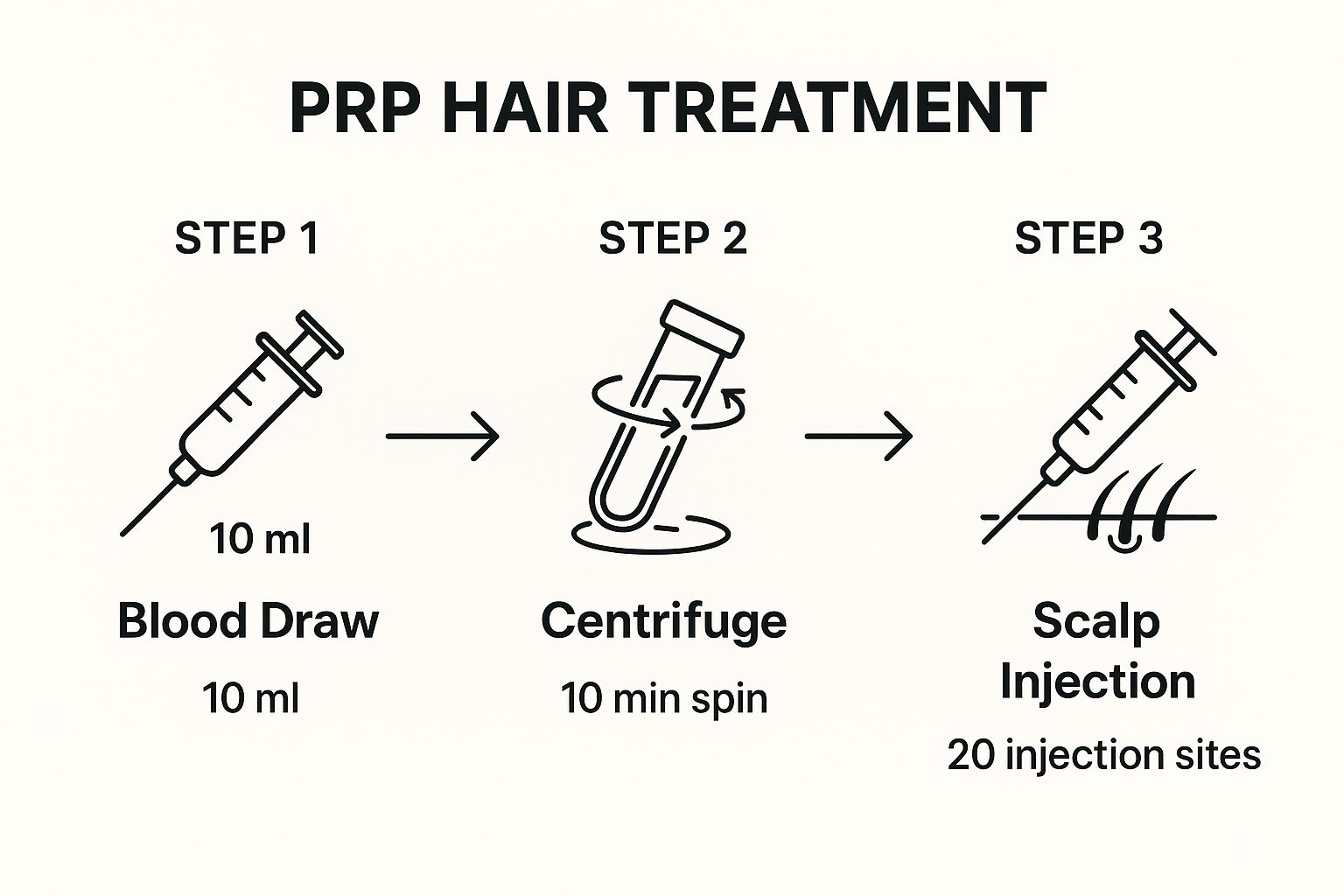
As you can see, the workflow is efficient and designed to prepare your platelets with absolute precision.
Step 2: Isolating the “Liquid Gold”
With the blood collected, we move on to the science-y part. Your blood sample is placed into a centrifuge—a machine that spins it at extremely high speeds for about 10 minutes. This isn't just for show; the intense spinning action separates your blood into three distinct layers based on their density.
After the spin cycle, you'll see red blood cells at the bottom, platelet-poor plasma (PPP) at the top, and a thin, golden-colored layer in between. That middle layer is the star of the show: the platelet-rich plasma (PRP). It’s absolutely packed with the powerful growth factors that wake up dormant hair follicles. We call it "liquid gold" for a reason!
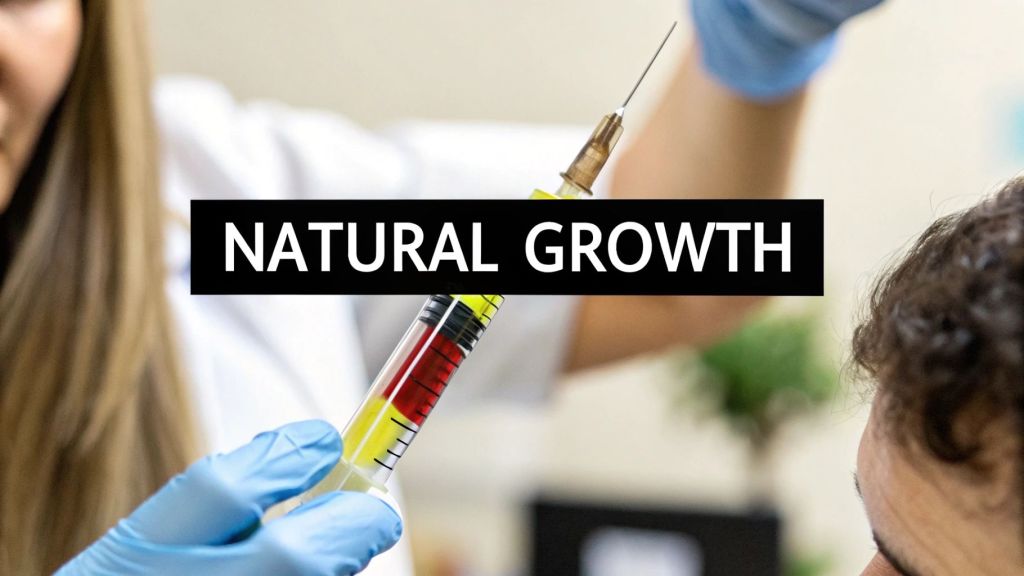
Your provider then carefully draws this concentrated PRP into a syringe, getting it ready for the final step.
Step 3: Precise Application to the Scalp
This is the part everyone asks about. The final stage involves injecting the PRP directly into the areas of your scalp that need it most. To make sure you’re comfortable, a topical numbing cream is usually applied to the treatment area first. This works wonders to minimize any sensation.
Once your scalp is numb, the practitioner uses a very fine needle to make a series of small injections across the thinning areas. The goal is to deliver the PRP right to the base of the hair follicles where it can get to work.
Though the idea of multiple injections sounds like a lot, most people say it just feels like a series of quick, tiny pinches. The numbing cream and the fine needle make it a very manageable experience.
From start to finish, the entire appointment usually takes about 60 minutes. Best of all, there's no real downtime. You'll get some simple aftercare instructions—like avoiding intense workouts or harsh hair chemicals for a day or so—but you can generally head right back to your daily routine.
Determining If You Are a Candidate for PRP
While PRP therapy offers a powerful, natural way to tackle thinning hair, it's crucial to understand that it isn't a silver bullet for every person or every type of hair loss. The success of this treatment really hinges on whether you're the right candidate. Figuring this out means taking a close look at the type and stage of your hair loss, your overall health, and, most importantly, the current condition of your hair follicles.
The best results almost always come from people who are in the early stages of hair loss. Here’s a good way to think about it: PRP is like a super-potent fertilizer for a garden where the plants are struggling. It can revive them and help them thrive, but it can't bring a completely barren patch of soil back to life. It works by waking up and strengthening follicles that are weak or dormant, not ones that have already died off completely.
Who Is an Ideal Candidate?
You're likely a strong candidate for PRP if your situation sounds like this. Folks in these categories tend to see the most significant, satisfying improvements in both hair density and thickness.
-
Androgenetic Alopecia: This is the classic male or female pattern baldness, and it's the number one reason people seek out PRP. It works exceptionally well for those who have noticeable thinning but still have visible—even if miniaturized—hair follicles.
-
Early Hair Thinning: Have you just started seeing more hair in the shower drain? Is your part looking a little wider than it used to? Acting early gives PRP the best shot at fortifying those existing follicles before they give up for good.
-
Good Overall Health: Since this treatment uses your body's own healing power, being in good general health is a huge advantage. A robust immune system and healthy blood mean the platelet-rich plasma we get from you will be that much more potent.
Who Might Not Be a Good Candidate?
On the flip side, some conditions can make PRP less effective or, in some cases, not recommended. It's so important to be upfront about this because it helps set realistic expectations and puts your safety first. You might need to reconsider or postpone treatment if any of these situations apply to you.
It's not just about who it works for, but also who it doesn't work for. Being a poor candidate means the procedure may not deliver the results you want or could pose unnecessary health risks.
To give you a clearer picture, I've put together a simple checklist to help you see where you might stand.
PRP Candidacy Checklist
This table breaks down the factors that make someone a great candidate versus someone for whom PRP might not be the best fit.
| Factor | Ideal Candidate | May Not Be Suitable |
|---|---|---|
| Stage of Hair Loss | Early to moderate thinning; follicles are weak but still active. | Complete baldness in an area; follicles are no longer viable. |
| Type of Hair Loss | Androgenetic alopecia (pattern baldness). | Hair loss from active infections, some autoimmune diseases, or certain medications. |
| Blood Health | Normal platelet count and function. | Low platelet count, clotting disorders, or currently on blood thinners. |
| Scalp Condition | Healthy, without active infections or severe skin conditions. | Active scalp infections, or chronic skin diseases like psoriasis on the scalp. |
| General Health | Good overall health, non-smoker. | Active cancer, chronic liver disease, or other severe systemic illnesses. |
This checklist really underscores the "why." For instance, people with conditions like platelet dysfunction syndromes, thrombocytopenia (which is a clinical term for a low platelet count), or those on anticoagulant therapy (blood thinners) are generally not advised to get PRP. The entire procedure depends on the quality and function of your platelets, and these conditions directly undermine that foundation.
At the end of the day, the only way to know for sure is to sit down for a consultation with a qualified professional. They can properly assess your hair loss, review your medical history, and help you determine if PRP treatment for hair is the right step on your restoration journey.
Real Results and Benefits You Can Expect
So, after digging into the science and what happens during the treatment, we get to the most important question: what can you actually expect to see? While everyone's hair journey is different, the results from PRP consistently hit on three key improvements.
It's important to set your expectations right from the start. PRP isn't an overnight fix. Think of it more like nurturing a garden than flipping a light switch. The growth factors need time to gently wake up your dormant hair follicles and nudge them back into a healthy growth cycle. This is a gradual process that unfolds over several months.
A Noticeable Drop in Hair Shedding
One of the very first things people notice—and get really encouraged by—is a real drop in hair shedding. Finding fewer hairs in the shower drain or on your hairbrush is often the initial sign that the PRP is kicking in. This happens because the growth factors are strengthening the hair's anchor in the follicle and keeping it in the growth phase for longer.
And this isn't just wishful thinking; there's solid science to back it up. A recent study saw a massive decrease in shedding. Before treatment, 75.6% of patients had a positive "hair pull test," which is how clinicians measure active shedding. After just three PRP sessions, that number plummeted to only 12.2%. That’s a powerful stabilizing effect.
Thicker Hair and Improved Density
Shedding less is a huge relief, but what most of us really want is fuller, thicker-looking hair. This is the next major benefit of PRP. The treatment has been shown to increase the actual diameter of individual hair strands, meaning the hair you have grows back thicker and more robust.
When each hair gets a bit thicker, the overall effect is a visible boost in density. Your hair starts to feel more substantial, and it does a better job of covering your scalp, making those thinning spots way less obvious. This is the kind of change that really restores your confidence.
The goal of PRP isn't just to stop the hair you have from falling out. It's about actively improving the quality and thickness of that hair, revitalizing your own follicles for a completely natural-looking fullness.
The data here is pretty compelling. That same 2025 study I mentioned found that PRP gave hair density a significant lift. The average hair count jumped from around 41 hairs per square centimeter to 66 hairs per square centimeter after three treatments. If you want to dive into the specifics, you can check out the full PRP patient satisfaction study yourself.
High Patient Satisfaction and Natural-Looking Results
Because PRP treatment for hair uses your body's own healing power, the results look and feel completely natural. There’s nothing synthetic involved—no plugs, no foreign materials. The new growth is 100% your own hair, just a healthier, stronger version of it. This is a huge reason why the treatment has become so trusted.
Not surprisingly, this leads to incredibly high patient satisfaction rates. People are happy with the outcome because it feels authentic. In that study, a staggering 97.6% of the participants rated their results as either satisfactory or very satisfactory.
Getting these results does take a bit of patience and commitment. The typical plan starts with a series of sessions to build up momentum, followed by maintenance treatments every so often to keep those follicles active and protect your great new results.
Your PRP Hair Therapy Questions, Answered
Deciding if PRP is the right move for your hair loss is a big deal. Even after you've got the basics down, it's natural to have more questions bubbling up. Getting those questions answered is what helps you move forward with confidence. So, let’s clear up some of the most common things people ask.
This final section gets straight to the point, tackling everything from treatment frequency and comfort to timelines and cost. The goal is to give you the clear, direct answers you need for your hair restoration journey.
How Many PRP Sessions Will I Need?
This is probably the most common question we hear, and for good reason. It's important to understand that PRP isn't a one-shot fix. Think of it more like starting a fitness program for your scalp—you need an initial push to get things going, followed by consistent maintenance to keep the results.
The typical game plan starts with an "activation" phase to really wake up those dormant follicles and saturate the scalp with growth factors.
- This usually means an initial series of 3 to 4 treatments.
- We space these sessions about 4 to 6 weeks apart, which lines up perfectly with the natural hair growth cycle.
Once you’ve completed this first round, the goal shifts to maintaining your hard-earned results. To keep that new growth healthy and prevent future thinning, you’ll need to come in for maintenance. For most guys, a follow-up treatment every 6 to 12 months is all it takes to keep their hair looking great.
Does the PRP Treatment Hurt?
Let's be honest, the idea of injections in your scalp sounds pretty intimidating. This is a huge concern for many people, and it’s a completely fair question. The good news is that the reality is much more comfortable than you’d imagine.
Your comfort is our priority. Before we even begin, a powerful topical numbing cream is applied to the entire treatment area. We let that sit for a while to make sure your scalp is properly desensitized.
Most people describe the feeling as a series of quick, light taps or tiny pinpricks. Between the numbing cream and the extremely fine needle we use, the vast majority of patients find the discomfort to be surprisingly minimal and very easy to tolerate.
It's normal to have some mild tenderness on your scalp afterward, but that usually fades within a day or two. Most people walk away saying it was much less of a big deal than they had built it up to be.
When Will I Actually See Results?
Patience is your best friend with PRP. Because the treatment works by kicking your body's own natural growth processes into gear, the results don't show up overnight. They build gradually over a few months, so it’s important to set realistic expectations from the start.
The very first sign that things are working is often a decrease in hair shedding, which you might notice after just one or two sessions. This means the growth factors are already helping to anchor your existing hairs more firmly.
The more noticeable results—thicker, denser hair—take a bit longer. Real, visible changes usually start showing up around the 3 to 6-month mark. This makes sense when you think about it; it takes time for the stimulated follicles to produce brand new, stronger hairs that are long enough to make a real difference to your overall volume.
What Is the Average Cost of PRP for Hair?
The investment for PRP can vary, so it helps to have a ballpark figure in mind. The price for a single session depends on a few things, like the clinic’s location, how experienced the practitioner is, and the specific technology they use.
On average, you can expect a single PRP hair treatment session to cost anywhere from $600 to $1,500. Don't forget, you'll likely need that initial series of treatments, so you’ll want to budget for that total amount.
Here’s a critical point to remember: PRP treatment for hair is almost always classified as a cosmetic procedure. Because of this, it is not something health insurance plans will typically cover.
At PRP For HairLoss, we're committed to giving you clear, trustworthy information to help you understand and tackle hair loss head-on. If you're ready to see how this natural and effective treatment could work for you, we encourage you to learn more about PRP for hair loss.
 PRP For Hairloss
Leave a comment