Yes, hair follicles can die, but it's probably not as common as you fear. For most people dealing with hair loss, the issue isn't that their follicles are gone for good. Instead, they're often just dormant—and that's a crucial difference because it means there's still a chance to wake them up.
Dead Follicles vs Dormant Follicles
To really get a handle on hair loss, you first need to understand the difference between a dormant follicle and a dead one.
Think of a dormant follicle like a hibernating bear. It’s not dead; it’s just in a deep sleep, waiting for the right signal to wake up and get back to work. A dead follicle, however, is like a fossil—the structure that once supported life is gone, and it can't be brought back.
This distinction is everything when it comes to effective treatment. Most of the time, common hair loss conditions don't just kill follicles overnight. They slowly push them into a longer and longer resting phase or cause them to shrink until they can no longer produce a visible hair.
The Miniaturization Process
This gradual shutdown is exactly what happens in androgenetic alopecia (male or female pattern baldness), the most common type of hair loss by a long shot. It affects a staggering 70% of men and 40% of women at some point in their lives.
With this condition, follicles don't just stop working; they miniaturize. With each new hair growth cycle, the follicle gets a little smaller, producing a hair that's finer and weaker than the last. If left unchecked, the follicle can shrink so much that it becomes permanently inactive or dies. This is precisely why catching it early makes all the difference. You can explore more about these hair loss statistics to see just how widespread this issue is.
The real goal of modern hair loss treatments isn't to bring dead follicles back from the grave—that’s not possible. The focus is on waking up the ones that are just sleeping and protecting the healthy ones you still have.
The image below gives you a great visual for what’s happening at the scalp level. It shows how a healthy follicle compares to one that's dormant versus one that is truly dead.
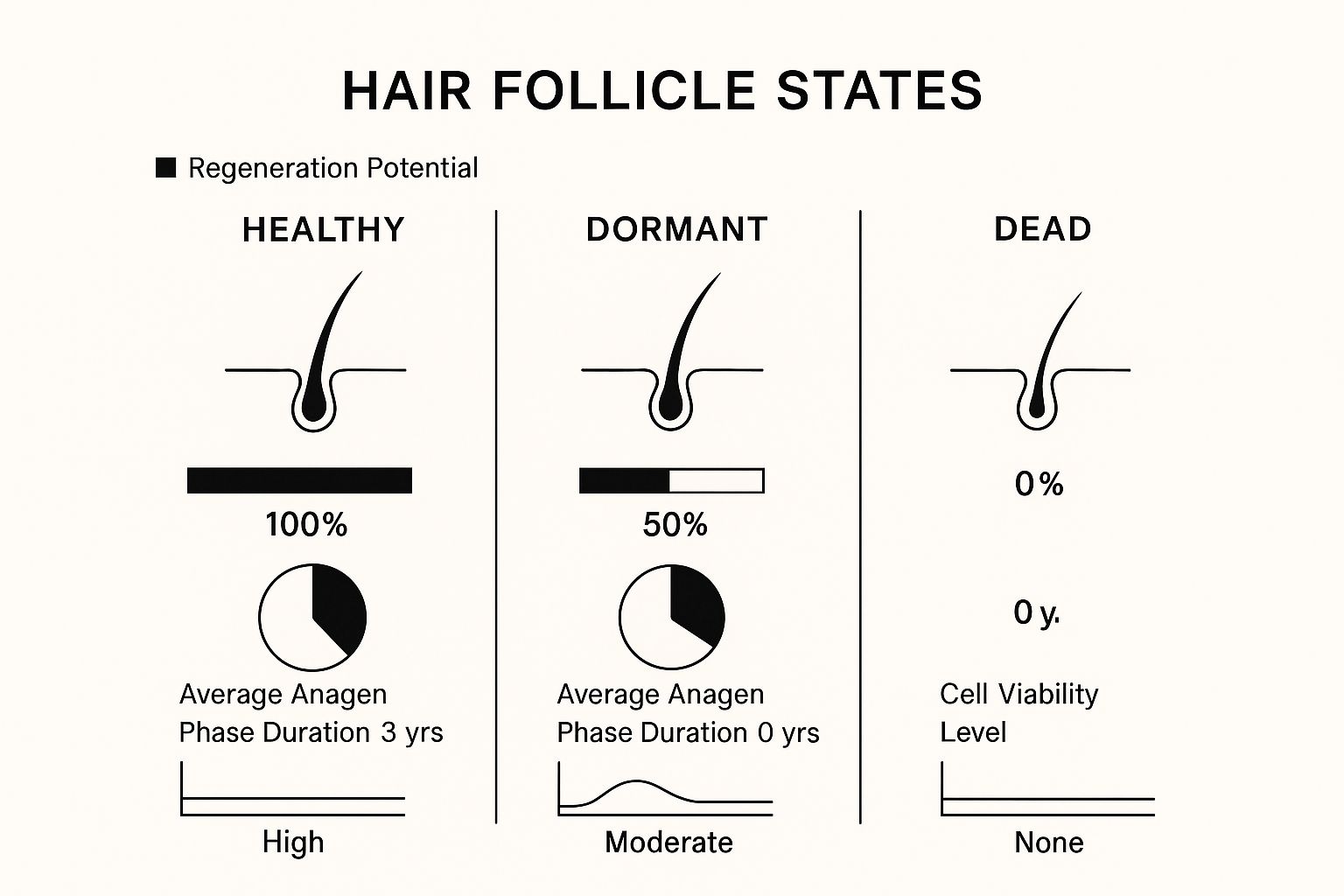
Notice how the dormant follicle still has its basic structure and some cellular activity, holding onto the potential for regrowth. The dead follicle, on the other hand, is completely gone.
To make this even clearer, let's break down the key differences in a simple table.
Hair Follicle Status: Dead vs Dormant
| Characteristic | Dormant Follicle | Dead Follicle |
|---|---|---|
| Appearance | Scalp may show thinning hair; fine, vellus-like hairs may be present. | Scalp appears smooth, shiny, and scarred. |
| Follicle Pores | Pores are still visible on the scalp, even if they appear empty or small. | No visible pores or openings in the skin. |
| Growth Potential | Can be reactivated with targeted treatments like PRP or minoxidil. | Cannot be reactivated; the follicle structure is permanently gone. |
| Underlying Cause | Often caused by hormonal changes (DHT), stress, or nutrient deficiencies. | Typically results from long-term untreated alopecia, scarring, or severe scalp injury. |
This table helps you see at a glance why identifying the state of your follicles is the first step toward finding a solution that actually works.
So, How Can You Tell Which Is Which?
While only a dermatologist can give you a definitive answer after examining your scalp, you can look for some tell-tale signs at home.
-
Signs of Dormant Follicles: You're seeing more scalp than you used to, your hair seems to be growing much slower, or the hairs that do grow are wispy and thin compared to how they used to be. Crucially, you can still see the tiny pores where the hairs should be.
-
Signs of Dead Follicles: The area of hair loss is completely smooth and often has a bit of a shine to it. There are no visible pores, and you haven't seen any hair grow from that spot for over a year.
Understanding this difference gives you a solid foundation. It helps frame where you might be on the hair loss spectrum before we get into the science of how we can support the follicles that are still in the game.
Understanding Your Hair's Natural Growth Cycle
Before we can get into why hair follicles might go dormant or die off completely, we need to understand what they're supposed to be doing. Every single hair on your head follows a predictable, repeating schedule—a three-act play of growing, transitioning, and resting.
You can think of each follicle as its own little hair-making factory. This isn't a chaotic process; it's a beautifully organized system that repeats over and over again throughout your life. In fact, on a healthy head of hair, about 85-90% of your follicles are in the "production" phase at any given moment.
It’s when this finely tuned cycle gets disrupted that we start to see problems. Something throws a wrench in the works, the production line slows down, and the result is the thinning and shedding you notice in the mirror.
The Anagen Phase: The Growth Spurt
This is the main event. The anagen phase is where all the action happens, as cells at the base of the follicle divide rapidly to build a new hair strand. This is by far the longest part of the cycle, and its duration is what dictates the maximum length your hair can reach.
For scalp hair, the anagen phase can last anywhere from 2 to 7 years. Your genetics, age, and overall health play a huge role here. Someone with a long anagen phase can grow their hair down to their waist, while someone with a shorter phase might struggle to get it past their shoulders.
The Catagen Phase: The Transition
After years of non-stop work, the follicle needs a quick break. The catagen phase is a very short transitional stage that marks the end of active growth. It’s like the factory shutting down for a moment to reset the machinery.
Lasting only about 10 days, this is where the follicle shrinks and cuts itself off from the blood supply that was feeding it. The hair strand stops getting longer and is pushed up toward the scalp, getting ready for its exit. It’s a crucial but fleeting step before the final resting period.
At its core, androgenetic alopecia (male pattern baldness) is a disease of the anagen phase. The hormone DHT attacks the follicle, systematically shortening this growth period with each new cycle. Eventually, the anagen phase becomes so brief that the new hair is too weak to even break through the skin's surface.
This progressive shortening is what we call "miniaturization." A thick, healthy terminal hair gradually becomes a wispy, almost invisible vellus hair. The follicle isn't dead yet, but its ability to produce a quality hair has been crippled.
The Telogen Phase: The Resting Period
Finally, we arrive at the telogen phase, a resting state for the hair. The now fully-formed hair is no longer growing; it's just sitting in the follicle while, underneath it, a brand-new hair is beginning to form for the next anagen phase. This resting period typically lasts about three months.
Once this phase is over, the old hair is shed—this is the hair you find in your comb or the shower drain—and the follicle gets back to work, starting the anagen phase all over again. Shedding 50 to 100 of these telogen hairs every day is perfectly normal and healthy.
The trouble starts when a major shock to your system—like intense stress, illness, or a hormonal shift—forces a huge number of follicles into this resting state all at once. This condition, called telogen effluvium, causes widespread shedding because you're losing far more than the usual 100 hairs per day. While it's often temporary, it's a stark reminder of how sensitive the hair cycle is to what’s happening inside our bodies.
What Causes Follicles to Go Dormant or Die?
The path from a healthy, thriving hair follicle to one that’s either dormant or gone for good isn't a random event. There are very specific biological triggers at work, and each one throws a wrench into the hair's natural growth cycle in its own unique way. Getting a handle on these culprits is the first real step toward figuring out if your follicles can be coaxed back to life.
For the vast majority of men dealing with hair loss, the main offender is Androgenetic Alopecia, which you probably know as male pattern baldness. It isn't really a disease. Think of it more as a genetic trait—a sensitivity to dihydrotestosterone (DHT), a byproduct of testosterone.
DHT essentially puts a chokehold on genetically susceptible follicles. It latches onto receptors in the follicle and kicks off a process called miniaturization. With every new hair cycle, the follicle shrinks, the anagen (growth) phase gets shorter, and the hair that comes out is thinner and weaker. Eventually, the follicle is so tiny it can't produce a visible hair, sending it into a dormant state and, if nothing changes, toward permanent shutdown.
The Genetic Blueprint for Baldness
It’s important to realize that DHT doesn't just kill a follicle overnight. It’s a slow-motion battle fought over many years and countless hair cycles.
Imagine your follicle is a busy factory churning out thick, strong cables (your hair). DHT comes in and systematically slashes the factory's budget, cycle after cycle. First, it starts producing slightly thinner cables, then fine wires, until finally, all it can manage is a nearly invisible thread before closing up shop. This gradual decline is exactly why catching it early is so effective; you're stepping in to support the factory before it's forced to shut its doors for good.
Autoimmune Attacks and Alopecia Areata
While pattern baldness is a slow fade, other conditions can cause a much more sudden and startling disruption. Alopecia Areata is an autoimmune disease where the body’s own immune system gets confused, mistakenly identifying hair follicles as a threat and attacking them.
This friendly fire doesn't usually kill the follicle. Instead, the intense inflammation sends the follicles into a state of shock, forcing them out of the growth phase and into a prolonged hibernation. The hair falls out, often in distinct patches, because the follicles have essentially hit the emergency brakes.
Alopecia areata is a major issue, impacting around 160 million people worldwide with its sudden and often distressing hair loss. This immune system attack derails the normal hair cycle, pushing follicles into an early resting state that can sometimes lead to permanent damage. You can find more information on the wide-ranging effects of this condition in research provided by Pfizer.
With Alopecia Areata, the potential for regrowth is often high because the follicle's fundamental structure remains intact. The key is to calm the immune response so the follicle can exit its defensive, dormant state and resume normal function.
Permanent Destruction from Scarring Alopecia
Finally, we have conditions that cause irreversible damage where the follicles truly die. Scarring alopecias, also known as cicatricial alopecias, are a group of disorders where inflammation doesn't just halt production—it completely destroys the follicle and replaces it with scar tissue.
This isn't a gentle shutdown; it's a permanent demolition of the follicle's structure. Once that scar tissue is there, regrowth from that specific spot is impossible.
These destructive conditions can be triggered by several factors:
- Fungal or bacterial infections that cause severe, deep inflammation.
- Physical trauma like burns or deep cuts to the scalp.
- Certain autoimmune conditions, such as lupus or lichen planopilaris, which specifically target and obliterate follicle cells.
In these cases, the answer to "Can hair follicles die?" is a definite yes. The goal of treatment shifts from trying to revive dormant follicles to stopping the scarring from spreading to healthy areas.
How to Spot the Signs of Dying Follicles

So, how can you tell if the hair you’re losing is just part of a normal cycle or something more permanent? Distinguishing between a dormant follicle and a dying one means you have to become a bit of a detective, paying close attention to the subtle clues your scalp is giving you.
The single most important sign of a follicle in trouble is a process called follicular miniaturization. This doesn't happen overnight. It’s a slow, gradual decline where, with each new hair cycle, the hair that grows back is noticeably thinner, shorter, and often lighter in color than the one before. That once-thick, healthy hair eventually becomes a fine, wispy strand.
This change is the primary red flag that a follicle is struggling, usually against the effects of DHT. You might start to notice your part line widening or your hairline looking less dense and defined. These are the direct results of miniaturization at work, as strong, terminal hairs are slowly replaced by weaker, almost invisible ones.
Reading the Scalp's Surface
Beyond the quality of your hair itself, the surface of your scalp holds critical clues. Take a close look at the areas where you're noticing thinning. Do you still see the tiny pores where hair should be growing from? If you can, that’s a good sign. It suggests the follicle structure is still intact, even if it's dormant or only producing a very fine, vellus hair.
On the other hand, if an area of your scalp looks perfectly smooth and has a slight shine to it, that's a strong signal that the follicles there have likely died off. The body has essentially healed over them with fibrotic, or scar-like, tissue.
A dead follicle doesn't leave a pore behind. The skin heals over the area where the follicle once was, creating a smooth, hairless surface. This is the point of no return for natural regrowth, as the fundamental hair-producing machinery is gone.
Telltale Signs to Watch For
To get a clearer picture, here are a few specific indicators to keep an eye on. While only a dermatologist can give you a definitive diagnosis, observing these changes can help you understand what’s really going on.
- Vellus Hairs: Notice an increase in soft, short, "peach fuzz" hairs in areas that once had thick, coarse hair? This is a classic symptom of advanced miniaturization.
- Lack of Regrowth: If a specific patch on your scalp has been completely bare for more than a year without any signs of even fine hairs popping up, those follicles are very likely gone for good.
- Increased Scalp Visibility: When you can see your scalp much more easily under normal lighting—without changing your hairstyle—it’s because the individual hair shafts have lost their diameter, providing far less coverage.
Knowing what to look for is empowering because it allows you to act sooner. By catching the early signs of follicular decline, like miniaturization, you can have a much more productive conversation with a professional. They can perform a proper scalp analysis to confirm what you’re seeing and discuss treatments that might successfully revive dormant follicles before they shut down permanently.
Waking Up Dormant Follicles and Preventing Hair Loss
https://www.youtube.com/embed/BNRlCZm_hoY
This all leads to the million-dollar question: can you actually bring your hair back? The honest answer starts with managing expectations. It's crucial to understand that follicles that are truly dead and scarred over are gone for good. Once that intricate hair-producing factory is shut down and dismantled, no cream, pill, or therapy can rebuild it from the ground up.
But that’s far from the end of the story. The entire point of modern hair loss treatments is to step in before follicles die off completely. The strategy is simple: wake up the sleeping (dormant) follicles and stop the healthy ones from going into decline. The great news? For most people dealing with hair loss, a huge number of their follicles are simply dormant, not dead.
How Treatments Revive Sleeping Follicles
Think of a dormant follicle like a plant in a drought. It's not dead, just waiting for water. It has shriveled up to conserve resources, but the root system is still there, ready to spring back to life.
Treatments like Minoxidil (you probably know it as Rogaine) are like a sudden downpour. Minoxidil is a vasodilator, which is a fancy way of saying it widens blood vessels. This action dramatically improves blood flow to the scalp, delivering a rush of much-needed oxygen and nutrients straight to those parched follicles. Often, this surge is all it takes to kick them out of the long resting phase (telogen) and back into the active growth phase (anagen).
The key takeaway is that intervention works best when follicles are merely sleeping. Acting early provides the best possible chance to reactivate these dormant units and preserve the hair you still have, stopping the progression before permanent loss occurs.
Tackling the Root Cause of Miniaturization
While Minoxidil gives follicles a jolt of energy, other treatments go after the source of the problem. For male pattern baldness, the main villain is DHT. This is where a prescription medication like Finasteride enters the picture. It acts as a DHT blocker by stopping the enzyme that turns testosterone into the follicle-shrinking DHT.
By lowering DHT levels right where it matters—in the scalp—Finasteride shields vulnerable follicles from its damaging effects. This not only stops hair loss in its tracks but can also give miniaturized follicles a chance to recover and start producing thicker, healthier hair again.
Of course, many people also look to diet and supplements to support hair health. For anyone wondering about the best way to absorb nutrients, this article comparing liquid vitamins versus pills offers some useful insights.
Other Ways to Stimulate Hair Growth
Beyond medication, a few other therapies work by stimulating the follicles directly. Two of the most common are:
-
Platelet-Rich Plasma (PRP) Therapy: This treatment uses your body's own healing power. A small amount of your blood is drawn and spun in a centrifuge to concentrate the platelets. This "liquid gold" PRP is then injected into your scalp, where it releases powerful growth factors that help awaken dormant follicles.
-
Low-Level Laser Therapy (LLLT): This is a non-invasive option that uses red light to gently energize the cells inside the follicles. The idea is that this cellular boost can help prolong the growth phase and encourage the production of thicker hair shafts.
In the end, the best results often come from a combined approach. Using a DHT blocker like Finasteride to protect the follicles while also using a growth stimulant like Minoxidil or PRP can be a powerful one-two punch against hair loss.
It's completely normal to still have questions, even when you understand the basic science behind hair loss. A lot of myths and half-truths get thrown around, making it tough to know what's real. Let's clear the air and tackle some of the most common questions I hear about follicle health.
Can Shampooing or Wearing a Hat Kill My Hair Follicles?
This is probably one of the biggest myths out there, but let me put your mind at ease: the answer is a firm no.
In fact, regular, gentle shampooing is good for your scalp. It clears away the sweat, oil, and product gunk that can clog pores and create an unhealthy environment for hair growth. Those hairs you see swirling down the drain? They were already in the telogen, or shedding, phase. The wash just helped them along their natural cycle.
The same goes for wearing a hat. A standard baseball cap or beanie isn't going to suffocate your scalp or cut off its blood supply. The only time headwear becomes a problem is when it's extremely tight and worn for long stretches. This can lead to a condition called traction alopecia, which is hair loss caused by constant, physical pulling. But for the average person, your favorite hat is perfectly safe.
Think of it this way: a healthy follicle is anchored deep within the dermis, the second major layer of your skin. Everyday things like washing your hair or wearing a cap just aren't powerful enough to damage that deep-seated structure.
How Long Does It Take for a Follicle to Actually Die?
There's no single answer to this one—it really depends on what's causing the hair loss in the first place.
- Genetic Hair Loss: For those with androgenetic alopecia (male or female pattern baldness), this is a very slow process. Follicular miniaturization can play out over years, sometimes even decades. Each hair growth cycle produces a slightly thinner, weaker strand, making it more of a gradual fade than a sudden shutdown.
- Scarring Alopecia: Here, the story is different. With conditions triggered by severe burns, infections, or certain autoimmune diseases, the destruction can happen much faster. The intense inflammation can wipe out the follicle and replace it with scar tissue in a relatively short amount of time.
- Alopecia Areata: In this case, the follicles aren't usually dying at all; they're just dormant. The body's immune system mistakenly attacks them, putting them into a deep sleep. They can stay this way for a while but often wake up once the immune response calms down.
The main point here is that for the most common type of hair loss, there's a window of opportunity to step in before the follicles are gone for good.
If My Follicles Are Dead, Is a Transplant My Only Option?
If a dermatologist has taken a close look at your scalp and confirmed the follicles are truly gone—you'll see smooth, shiny skin with no visible pores—then yes, a hair transplant is the only proven method to get hair growing in that area again. You simply can't bring back something that no longer exists.
A hair transplant is essentially a relocation project. A surgeon takes healthy follicles that are genetically resistant to balding (usually from the back and sides of your head) and moves them to the areas where you've lost hair. Since these transplanted follicles aren't bothered by the DHT hormone that caused the initial problem, they can settle into their new home and grow hair for the long haul.
Figuring out whether your follicles are just sleeping or have permanently checked out is the crucial first step. For men looking into effective ways to combat male pattern baldness, PRP For HairLoss offers a wealth of information on promising options like PRP therapy. You can find more guides and resources by visiting their site at https://prpforhairloss.com.

 PRP For Hairloss
Leave a comment