Alright, let's get right to the question on everyone's mind: **how soon does Rogaine actually work?Alright, let's get right to the question on everyone's mind: how soon does Rogaine actually work? If you're looking for a quick answer, most people begin to see the first encouraging signs of new hair around the 4-month mark. More substantial, noticeable results typically follow between months 6 and 9.
Think of it this way: treating hair loss with minoxidil is a long-term project, not an overnight fix. It’s a commitment. Understanding what the journey looks like month-to-month is the single best way to stay motivated and see it through to success.
Your Realistic Rogaine Results Timeline
When you start using Rogaine (the brand name for minoxidil), you're investing in the future of your hair. The process starts deep within the scalp, revitalizing follicles long before you’ll spot any new growth in the mirror.
One of the very first signs that the treatment is working can be, ironically, more hair shedding. This phase, which many users call the "dread shed," usually kicks in between weeks 2 and 8. It can be unsettling, but it’s actually a fantastic sign. Rogaine is pushing out the old, weaker hairs that were going to fall out anyway, clearing the way for healthier, stronger strands to grow in their place.
This is the exact point where many people get discouraged and stop, thinking the product is making things worse. Knowing this is a normal—and necessary—part of the process will help you push through.
The key to getting results with Rogaine is managing your expectations. The product works by waking up dormant hair follicles and prolonging the hair's growth phase. That biological process simply can't be rushed. Consistency is everything.
The Path to Visible Growth
Once that initial shedding phase is over, your follicles really start kicking into gear. You won’t wake up one morning with a completely different head of hair, but you will start to see subtle, encouraging changes.
The following timeline breaks down what you can realistically expect during your first year of using Rogaine.
Expected Rogaine (Minoxidil) Results Timeline
This table maps out the typical user experience, from the initial shedding phase to seeing significant, lasting regrowth.
| Timeframe | What to Expect | Key Milestone |
|---|---|---|
| Months 1-2 | Initial shedding (the "dread shed") may occur as old hairs are pushed out. This is a normal and positive sign. | Activation Phase: The treatment is beginning to work at the follicle level. Stick with it. |
| Months 3-4 | Shedding subsides. You may start to see fine, soft, "peach fuzz" hairs in thinning areas. | First Signs of Regrowth: These initial baby hairs are the first visible proof that new growth is underway. |
| Months 5-6 | The new hairs should start to become thicker, longer, and more pigmented, blending in with your existing hair. | Noticeable Improvement: You and others might start to see a visible difference in density and coverage. |
| Months 9-12 | Results should be at or near their peak. Hair appears fuller, and hair loss has noticeably slowed or stopped. | Maximum Efficacy: You're seeing the full effect of the treatment. Continued use is needed to maintain results. |
Remember, this is a general guide. Everyone's body responds differently, so your personal timeline might vary slightly.
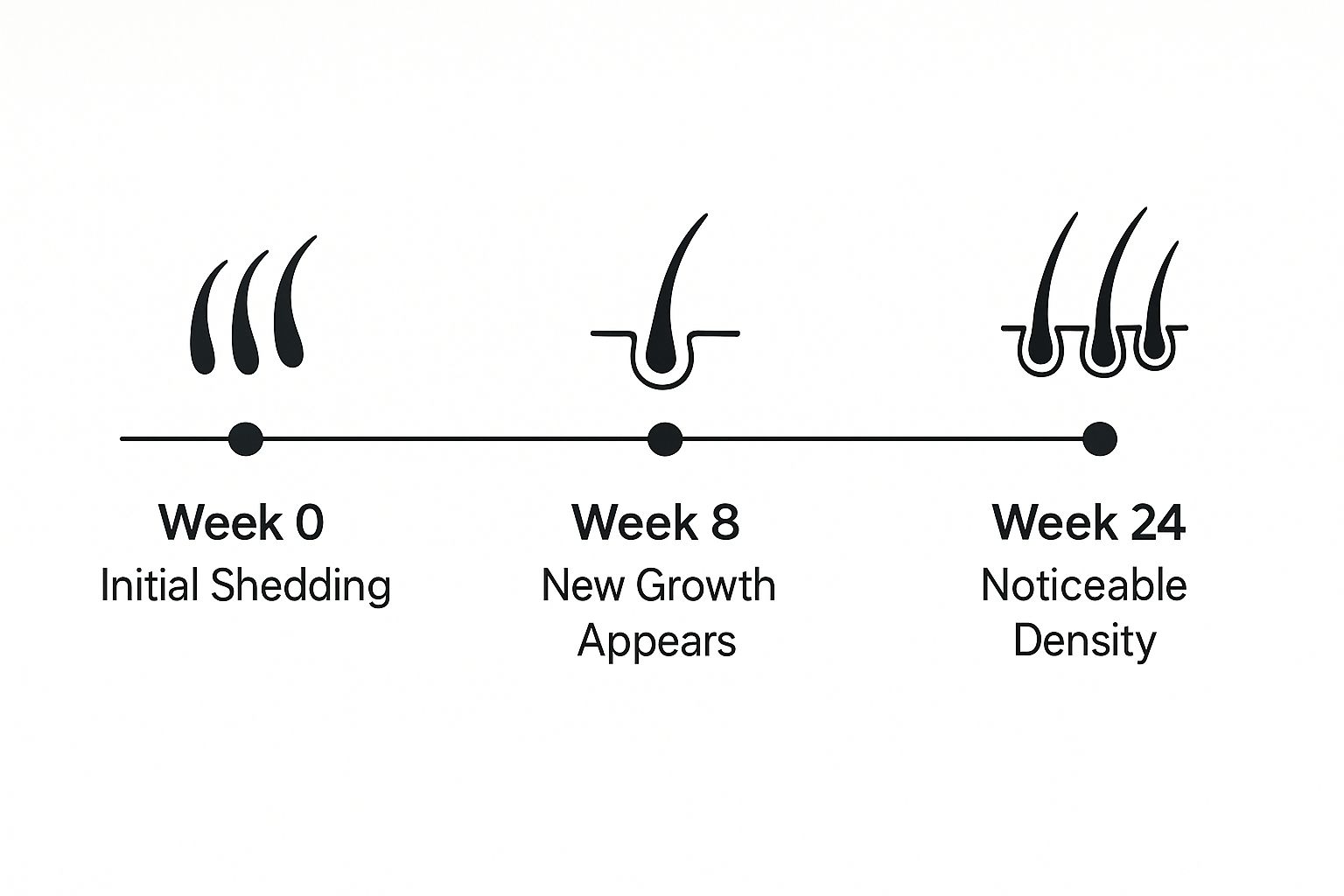
As you can see, the journey moves from preparing the scalp to those first exciting signs of regrowth, with real, visible density appearing closer to the six-month mark.
Both clinical studies and real-world user experiences back this up. Visible results generally start appearing after about 4 months of consistent, twice-daily application. For example, studies on the 5% minoxidil foam show that around 55% of men achieve visibly fuller hair by the 16-week point.
However, to get the absolute best results possible, you'll want to stick with it for 9 to 12 months. It's also critical to know that if you stop the treatment, you can expect the new hair to fall out within three to four months. For more details on what to expect, you can find additional insights on treatment timelines from Healthline.com.
How Rogaine Wakes Up Sleeping Hair Follicles
Before we can talk about how fast Rogaine works, we need to get a clear picture of what it's actually doing up on your scalp. Minoxidil, the workhorse ingredient in Rogaine, doesn't magically sprout brand-new hair follicles. What it does is jolt the existing, shrunken, and sleepy ones back to life.
I like to use a garden analogy. Think of your scalp as a garden bed, and your hair follicles are the little flower bulbs buried just beneath the surface. For many of us, genetics and hormones cause some of these bulbs to go dormant, stop producing vibrant blooms, and essentially fall asleep. Rogaine is like a potent, specialized fertilizer designed to wake them up.
It pulls this off by being a vasodilator, a fancy term that just means it widens the tiny blood vessels around each hair follicle. This is the whole key. By opening up those pathways, it dramatically increases the flow of nutrient-and-oxygen-rich blood right to the hair’s root.
Extending the Growth Phase
This sudden rush of nourishment directly impacts your hair's natural life cycle. Every single hair on your head cycles through a growth phase (anagen), a transition phase (catagen), and a resting phase (telogen), after which it sheds. In people with hereditary hair loss, that anagen growth phase gets shorter and shorter, leading to thinner, weaker hairs with each new cycle.
Rogaine steps in and essentially props the door open on the anagen phase, keeping it going for longer. When follicles get more resources for a longer period, they have the fuel they need to produce thicker, healthier, and more pigmented hair strands. It’s like giving those sleeping flower bulbs a long, extended spring to grow strong and vibrant.
At its core, the science is beautifully simple: better blood flow means better-fed follicles. Well-nourished follicles stay in their active growth phase longer, which results in more substantial hair.
This process is also why you see some weird things happen when you first start. That initial shedding phase everyone talks about? That's just the Rogaine pushing out the old, weak hairs to clear the way for new, healthy growth. It’s not a sign it’s failing—it’s a sign the garden is being tilled and prepped for new seeds.
From Peach Fuzz to Mature Hair
After that shedding period, the very first signs of new growth are usually super fine, soft, and colorless hairs. You might hear them called "peach fuzz" or vellus hairs. In our garden, these are the first tiny green sprouts poking through the soil. They are an incredibly welcome sight because they prove the follicles are waking up and responding.
This is a crucial milestone. Seeing these little hairs is your confirmation that the product is doing its job on your scalp. Stick with it.
With consistent, daily application over the next few months, these vellus hairs will start to mature. They'll transition into what are called terminal hairs—the thicker, longer, colored strands that actually create the appearance of density. Your flowers are finally starting to bloom, filling in the patchiness. This whole journey, from waking the bulb to seeing a full flower, takes time and patience, which is why real, noticeable results take several months to appear.
The Month-By-Month Journey with Rogaine
Understanding the science behind Rogaine is one thing, but knowing what to expect in the mirror is another entirely. The journey can feel a bit like a rollercoaster, especially in the early days when things might seem to be getting worse before they get better.
Let's walk through what a typical year of using Rogaine looks like. Knowing what’s coming will help you stick with it long enough to see the results you're hoping for.
Weeks 2-8: The "Dread Shed"
After a couple of weeks of consistent use, you might notice something that feels completely wrong: more hair in the shower drain or on your brush. This is the notorious "dread shed." It can be unsettling, but take a deep breath—it's actually the best early sign that the treatment is kicking into gear.
Think of it as a changing of the guard on your scalp. Rogaine is essentially waking up your hair follicles and pushing them into a new, more robust growth cycle. To make way for the stronger hairs that are coming, your follicles first have to push out the old, weaker hairs that were getting ready to fall out anyway. It’s a necessary reset.
Months 2-4: First Signs of Hope
Once the shedding phase calms down, the real rebuilding begins. It starts small. Around the two-month mark, if you look closely at your thinning spots, you might start to see the first hints of new growth.
What you're looking for are very fine, soft, almost colorless hairs, often called "peach fuzz." These are known as vellus hairs, and they are proof that previously dormant follicles are stirring back to life. This is a huge milestone. It’s the first real, tangible sign that your patience is paying off.
It's easy to feel discouraged if these first hairs are barely there, but don't be. Their appearance is the critical signal that your scalp is responding. These little sprouts are the precursors to the thicker, healthier hair you're waiting for.
Months 4-9: Visible Progress Emerges
This is where your commitment really starts to show. Those soft, vellus hairs begin to mature. Thanks to the improved blood flow, they start to transform into terminal hairs—the thicker, colored, and stronger hairs that make up the rest of your head.
As these new hairs grow in, they'll start to blend with your existing hair. This creates a noticeable improvement in overall thickness and coverage. By the six-month mark, many people report that not only can they see a difference, but their friends and family can, too. You'll stop hunting for tiny sprouts and start appreciating a fuller look.
Months 9-12: Achieving Peak Density
You'll see great progress by month nine, but the journey isn't quite over. This final stretch is all about maximizing your results. From nine months to the one-year mark, more of those vellus hairs will mature into terminal hairs, and the existing new hairs will continue to thicken.
This timeline is pretty consistent across the board. About 30% of users go through the initial shed, with those first fine hairs showing up around week 8. Clinical trials for the 5% solution show that by four months, a solid 55% of men see cosmetic thickening. However, the best possible results are typically seen closer to a full year of dedicated use. You can dive deeper into the data on minoxidil timelines and user results on Eurekahealth.com.
Ultimately, this whole process proves that when it comes to Rogaine, consistency is everything.
Factors That Speed Up or Slow Down Your Results
Ever wonder why you and a friend could start using Rogaine on the exact same day but have totally different results six months later? It’s completely normal. There’s no single, universal timeline for how quickly Rogaine works. The speed and quality of your results are shaped by a unique mix of factors—some you can control, and others you simply can’t.
Getting a handle on these variables is key to setting realistic expectations for your hair journey. It helps you focus on what you can do to get the best possible outcome while making peace with the things that are just part of your personal biology.
Your Hair Loss Profile
The type and severity of your hair loss are probably the biggest predictors of your success. Rogaine is specifically designed for and most effective against hereditary hair loss (androgenetic alopecia), especially when you catch it early.
Think of it like tending to a garden. It's far easier to revive a wilting plant than to bring a dead one back to life. In the same way, Rogaine works best when your hair follicles are weakened and miniaturized but still alive and kicking.
- Recent Thinning: If your hair started thinning in the last few years, your follicles are likely just dormant. This makes them perfect candidates for being reawakened by minoxidil.
- Vertex (Crown) Area: Rogaine was originally tested and approved for the vertex—that spot on the top of your head. While it can definitely help with a receding hairline, the results are typically more pronounced at the crown.
On the other hand, if your hair loss is advanced or has been progressing for a decade or more, many follicles may have shut down for good. In those situations, Rogaine is still valuable for holding onto the hair you have left, but it might not deliver a ton of new growth.
Product Choice and Consistency
Here’s where you have the real power. Your daily routine and the specific product you use can make or break your results.
Product Concentration: Rogaine is available in 2% and 5% minoxidil formulas. The evidence from clinical trials is crystal clear: the 5% concentration works faster and grows more hair for men. If you’re a man using the 2% solution, don't be surprised if your progress feels a bit slower or less impressive.
Your application routine is non-negotiable for success. Skipping days or applying it haphazardly is like trying to water a plant by just occasionally splashing it. The follicles need a consistent supply of minoxidil to stay in the growth phase.
Application Consistency: This might be the single most critical factor you can control. You absolutely must apply it as directed, every single day. No excuses. Missing applications interrupts the steady stimulation your follicles need, which will slow down your progress or stop it in its tracks. Make it a non-negotiable part of your morning or evening routine, just like brushing your teeth.
By taking charge of these elements, you can give yourself the best shot at seeing real, satisfying results.
Practical Tips to Maximize Your Rogaine Results
Just slapping on some Rogaine and hoping for the best isn't enough if you're serious about results. Think of it this way: you're not just applying a product; you're creating the perfect environment for new hair to sprout and thrive. Moving beyond the basic instructions can be the difference between a so-so outcome and truly impressive regrowth.
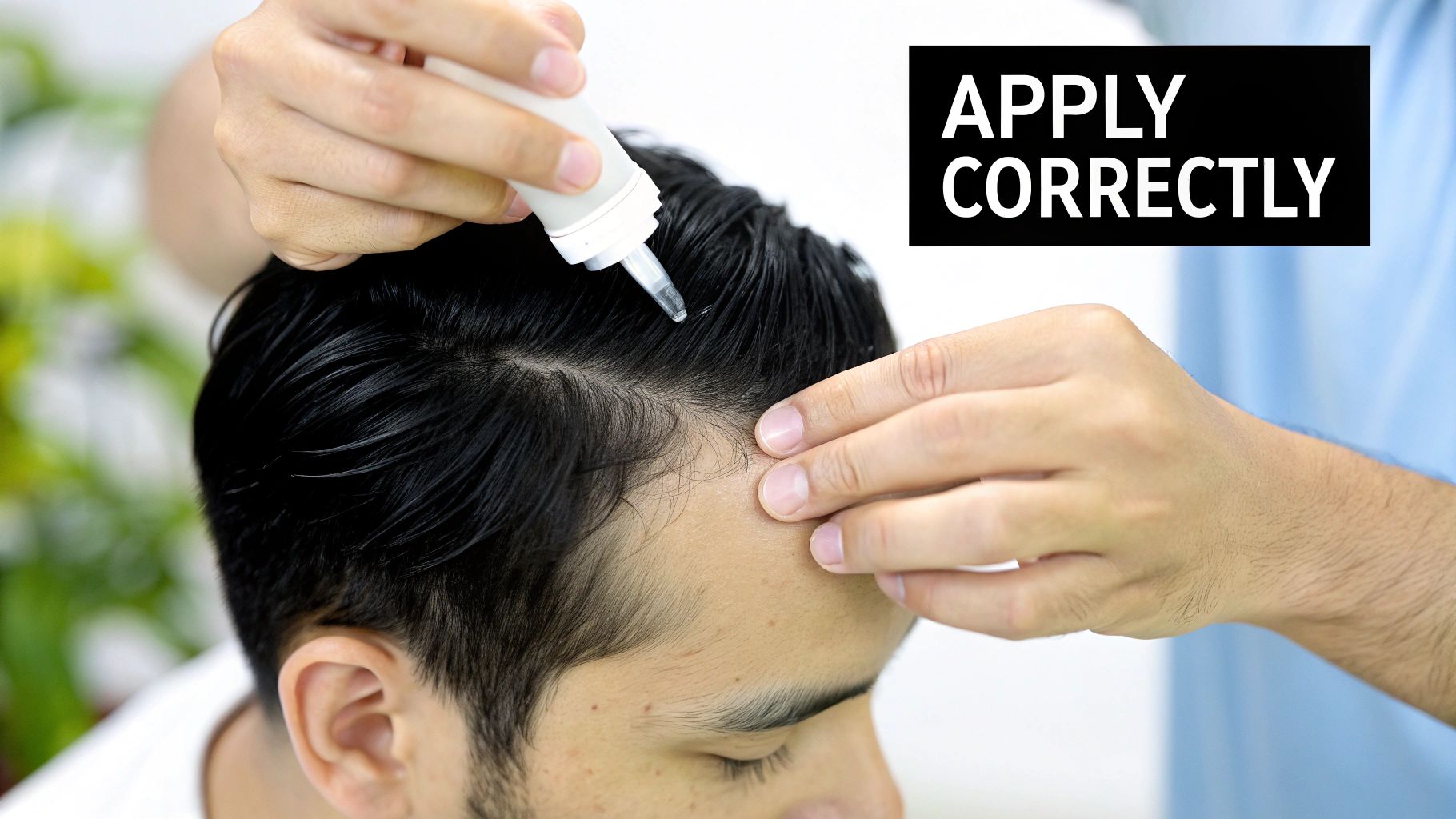
The absolute golden rule is consistency. Skipping applications is like forgetting to water a seedling—it kills the momentum. Your best bet is to anchor it to an existing habit, like brushing your teeth. Do it every day, without fail. Also, a pro tip: always apply Rogaine to a completely dry scalp and hair. Any moisture will dilute the minoxidil and mess with its absorption, meaning less of it gets to the follicles where it counts.
Creating the Ideal Scalp Environment
Your scalp is the garden bed for your hair. If the soil is unhealthy, the plants won't grow well. It's a simple concept, but one that many people overlook. A few small tweaks to your routine can have a surprisingly big impact on how quickly you see progress.
- Choose Gentle Shampoos: Forget those harsh, stripping shampoos. They can irritate your scalp, causing inflammation that works directly against what you're trying to achieve. Look for sulfate-free formulas that clean your hair without creating a hostile environment for your follicles.
- Manage Scalp Buildup: All that product residue, natural oil, and dead skin can clog up your hair follicles, essentially blocking Rogaine from doing its job. A good clarifying shampoo used once a week can cut through the gunk and keep your scalp clean and receptive.
- Be Gentle with Your Hair: Remember, those new hairs are delicate and fragile, especially when wet. Aggressive towel-drying or yanking a comb through your hair can easily pull them out before they have a chance to mature. Pat dry and handle with care.
A key thing to remember is that Rogaine is a powerful tool, but it doesn't work in a vacuum. A healthy scalp, unwavering consistency, and good habits all team up to give you the best shot at significant hair regrowth.
Supporting Growth From the Inside Out
While Rogaine tackles the problem from the outside, what you do for your internal health provides the actual building blocks for new hair. Giving your body what it needs can complement the topical treatment and even speed things up.
Think about incorporating a few lifestyle changes that are known to support healthy hair. Chronic stress is a notorious hair-shedder, so finding ways to manage it through exercise or meditation can make a real difference. And, of course, a balanced diet provides the raw materials. Make sure you're getting enough hair-friendly nutrients like iron, zinc, and biotin, which your follicles need to construct strong, healthy hair strands.
When you combine these internal strategies with your external treatment, you create a powerful, holistic approach that gives you the best possible odds on your regrowth journey.
Your Rogaine Questions, Answered
Even when you know the timeline, starting a new treatment like Rogaine can bring up a lot of questions. It's completely normal. Let's walk through some of the most common concerns so you can feel confident you're on the right track.
What Happens If I Stop Using Rogaine?
This is probably the most important thing to understand before you even start. If you stop using Rogaine, any hair you've regrown will eventually fall out. The treatment's effect is temporary and depends on continuous use to keep hair follicles in their active growth phase.
Think of it like tending to a garden. Your hair will thrive as long as you keep "watering" it with Rogaine. Once you stop, you can expect to lose that new growth within about 3 to 4 months as the follicles revert to their previous state. Consistency is truly the key to keeping your results.
Can I Use Rogaine to Grow a Beard?
You've probably seen this trend online, but it’s important to know that Rogaine is only FDA-approved for hereditary hair loss on the scalp. Trying to use it to grow a beard is what's known as an "off-label" use.
This means its safety and effectiveness for your face haven't been properly studied in clinical trials. You could run into unwanted side effects like skin irritation or even heart palpitations. It’s always best to talk to a dermatologist before using a product for something it wasn't designed for.
Is the "Dread Shed" Guaranteed to Happen?
That initial shedding phase—often called the "dread shed"—is a well-known phenomenon, but it doesn't happen to everyone. Some people notice a definite increase in shedding when they start, while others sail through without ever seeing it.
Ultimately, whether you shed or not has no bearing on your final results. The real game-changer is sticking with the treatment consistently for at least four to six months. So, don't panic and stop if you see some shedding, and don't worry if you don't. Just stay the course.
At PRP For HairLoss, our goal is to give you clear, honest information about all your hair restoration options. While Rogaine is a well-known first step, treatments like Platelet-Rich Plasma therapy can offer another powerful path to regrowth. You can learn more about all your options on our website.
 PRP For Hairloss
Leave a comment