Diving into the world of hair loss treatments can feel a bit like learning a new language. You'll hear medical names for different conditions (like Alopecia), technical terms for the biological processes causing the thinning, and a whole host of names for the treatments themselves. Getting a handle on these key terms is the best first step you can take. It puts you in the driver's seat for an informed chat with a specialist and helps you confidently choose the right path forward.
Quick Guide to Essential Hair Loss Terms
To really get to the bottom of what's causing your hair loss and what can be done about it, you need to know the lingo. This section is your starting point, breaking down the most common terms you'll run into. Once you're familiar with this vocabulary, you'll find it much easier to do your own research and understand what a specialist is telling you.
When you start looking into it, you'll see the term "alopecia" everywhere. It’s just the medical word for hair loss, and there are many different types. The one you’ll see most often is Alopecia Androgenetica—what most of us know as male or female pattern baldness. In fact, it's responsible for about 95% of all hair loss cases around the world. These global hair loss statistics really show how common it is.
Common Conditions at a Glance
The image below gives you a quick visual on the prevalence of the most common types of hair loss you're likely to come across.
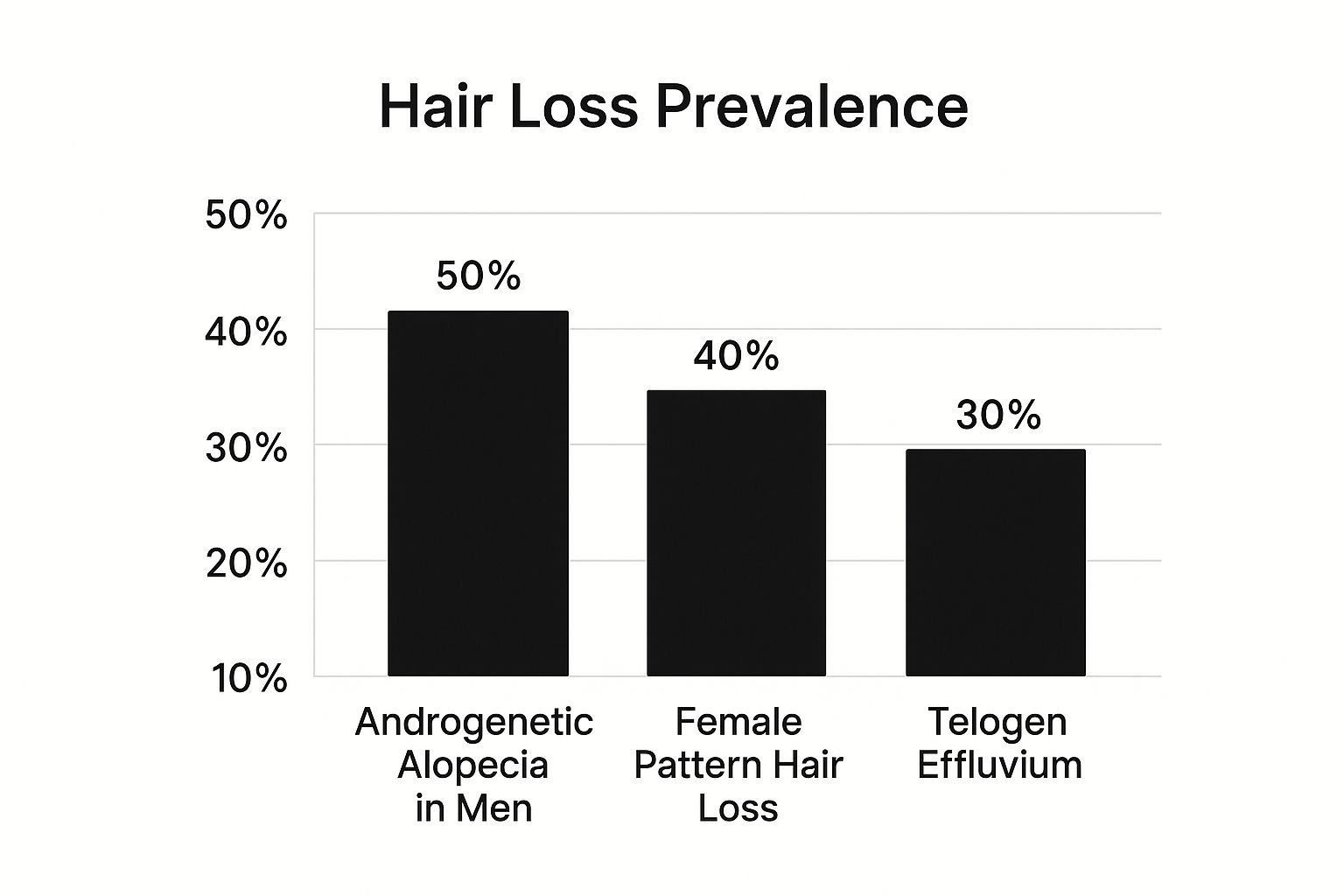
As you can see, pattern hair loss is by far the most widespread condition for both men and women.
For a simple side-by-side look, this table breaks down the most common types of hair loss. It’s a handy reference to quickly tell one from another.
Common Types of Hair Loss at a Glance
| Term | Common Name | Primary Cause | Primary Affected Group |
|---|---|---|---|
| Alopecia Androgenetica | Male/Female Pattern Baldness | Genetics and hormones (DHT) | Men and women |
| Alopecia Areata | Patchy Hair Loss | Autoimmune condition | All genders, often starts in childhood/young adulthood |
| Telogen Effluvium | Diffuse Thinning | Stress, illness, hormonal shifts | Primarily women |
| Traction Alopecia | Mechanical Hair Loss | Repetitive pulling/tension on follicles | Anyone with tight hairstyles |
This quick comparison should help you start to differentiate between the various conditions. Knowing the right name for what you might be experiencing is crucial for finding the right solution.
The Science Behind Your Hair Growth Cycle
To really get a handle on hair loss, you first need to understand how hair grows in the first place. It's not just one long, continuous process. Instead, every single hair on your head goes through a specific cycle with three distinct phases. When you start seeing thinning or bald spots, it's usually because something has thrown this natural rhythm out of whack.
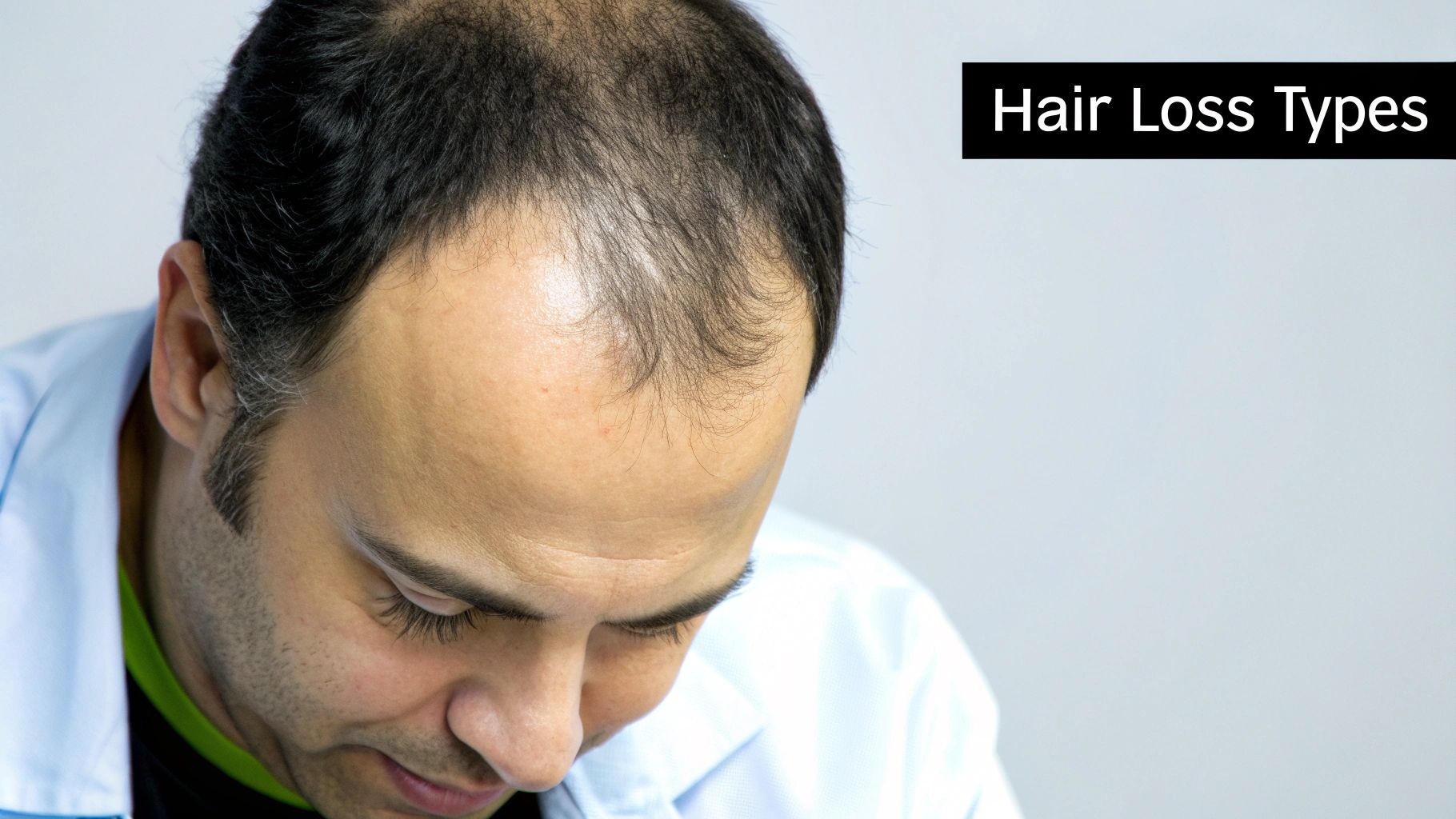
I tell my clients to think of a hair follicle like a tiny, dedicated factory buried in the scalp, tasked with producing one hair strand. The factory's command center is the dermal papilla, a small structure at the base that directs everything by supplying the blood and nutrients needed for growth. This whole operation depends on that microscopic hub.
The Three Phases of Hair Growth
The overall health and thickness of your hair come down to the timing and balance of these three crucial phases.
- Anagen (The Growth Phase): This is the main event. During the Anagen phase, cells inside the follicle are actively dividing and building new hair. Your hair grows about half an inch a month and can stay in this active stage for anywhere from 2 to 6 years.
- Catagen (The Transition Phase): After the growth phase, the hair enters a brief transitional period that only lasts about 2-3 weeks. Growth halts, the follicle begins to shrink, and the hair shaft gets cut off from its vital blood supply.
- Telogen (The Resting Phase): Finally, the follicle takes a break for about 3 months. While the old hair is just sitting there, a new one is already starting to form underneath it. Eventually, that old hair is shed—what you see in your brush or shower drain—and the new strand takes its place, starting the cycle all over again.
This brings us to a critical term you'll hear a lot: miniaturization. This is the core process behind male pattern baldness. It happens when the anagen (growth) phase gets shorter and the telogen (resting) phase gets longer. With each cycle, the follicle shrinks and produces a progressively thinner, weaker, and shorter hair until it eventually just gives up and stops producing hair entirely.
Key Takeaway: Male pattern baldness isn't really about hair falling out faster. It's about the growth phase shortening over time, which results in hairs that are too fine and weak to contribute to a full head of hair.
Of course, a healthy growth cycle relies on a healthy scalp. Creating the right environment is key, and using products like a P 11 Deep Cleanse Scalp Scrub Rosemary Mint can help keep your follicles clear and ready to do their job.
Understanding the Different Types of Alopecia
While "alopecia" is the medical catch-all for hair loss, it’s not a single diagnosis. Think of it more as an umbrella term. Getting to the root of your hair loss means figuring out exactly which type you're dealing with, as each one has its own cause, pattern, and, most importantly, its own path to treatment. Nailing down the specific kind of alopecia is the crucial first step.

If you're experiencing hair loss, you're far from alone. Around 56 million people are in the same boat, including 35 million men. For a lot of guys, it starts surprisingly early—about 25% see the first signs of balding before they even hit 21. That figure climbs to a staggering 66% by age 35. You can dig deeper into these statistics to see just how common this is across different groups.
Androgenetic Alopecia (Pattern Baldness)
This is the big one, the most frequent reason for hair loss in men. You've probably heard it called male pattern baldness. As its name implies, it's a tag-team effort between your genetics and male hormones (androgens). This is what creates that classic M-shaped receding hairline and the thinning spot at the crown. It all comes down to a process called miniaturization, where your hair follicles literally shrink over time, producing finer and shorter hairs until they stop altogether.
Alopecia Areata
This one is a completely different beast. Unlike pattern baldness, Alopecia Areata is an autoimmune issue. In simple terms, your body’s immune system gets confused and starts attacking your healthy hair follicles. This leads to hair falling out in small, sometimes perfectly round, smooth patches. It can pop up suddenly on your scalp, in your beard, or anywhere else on the body, and it can happen at any age.
Telogen Effluvium
Ever go through a really stressful period—a major illness, surgery, or a big life change—and then notice a ton of shedding a few months later? That’s probably Telogen Effluvium. It happens when a significant shock to your system pushes a large number of hair follicles into the resting (telogen) phase all at once. The result is a diffuse, all-over thinning rather than a specific bald spot or receding line.
Important Distinction: The key difference here is that Telogen Effluvium is usually temporary. Once the stressor is gone, the hair typically regrows. This makes it very different from the progressive, long-term nature of Androgenetic Alopecia.
Traction Alopecia
This type of hair loss is entirely mechanical—it's caused by physical stress on the hair. If you consistently wear tight hairstyles like braids, ponytails, or weaves that pull on the scalp, you're at risk. Over time, this constant tension can scar the follicles to the point where they're permanently damaged and can no longer produce hair.
Understanding Hormonal and Genetic Factors
For most men, getting a handle on hair loss starts with a look at the interplay between your genes and hormones. The main player in this story is a powerful hormone called Dihydrotestosterone (DHT). You can think of DHT as the specific trigger that kicks off the process of hair follicle shrinkage.
This potent androgen doesn't just appear on its own; it’s converted from testosterone by an enzyme called 5-alpha reductase. If your hair follicles are genetically programmed to be sensitive to DHT, they'll react to its presence by shrinking over time. This shrinking shortens the hair's growth phase (the anagen phase), which is the textbook definition of what happens in male pattern baldness.

The Norwood Scale Explained
To put a name to the different stages of male pattern baldness, doctors and specialists use a standardized system called the Norwood Scale. It’s essentially a visual guide that breaks down the progression into seven distinct stages, starting from a full head of hair and moving toward the familiar horseshoe pattern.
Why It Matters: Being able to identify your stage on the scale (for example, saying "I'm a Norwood 3 Vertex") gives you a clear and precise way to talk to a professional. It helps set realistic expectations for what treatments can achieve for your specific level of hair loss.
Getting familiar with how these hormones work is crucial. It’s also worth noting that hormonal imbalances can cause other issues beyond hair loss on the scalp; you can learn more about the reasons for unwanted hair growth like hirsutism. When you grasp this core terminology, you'll also understand exactly how medications like Finasteride work—by blocking the 5-alpha reductase enzyme to reduce DHT levels.
A Guy's Guide to Regenerative Medicine and PRP Terms
Diving into the world of advanced hair restoration can feel like learning a new language. You'll start hearing a lot of scientific-sounding terms, especially when it comes to Platelet-Rich Plasma (PRP) therapy. Getting a handle on this lingo is the first step to having a real, productive conversation with a specialist about whether this treatment is right for you.
Let's break down the essential vocabulary you'll come across.
Understanding the Core Components
It all starts with your own blood. The key player here is the Platelet-Rich Plasma (PRP), which is essentially a super-concentrated dose of healing power derived directly from a sample of your blood. The magic isn't in the plasma itself, but in what it carries: platelets.
These platelets are packed with Growth Factors. Think of these as tiny, powerful proteins that act like foremen on a construction site, directing your body’s natural repair and regeneration processes. They're the critical element that helps stimulate your hair follicles.
The Tools and Techniques of the Trade
So, how do we get this liquid gold? Your blood sample is placed into a Centrifuge, a machine that spins incredibly fast. This high-speed rotation separates the heavier red and white blood cells from the lighter, platelet-rich plasma, concentrating all those beneficial growth factors into a potent serum.
Once this PRP is ready, it needs to get to the hair follicles where it can do its job. This is often done using a technique called Microneedling. A specialized device with very fine needles creates tiny, controlled punctures in your scalp. This serves two main purposes:
- It kick-starts your body's own natural healing response, which can stimulate follicle activity.
- It creates micro-channels, allowing the PRP to soak in deeper and reach the follicles more directly.
In a nutshell, the whole idea behind PRP is to use your body's own powerful healing systems to tackle hair thinning. By delivering a concentrated blast of growth factors right where they're needed, the goal is to wake up dormant follicles, boost blood supply, and push your hair back into its active growth phase.
To make things even clearer, here’s a quick-reference table summarizing the key terms you're likely to encounter when discussing PRP for hair restoration.
Key Terminology in PRP Hair Treatment
| Term | Definition | Role in Hair Restoration |
|---|---|---|
| Platelet-Rich Plasma (PRP) | A concentration of platelets from your own blood, suspended in plasma. | The core substance used in the treatment, rich in growth factors to stimulate follicles. |
| Growth Factors | Naturally occurring proteins within platelets that signal cells to heal and regenerate. | Act as messengers to awaken dormant hair follicles and improve scalp health. |
| Centrifuge | A laboratory machine that spins at high speed to separate components of a fluid. | Used to isolate and concentrate the platelets and plasma from your blood sample. |
| Microneedling | A cosmetic procedure using fine needles to create tiny, controlled skin injuries. | Creates channels for PRP absorption and independently stimulates the scalp’s healing response. |
| Anagen Phase | The active growth stage of the hair cycle. | The goal of PRP is to encourage more follicles to enter and remain in this growth phase. |
Familiarizing yourself with these terms will make you much more confident as you navigate your options and talk with professionals about restoring your hair.
A Look at Common Hair Restoration Treatments
When you're exploring ways to tackle hair loss, PRP is just one piece of the puzzle. To really make an informed decision, it helps to get familiar with the other mainstream treatments out there. Getting a handle on this terminology will put you in a much better position to weigh your options.
Two of the biggest names you'll constantly hear about are Minoxidil and Finasteride. These are the go-to non-surgical options for millions of men.
You probably know Minoxidil by its brand name, Rogaine. It’s a topical treatment you apply right to your scalp. Its main job is to kickstart and extend the anagen (growth) phase of your hair follicles while also boosting blood flow to the area.
Finasteride, which you might know as Propecia, is a daily pill that fights hair loss from the inside. It works by blocking an enzyme called 5-alpha reductase, which significantly lowers the amount of DHT—the hormone notorious for shrinking hair follicles—in your body.
Surgical Hair Transplant Options
If you're looking for a more permanent fix, surgery is often the next step. The two leading techniques you'll come across are FUT and FUE.
- Follicular Unit Transplantation (FUT): This is the classic "strip method." A surgeon removes a small strip of tissue, full of healthy hair follicles, from the back of your head. Technicians then carefully dissect that strip into individual follicular units to be transplanted into thinning areas.
- Follicular Unit Extraction (FUE): A more recent and less invasive technique. Instead of a strip, the surgeon extracts individual follicular units directly from the scalp with a tiny, precise punch tool. This method avoids the linear scar associated with FUT.
Key Difference: It all comes down to how the hair is harvested. FUT takes a strip, leaving a fine line of a scar, but often allows for a higher number of grafts in one go. FUE is a meticulous, one-by-one extraction process that leaves no linear scar but can take more time.
Beyond these medical and surgical routes, many guys also look into supportive products. For instance, finding a good Japanese shampoo for hair loss can be a great addition to your overall routine.
Frequently Asked Questions About Hair Loss Terms
Getting a handle on the basic lingo is a great start, but what really counts is knowing what it all means for you. This is where we bridge the gap between simply defining terms and giving you practical, real-world advice. Let's tackle some of the most common questions men have when they're trying to figure out what's happening on their scalp.
If you think you're seeing the first signs of male pattern baldness, don't panic. The best first step is to get a clear picture of where you stand. A great tool for this is the Norwood Scale. Think of it as a personal roadmap; use it to get a rough idea of your current stage of hair loss. This gives you a solid, objective starting point for a discussion with a hair loss specialist. A word to the wise: acting sooner is always better, as early intervention gives you the best shot at success.
Shedding vs. Permanent Loss: How to Tell the Difference
This is a big one. It's probably the most common point of confusion we see: is my hair just shedding temporarily, or is this the real deal? Knowing how to spot the difference is crucial.
-
Temporary Shedding (Telogen Effluvium): This usually feels like it came out of nowhere. You'll notice a sudden, diffuse thinning across your entire scalp, not just in one spot. It's almost always kicked off by a major event—think a serious illness, surgery, or a period of intense stress. The good news is that it typically resolves on its own once your body recovers from the shock.
-
Permanent Loss (Androgenetic Alopecia): This is a slow, creeping process. Unlike sudden shedding, it follows a very predictable pattern, like the classic receding M-shaped hairline or a thinning spot on your crown. This type of loss is genetic and progressive, meaning it won't stop without some form of treatment.
A Quick Self-Check: Ask yourself a simple question. Was the loss sudden and all over? That points towards temporary shedding. Is it a slow, gradual loss in a specific pattern? That's the classic sign of pattern baldness. Getting this distinction right is a fundamental piece of the puzzle.
While our focus is often on men, it's worth noting that hair loss affects everyone, and the terminology applies broadly. Trends show that hair loss is becoming more prevalent in different groups. For instance, in China, the percentage of women reporting hair loss surged from 31% to 53% between 2017 and 2021. You can dive deeper into these figures and more in these comprehensive baldness statistics.
At PRP For HairLoss, we're committed to empowering you with clear, honest information. We believe knowledge is your best tool in tackling hair loss. To explore your treatment options and see how PRP might fit into your plan, take a look at our resources at https://prpforhairloss.com.

 PRP For Hairloss
Leave a comment