When you boil it down, the core difference between finasteride and Propecia is all about branding and price. Think of it this way: Propecia is the original, brand-name version of the 1mg finasteride pill, while what we call "finasteride" is simply the generic—and much more affordable—equivalent.
Medically speaking, they are identical twins. Both contain the exact same active ingredient and work in precisely the same way to treat male pattern baldness.
Finasteride and Propecia: What Is the Difference?
Let's use a common analogy. Comparing finasteride to Propecia is a lot like comparing a generic ibuprofen to Advil. They accomplish the same thing because they are built from the same core component. Propecia was simply the first 1mg finasteride tablet to get the FDA's green light specifically for treating hair loss, which is how it carved out its spot in the market.
Once the patent for Propecia expired, the floodgates opened. Other pharmaceutical companies were then legally permitted to manufacture and sell their own versions, which we now know as generic finasteride. To get to market, these generics have to pass strict FDA standards for bioequivalence, proving they deliver the same clinical punch as the original. The magic is in the active ingredient, finasteride, which blocks the enzyme that turns testosterone into dihydrotestosterone (DHT), the hormone that's the main culprit behind male pattern hair loss.
Brand Name vs. Generic Breakdown
So, if the active ingredient is the same, what is different? The distinctions aren't in the medicine itself but in the surrounding details—like who makes it, what it costs, and how people perceive it.
While the finasteride doing the work is identical, the inactive ingredients can differ. We're talking about the binders, fillers, and coatings that make up the rest of the pill. These variations don't change the drug's effectiveness, but in very rare cases, they might affect how an individual's body tolerates it.
This image really helps to visualize the timeline and key differences.
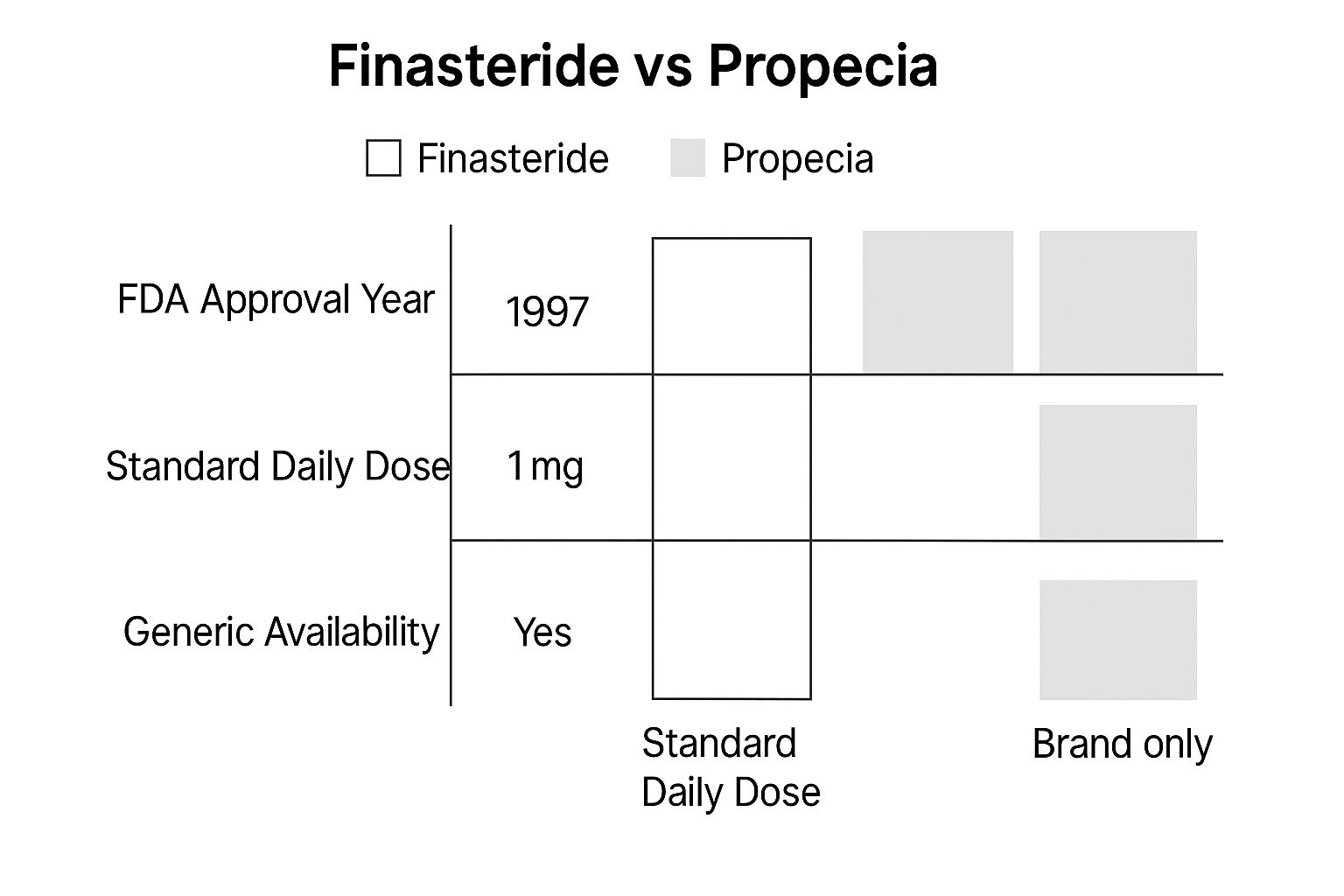
As you can see, Propecia may have been the trailblazer, but its generic counterpart has been on the scene for a long time, providing a widely available and cost-effective alternative. This competition is exactly why there's such a significant price gap between the two.
For a quick side-by-side view, this table lays out the essential facts.
Finasteride vs Propecia at a Glance
| Attribute | Generic Finasteride | Brand-Name Propecia |
|---|---|---|
| Active Ingredient | Finasteride (1mg) | Finasteride (1mg) |
| Medical Purpose | Treats male pattern baldness | Treats male pattern baldness |
| Effectiveness | Medically identical to Propecia | The original FDA-approved drug |
| Cost | Significantly lower | Significantly higher |
| Availability | Widely available from multiple manufacturers | Available only from Merck & Co. |
| Appearance | Varies by manufacturer (different shapes/colors) | Consistent appearance (tan, octagonal tablet) |
Ultimately, both paths lead to the same destination: a clinically proven way to combat hair loss.
The demand for these treatments is only growing stronger. The global market for finasteride tablets is expected to surge from USD 450 million to USD 780 million by 2032, underscoring its crucial role in managing hair loss.
While this guide zeroes in on medical treatments, many people also use various hair products to support their overall hair care routine.
How Finasteride Stops Hair Loss at the Source
Before you can really weigh finasteride against Propecia, you need to understand what the medication actually does. The good news is that the science is exactly the same for both the brand name and the generic. It all boils down to tackling a single, powerful hormone.
The main driver behind male pattern baldness is a hormone called dihydrotestosterone, or DHT. While most people know about testosterone, DHT is a much more potent version that has a destructive effect on the hair follicles on your scalp.
DHT triggers a process known as miniaturization, where it systematically shrinks your hair follicles. This shortens the hair's natural growth phase, causing new hairs to grow back thinner and weaker with each cycle. Eventually, the follicles just give up and stop producing hair entirely. This is the biological domino effect that finasteride is built to stop.
Targeting the Root Cause
Finasteride works by blocking an enzyme called 5-alpha-reductase. You can think of this enzyme as a converter, turning regular testosterone into the highly aggressive, follicle-damaging DHT. Finasteride’s job is to get in there and shut down that conversion process.
By inhibiting this enzyme, finasteride causes a major drop in DHT levels throughout your body, but most critically, right at the scalp. In fact, clinical trials have demonstrated it can slash scalp DHT levels by over 60%—a huge reduction that gives your hair a real chance to recover.
Key Insight: Finasteride’s power lies in its precision. It doesn't just manage the symptoms of thinning hair; it goes straight to the hormonal source and disrupts the very process causing the problem.
This massive drop in DHT is what gives your follicles breathing room. With less DHT on the attack, the miniaturization process can slow down, halt completely, or in many cases, even begin to reverse. This allows your hair to stay in its active growth phase for longer, ultimately resulting in the thicker, stronger hair you’re looking for.
It's no surprise that treatments like this are in high demand. Roughly two-thirds of men will experience some form of hair loss by age 35, creating a huge market for solutions that actually work. Because finasteride is also used to treat conditions like benign prostatic hyperplasia (BPH), its market continues to expand. For a deeper dive into market trends, you can review recent industry analysis.
So, here’s the bottom line: whether you reach for the Propecia box or a generic finasteride prescription, the core mechanism is identical. Both versions deliver the exact same active ingredient to accomplish the same goal—lower DHT and save your hair.
A Practical Cost Comparison of Finasteride and Propecia
When it comes to treating hair loss, the conversation about finasteride versus Propecia almost always lands on one critical factor: the price. This isn't just a minor detail, either. Since finasteride is a long-term, daily medication, the cost difference can add up to thousands of dollars over the years.
So, why the huge price gap? It really comes down to branding and history. Propecia was the original, trailblazing drug developed by Merck & Co. They poured immense resources into the research, clinical trials, and marketing required to get the first 1mg finasteride tablet FDA-approved specifically for male pattern baldness. That massive investment, along with decades of brand building, is baked into its premium price.
Breaking Down the Monthly Costs
Once Propecia's patent expired, the floodgates opened for other companies to produce generic finasteride. These manufacturers didn't have to shoulder those initial R&D costs, allowing them to offer the exact same active ingredient for a tiny fraction of the price. That competition is what makes the treatment so much more accessible today.
While prices can shift based on your pharmacy and location, here's a general snapshot of what to expect:
- Brand-Name Propecia: A 30-day supply will often set you back $120 to $150, and sometimes even more.
- Generic Finasteride: You can typically find a 30-day supply for as low as $25 to $50, and often for much less.
The real financial question becomes: are you willing to pay a 200-400% premium every single month just for the brand name printed on the box? When the medication inside is chemically identical, most people find the answer is a resounding no.
How to Get the Best Price
Your final out-of-pocket cost is rarely set in stone. A few smart moves can slash what you pay, especially for the generic version. The price at one pharmacy might be double what you'd find down the street, so it pays to be a savvy shopper.
One of the most powerful ways to lower costs is by using prescription discount services.
- Check platforms like GoodRx or Blink Health. They often have coupons that can bring the price of generic finasteride down to under $10 per month.
- Don't forget to check your insurance. Many plans won't cover hair loss treatments, labeling them "cosmetic," but some may offer partial coverage, particularly for the more affordable generic.
Ultimately, opting for generic finasteride is the simplest way to make your hair loss treatment sustainable. The savings are substantial and immediate, making it the practical and logical choice for nearly everyone. You’re getting the same key to stopping hair loss, just without the costly brand name attached.
Are Generic and Brand-Name Equally Effective?

When you're comparing generic finasteride and Propecia, one of the first questions that pops up is a big one: does the cheaper generic version really work as well as the brand name? It’s a fair question, and the answer, backed by some pretty strict rules, is yes. Their effectiveness is considered identical.
That confidence comes directly from the U.S. Food and Drug Administration (FDA) and its requirement for something called bioequivalence. Before any generic drug hits the pharmacy shelves, the company making it has to prove to the FDA that it performs just like the original.
Understanding Bioequivalence in Practice
So what does bioequivalence actually mean for you? It means the generic drug must have the exact same active pharmaceutical ingredient (API) as the brand-name version. It also has to match in strength, dosage form (like a tablet), and how it's taken.
In simple terms, the FDA mandates that generic finasteride must release the same amount of its active ingredient into your bloodstream, at the same rate, as Propecia does. This ensures it has the same effect on your body—in this case, blocking the DHT responsible for hair loss.
Now, there can be slight differences in the inactive ingredients. These are the binders and fillers that give the pill its color, shape, and size. You might see a generic finasteride that's a round white pill, while another is a different shape or color. These minor cosmetic variations almost never impact the drug's performance and are considered insignificant for most people.
Key Takeaway: The FDA's tough bioequivalence standards mean that generic finasteride and Propecia are, for all practical purposes, interchangeable. You're getting the same clinical benefit from the generic, just without the brand-name price.
Sticking to the Proven Dosage
Whether you go with generic finasteride or Propecia, the approved and effective dosage for treating male pattern baldness is a single 1mg tablet taken once per day. Consistency is everything when it comes to seeing and keeping your results, so sticking to that daily schedule is crucial.
You may have seen finasteride available in a 5mg dose, which is sold under the brand name Proscar to treat an enlarged prostate. Some people try to save money by cutting these larger pills into quarters.
Frankly, this is a bad idea unless your doctor specifically tells you to do it.
- Uneven Dosing: It's practically impossible to split a tiny pill into four perfectly equal pieces at home. This leads to inconsistent doses from day to day, which can mess with the treatment's overall effectiveness.
- Pill Coating Issues: The coating on these tablets isn't meant to be broken. When you cut them, the coating can crumble, making accurate dosing even more of a guessing game.
To get the reliable results you're after, your best bet is to stick with the 1mg tablets made for hair loss. It takes all the guesswork out of the equation and guarantees you're getting the right therapeutic dose every single day. The choice between finasteride vs Propecia really just boils down to cost, not how well they work.
A Realistic Look at the Potential Side Effects of Finasteride
Whenever you're thinking about starting a new medication, it's a smart move to weigh the good against the bad. Since finasteride is the active ingredient in both generic finasteride and brand-name Propecia, their side effect profiles are identical. The good news is that most men tolerate it very well, but it's still crucial to know about the potential risks before you begin treatment.
For the vast majority of guys, finasteride is a safe and effective way to tackle hair loss without any problems. However, clinical studies did show a small percentage of men experiencing certain side effects, most often related to sexual health.
These can include:
- A drop in libido (sex drive)
- Difficulty getting or maintaining an erection (erectile dysfunction)
- A decrease in the amount of semen
It’s important to put these numbers into perspective. These effects were reported by a very small group—often less than 2% of men in studies—and in many cases, the issues went away on their own after stopping the medication.
Mental Health and Other Factors to Consider
Beyond the physical, some reports have linked finasteride to changes in mood, such as feelings of depression or anxiety. The science on this connection is still developing, but it's something to be mindful of. Keeping an open line of communication with your doctor about any shifts in your mental state is just as vital as watching for physical side effects.
The overwhelming majority of men use finasteride without any significant side effects. Knowing the potential risks simply empowers you to make an informed choice and work with your doctor to monitor your health proactively.
The demand for these treatments is significant, especially in certain parts of the world. North America, for example, currently leads the market in revenue, thanks to the high rates of male pattern baldness and strong public awareness of options like Propecia. If you're interested in the business side of things, you can explore detailed finasteride market research to see these regional trends.
What Is Post-Finasteride Syndrome (PFS)?
If you've spent any time researching finasteride online, you've probably come across the term "post-finasteride syndrome," or PFS. This term describes a collection of persistent side effects—sexual, physical, and neurological—that some individuals report continue even after they’ve stopped taking the drug.
It's really important to approach this topic with a clear and balanced view. Currently, PFS is not recognized as a formal medical diagnosis by many major health organizations. Its existence and the biological reasons behind it are still being debated and researched within the medical community.
The symptoms that men who identify with PFS describe are serious and very real to them. However, the condition is considered to be extremely rare. The best thing you can do is discuss any persistent or troubling symptoms with your doctor. They can help you understand the complete picture, rule out other possible causes for what you're experiencing, and guide you toward the safest and most effective path for your health.
Making an Informed Decision with Your Doctor

Ultimately, the choice between finasteride and Propecia isn't really about finding a "better" medication. They're medically the same. The real decision comes down to your personal priorities and what you're most comfortable with in a treatment plan.
We've established that both options use the exact same active ingredient to work in precisely the same way. The only practical differences are the price tag and the brand name on the box. This simplifies things and helps you create a clear framework for making a choice.
Situational Guidance for Your Choice
Take a moment to think about what matters most to you. Are you laser-focused on getting a clinically proven treatment for the lowest possible cost? Or does the peace of mind that comes with a trusted, long-standing brand name mean more?
Here’s a simple way to break it down:
- If cost is your primary concern: Generic finasteride is the obvious choice. You receive the exact same clinical benefit for a fraction of the price, which makes sticking with the treatment long-term much more affordable.
- If brand trust is your priority: Propecia gives you the assurance of the original, FDA-approved product from one consistent, highly reputable manufacturer. For many men, that added confidence is worth the significant extra cost.
The most crucial takeaway is this: picking between finasteride and Propecia is a secondary decision. Your first, most important move is to talk with a doctor. They can properly diagnose your hair loss and determine if this type of medication is even right for you in the first place.
A healthcare professional can assess your specific condition, walk you through the potential risks and benefits, and provide a prescription. They will make sure you begin your journey safely and with realistic expectations about the road ahead.
The goal of this guide is to arm you with the knowledge you need for that conversation. Now, you can ask the right questions and feel confident in whatever path you choose. Whether you go with the brand name or the generic, you're opting for a treatment backed by decades of proven success in combating male pattern baldness.
Answering Your Top Questions About Finasteride
When you're looking into hair loss treatments, you're bound to have questions. Let's tackle some of the most common ones about finasteride to give you the clarity you need.
Can Women Use Finasteride for Hair Loss?
The short answer is no. Finasteride is not approved for women, and it’s especially dangerous for those who are pregnant or might become pregnant. Because the drug works by altering hormones, it can cause severe birth defects in a male fetus.
For this reason, it's prescribed only to men who are dealing with male pattern baldness.
How Long Until I See Results?
This is a long game, so patience is absolutely essential. Most guys won't see any changes for at least three to four months of daily use. Early on, this might just look like less hair shedding.
The more dramatic results—think noticeable regrowth and thicker hair—often don't show up until the six to twelve-month mark. The key takeaway is that you have to be consistent to see and keep your results.
If I Stop Taking It, Will My Hair Fall Out Again?
Yes, unfortunately, the benefits only last as long as you take the medication. Finasteride actively suppresses DHT, the hormone responsible for shrinking hair follicles. Once you stop, your DHT levels will creep back up to their previous levels.
The hair loss you were trying to prevent will typically resume within 12 months. Any hair you maintained or regrew will likely be lost, which is why finasteride is considered a long-term commitment.
Can I Combine Finasteride with Other Hair Loss Treatments?
Absolutely, and many men find this approach gives them the best results. A popular combination is taking oral finasteride while using a topical treatment like minoxidil (the active ingredient in Rogaine). They attack the problem from two different angles: finasteride works internally on DHT, while minoxidil works on the surface to stimulate follicles.
However, you should always consult your doctor before mixing treatments. A professional can help you build a plan that’s both safe and effective for your specific needs.
At PRP For HairLoss, our goal is to provide clear, reliable information so you can understand every option available for fighting hair loss. We encourage you to explore our resources to learn about advanced treatments like PRP. You can find out more at https://prpforhairloss.com.
 PRP For Hairloss
Leave a comment