Let's get straight to the point: Yes, in many cases, hair loss is reversible. The real answer, however, isn't a simple yes or no. It really hinges on the root cause, how long you've been dealing with it, and the path you take to treat it.
Is Reversing Hair Loss Actually Possible?
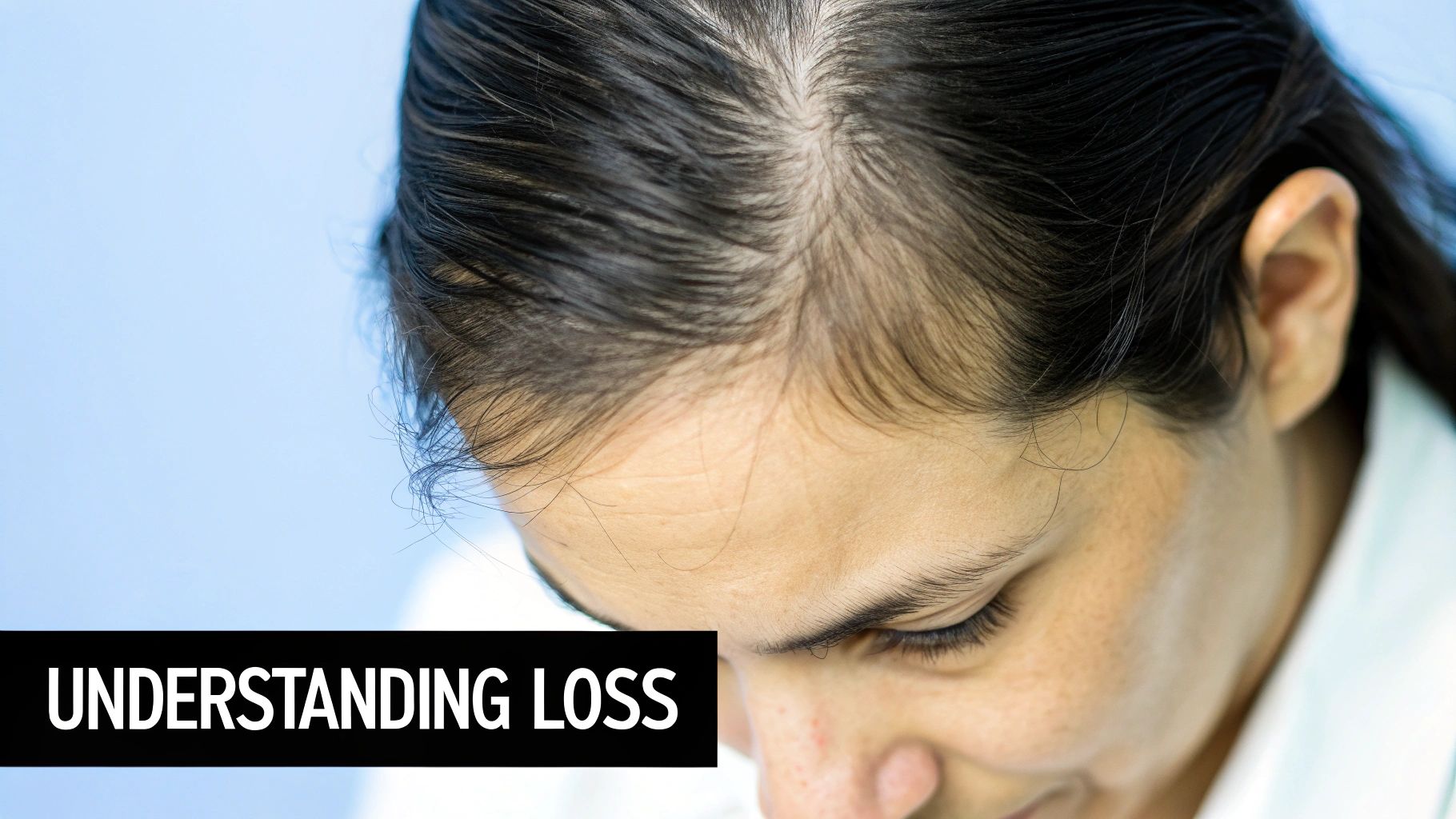
Think of your hair follicles like a garden. If the soil—your scalp—is just lacking nutrients and care, the plants can often grow back with the right attention. But if the roots have been neglected for too long and become permanently damaged, bringing them back to life is a much bigger challenge. Figuring out if your "garden" can be saved starts with identifying what's causing the trouble in the first place.
This is the most critical question you'll face on the journey to restoring your hair. The good news is that for many common types of hair loss, scientific evidence shows the potential for reversal is high, especially when you act early.
Understanding The Potential For Reversal
The key really comes down to the state of your hair follicles. Are they just dormant—asleep but still alive—or have they shrunk and scarred to the point of no return? For a lot of people, the follicles are simply stuck in a prolonged resting phase, often triggered by things like stress, poor nutrition, or hormonal shifts.
A condition called Telogen Effluvium is a perfect example of reversible hair loss. It's usually caused by a major shock to your system, like a serious illness, rapid weight loss, or intense stress. In these situations, the body forces a huge number of hairs into the shedding phase all at once. The encouraging part is that once the stressor is gone, the hair growth cycle typically gets back on track within a few months.
Key Insight: Reversing hair loss isn't about finding a single magic "cure." It's about getting an accurate diagnosis for the specific cause and then addressing it directly. This is the most powerful first step you can take.
To give you a clearer picture of where your situation might fall, we've put together a quick guide. It breaks down the most common types of hair loss and their general potential for reversal, helping you set realistic expectations.
Hair Loss Types and Reversibility Potential
This table provides a snapshot of common hair loss conditions and how likely they are to respond to the right intervention.
| Type of Hair Loss | Primary Cause | General Reversibility |
|---|---|---|
| Androgenetic Alopecia (Pattern Baldness) | Genetics & Hormones (DHT) | Reversible with consistent, long-term treatment |
| Telogen Effluvium | Stress, Illness, Nutritional Gaps | Highly reversible once the trigger is resolved |
| Traction Alopecia | Physical Stress from Hairstyles | Reversible if caught early; may be permanent if scarring occurs |
| Alopecia Areata | Autoimmune Condition | Often reversible, but can be unpredictable |
Remember, this is a general guide. The best way to understand your unique situation and treatment options is to consult with a specialist who can provide a precise diagnosis.
Understanding Your Hair's Natural Growth Cycle
Before we can even begin to talk about reversing hair loss, we have to get on the same page about how hair actually grows. It's not a static process. Think of each hair on your head as having its own distinct lifespan—a four-stage journey of growing, transitioning, resting, and finally, shedding.
Grasping this natural rhythm is crucial. Why? Because hair loss isn't usually an abrupt event where follicles just give up. It’s almost always a problem of disruption, where something throws this beautifully balanced cycle completely out of whack.
At any given moment, the vast majority of your hair—around 85-90% of it—is actively growing. This is the first, and most important, stage.
The Anagen Or Growth Phase
We call this active period the Anagen phase. Deep inside the follicle, cells are rapidly dividing and building the hair strand, pushing it upward and outward. This phase dictates the maximum length your hair can ever reach, lasting anywhere from two to seven years depending on your genetics.
When your body is running smoothly, this phase is a model of efficiency, producing strong, healthy hair. But it's also the most sensitive part of the cycle, and the first to suffer when things go wrong.
The Catagen And Telogen Phases
Once the Anagen phase wraps up, the hair enters a short transitional period called the Catagen phase. Lasting only two or three weeks, this is when the hair strand stops growing and the follicle begins to shrink, cutting itself off from the blood supply that nourished it.
Next up is the Telogen phase, or the resting stage. For about three months, the old "club hair" just sits there while, underneath it, a brand new hair starts to form in the same follicle, getting ready to start its own growth journey. Typically, about 10-15% of your hairs are in this resting state at any time.
The Exogen Or Shedding Phase
The final act is the Exogen phase, which is really just the end of the resting stage. This is when the old, resting hair is finally pushed out and sheds to make way for the new hair coming in behind it. Shedding between 50 and 100 hairs a day is perfectly normal; it’s just the cycle completing itself.
The real trouble begins when this finely tuned process gets disturbed. The image below highlights the common culprits that can knock this cycle off-balance.
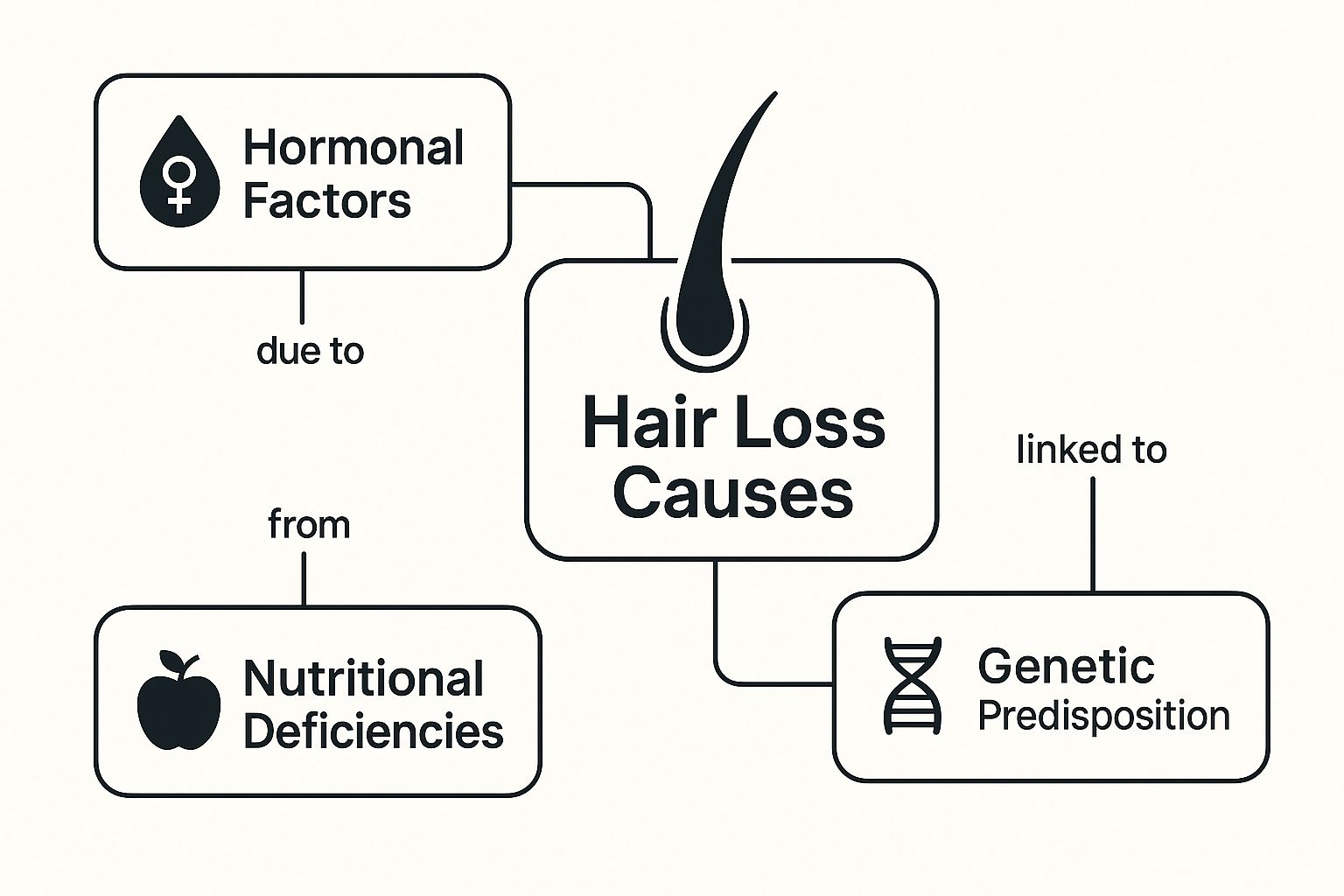
As you can see, things like hormonal changes (especially DHT), nutritional shortfalls, and your own genetic blueprint are the primary troublemakers that interfere with your hair's natural rhythm.
What Happens When The Cycle Is Disrupted
So what does a "disrupted" cycle actually mean for your hair? When triggers like hormones, stress, or poor nutrition enter the picture, they deliver a one-two punch:
- They cut the Anagen (growth) phase short.
- They push more hair follicles into the Telogen (resting) phase way too soon.
The result is a frustrating downward spiral. You start shedding more hair than usual, and the new hairs that grow back are thinner, weaker, and less pigmented because their growth phase was interrupted. This progressive shrinking of the hair is called miniaturization, and it's the classic sign of androgenetic alopecia, or pattern hair loss. If left unchecked, the follicle can shrink so much that it simply stops producing any visible hair at all.
The Bottom Line: Reversing hair loss isn't about magic or growing brand-new follicles. It's about intervening in this disrupted cycle. The goal is to wake up dormant follicles, coax them back into a longer Anagen phase, and shield them from the triggers causing them to shrink and weaken. It's all about restoring your hair's healthy, natural growth rhythm.
What Determines If Your Hair Will Grow Back?
So, can you get your hair back? The general answer is yes, but the real answer for you gets a lot more personal. It all comes down to one crucial thing: the current state of your hair follicles. Think of them as the tiny, powerful engines that build each strand of hair. Their health is everything when it comes to reversing hair loss.
Here’s a helpful way to picture it. Imagine your scalp is covered in tiny light bulbs. A dormant follicle is like a bulb that’s just been switched off. The power is still connected, the filament is intact—it just needs the right signal to light up again. But a dead or scarred follicle? That’s like a shattered bulb. No matter how much power you send its way, it’s never going to glow again. Figuring out which state most of your follicles are in is the first step to knowing what’s possible.
Dormant Versus Damaged Follicles
The most critical distinction we need to make is whether your hair follicles are just sleeping or if they're gone for good.
A dormant follicle is still alive. It's connected to its blood supply and has all the machinery to produce hair. It’s just temporarily shut down production, maybe due to hormonal shifts, a period of high stress, or a nutritional deficiency. The key takeaway is that the potential to grow hair is still there.
A dead follicle, on the other hand, is one that has scarred over or has shrunk so much that it's disconnected from its life-giving blood supply. At this stage, no treatment—no cream, pill, or therapy—can bring it back to life. This is precisely why catching hair loss early makes such a massive difference.
The Point of No Return: When a follicle stays dormant and continues to be bombarded by negative signals (like the hormone DHT), it gets weaker and weaker. Over time, this temporary dormancy can become permanent. The goal of any effective hair loss treatment is to jump in and wake those follicles up before they cross that line.
Let's look at two very different, real-world examples:
-
Scenario A: The Stressed Professional: A man notices a ton of shedding after a few incredibly stressful months at his job. His follicles have been prematurely pushed into a resting phase, a condition called Telogen Effluvium. The good news is the follicles themselves are perfectly healthy. Once his stress levels return to normal, his chances of a full recovery are excellent.
-
Scenario B: The Long-Term Thinner: A man has been gradually losing his hair for over a decade due to male pattern baldness, or Androgenetic Alopecia. For years, the hormone DHT has been relentlessly shrinking his follicles. Many have now miniaturized to the point of being effectively dead. While he can still get great results by saving the follicles that are merely dormant, he can't revive the ones that have already scarred over and shut down permanently.
The Critical Role Of Early Intervention
These scenarios really hammer home why timing is everything. The longer you wait, the more of your follicles make the journey from a salvageable, dormant state to a permanently non-productive one.
It’s just like tending to a wilting plant. If you catch it early and give it a good watering, it perks right back up. But if you wait until the leaves are brown and the roots have rotted, no amount of care is going to save it.
Several factors influence this timeline and your potential for regrowth:
- Duration of Hair Loss: If you've only been thinning for a year or two, you have a much larger pool of viable, dormant follicles to work with. This gives treatments a much better chance of success compared to someone who has been extensively bald for many years.
- Type of Hair Loss: As we saw, temporary conditions like Telogen Effluvium are often completely reversible because the follicle isn't permanently damaged. Genetic hair loss, however, is a progressive battle that causes lasting damage if you don't fight back.
- Genetic Predisposition: If baldness runs in your family, your follicles are likely more sensitive to DHT's miniaturizing effect. For you, taking early action is non-negotiable.
Ultimately, figuring out if your hair loss is reversible comes down to taking an inventory. How many of your follicles are just sleeping, and how many are gone for good? Acting quickly is the best way to ensure you save as many as you can before they cross that point of no return.
Proven Topical Treatments That Can Reverse Hair Loss
When you're trying to figure out if hair loss is reversible, topical treatments are usually the first place people start. These are solutions you apply directly to your scalp, and they happen to be some of the most well-researched and accessible tools we have for waking up dormant follicles.
Don't think of these as overnight miracles. It's more helpful to see them as a dedicated workout routine for your hair. They work consistently in the background to improve the scalp environment, strengthen weakened follicles, and nudge them back into the active growth (Anagen) phase we talked about earlier.
Minoxidil: The First FDA-Approved Topical
Minoxidil, which most people know as Rogaine, is really the foundation of topical hair loss treatments. It has a fascinating backstory—it was first developed as a pill for high blood pressure, but doctors soon noticed a very welcome side effect: their patients were growing more hair.
That happy accident led to its rebirth as a topical solution. Minoxidil’s main job is to act as a vasodilator. Picture the tiny blood vessels feeding your hair follicles as narrow, constricted pipes. Minoxidil basically widens those pipes, letting a rush of oxygen, blood, and nutrients get directly to the follicle.
This nutrient surge accomplishes two key things:
- It helps push follicles out of their resting (Telogen) phase and into the growth (Anagen) phase.
- It can extend the Anagen phase, leading to visibly thicker and healthier hair strands over time.
For a lot of guys, this makes a huge difference. In one year-long observational study of nearly 1,000 men using 5% minoxidil twice a day, dermatologists rated the treatment as "effective" or "very effective" for 63.7% of them. Even better, the actual area of hair loss got smaller for 62% of the men.
How to Use Topical Treatments Effectively
If you’re going to use a topical, consistency is everything. It’s not optional. Applying it has to become as automatic as brushing your teeth. If you start skipping days or stop completely, any hair you’ve regrown or maintained will likely fall out, because the follicles will just go back to their previous state.
Key Takeaway: Topical treatments like Minoxidil don’t cure the root cause of genetic hair loss. They work by continuously counteracting its effects. As long as you keep using them, they help keep your follicles active.
For the best results, always put the solution on a dry scalp so it can be absorbed properly. Gently massaging it in can also boost circulation and help it reach the follicles. But most of all, you need patience. It usually takes at least three to six months of consistent use before you see any real changes in shedding or new growth. While we're talking about medical treatments, many people also like to explore other avenues; you can find guides to top natural hair products that can complement a regrowth routine.
Emerging Topical Compounds and Formulations
Minoxidil is still a heavyweight champion, but the science of hair restoration is always moving forward. Researchers are constantly developing new topical compounds that attack hair loss from different angles, often blending them into powerful, multi-action formulas.
These newer solutions frequently include ingredients that go beyond just improving blood flow to tackle other aspects of hair health.
Common Ingredients in Advanced Topicals
| Ingredient Type | Primary Function & How It Helps |
|---|---|
| DHT Blockers | Ingredients like Saw Palmetto or Azelaic Acid work right on the scalp to lower DHT levels, giving follicles direct protection from miniaturization. |
| Anti-Inflammatories | Things like caffeine or certain peptides help calm down scalp inflammation, which creates a much healthier and more supportive environment for hair to grow. |
| Growth Stimulants | Newer molecules such as Aminexil or Stemoxydine work to reinforce how the hair is anchored in the follicle, which cuts down on shedding and helps with density. |
When you combine these ingredients with a vasodilator like Minoxidil, you get a multi-pronged attack. Think of it like sending in a team of specialists: one opens the supply lines (vasodilator), another defends the base (DHT blocker), and a third fortifies the whole structure (growth stimulant). This kind of synergy is why many modern formulas are showing such great promise for men trying to reverse their hair loss.
The Future of Hair Restoration Technology

While the established topical treatments are a solid foundation, the science of hair restoration is always moving forward. For men looking for more than the standard options, a new wave of technologies and therapies is opening up some exciting doors. We're moving beyond just slowing down hair loss and stepping into an era focused on actively rejuvenating the hair follicles themselves.
This is a big deal, especially for guys who feel like they've exhausted their options. It shows that science is finding more direct and powerful ways to stimulate real regrowth, making the answer to "is hair loss reversible?" more optimistic every year.
One of the most proven advanced therapies available right now is Low-Level Laser Therapy (LLLT). This isn't some futuristic gimmick; it's a clinically backed treatment that uses specific wavelengths of red light to give your hair follicles a much-needed energy boost at the cellular level.
Energizing Follicles with Light
Picture a sleepy hair follicle as a battery that's nearly dead. It still has the blueprint to grow hair, but it just doesn't have the juice. LLLT acts like a sophisticated battery charger, delivering targeted light energy—a process called photobiomodulation—directly to the cells within the follicle. This jumpstarts cellular metabolism and cranks up the production of ATP, the fuel that powers our cells.
This fresh surge of energy accomplishes a few critical things:
- It helps nudge follicles out of the resting (telogen) phase and back into the active growth (anagen) phase.
- It improves blood flow to the scalp, bringing a richer supply of nutrients right where they're needed.
- It can help calm inflammation around the follicle, creating a healthier, more hospitable environment for hair to thrive.
The great thing is that LLLT is no longer just an in-office treatment. It's now widely available in user-friendly at-home caps and combs, making it a practical option for consistent use.
The real beauty of LLLT is that it works by waking up dormant follicles without chemicals or invasive procedures. It’s simply giving them the raw energy they need to get back to their natural job of producing hair.
And the clinical evidence is solid. A major 2014 study looked at 269 men and women with pattern hair loss. After 26 weeks, the groups using LLLT devices saw statistically significant improvements in hair density compared to those using a sham device. This isn't just wishful thinking; the therapy has a measurable biological effect. You can dig into the full findings from this landmark trial to see the data for yourself.
Promising Therapies on the Horizon
Looking beyond light therapy, researchers are fine-tuning a whole new generation of treatments. These are designed to target the biological triggers of hair loss with remarkable precision. While many are still in the pipeline, they give us a preview of what hair restoration could look like in the next decade.
- Peptide Therapies: Specific peptides (which are just short chains of amino acids) are being investigated for their ability to signal hair follicles to grow and to anchor the hair shaft more firmly, which could reduce shedding and improve overall thickness.
- Stem Cell Applications: This is one of the most exciting frontiers. The research here aims to use a person's own stem cells to regenerate miniaturized or even lost hair follicles. The ultimate goal is to grow entirely new, healthy follicles from scratch.
- Advanced Drug Delivery: Scientists are devising clever new ways to get active ingredients directly to the hair follicle. Think of microscopic delivery systems that can increase a drug's effectiveness while minimizing potential side effects elsewhere.
These developments signal a fundamental shift in our approach. Instead of playing defense against hair loss, the future is all about going on offense—actively rebuilding and regenerating the scalp's ability to grow healthy hair. This is what's making the idea of reversing hair loss more of a reality than ever before.
Your Action Plan for Hair Regrowth
So, we've walked through the science of how hair loss works and what treatments are out there. Now it's time to put all that knowledge into practice with a clear, straightforward roadmap.
The most powerful takeaway is this: whether or not your hair loss is reversible often depends on taking decisive, well-informed action. And that entire journey starts with one crucial step.
Start with a Proper Diagnosis
Before you spend a single dollar or a single minute on any treatment, you absolutely must know what you're dealing with. Trying to guess the cause of your hair loss can lead you down a frustrating path of using products that simply won't work for your specific situation. It’s the most common mistake people make.
Think of it this way: you wouldn't take medication for a headache if you actually had a broken arm. The same logic applies here. A consultation with a dermatologist or a dedicated hair restoration specialist is non-negotiable. They have the tools and expertise to pinpoint the exact type of hair loss you have—whether it’s genetic, triggered by stress, or something else entirely—and see how healthy your follicles still are. This professional insight is the foundation of any successful regrowth strategy.
Building Your Personal Strategy
Once you have a confirmed diagnosis, you can finally move forward with real confidence. The road to getting your hair back isn't a one-size-fits-all deal; it's about creating a personalized plan based on science and, most importantly, sticking with it.
Here’s a simple, step-by-step approach to get you started:
-
See a Professional: This is your starting line. A specialist will uncover the root cause of your hair loss, which immediately narrows down the most effective ways to treat it.
-
Learn Your Condition: With a diagnosis in hand, like Androgenetic Alopecia or Telogen Effluvium, you can do your own research. Understanding the "why" behind your hair loss makes the "how" of treatment make so much more sense.
-
Discuss Proven Treatments: Have an open conversation with your doctor about clinically backed options. This could be Minoxidil, Finasteride, LLLT, or even Platelet-Rich Plasma (PRP) therapy. Each one works in a different way, and the best choice for you will depend on your diagnosis, budget, and personal goals.
-
Commit to the Plan: This is where the magic happens. Reversing hair loss takes patience and real consistency. Whether you’re applying a topical foam every night or coming in for a series of PRP sessions, sticking to the routine is the only way you'll see results.
Key Takeaway: Meaningful hair regrowth is a marathon, not a sprint. The hair growth cycle is naturally slow, so it takes time for sleeping follicles to wake up and produce hair that you can actually see. You have to commit to a proven plan for at least six to nine months to give it a fair shot.
Recent clinical data really drives this point home. A 2023 study on a new hair restoration technology, for example, found that shedding was significantly reduced after six months. But the real payoff came at the nine-month mark, when average hair growth had increased by up to 32.5%. It's a perfect illustration of how consistent treatment delivers measurable results over time. You can dig into the detailed findings on this hair restoration study yourself.
Ultimately, taking control of your hair health is incredibly empowering. When you have a clear diagnosis and a strategic, science-backed plan, you're no longer just hoping for the best—you're equipped to fight back against hair loss and work toward real, lasting regrowth.
Common Questions About Reversing Hair Loss
Once you start digging into the science of hair restoration, a lot of practical questions pop up. It's only natural to wonder about timelines, how your lifestyle plays a role, and what happens if you ever stop treatment. Getting straight answers to these questions is crucial for setting realistic expectations and feeling confident about the path you choose.
Let's walk through some of the most common questions people ask. Getting these answers sorted out will help you figure out what's possible for your own situation.
How Long Does It Take To See Results?
When it comes to regrowing hair, patience isn't just a virtue—it's a requirement. The hair growth cycle moves at its own unhurried pace, so you have to be consistent with any treatment you try.
You can expect to see the very first signs of progress after about three to six months of consistent use. Don't expect a full, thick mane right away. The initial changes are usually subtle, like shedding less hair in the shower or noticing some soft, new "peach fuzz" along your hairline. To see a real, noticeable difference in density and thickness, you're looking at a commitment of up to a year, sometimes even longer.
Crucial Reminder: The biggest mistake people make is giving up too soon. You absolutely have to stick with a proven treatment for the full recommended time before you can decide if it's working for you.
Can Lifestyle Changes Alone Reverse Hair Loss?
This one completely depends on why you're losing hair in the first place. For some types of hair loss, simple changes to your daily routine can absolutely turn things around.
If the culprit is Telogen Effluvium—a type of shedding often triggered by major stress, a serious illness, or a big nutritional deficiency—then yes, lifestyle changes can often lead to a full recovery. When you get your stress under control or fix the nutritional gaps by getting enough iron, zinc, and biotin, you remove the trigger. Your hair growth cycle then naturally gets back on track.
But for genetic conditions like Androgenetic Alopecia (what we all know as pattern baldness), a healthy lifestyle helps, but it’s rarely enough to do the job on its own. Good nutrition and stress management create a healthier foundation for hair to grow, but they can't block the hormonal process that causes follicles to shrink. In these cases, you almost always need medical treatments to see any meaningful regrowth.
What Happens If I Stop My Treatment?
For an ongoing, progressive condition like male pattern baldness, the answer is pretty clear: yes, the hair you worked so hard to regrow will eventually fall out. Treatments like minoxidil and finasteride don't cure the underlying condition; they just hold it at bay by fighting the genetic and hormonal triggers.
Think of it like putting up a shield. When you stop the treatment, you take that shield down. The miniaturization process caused by DHT kicks back into gear, and the follicles start shrinking again. Within a few months, most of the hair you maintained or regrew with the treatment will likely be lost. For genetic hair loss, true long-term success hinges on continuous, uninterrupted use of your chosen therapy.
At PRP For HairLoss, we focus on giving men the latest, science-backed information on treatments that actually work, including PRP therapy. To learn how you can take charge of your hair restoration, explore your options at PRPforhairloss.com.

 PRP For Hairloss
Leave a comment