So, you're asking yourself, "Is my hair actually thinning?" It's a common concern, and the answer usually isn't found in a sudden, dramatic hair loss event. Instead, it’s the small, almost unnoticeable changes that creep up over time.
Maybe you've noticed your part line looks a little wider than it used to, or your ponytail just doesn't feel as full. Perhaps you’ve caught a glimpse of your scalp under bright lights. These are often the very first whispers that something is changing.
The Tell-Tale Signs of Thinning Hair
Realizing your hair is thinning can be a bit of a shock, but you're definitely not alone. For most of us, this doesn't happen overnight. It's a slow burn—a gradual process you might only catch when you see an old photo or find yourself wrapping your hair tie an extra time.
This visual breaks down some of the key things to look out for, along with some baseline numbers to keep in mind.
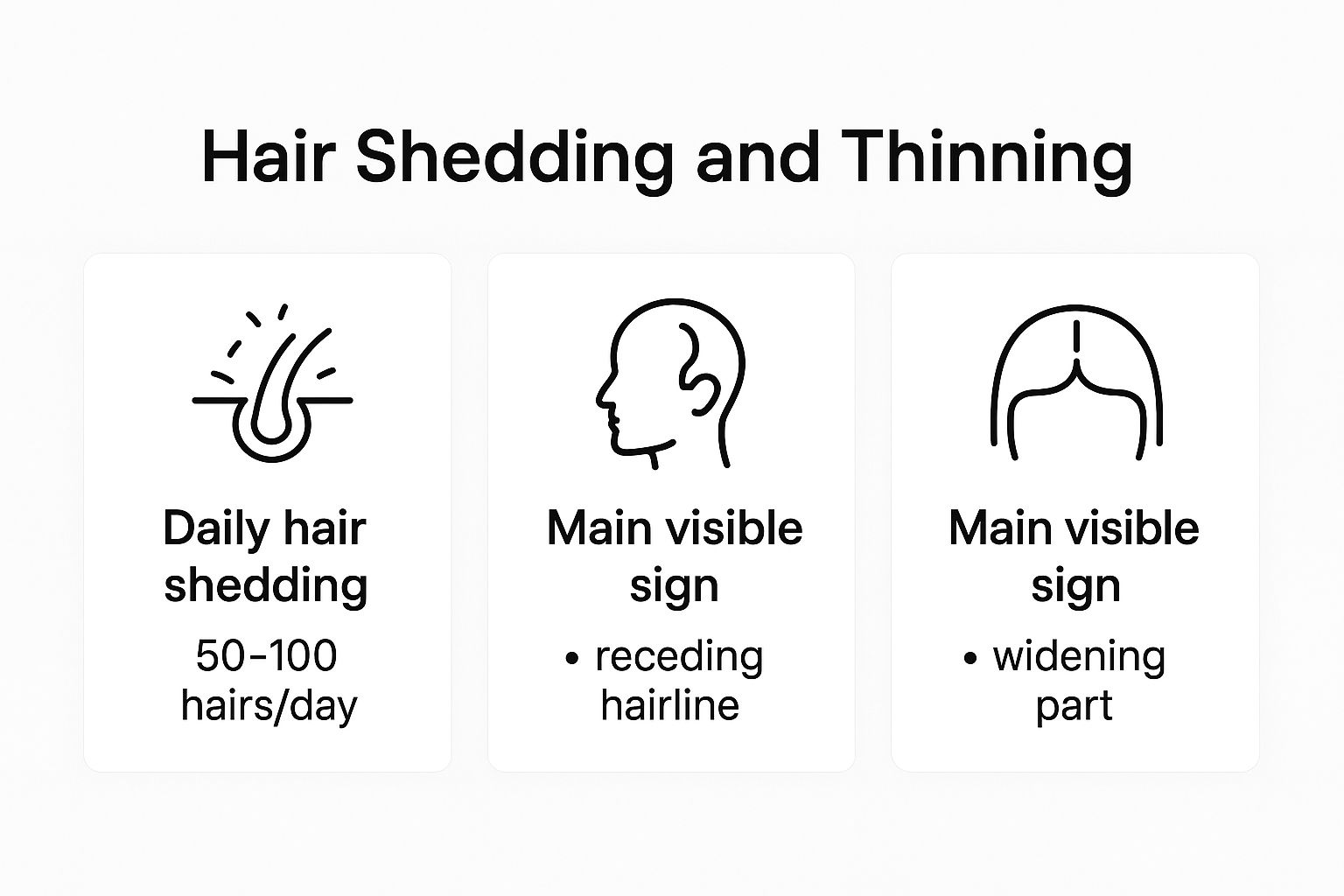
As you can see, shedding up to 100 hairs a day is perfectly normal. It's the more noticeable shifts, like a visible change in your part or hairline, that really signal it's time to pay closer attention.
What to Actually Look For
Once you know what to watch for, the signs are pretty clear. The main thing you'll notice is a gradual decrease in hair density. This is why your scalp might suddenly seem more prominent, especially under direct lighting. It’s not just in your head; it’s a tangible physical change.
This is a widely recognized symptom. In fact, medical experts point out that about 26% of people with hair loss conditions cite reduced density as a primary sign. It's an incredibly common experience, impacting an estimated 85% of men and 33% of women during their lifetime. If you want to dive deeper, you can find more hair loss statistics from medical studies that highlight just how widespread this is.
My Two Cents: Don't just focus on the hairs in your brush. Pay more attention to how your hair feels and looks over several weeks or months. Real-world changes, like needing that extra loop in your ponytail holder, are far more telling than trying to count every single shed hair.
To make this easier, I've put together a quick reference table. It breaks down the most common signs and what they really mean in your day-to-day life.
Quick Guide to Spotting Thinning Hair
| Common Sign | What It Means | What to Look For |
|---|---|---|
| Widening Part | Your hair density is decreasing right where you part it. | Check in the mirror. Does your part line look wider? Is more scalp showing through? |
| Thinner Ponytail | You're experiencing an overall drop in hair volume. | Your hair tie needs an extra twist to feel secure, or the ponytail itself feels lighter. |
| More Scalp Visibility | Hair strands may be getting finer, or there are simply fewer of them. | You notice your scalp shining through, particularly under sunlight or bright indoor lights. |
Keep these points in mind as you go about your routine. Spotting the signs early gives you a major advantage in figuring out your next steps.
Your Hair Part and Scalp Tell a Story
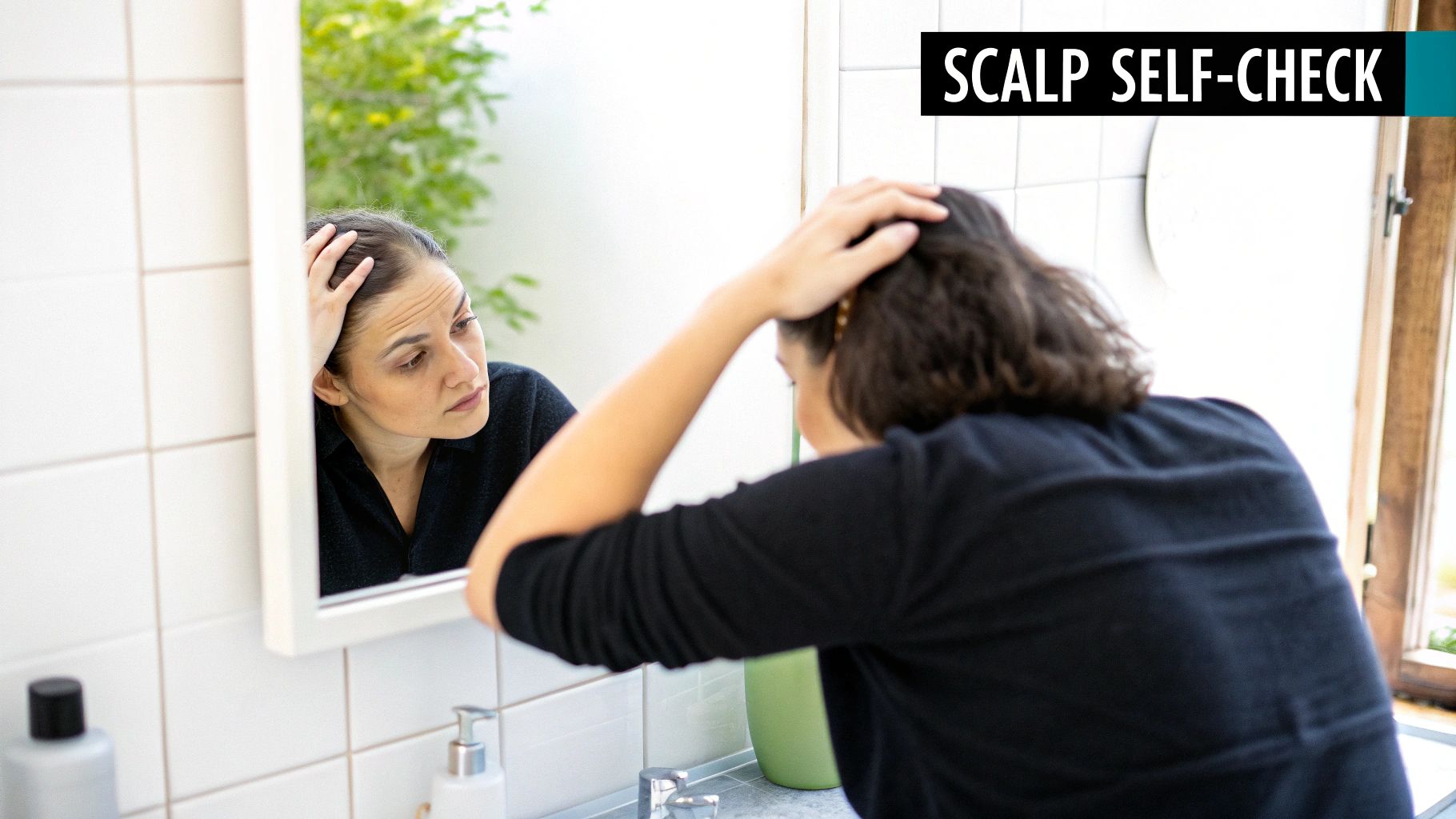
Often, the first real clues about hair thinning aren't found in the shower drain or on your hairbrush. They're hiding in plain sight, right on top of your head. Your part line, and how much scalp you can see through your hair, are two of the most reliable indicators of what's happening long before the changes become obvious to everyone else.
Think of your part as a window into your hair's density. When follicles start producing finer, weaker hairs or even stop producing them entirely, that "window" starts to look wider. This is a classic sign, especially for men with androgenetic alopecia, which often begins with thinning at the crown and hairline.
This slow-burn widening is precisely why asking, "how to tell if my hair is thinning?" is so tough to answer with a quick glance in the mirror. It's a game of millimeters, a gradual shift that happens over months or years.
The Photo Documentation Method
One of the best things you can do is take the guesswork out of it. Your phone is your most powerful tool here. Creating a visual log is a simple, data-driven way to track changes without relying on a fickle memory.
Here’s a practical way to do it:
- Find Your Spot: Always stand in the same place with the same bright, overhead lighting. Your bathroom is usually perfect for this.
- Take Consistent Photos: Once a month, part your hair like you normally would and snap a clear picture from directly above. Make sure it's in focus.
- Compare and Contrast: After about 3-6 months, pull up the photos side-by-side. Any gradual widening of your part or increased scalp visibility will be undeniable.
This method gives you cold, hard evidence. You're no longer just feeling like something is changing; you're actually observing and tracking it.
Key Insight: Don't trust your memory. Our day-to-day perception is notoriously unreliable. A photo log creates an objective timeline of your hair's density, which is invaluable information whether you're just monitoring the situation or talking to a professional.
When Your Scalp Becomes More Visible
Another tell-tale sign is simply seeing more of your scalp than you used to. This often becomes most apparent when your hair is wet. After a shower, for instance, water clumps the strands together, temporarily reducing coverage and making the skin underneath pop.
You might also catch glimpses in unexpected places—under the harsh fluorescent lights of an elevator or when the sun hits your head just right. It’s not that your scalp has suddenly expanded; it's that the reduction in hair density has made it more prominent.
This happens because the hair strands themselves can shrink in diameter over time, a process called miniaturization. Thinner strands just don't provide the same scalp coverage, creating that see-through effect. For many men, this subtle change is one of the very first whispers of male pattern baldness.
Is Your Daily Hair Shed a Red Flag?

We’ve all seen it—a few strands of hair on the pillow or tangled in the shower drain. It’s a completely universal experience, but it’s the amount that really separates normal shedding from the first signs of thinning.
Your hair grows in cycles, and shedding is just one part of that natural process. Old hairs fall out to make way for new, healthy ones. The average person loses between 50 to 100 hairs every single day. That sounds like a lot, but with about 100,000 hairs on your head, it’s a pretty small percentage.
The real trick is figuring out what’s normal for you. Nobody has the time to count every single strand, so you need a more practical approach. It all comes down to consistent observation.
How to Get a Handle on Your Hair Shed
To really know if you're losing more hair than usual, you have to establish your own personal baseline. Pay attention to the same spots for a few weeks to get a feel for what your typical shedding looks like.
- In the Shower: After you wash your hair, what does the clump in the drain catcher look like? Is it just a few strands, or is it a noticeable ball of hair?
- On Your Hairbrush: Before cleaning it out, take a look. How much hair collects in your brush after a week of normal use?
- On Your Pillow: A quick glance in the morning is all you need. Are there one or two stray hairs, or are you seeing a small collection every single day?
The point isn't to get an exact count. It's about spotting a change. If the amount of hair you see in the shower drain suddenly doubles—and stays that way for a few weeks—that’s the signal. A sustained increase in shedding is one of the classic early indicators of hair thinning.
If you’re noticing this, you're not alone. Hair loss is a huge issue, affecting an estimated 35 million men and 21 million women in the U.S. alone. Yet, many people wait too long to address it. For example, in the UK, only 11% of men seek professional advice right away. You can learn more about these hair loss statistics to understand just how common this is.
By paying closer attention to your shedding, you’re taking the first, most important step—gathering the evidence you need to act early.
Feeling the Difference: When Hair Texture and Volume Change

Sometimes, the very first hint that your hair is thinning isn't something you see in the mirror. It's something you feel. Those subtle, almost imperceptible shifts in your hair's texture and overall body are often the earliest signs that something is changing up top.
You might be running your fingers through your hair and just notice it feels… different. Maybe a bit finer, or perhaps it doesn't have the same weight it used to. Individual strands can lose their coarse, robust quality, making your hair feel less substantial as a whole. It's a change so gradual that it’s incredibly easy to write off or ignore.
The Ponytail Test: A Classic Clue
One of the most common and reliable ways people notice a change is what I call the "ponytail test." If you regularly tie your hair up, you know exactly what I'm talking about. You have a built-in muscle memory for how many times you need to wrap that hair tie for a snug fit.
Suddenly finding you need an extra loop to get the same secure hold is a huge tell. It's a direct, physical reflection of reduced hair mass. That smaller ponytail circumference is a clear sign you're working with less hair than you were before.
Key Takeaway: Don't dismiss this! That extra twist of the elastic isn't your imagination. It’s a tangible measurement showing your ponytail’s density has decreased—a classic symptom of hair thinning.
Other Tactile Clues to Pay Attention To
Besides the trusty ponytail test, other physical sensations can alert you to a drop in volume. Learning how to tell if my hair is thinning is really about tuning into these tactile differences before they become super obvious visually.
Think about these real-world scenarios:
- Styling feels different: Does your hair seem to have less "pushback" when you're blow-drying or applying products? It might feel like you're working with less material.
- A "wispy" quality: As follicles shrink, they can produce finer, more delicate hairs. You might feel these wispier strands mixed in with your more mature, coarser ones.
- It just feels lighter: When you gather your hair in your hand, does it feel less dense or noticeably lighter than it once did?
These sensory details are your body's early warning system. By paying closer attention to how your hair feels day-to-day, you can catch the subtle yet significant signs of thinning well before they ever show up in pictures.
When to Talk to a Professional
https://www.youtube.com/embed/khblU1xkVk0
So, you've used some of the methods we've covered and you're pretty sure your hair is thinning. That's a huge first step. But figuring out that something is happening is different from understanding why it's happening.
This is where you need to bring in an expert. Self-monitoring is great for spotting the signs, but getting to the root cause usually means talking to someone with specialized knowledge.
If you’re seeing sudden and dramatic hair loss, finding noticeable bald patches, or if the thinning comes with an itchy or painful scalp, don't put it off. It’s time to book an appointment with a doctor or dermatologist. These symptoms can point to underlying health issues that need a proper diagnosis, and waiting will only make it harder to treat.
Preparing for Your Consultation
Think of your first consultation as a fact-finding mission. A dermatologist or a trichologist (a hair and scalp specialist) will want the full story. They'll ask about your diet, recent stress, family history of hair loss, and any medications you're on.
From there, they’ll likely perform a physical examination, which can include a few different things:
- A Scalp Exam: This isn't just a quick look. They'll often use a dermatoscope, which is basically a powerful magnifying glass for your skin, to get a close-up view of your scalp and hair follicles.
- A Pull Test: It sounds a bit scary, but it's a simple diagnostic tool. The doctor will gently tug on a small group of about 50-60 hairs to see how many come out. It helps them gauge the severity of the shedding.
- Blood Tests: These are incredibly useful for spotting common culprits that don't show up on the surface, like vitamin deficiencies, hormonal imbalances, or potential thyroid issues.
Expert Insight: The whole point is to move past the general question of "is my hair thinning?" and get to the specific answer of "why is my hair thinning?". A professional can connect the dots and tell you if it's genetics, stress, hormones, or something else. That diagnosis is what determines the right treatment path for you.
The good news is that you have more options than ever before. With growing awareness and major scientific breakthroughs, the market for hair loss treatments is booming. It was valued at around USD 1.51 billion in 2024 and is expected to nearly double by 2030. This means better, more effective solutions are always hitting the market.
Speaking with a professional is the only reliable way to cut through the noise and find a solution that’s actually right for your specific situation.
Your Top Questions About Hair Thinning, Answered
Once you spot those first few signs of thinning hair, a million questions probably start running through your head. It’s completely natural. Getting some clarity on the common concerns can help you make sense of what you're seeing and decide what to do next.
Let's dive into some of the questions I hear all the time.
Can Diet or Stress Really Cause Hair Thinning?
Absolutely. Both can have a huge impact on your hair's health.
A major life event—whether it's intense emotional stress or a significant physical shock to your body—can trigger a condition called telogen effluvium. This essentially shoves a large number of your hair follicles into the shedding phase all at once. You typically won't see the shedding until a few months after the stressful event, which can make it tricky to connect the dots.
Your diet plays a massive role, too. If you're not getting enough key nutrients, your hair is often one of the first things to suffer. Deficiencies in things like iron, zinc, and protein are notorious for disrupting the hair growth cycle. While looking into various hair products can be part of a hair care strategy, the great news is that thinning from these root causes is usually reversible once you manage the stress or correct your diet.
Is Losing a Ton of Hair in the Shower a Bad Sign?
Finding hair in the drain is normal. In fact, everyone loses hair every single day. The shower just makes it more obvious, as the water and shampoo help release the hairs that were already ready to fall out. Losing between 50 to 100 hairs a day is perfectly average.
The real signal to watch for isn't just seeing hair—it's noticing a sudden and sustained increase over several weeks. If your drain consistently goes from a few strands to a noticeable clump every time you wash, that’s your cue to start paying closer attention.
How Does Hair Thinning Look Different for Men and Women?
The patterns are often quite different, and knowing what to look for can be one of the most helpful clues.
-
In men, thinning from male pattern baldness (androgenetic alopecia) typically shows up in two key areas. You might see a receding hairline, which often forms a distinct 'M' shape, and/or a growing bald spot at the crown (the vertex) of your head.
-
In women, thinning is usually more spread out and diffuse across the whole scalp. The most common giveaway is a gradually widening part. You’ll start to see more of your scalp along your center part line, but the front hairline often stays put.
Recognizing these classic patterns is a crucial step in understanding what might be happening and how to move forward.

 PRP For Hairloss
Leave a comment