It’s easy to assume your hair just… grows. But the truth is far more fascinating. What’s happening on your scalp is less like a constant, steady process and more like a carefully choreographed, four-act play, with each of your 100,000 hair follicles working on its own independent schedule.
This is the hair growth cycle: a dynamic, repeating rhythm of growth, rest, and renewal that dictates everything from how long your hair can get to its overall health and thickness.
Decoding Your Hair's Natural Rhythm
The fact that each follicle runs on its own timeline is a brilliant bit of biological design. It's why we don't shed all our hair at once like some animals do. Instead, we experience a staggered, almost unnoticeable process of shedding and regrowth that maintains a full head of hair.
Getting a handle on this natural rhythm is the key to understanding what's normal for your hair and what might signal a problem. It’s the foundation for everything, from everyday shedding to the more complex science behind treating hair loss.
The Phases in a Nutshell
The journey of a single hair strand is defined by four distinct stages. These phases are what determine your hair's maximum length, its strength, and even its density. The primary stages are anagen (growth), catagen (transition), and telogen (rest), with a fourth stage, exogen (shedding), marking the grand finale.
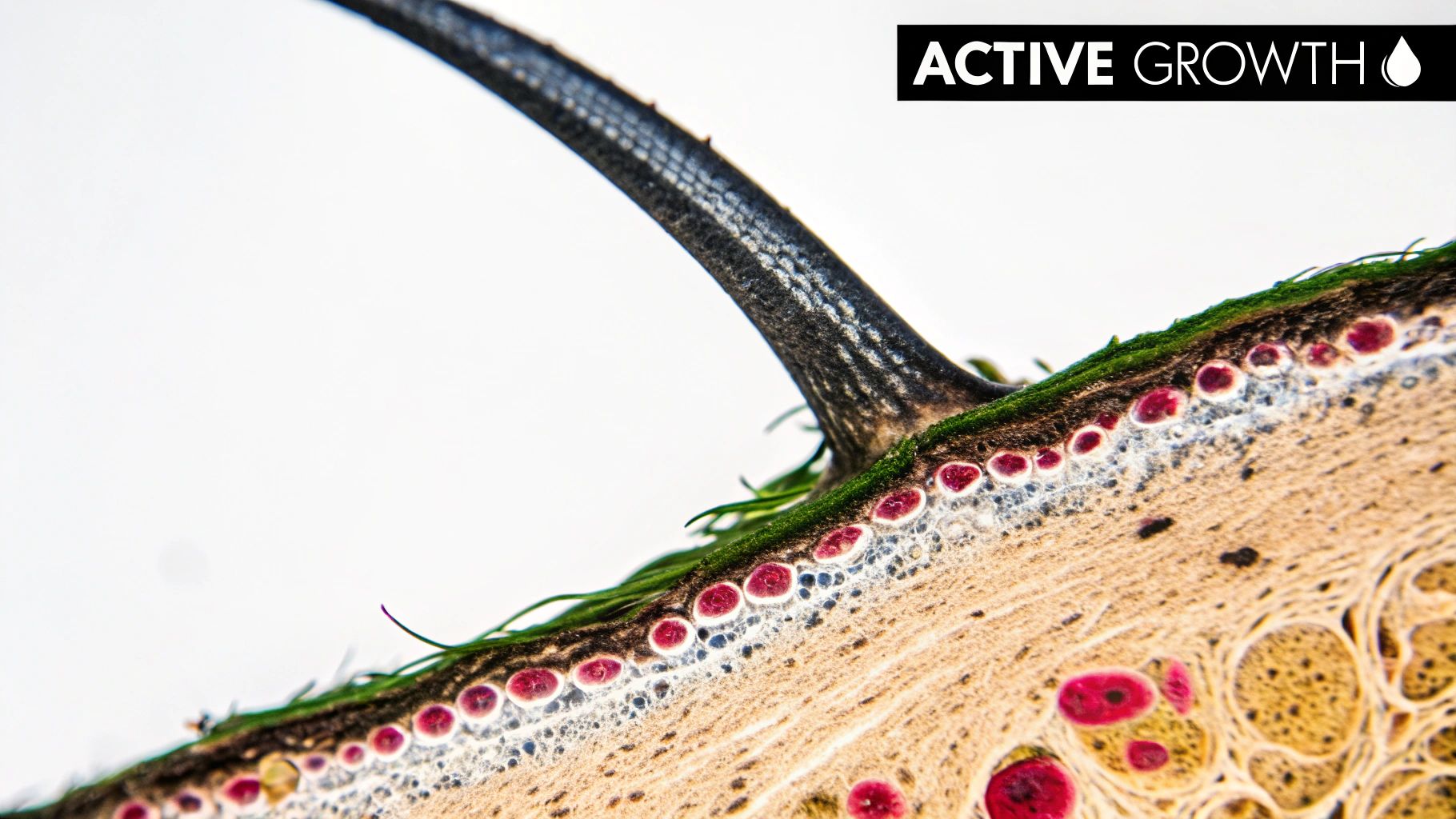
Remarkably, at any given moment, about 90% of your hair is actively in the anagen, or growth, phase. This powerful phase can last anywhere from two to seven years, with hair growing roughly half an inch per month. If you're curious, you can dive into more jaw-dropping hair growth statistics to see just how incredible this process is.
After its long growth spurt, the hair enters a very brief transitional period called the catagen phase, which lasts only a couple of weeks. Here, the follicle shrinks and prepares for rest. Finally, it enters the telogen, or resting phase, for about three months before it eventually sheds, making way for a new hair to begin its own journey.
Key Takeaway: The hair growth cycle is asynchronous. Think of it like a busy city where everyone is on their own schedule—this ensures the city is never empty. Your scalp works the same way, preventing mass shedding and keeping your hair looking full.
To make this a bit easier to visualize, let's break down exactly what happens during each part of the cycle.
A Quick Look at the Hair Growth Phases
Here's a simple table that summarizes the four key stages of the hair growth cycle, what’s happening in each, and how long they typically last.
| Phase | What Happens | Typical Duration |
|---|---|---|
| Anagen | This is the active "growing" stage. The follicle is busy forming a new hair and pushing it out. | 2 to 7 years |
| Catagen | A short, transitional period where hair growth stops and the follicle begins to shrink. | 2 to 3 weeks |
| Telogen | The "resting" stage. The hair is dormant in the follicle, no longer growing but not yet shed. | About 3 months |
| Exogen | This is the "shedding" phase, where the old hair falls out to make room for a new hair starting its anagen phase. | Part of Telogen |
Understanding this fundamental cycle is the first real step toward taking control of your hair health. Every treatment, from supplements to advanced procedures, works by interacting with and influencing these very phases.
The Four Phases of Hair Growth Explained
To really get what's happening on your scalp, you have to look past the hair you see in the mirror. Each strand is on its own journey, moving through a four-part cycle. Think of your scalp as being covered in tiny, independent factories—the hair follicles. Each one has a specific production schedule, ensuring that your hair is constantly being renewed in a staggered way.
This system of growth, transition, rest, and shedding is what keeps your hair looking full. Let's break down exactly how it works, phase by phase.
Phase 1: Anagen (The Growth Phase)
This is the main event. The anagen phase is when your hair is actively and visibly growing. Deep inside the follicle, cells are dividing like crazy to build new hair fiber. The follicle anchors itself firmly into the deeper layers of your scalp, tapping directly into the blood supply for all the oxygen and nutrients it needs to build a strong, healthy strand of hair.
This is by far the longest stage, lasting anywhere from two to seven years. Honestly, your genetics are the main decider here, and the length of your anagen phase determines the maximum length your hair can ever reach. On a healthy head of hair, about 85-90% of follicles are in this growth phase at any given moment. It’s the true workhorse of the entire cycle.
Phase 2: Catagen (The Transition Phase)
After years of non-stop work, the follicle needs to wind down and prepare for a rest. That’s where the catagen phase comes in. It's a very short but absolutely critical transition period that signals the end of active growth. Think of it as the factory shutting down the assembly line before a scheduled break. This whole process is incredibly quick, lasting only about two to three weeks.
Here’s what happens during this brief transition:
- Growth Stops: The follicle gets the signal to stop all growth. Cell division comes to a halt, and the hair is no longer getting any longer.
- The Follicle Shrinks: The base of the follicle shrivels up and detaches from the blood vessels, cutting off its nutrient pipeline.
- A "Club Hair" Forms: As the follicle shrinks, it pushes the hair strand upward. The root of the hair hardens into a small, white bulb, known as a "club hair." This club acts as an anchor, holding the hair in place for the next phase.
This image really helps visualize how the follicle methodically prepares for its resting period.

You can see how the growth machinery shuts down and the follicle itself miniaturizes, getting the old hair ready for its final stages.
Phase 3: Telogen (The Resting Phase)
With the transition complete, the follicle enters the telogen, or resting, phase. The fully formed club hair is now just sitting dormant in the follicle. It’s not growing, and it’s not yet falling out. The factory is essentially in hibernation—the lights are off, but the finished product is still sitting there, waiting for the next production run to start.
This resting state typically lasts for about three months. While this old hair is hanging out, a brand new hair is often already beginning to form in the follicle below it, gearing up for its own anagen phase.
Did You Know? At any given time, roughly 10-15% of all the hairs on your head are in the telogen phase. Seeing these hairs fall out is a perfectly normal part of a healthy cycle.
This rest period is essential. It gives the follicle a chance to reset and recover before kicking off the demanding process of growing a new hair all over again.
Phase 4: Exogen (The Shedding Phase)
The exogen phase isn't so much a separate stage as it is the grand finale of the telogen phase. This is simply the point where the old club hair is shed from the follicle. This shedding is what finally makes room for the new anagen hair that's been growing beneath it to push its way through the scalp.
Losing 50 to 100 hairs a day might sound like a lot, but it’s a healthy and necessary sign that your hair growth cycle is working exactly as it should. It’s proof that old hairs are making way for new ones, ensuring your hair remains in a constant state of renewal. This beautifully staggered cycle across tens of thousands of follicles is what maintains consistent hair density over time.
Factors That Influence Your Hair's Growth Cycle
It’s easy to think of your hair's growth schedule as a simple, fixed program, but it's far from it. Think of it more like a sensitive ecosystem that can be nudged, disrupted, or thrown completely off course by what's happening both inside your body and in your daily life.
Getting a handle on these influences is the first step toward understanding why you might be seeing changes in your hair's health, density, or length. Some factors are simply out of our hands, but many others are directly connected to our lifestyle and well-being.
Core Biological Drivers
At the very foundation of your hair's behavior are your genetics, age, and hormones. These are the primary architects of your hair growth cycle, setting the baseline for how your hair acts throughout your life.
-
Genetics: Your DNA is the single biggest determinant of your hair’s potential. It dictates how long your anagen (growth) phase can last, which in turn sets the maximum possible length your hair can reach. It also governs your sensitivity to conditions like androgenetic alopecia (pattern baldness).
-
Age: As the years go by, it’s completely normal for the anagen phase to shorten. This is why hair often doesn’t grow as long as it did when we were younger. You might also notice that the follicles start producing finer, less pigmented strands over time.
-
Hormones: Hormones are powerful messengers, and some have a profound effect on hair follicles. The androgen hormone dihydrotestosterone (DHT) is a major player. For people with a genetic sensitivity, DHT can shrink hair follicles and cut the growth phase short—the exact mechanism behind pattern hair loss.
The Impact of Nutrition on Hair Health
Imagine your hair follicles as tiny, high-demand factories. To keep the assembly line running smoothly, they need a constant, reliable supply of raw materials. If you’re not providing those materials through your diet, production slows down and the whole system can get disrupted.
A well-balanced diet isn't just a suggestion for healthy hair—it's a requirement. Without the right nutrients, your follicles simply can't sustain the demanding work of the anagen phase. This can push hairs into the shedding phase prematurely, leading to thinner-looking hair.
Your hair follicles are particularly hungry for these key nutrients:
- Protein: Hair is made almost entirely of a protein called keratin. When your protein intake is low, your body has to ration it, and building hair is not considered an essential function. It’s one of the first things to get cut back.
- Iron: This mineral is essential for making hemoglobin in your red blood cells. Hemoglobin’s job is to carry oxygen, which is critical for the growth and repair of all cells—including the ones that power your hair follicles.
- Zinc: Zinc is a workhorse for hair. It plays a direct role in hair tissue growth and repair, and it helps keep the oil glands around the follicles functioning properly.
- Vitamins: A whole host of vitamins, especially Biotin, Vitamin D, and Vitamin E, are crucial for supporting the cellular activity that fuels a strong and lengthy anagen phase.
Stress and Lifestyle Influences
Beyond your biology and diet, your daily life casts a long shadow over your hair. Stress, in particular, is a notorious saboteur of the hair growth cycle.
When you experience a major physical or emotional shock—think surgery, a serious illness, or a period of intense psychological pressure—your body can react by hitting the panic button. This can force a large number of growing hairs to shift prematurely from the anagen phase straight into the telogen (resting) phase. The result is a condition called telogen effluvium, where you experience significant shedding a few months after the stressful event.
On the flip side, positive habits can fortify your hair. Things like using an organic hair oil for healthy hair can nourish the scalp and strands, helping to create a better environment for a robust growth cycle. It’s a perfect example of how internal health and external care must work together.
How the Growth Cycle Relates to Common Hair Problems
When your hair starts to thin or shed more than usual, it's easy to blame the hair itself. But the real problem isn't the strands you see; it’s almost always a disruption happening beneath the surface, deep within the hair growth cycle.
Think of your scalp as a busy factory running on a tight schedule. If one part of the assembly line gets delayed or shut down, the whole production suffers. That's exactly what's going on with the most common hair loss conditions. They aren't just random occurrences—they are direct consequences of the anagen, catagen, or telogen phases being thrown off-kilter.
Once you understand this connection, you can start looking past the surface symptoms. You begin to see thinning hair and excessive shedding for what they truly are: signs that your body's natural hair-building rhythm is out of sync. Let's dig into how two of the most widespread hair problems tie directly back to these cyclical shifts.
Telogen Effluvium: The Sudden Shed
Have you ever gone through a stressful period and noticed a startling amount of hair in your brush or shower drain? I'm not talking about the normal 50-100 strands we all lose daily, but a sudden, dramatic increase in shedding all over your scalp. This is the hallmark of a condition called Telogen Effluvium.
Though the name sounds complicated, the mechanism behind it is surprisingly simple. It’s triggered when a major physical or emotional shock hits your system—think major surgery, a high fever, childbirth, or even a period of intense psychological stress. This event sends an alarm signal throughout your body, and your hair follicles listen.
In a state of emergency, a large percentage of follicles will abruptly halt the anagen (growth) phase and prematurely jump straight into the telogen (resting) phase. A few months down the line, all of those hairs enter the shedding phase at roughly the same time, leading to very noticeable, diffuse thinning.
The good news? Telogen Effluvium is almost always temporary. As soon as the stressor is gone and your body finds its equilibrium again, the hair growth cycle typically resets, and the lost hair starts to grow back.
Androgenetic Alopecia: The Progressive Shrink
In sharp contrast to the sudden drama of Telogen Effluvium, Androgenetic Alopecia (commonly known as male or female pattern hair loss) is a much quieter, more gradual affair. It doesn't cause a massive, all-at-once shed. Instead, it methodically weakens the hair growth cycle over the course of years.
At the heart of this condition is a genetic sensitivity to a hormone called dihydrotestosterone, or DHT. In people with this genetic trait, DHT wages a two-front war on their hair follicles:
- It relentlessly shortens the anagen phase. With every new hair cycle, the growth phase gets a little bit shorter. This means the hair simply doesn't get the time it needs to grow to its full length and thickness.
- It physically shrinks the follicle. This process, called miniaturization, forces the follicle to produce progressively finer, weaker, and lighter-colored hairs with each passing cycle.
Over time, this insidious one-two punch causes healthy, thick "terminal" hairs to be replaced by soft, downy "vellus" hairs, creating the recognizable patterns of baldness. Grasping this slow-motion process is the first step toward finding treatments that can defend the follicle and encourage a longer, healthier growth cycle.
How PRP Therapy Can Support the Hair Growth Cycle

So, we know how the hair growth cycle can get thrown off track. The next logical step is figuring out how we can nudge it back into its natural rhythm. This is where treatments like Platelet-Rich Plasma (PRP) therapy come into play, working with your body’s own biology to get your follicles back on track.
PRP isn't some synthetic formula cooked up in a lab. It’s a concentrated dose of the healing and growth factors found in your own blood. The process is straightforward: we take a small sample of your blood, use a centrifuge to separate the powerful platelets, and then carefully inject this "liquid gold" right into the scalp where you’re seeing thinning.
The whole concept is beautifully simple: deliver a boost of natural growth factors exactly where the hair follicles need them the most.
Reawakening Dormant Follicles
At its core, PRP therapy aims to influence the hair growth cycle in two major ways. First, it tries to "wake up" follicles that have gone dormant. Second, it works to strengthen the hair you still have.
Imagine a hair follicle that's stuck in the telogen (resting) phase. It's not gone for good, just sleeping on the job. The growth factors in PRP act like a gentle but firm wake-up call, sending the biochemical signals needed to kick that follicle back into the active anagen (growth) phase.
For the follicles that are still producing hair but are weakened by DHT and other factors, PRP provides much-needed reinforcement. This support can help extend the anagen phase, giving each strand more time to grow longer and stronger before the cycle inevitably resets.
The PRP Advantage: By harnessing your body's own platelets, PRP therapy stimulates tissue regeneration from the inside out. This process can increase blood supply to the scalp, which means more oxygen and nutrients are delivered directly to the follicles, fueling a healthier and more robust hair growth cycle.
This approach of revitalizing the scalp's environment is what has made PRP a compelling option for men navigating pattern hair loss.
The Bigger Picture of Hair Health
PRP therapy is just one piece of a much larger puzzle. The demand for effective hair health solutions is massive—in 2022, the U.S. market for hair growth products shot past $120 million. This number tells a clear story: people are serious about investing in their hair.
Consumers, especially those in the Millennial and Gen X demographics, are increasingly looking for treatments that feel more natural and work with the body, which is precisely where therapies like PRP fit in. You can learn more about the booming market for hair growth solutions and see what’s driving people’s choices.
This widespread interest is what continues to push the field forward. The goal is always the same: to positively intervene in the hair growth cycle and fight back against the things that weaken it. By directly stimulating follicles and enriching their environment, PRP offers a proactive strategy for rebuilding the very foundation of healthy hair.
Your Hair Growth Cycle Questions, Answered
When you start digging into the science of how hair grows, it naturally brings up questions about what you’re seeing in your own shower drain or hairbrush. It's crucial to know what’s normal and what might be a red flag.
Let's clear up some of the most common questions and myths we hear all the time, grounding our answers in the way the hair cycle actually works.
How Much Shedding Is Actually Normal?
Seeing hair fall out can be alarming, but losing between 50 and 100 hairs every single day is completely normal. In fact, it's a sign that your hair growth cycle is working exactly as it should.
Each hair that sheds has simply reached the end of its journey. It’s a telogen (resting) hair making way for a brand new anagen (growing) hair to push through the follicle. The time to pay closer attention is when you notice widespread, visible thinning or a sudden, dramatic increase in shedding—that’s when it might be time to talk to a professional.
Will Cutting My Hair Make It Grow Faster?
This is one of the most stubborn myths out there, but the short answer is no. A haircut has absolutely no impact on the biological activity happening down in your scalp.
Hair growth starts at the follicle, deep within the skin. Trimming the dead ends of the hair shaft doesn't send a magical signal back to the root telling it to kick into high gear. What it does do, however, is keep your hair healthy. Regular trims get rid of split ends before they can travel up the hair shaft and cause breakage. This helps you hold onto your length, making your hair look fuller, healthier, and ultimately longer.
The Real Reason for a Trim: A haircut won't speed up growth, but it's essential for retaining length. By preventing breakage, trims let you actually see the results of your healthy growth cycle.
What Should I Eat for Healthy Hair?
You can't talk about a healthy hair growth cycle without talking about nutrition. Your follicles are tiny factories, and they need a consistent supply of raw materials to build strong hair.
For robust, healthy growth, you need to make sure your diet is rich in these key nutrients:
- Protein: The literal building block of hair.
- Iron: Helps carry oxygen to the follicles, fueling their work.
- Zinc: Crucial for hair tissue growth and repair.
- Vitamins A, C, D, E, and Biotin: A team of vitamins that support everything from scalp health to keratin production.
If you're deficient in any of these, it can disrupt the cycle. You might see a shorter anagen phase, weaker strands, or more shedding than usual.
Can Stress Really Make My Hair Fall Out?
Yes, absolutely. A major physical or emotional shock to your system is a known trigger for a condition called telogen effluvium.
What happens is that the stress event abruptly shoves a large number of your growing follicles straight into the resting (telogen) phase all at once. Then, a few months down the line, all those hairs shed simultaneously, leading to a sudden and noticeable bout of hair loss. The good news? This type of shedding is usually temporary. Once the stressor is gone and your body finds its balance again, the cycle typically returns to normal.
At PRP For HairLoss, we know that getting to the root cause of your hair loss is the first real step toward a solution. Understanding how a treatment like PRP therapy can work with your body’s natural hair growth cycle empowers you to make the best decisions for your hair. To see how you can support your hair's natural rhythm, learn more about our approach at PRP For Hairloss.

 PRP For Hairloss
Leave a comment