It's an unsettling feeling, isn't it? Spotting more hair than usual in the shower drain or on your pillow. But here’s the good news: finding an effective hair loss treatment for men is more straightforward and scientifically sound than ever. The trick is to understand that for most guys, hair loss isn't just bad luck—it's a predictable process you can actually do something about. Once you get a handle on the why, you're in a much better position to figure out the how.
Why Male Hair Loss Happens and What You Can Do
Let’s cut through the noise and get straight to the primary cause of most hair loss in men. It’s almost certainly not from wearing a hat too much or using the wrong kind of shampoo. For the overwhelming majority of men, thinning hair comes down to a genetic condition called Androgenetic Alopecia, which you probably know as male pattern baldness.
Picture your hair follicles as tiny, individual gardens dotting your scalp. Under normal circumstances, they produce healthy, strong hair. But if you have the genetic blueprint for baldness, a hormone called Dihydrotestosterone (DHT) starts acting like a persistent weed killer in that garden.
The Role of DHT in Hair Thinning
DHT is actually a byproduct of testosterone, a hormone that’s perfectly normal and necessary for men. The problem starts when your hair follicles are genetically sensitive to it. Over time, DHT attaches to these sensitive follicles and begins to slowly shrink them.
This process is called miniaturization, and it's a gradual weakening of the hair follicle. It doesn't happen all at once. With each new growth cycle, the hair that emerges from an affected follicle is a little thinner, shorter, and weaker than the one before it. Eventually, the follicle shrinks so much that it can no longer produce a visible hair. This is precisely why male pattern baldness tends to follow such a recognizable pattern, typically starting at the temples or the crown of the head.
Are Genetics the Only Factor?
While your genes and DHT are the main culprits, a few other things can speed up the process or contribute to hair loss. They won't cause true male pattern baldness on their own, but they can definitely make a bad situation worse.
- Significant Stress: A major life event or ongoing chronic stress can sometimes kick-start a condition called telogen effluvium. This is where a large number of your hairs are suddenly pushed into the shedding phase all at once.
- Nutritional Deficiencies: Your hair needs the right fuel. A diet lacking in essential vitamins and minerals—think iron, zinc, and biotin—can seriously impact your hair's health and strength.
- Medical Conditions: In some cases, underlying health issues can play a role in thinning hair.
Understanding the root cause is the first and most critical step. Since Androgenetic Alopecia is the culprit in most cases, effective treatment must address the effects of DHT on your follicles.
This is an incredibly common condition. Men are the largest part of the hair loss market for a reason: androgenetic alopecia can kick in as early as the late teens or early 20s. In fact, it affects roughly 50% of men by the age of 50 worldwide. If you're curious about the industry behind these solutions, you can read the full research about the hair loss growth market.
Ultimately, accepting that your hair loss is most likely due to your genetics and hormones allows you to stop worrying and start creating a plan. With this scientific understanding, you can confidently explore real solutions that get to the heart of the problem and find the right hair loss treatment for you.
Your Guide to FDA-Approved Hair Loss Medications
When you're ready to stop researching and start doing something about hair loss, your first stop should be the world of clinically proven treatments. For men looking for a reliable way to fight back, two medications have stood the test of time, backed by decades of research and FDA approval: Minoxidil and Finasteride. These aren't just hopeful theories; they're scientifically validated tools designed to tackle male pattern baldness head-on.
Let's use an analogy. If the hormone DHT is an army laying siege to your hair follicles, these two treatments are like different military strategies. One acts as a powerful defensive shield, while the other reinforces the supply lines to keep your follicles strong.
Figuring out which strategy is right for you—or if a combination is best—starts with understanding how each one actually works. Both can be incredibly effective, but they approach the problem from completely different angles.
Finasteride: The DHT Blocker
Finasteride takes the fight directly to the source. It’s what’s known as a 5-alpha-reductase inhibitor, which is just a technical way of saying it stops your body from turning testosterone into the hair-destroying hormone, DHT.
Think of it like a factory inside your body that’s constantly churning out DHT. Finasteride walks in and shuts down a key machine on the assembly line. By dramatically lowering the amount of DHT in your system, it gives your genetically vulnerable hair follicles a much-needed break from the miniaturization process.
Finasteride essentially acts like a bodyguard for your hair follicles, intercepting DHT before it can do any damage. This allows weakened follicles to recover and, hopefully, start producing thicker, healthier hair again.
This medication usually comes as a daily pill. Its greatest strength is its ability to stop hair loss in its tracks and, for many men, even regrow hair, particularly at the crown and vertex of the scalp.
Minoxidil: The Growth Stimulant
Minoxidil, which most people know by the brand name Rogaine, takes a completely different path. It’s a vasodilator, meaning it works by widening the blood vessels wherever it’s applied. The key here is that it doesn't block DHT or mess with your hormones at all.
Imagine your scalp's blood vessels are tiny highways delivering crucial supplies—oxygen, blood, and nutrients—to your hair follicles. DHT creates traffic jams and roadblocks, slowly starving the follicles. Minoxidil is like a road crew that comes in to clear the blockages and widen the lanes, allowing a flood of nutrient-rich blood to get through.
This surge in blood flow can revitalize shrunken follicles and even jolt them out of their resting phase and back into an active growth phase. It’s a powerful tool for supporting the hair you still have and encouraging new growth to emerge.
While lifestyle factors can play a role, this infographic clearly shows that genetics and hormones are the main drivers of male hair loss.
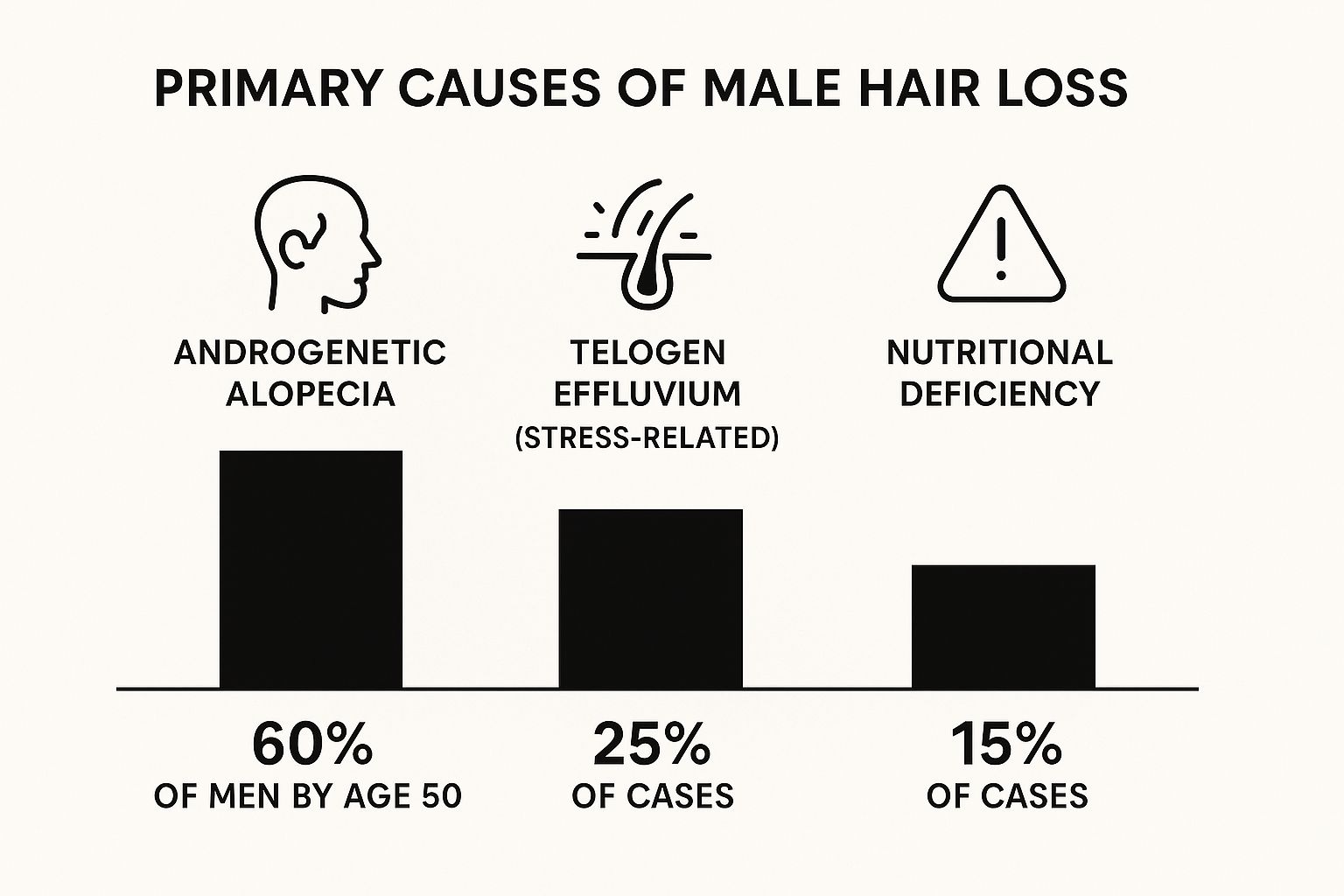
The data makes it clear: while things like stress and diet matter, hereditary sensitivity to DHT is the reason most men lose their hair.
Comparing FDA-Approved Hair Loss Medications
So, how do you choose between Finasteride and Minoxidil? Or should you consider using both? To help you decide, let's look at them side-by-side.
Comparing FDA-Approved Hair Loss Medications
| Feature | Minoxidil (Rogaine) | Finasteride (Propecia) |
|---|---|---|
| Mechanism | A vasodilator that increases blood flow and nutrient delivery to the scalp. | A 5-alpha-reductase inhibitor that blocks the production of DHT. |
| Application | Typically a topical foam or liquid applied to the scalp twice a day. Low-dose oral versions also exist. | A once-a-day oral pill. |
| Primary Outcome | Stimulates dormant follicles to enter the growth phase and extends the duration of that phase. | Halts the progression of hair loss and protects follicles from further DHT-induced damage. |
Many doctors and hair loss experts now consider a combined approach the gold standard for non-surgical treatment. Using Finasteride to stop the underlying hormonal cause (defense) while using Minoxidil to actively stimulate growth (offense) can produce powerful results.
No matter which path you choose, consistency is everything. You typically won't see noticeable results for 4-6 months, and if you stop the treatment, the benefits will unfortunately reverse over time.
Using Your Body’s Own Healing Power: A Look at PRP Therapy

What if the best tool to fight your hair loss was already inside you? That’s the simple idea behind Platelet-Rich Plasma (PRP) therapy. This treatment uses your body's natural healing abilities to awaken dormant hair follicles, offering a completely different path from daily pills or major surgery.
Think about what happens when you get a cut. Your body immediately sends special cells called platelets to the rescue. These platelets are full of powerful growth factors that manage the entire repair process, telling other cells to heal the wound and build new tissue. PRP therapy takes this natural process and puts it to work for your hair.
We isolate those incredible growth factors from a small sample of your blood, concentrate them, and create a powerful serum. This serum is then carefully injected into the parts of your scalp where hair is thinning. It’s like giving your hair roots a direct application of a super-concentrated, all-natural fertilizer, signaling them to wake up and get back to growing.
The PRP Treatment Journey From Start to Finish
The whole process is surprisingly simple and happens right in the clinic, with no complex surgery or long recovery time.
Here’s a quick rundown of what you can expect:
- Simple Blood Draw: It all starts with drawing a small amount of blood from your arm, no different than a routine check-up.
- Centrifuge Separation: That blood sample goes into a special machine called a centrifuge. It spins at an incredibly high speed, which separates the blood into layers. The heavier red blood cells go to the bottom, leaving the valuable platelet-rich plasma at the top.
- Targeted Injections: This "liquid gold"—the concentrated PRP—is then meticulously injected into the specific scalp areas where your hair has started to thin. The entire appointment is usually over in less than an hour.
Once injected, the growth factors get to work stimulating blood flow, calming inflammation, and pushing those miniaturized follicles back into their active growth phase. It’s a targeted boost designed to give your follicles everything they need to thrive again.
Who Is an Ideal Candidate for PRP Therapy?
While PRP shows a lot of promise, it isn't the right fit for every single person. It works best for men in the earlier stages of male pattern baldness, where the hair follicles are weak or dormant but haven't disappeared completely.
PRP is all about revitalizing the follicles you still have. It’s much less effective for regrowing hair on areas that have been completely slick and bald for years, because at that point, the follicles may no longer be able to be revived.
The ideal candidate is someone who has noticeable thinning but still has a decent amount of hair left. A specialist can take a close look at your hair loss to see if PRP is a good option for you. It's also often used in combination with other treatments like Finasteride or Minoxidil to create a more powerful, well-rounded attack on hair loss.
This growing interest in regenerative treatments is a big reason the industry is expanding. The global hair loss treatment market was valued at USD 4.78 billion in 2025 and is expected to climb to USD 7.28 billion by 2032, largely thanks to the demand for effective non-surgical options. You can dive deeper into the data on the growing hair loss treatment market here.
Understanding the Treatment Schedule and What to Expect
PRP isn't a one-and-done solution. Getting the best results means committing to an initial series of treatments and then coming back for occasional maintenance.
A typical plan looks like this:
- Initial Phase: Most people start with three treatments, each spaced about 4-6 weeks apart. This initial push helps saturate the scalp with growth factors and really kick-starts the rejuvenation process.
- Maintenance Phase: After that, you'll likely need a follow-up treatment every 6-12 months to keep the results going strong. Think of it as a regular tune-up for your hair.
Results don't happen overnight. Most men begin to see real improvements in hair thickness, texture, and less shedding within 3-6 months of their first session. The hair growth cycle is naturally slow, so patience is a must. And because PRP uses your own biological material, the risk of an allergic reaction is incredibly low, making it a very safe choice for most people.
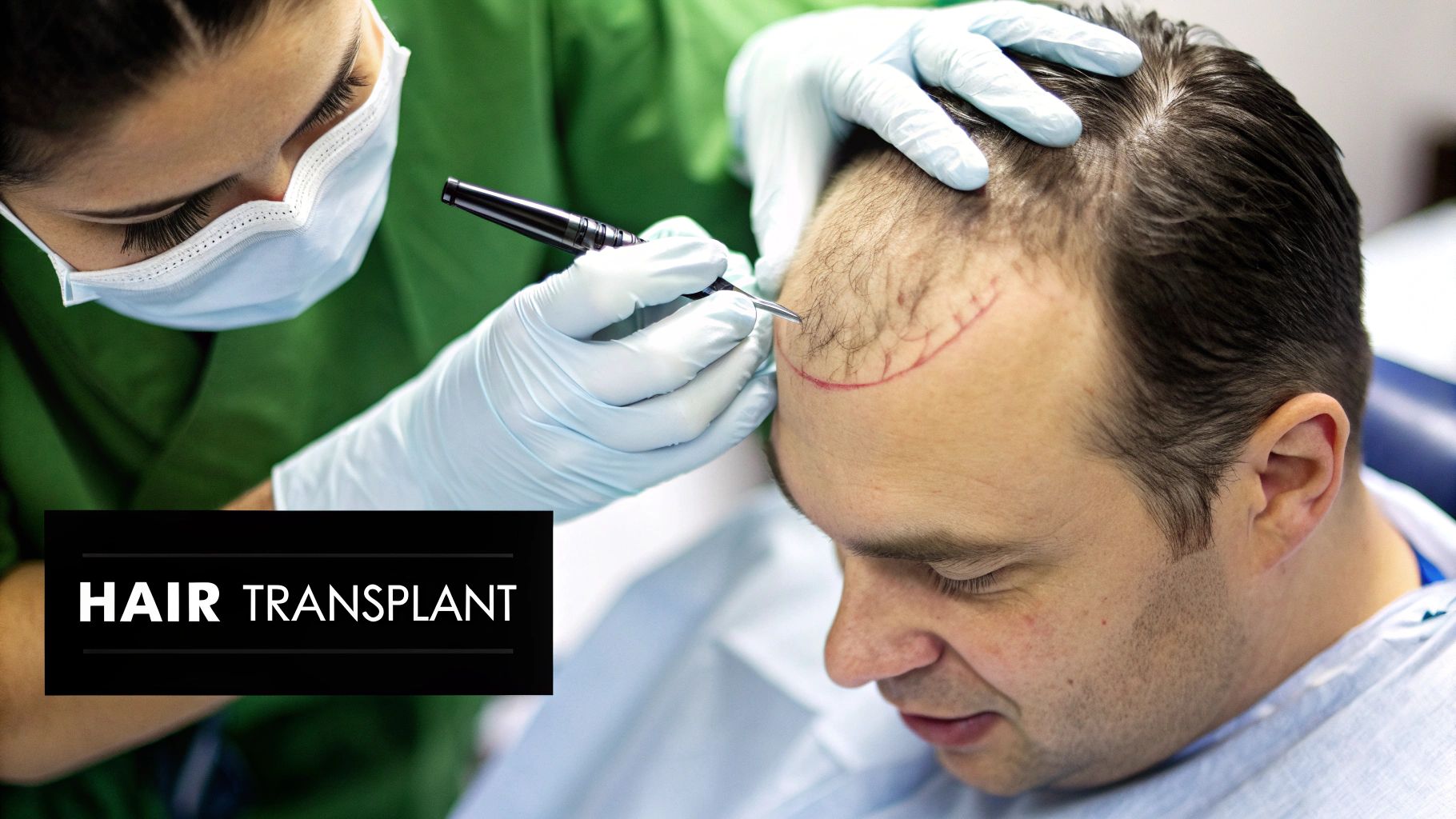
Exploring Permanent Hair Transplant Solutions

When medications and therapies don't deliver the results you're after, or if you're simply ready for a definitive, long-term fix, it's time to look at hair transplantation. While it is a surgical procedure, the concept behind it is surprisingly simple. Think of it as relocating your own healthy hair to where you need it most.
Imagine you have a thriving, dense patch of grass in your backyard that’s naturally resilient. A hair transplant is like carefully moving plugs of that healthy grass to the bare spots on your front lawn. Once they take root, they'll grow just as strong as they did before.
The real magic is that the transplanted hair follicles are harvested from the back and sides of your head—areas genetically programmed to resist the effects of DHT. When they're moved to the balding areas, they bring that resistance with them. This is why a transplant is considered a permanent solution; the new hair isn't susceptible to the same balding process.
Follicular Unit Transplantation (FUT)
The first of the two major techniques is Follicular Unit Transplantation, often called the "strip method." This tried-and-true approach is fantastic for moving a large number of hair grafts in a single session.
With FUT, a surgeon removes a thin, linear strip of scalp from the donor area. A skilled team then works under powerful microscopes to meticulously separate that strip into thousands of individual follicular units. These tiny, natural hair groupings are then carefully implanted into the thinning or bald areas of the scalp.
FUT is an excellent choice for men with more advanced hair loss who need the maximum number of grafts possible. The main trade-off is a fine linear scar in the donor area, but it's easily hidden as long as you keep your hair at least a half-inch long.
Follicular Unit Extraction (FUE)
The second, more modern method is Follicular Unit Extraction. FUE has become incredibly popular because it's less invasive and offers more flexibility with hairstyles.
Instead of taking a strip, the FUE technique involves extracting each follicular unit one by one, directly from the scalp. The surgeon uses a tiny punch tool to remove individual grafts, leaving behind small, dot-like scars that are virtually undetectable once healed. This makes FUE a go-to for guys who like to keep their hair buzzed short.
Let's break down how the two methods stack up against each other.
| Feature | Follicular Unit Transplantation (FUT) | Follicular Unit Extraction (FUE) |
|---|---|---|
| Graft Collection | A strip of skin is removed and dissected into individual grafts. | Individual follicular units are extracted one-by-one directly from the scalp. |
| Scarring | Leaves a single, fine linear scar at the donor site. | Results in tiny, dispersed dot-like scars that are much less noticeable. |
| Best For | Patients needing a large number of grafts who wear their hair longer. | Men who prefer shorter hairstyles and want to avoid a linear scar. |
| Recovery | Generally involves a slightly longer recovery with more initial discomfort. | Typically offers a quicker recovery time with less discomfort after the procedure. |
Are You a Good Candidate for a Hair Transplant?
A hair transplant can be genuinely life-changing, but it isn’t the right call for everyone. The best candidates are those whose hair loss has stabilized, meaning the balding pattern is mostly set.
It's also essential to have a healthy, dense donor area that can provide enough grafts to achieve the desired coverage. The only way to know for sure is to sit down with a qualified hair restoration surgeon. They can assess your specific situation and help you decide if a transplant is the right path for you.
Taking a Look at New and Alternative Treatments
While FDA-approved medications and hair transplants get most of the attention, a lot of exciting work is happening with other therapies. These newer options provide a middle path for guys who want a non-invasive hair loss treatment for men that’s different from daily pills and less intense than surgery. The two you’ll hear about most often are Low-Level Laser Therapy and microneedling.
These treatments are picking up steam because they work with your body’s own biology to support hair follicles, all without chemicals or going under the knife. The hair care industry is booming, and that means more innovation. In fact, the market for hair loss treatment products was recently valued at around USD 233.84 million globally, and it’s only getting bigger. You can dig into more of the data on the hair loss products market landscape to see just how fast things are moving.
Low-Level Laser Therapy (LLLT)
Low-Level Laser Therapy (LLLT) usually comes in the form of an at-home cap, comb, or headband that uses red light to kickstart activity in your scalp.
Think of struggling hair follicles like tiny, worn-out batteries. LLLT is like putting them on a charger. The targeted light energy gets absorbed by the cells, giving them a much-needed jolt. This energy boost is believed to fire up their metabolism, improve blood circulation, and calm inflammation around the follicle. The end goal is to nudge dormant follicles out of their resting state and back into their active growth phase.
How LLLT Works
- An Energy Jolt: The light is absorbed by the mitochondria (the cell's power plant), which can ramp up energy production.
- Better Blood Flow: It may improve circulation, delivering more oxygen and key nutrients directly to the hair roots.
- Calms Inflammation: LLLT has known anti-inflammatory effects, which helps create a healthier scalp environment for growth.
But there’s a catch: LLLT isn't a quick fix. You have to be consistent. Most devices require sessions of about 15-30 minutes several times a week, and it can take months of steady use before you start seeing any real change.
Microneedling for Hair Regrowth
Microneedling is another smart approach that taps into your body's own healing powers. The technique uses a special tool, like a dermaroller or microneedling pen, which is covered in hundreds of tiny needles. Rolling it over the scalp creates microscopic punctures.
These tiny, controlled injuries sound intense, but they signal your body to kickstart its natural repair cycle. It rushes growth factors and stem cells to the site to heal the "damage." This process does more than just wake up the follicles—it also dramatically boosts how well your scalp absorbs topical treatments.
Imagine you're trying to grow a lawn. Microneedling is like aerating the soil before you spread the grass seed. It opens up little channels that let a topical treatment like Minoxidil sink in deeper and get to work where it's needed most.
Plenty of research shows that using microneedling right before applying Minoxidil gets far better results than just using Minoxidil by itself. It's a one-two punch that combines physical stimulation with proven medication, making it a very effective strategy for many men. As with any treatment, it's crucial to do your homework and have realistic expectations, because what works for one person might not work for another.
Building Your Personal Hair Restoration Action Plan
Information is power, but it’s action that truly creates change. Now that you understand the "why" behind hair loss and the different ways to fight it, it's time to build a strategy that works for you. This is where you shift from simply reading about solutions to actively shaping your hair's future.
Let’s get one thing straight: there's no single magic bullet. From my experience, the best results almost always come from a personalized, multi-pronged approach that attacks the problem from different angles. Think of this as your playbook for taking that next step with total confidence.
Step 1: Get a Professional Diagnosis
Before you even think about spending a dollar on a hair loss treatment for men, your first move must be to confirm what you’re up against. Yes, male pattern baldness is the usual suspect, but a specialist needs to rule out other potential causes, like a thyroid issue or a simple nutritional deficiency.
This isn't just a box to tick; it's the very foundation of your plan. A professional can properly assess the stage of your hair loss, see how robust your donor area is (if a transplant is on your mind), and give you a straight-up, realistic picture of what each treatment can do for your specific case. This initial diagnosis makes sure you're aiming at the right target from day one.
Step 2: Discuss Your Full Range of Options
Once you have a clear diagnosis, the next conversation is a deep dive with a specialist. This is your opportunity to lay every option on the table—from FDA-approved medications and PRP therapy to the more permanent solution of a hair transplant.
Your objective here is to get a handle on the pros, cons, and real-world outcomes of each path. Go into that meeting prepared with questions.
- Effectiveness: Realistically, what kind of results should I expect?
- Timeline: How long until I actually see a difference?
- Commitment: What’s the daily routine? What does long-term maintenance involve?
- Cost: What’s the upfront investment, and what are the ongoing costs?
This conversation is all about weighing the benefits against the practical side of each choice. It helps you find that sweet spot where medical effectiveness meets what you can actually manage in your life.
The most successful hair restoration journeys are partnerships. You bring the goals and commitment; your specialist brings the medical expertise. Together, you build a plan that is both effective and sustainable for the long haul.
Step 3: Create a Sustainable, Collaborative Plan
Finally, it’s time to assemble the pieces into a solid action plan. This strategy has to be built around your personal goals, your budget, and your lifestyle. For some guys, that might mean starting with a combination of oral Finasteride and topical Minoxidil. For others, an initial round of PRP sessions followed by maintenance medication might be the perfect path.
As you map out your plan, consider incorporating specialized hair health products to support your scalp and follicles from the inside out. The absolute key here is sustainability. A plan you can stick with consistently is the one that will ultimately get you results. Remember, your plan isn't set in stone—it's a living document that can be adjusted as you see progress and your needs evolve.
Common Questions About Hair Loss Treatments
When you start looking into hair loss solutions, a flood of questions usually follows. Getting clear, honest answers is the only way to feel confident about choosing the right hair loss treatment for men. Let's cut through the noise and tackle some of the most common questions I hear.
This isn't about vague possibilities; it's about giving you the practical information you need to make a solid decision.
At What Age Should I Start Treatment?
If there’s one secret to success, it’s timing. The best time to start any treatment is the moment you first notice significant, ongoing thinning. Don't wait.
Why? Because early intervention is dramatically more effective. It's far easier to slow down the balding process and hang on to the hair you still have. Most treatments work by shielding and reviving weakened follicles. Once a follicle has shut down for good, it’s incredibly difficult to bring it back. Starting treatment at the first sign of trouble gives you a massive advantage and the best possible odds for a great result.
Can I Combine Different Hair Loss Treatments?
Absolutely. In fact, for many guys, a combination approach is the most powerful strategy you can use. Hitting hair loss from multiple angles at once often produces far better results than relying on just one method.
One of the most common and effective pairings is Finasteride and Minoxidil.
- Finasteride works from the inside out, lowering the levels of DHT—the hormone at the root of male pattern baldness.
- Minoxidil is a topical treatment that works on the surface, boosting blood flow and directly stimulating the hair follicles.
Think of it as playing both offense and defense. You're blocking the cause of the problem while actively encouraging new growth. From there, therapies like PRP or LLLT can be layered on top to give your hair an even bigger boost. Just be sure to work with a doctor to create a plan that’s safe and smart for your specific situation.
Are the Results from Treatments Permanent?
This is a big one, and the answer really depends on which path you take. It's critical to understand the long-term commitment each treatment requires.
Some treatments are a daily commitment to keep your results, while others offer a more permanent fix. Understanding the difference is key.
Here’s how they generally stack up:
| Treatment Type | Permanence of Results |
|---|---|
| Medications | The results are temporary. They only work as long as you keep taking the medication. Stop, and the hair loss will pick up where it left off. |
| PRP Therapy | Results are long-lasting, but not forever. You'll need periodic maintenance sessions, usually once every 6-12 months, to sustain the benefits. |
| Hair Transplant | This is considered a permanent solution. The transplanted follicles are taken from areas resistant to balding, so they'll continue to grow for life. |
How Long Until I See Results?
Patience is non-negotiable here. Hair growth is just a slow biological process, and turning back the clock on thinning follicles takes time. There are no overnight miracles.
With medications like Minoxidil and Finasteride, you’ll need to be consistent for at least 4-6 months before you can expect to see the first real signs of improvement. The most dramatic results often don't become apparent until you hit the one-year mark. For PRP therapy, many men notice reduced shedding and an increase in hair thickness within 3-4 months, typically after their initial round of sessions is complete.
At PRP For Hairloss, we are committed to providing you with the most accurate and up-to-date information on Platelet-Rich Plasma therapy and other effective hair loss solutions. Explore our resources to learn more about how this treatment can help you regain your hair and your confidence. Discover your options today at https://prpforhairloss.com.
 PRP For Hairloss
Leave a comment