Your hairline is one of the most defining features of your face, yet many men don't fully understand the different shapes it can take. It's not just a simple question of whether it's receding; the specific pattern plays a crucial role in your appearance, how you style your hair, and what it might signal about your genetics and age. From a sharp, straight line to a distinguished widow's peak, each type has unique characteristics.
Understanding the specifics of your hairline is the first step toward mastering your personal style. It empowers you to make informed decisions about grooming, haircuts, and potential hair health strategies. This guide moves beyond surface-level descriptions to provide a comprehensive look at the most common male hairline types.
We will explore the distinct features of each one, from the youthful straight hairline to the complexities of an uneven or receding pattern. You will gain the knowledge needed to identify your own type, understand what causes it, and learn how to manage it with confidence. By the end, you'll have a clear roadmap to embrace and style your natural hairline effectively.
1. Straight/Horizontal Hairline
The straight or horizontal hairline is one of the most classic and sought-after male hairline types. It is defined by its clean, linear path across the forehead, creating a distinct, almost rectangular frame for the face. This hairline typically has minimal to no curving or recession at the temples, resulting in a strong, uniform appearance.
Often referred to as a "juvenile" hairline, it is most common in teenagers and young men before any natural maturation or recession begins. Its sharp, even line is frequently associated with a youthful look and is often highlighted in professional headshots and high-fashion modeling to create a strong, symmetrical facial structure.
Characteristics and Ideal Candidates
The primary characteristic of a straight hairline is its lack of a widow's peak or M-shaped recession. It runs almost perfectly horizontally from one temple to the other, sitting relatively low on the forehead. This creates a powerful aesthetic that complements certain facial structures exceptionally well.
Expert Insight: The straight hairline is particularly flattering for individuals with oval or square face shapes. The horizontal line balances the vertical length of an oval face and accentuates the strong jawline of a square face, creating a harmonious and proportionate look.
Maintenance and Styling
Maintaining a perfect straight hairline requires dedication and precision. Since even minor, asymmetrical growth can disrupt the clean line, frequent upkeep is essential.
- Regular Barber Visits: Schedule appointments every 2-3 weeks to have your barber professionally trim and "shape up" the hairline, keeping the edges sharp and clean.
- Precise Home Trimming: For those comfortable with home grooming, a high-quality trimmer or detailer can be used between barber visits to maintain the crisp line.
- Product Use: Use styling products like pomades or light-hold gels to keep hair neat and in place, further emphasizing the hairline's structure.
The following infographic provides a quick reference for the key attributes associated with the straight hairline, including its typical position and maintenance schedule.
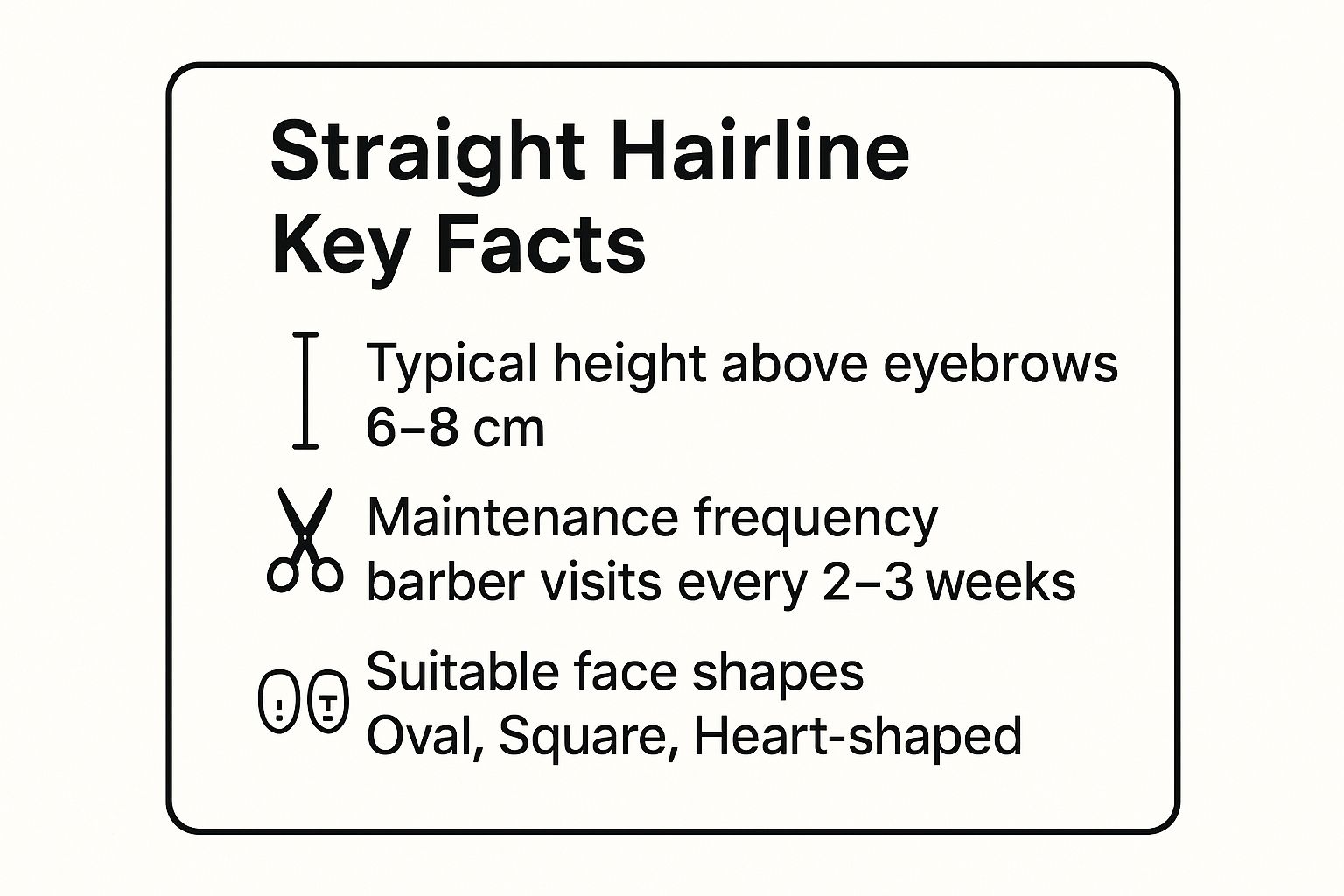
These key facts highlight that the straight hairline not only sits at a specific height but also demands consistent maintenance to preserve its signature sharp appearance. Its suitability for specific face shapes underscores its role in creating a balanced facial aesthetic, making it a powerful element of personal style.
2. Widow's Peak Hairline
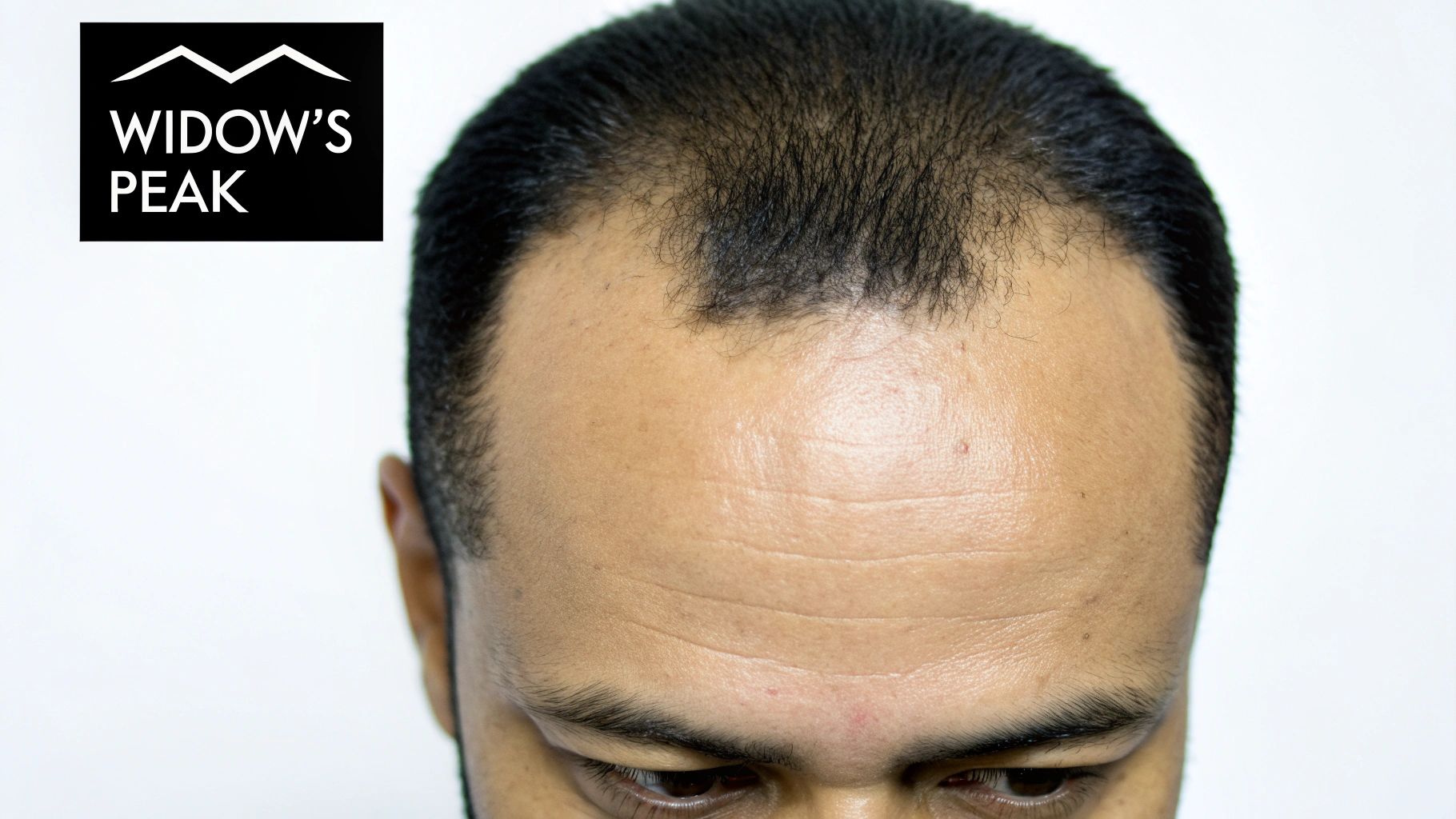
The widow's peak hairline is one of the most recognizable and distinctive male hairline types, defined by a V-shaped point of hair that dips down toward the center of the forehead. This genetic trait creates a striking contrast with the higher, often slightly receded, hairline on either side of the V. It gets its name from an old superstition that it was a sign a woman would outlive her husband, but today it is simply seen as a unique and often distinguished feature.
While sometimes mistaken for the onset of balding, a true widow's peak is a naturally occurring hairline shape present from a young age. It has been famously sported by classic Hollywood actors like Cary Grant and modern celebrities, giving it an association with charisma and a strong, memorable look. This hairline type is particularly common among those with European and Mediterranean ancestry.
Characteristics and Ideal Candidates
The primary characteristic of a widow's peak is its prominent downward point in the middle of the forehead, which can range from subtle and soft to sharp and dramatic. This feature creates a natural frame for the face, drawing attention to the eyes and brow line. The hair on either side of the peak is typically higher, forming a shape that resembles the top of a heart.
Expert Insight: A widow's peak can complement various face shapes, but it is especially effective for those with round or square faces. The downward point adds a perception of length to a round face, while the angular shape can add interesting contrast to the strong lines of a square jaw.
Maintenance and Styling
Styling a widow's peak is about working with its natural shape rather than fighting against it. The goal is to choose a hairstyle that either highlights the unique V-shape or integrates it seamlessly. Embracing this feature can turn it into a powerful style statement.
- Embrace the Shape: Hairstyles that are swept back or styled with volume, like a pompadour or a quiff, can showcase the peak as an intentional and stylish feature.
- Consult an Expert: Work with a barber who has experience with this hairline type. They can suggest cuts that prevent the peak from looking like an uneven M-shape, which can happen with a poor haircut.
- Controlled Styling: For a neater look, use a medium-hold pomade or wax to control the hair at the point, keeping it from becoming unruly. A slicked-back style, famously worn by actors like John Travolta, makes the widow's peak a central part of the look.
- Longer Styles: Growing the hair longer can also work well, allowing the peak to blend naturally with the rest of the hair, softening its appearance if desired.
3. Receding/Mature Hairline
The receding or mature hairline is perhaps the most common of all male hairline types, representing a natural progression for a significant portion of the male population. This hairline is defined by a gradual and often symmetrical withdrawal of hair from the temples, which slowly transforms a straight or low hairline into a more prominent M-shape over time.
Contrary to being a sign of premature baldness, a mature hairline is a normal part of the aging process for most men, typically beginning in the late teens or early twenties and becoming more established by age 30. It is influenced heavily by genetics and hormones, particularly dihydrotestosterone (DHT). This hairline type is incredibly prevalent and is sported by many distinguished public figures, from actors like Jude Law and Jason Statham to leaders like Prince William.
Characteristics and Ideal Candidates
The key characteristic of a receding hairline is the noticeable backward movement of hair at the corners of the forehead, creating higher temples. Unlike aggressive balding, a mature hairline often stabilizes, typically resting about an inch higher than a juvenile hairline. The degree of recession can vary, from a subtle softening of the corners to a more pronounced M-shape.
Expert Insight: Embracing a receding hairline is about adapting your style to work with your natural pattern, not against it. This hairline can add a look of distinction and maturity, framing the face in a new way. It complements virtually all face shapes, as its appearance is a natural evolution rather than a stylistic choice.
Maintenance and Styling
Styling a receding hairline is about minimizing contrast and creating a balanced, intentional look. The goal is to build confidence by choosing a haircut that complements, rather than attempts to hide, the hairline’s shape.
- Adapt Your Hairstyle: Opt for shorter haircuts like a buzz cut, a crew cut, or a textured crop. These styles reduce the visual contrast between your forehead and your hair, making the recession less prominent.
- Work with the Pattern: Instead of combing hair forward to cover the temples, which can often look unnatural, try styling it in a way that incorporates the recession, like a classic side part or a messy, textured look.
- Use the Right Products: Lightweight matte clays or pastes can add texture and volume to thinning areas without weighing hair down. Avoid heavy, greasy products that can clump hair together and expose more scalp.
- Focus on Overall Grooming: A sharp, well-maintained beard can draw attention downward and balance the higher hairline, creating a strong and confident overall appearance.
A receding hairline is not something to be concealed but rather a feature to be styled with confidence. By choosing the right haircut and focusing on overall grooming, it can become a distinguished and handsome part of your personal look, showcasing maturity and a powerful aesthetic.
4. Cowlick Hairline
The cowlick hairline is characterized by a distinctive whorl or spiral pattern where hair grows in a direction different from the surrounding strands. This genetic trait, determined by the orientation of hair follicles, creates a unique disruption in the flow of the hairline. It can appear anywhere along the forehead, most commonly at the front or corners, and is a permanent feature present from birth.
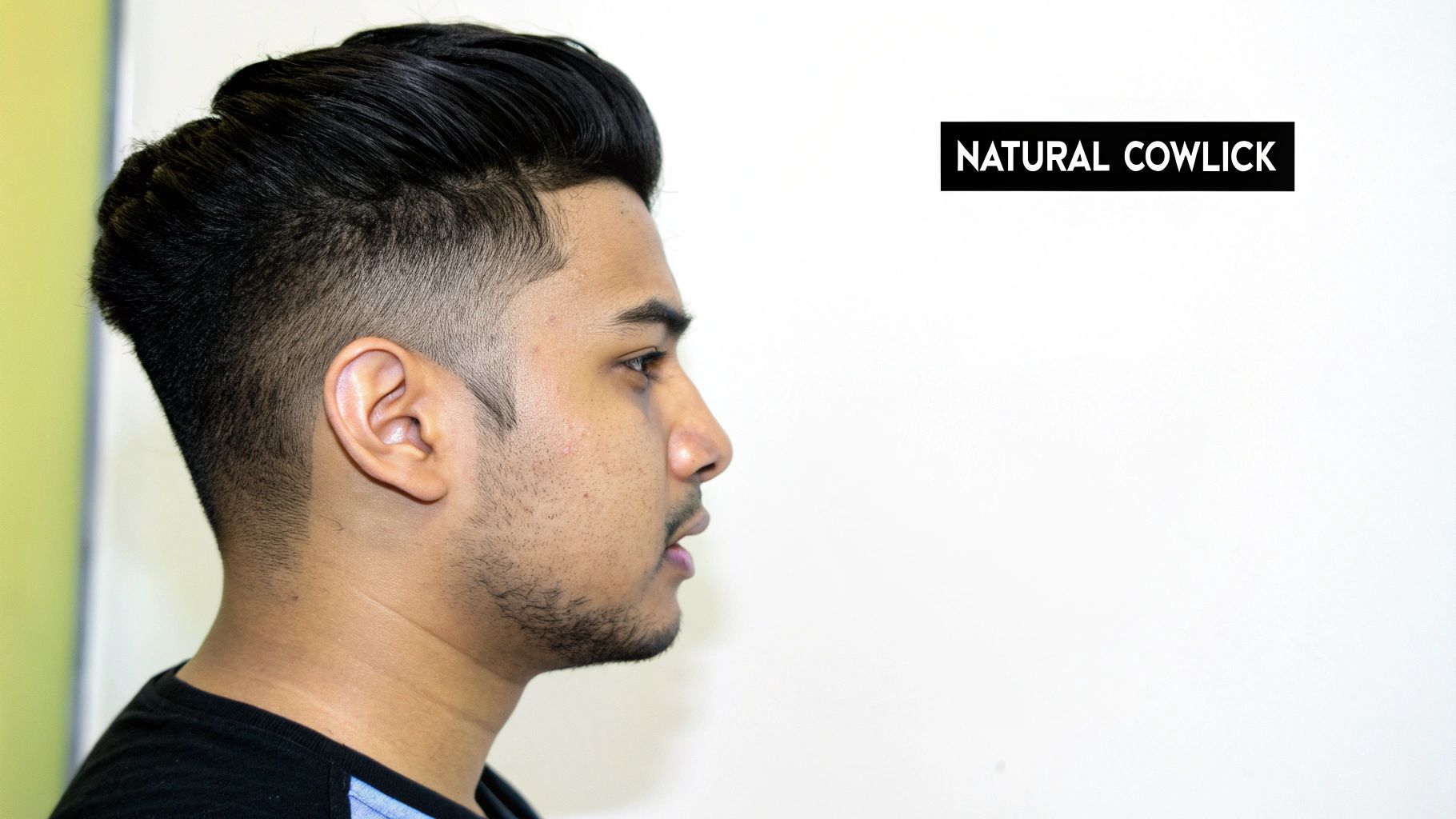
While often seen as a styling challenge, a cowlick can also add character and natural volume to a hairstyle. Many men, including celebrities, have successfully integrated a prominent cowlick into their signature look, turning a potential frustration into a stylish asset. Understanding how to manage a cowlick is key to mastering its unique properties.
Characteristics and Ideal Candidates
The defining feature of this hairline is the spiral growth pattern that forces a section of hair to stand up or lie in an opposing direction. This can create a natural lift at the hairline, a parted effect, or even a small wave. Unlike other male hairline types that are defined by their shape, the cowlick is defined by its behavior and growth direction.
Expert Insight: A cowlick is not an indicator of hair loss, but rather a unique feature of your hair's natural growth pattern. The best approach is to embrace it. Forcing the hair to go against its natural direction often results in a stubborn, unnatural look. Working with the cowlick allows for more effortless and sustainable styling.
Maintenance and Styling
Managing a cowlick successfully is less about fighting it and more about skillful guidance. The goal is to incorporate it into your desired hairstyle, using its natural tendencies to your advantage. Finding a barber experienced with this trait is crucial.
- Work With the Growth: Style your hair in the direction the cowlick naturally wants to go. This will prevent the hair from sticking up awkwardly and create a more cohesive look.
- Strategic Haircut Length: Longer hair can weigh down a cowlick, making it more manageable, while very short styles can sometimes minimize its appearance. A mid-length cut often presents the biggest challenge.
- Use the Right Products: A strong-hold pomade, wax, or clay can provide the control needed to tame the whorl. For a more natural look, a sea salt spray can enhance the texture the cowlick provides.
- Blow-Drying Technique: Using a blow dryer and a brush can help train the hair into place while it is still damp. Direct the heat and airflow in the direction you want the hair to lie.
The following video demonstrates practical techniques for styling and controlling a stubborn cowlick, offering visual guidance for taming this common hair feature.
Ultimately, the cowlick hairline is a perfect example of how to embrace individuality. Instead of viewing it as a flaw, consider it a built-in style element that adds unique texture and movement to your hair, setting you apart from more uniform hairline types.
5. Rounded/Curved Hairline
The rounded or curved hairline offers a softer, more organic frame for the face compared to its linear counterparts. Defined by a gentle, convex arch across the forehead, this hairline follows a smooth, continuous curve from one temple to the other. It lacks the sharp corners of a straight hairline or the distinct point of a widow's peak, resulting in a balanced and approachable look.
This type is one of the most common and natural-looking male hairline types. Its gentle contour creates a harmonious transition between the forehead and the hair, making it a versatile and widely flattering option. It is frequently seen in both casual and professional environments, favored by men who prefer a classic yet understated appearance that doesn't draw excessive attention.
Characteristics and Ideal Candidates
The key characteristic of a rounded hairline is its consistent, gentle arc. The curve is typically symmetrical and sits at a moderate height on the forehead, providing a soft frame that complements the natural contours of the face. This type avoids any harsh angles, which contributes to its friendly and open aesthetic.
Expert Insight: The rounded hairline is especially well-suited for individuals with heart, triangular, or diamond face shapes. The soft curve helps to balance a wider forehead or prominent cheekbones, while also softening the sharpness of a pointed chin, creating an overall look of gentle proportion.
Maintenance and Styling
While a rounded hairline is generally low-maintenance, a bit of upkeep is necessary to keep it looking neat and intentional. The goal is to preserve its natural shape without letting it become uneven or untidy.
- Regular Trimming: Visit your barber every 3-4 weeks for a cleanup. This will ensure the curved line remains clean and well-defined, preventing stray hairs from blurring the shape.
- Complementary Hairstyles: Choose haircuts that work with the curve, not against it. Styles with some softness, like a classic side part, a textured crop, or even slightly longer, layered looks, can enhance the natural flow of this hairline.
- Minimal Product Use: A rounded hairline looks best when it appears natural. Opt for light-hold styling creams or mousses to provide control without creating a stiff, overly sculpted look that would contradict its soft nature.
6. Irregular/Uneven Hairline
The irregular or uneven hairline is defined by its lack of symmetry and a consistent, predictable line across the forehead. This is one of the most unique male hairline types as it can manifest in countless ways, often resulting from genetics, scarring from an injury or surgery, or patchy hair loss from conditions like alopecia areata. It can also be the natural result of an aging hairline that hasn't receded into a distinct M-shape or U-shape.
While some may view an irregular hairline as a flaw to be corrected, many embrace its distinctiveness. It can add a rugged, unconventional character to a person's look. Its asymmetry means that no two uneven hairlines are exactly alike, making it a truly individual feature. Understanding how to manage and style it is key to turning a potential concern into a confident part of your appearance.
Characteristics and Ideal Candidates
The core characteristic of an irregular hairline is its asymmetry. One side might be higher than the other, the line might have random dips and peaks, or there could be isolated patches of hair missing along the frontal line. This type of hairline doesn't conform to any standard shape like a straight line or a widow's peak.
Expert Insight: An uneven hairline can work with any face shape because its lack of structure doesn't impose a new geometric line onto the face. Instead, it allows for creative styling solutions that can be tailored to either soften or accentuate your natural facial features, offering a high degree of versatility.
Maintenance and Styling
Managing an irregular hairline is less about forcing it into a perfect shape and more about working with its natural pattern. The goal is to create a look that feels intentional and balanced, even if it isn't symmetrical.
- Consult a Professional: A skilled barber or stylist is your greatest asset. They can recommend haircuts that complement the hairline's unique shape, such as textured crops, fringe styles, or longer, swept-back looks that strategically use volume to create a sense of balance.
- Strategic Styling: Embrace styles that add texture and volume. A messy, textured look can make irregularities much less noticeable. Avoid slicked-back styles with strong-hold gels, as this can accentuate the unevenness.
- Consider Corrective Options: For those who feel self-conscious, options like scalp micropigmentation (SMP) can create the illusion of a fuller, more defined hairline. In cases of significant hair loss or scarring, a consultation for hair restoration may be a viable path.
Male Hairline Types Comparison Table
| Hairline Type | Implementation Complexity 🔄 | Resource Requirements ⚡ | Expected Outcomes 📊 | Ideal Use Cases 💡 | Key Advantages ⭐ |
|---|---|---|---|---|---|
| Straight/Horizontal | Moderate to High | Regular barber visits, quality hair products | Clean, structured, youthful appearance | Oval, Square, Heart-shaped faces; formal looks | Strong facial symmetry; easy to style |
| Widow's Peak | Moderate | Styling products, skilled barber guidance | Distinctive, mature, memorable look | Those wanting character and uniqueness | Enhances facial symmetry; adds distinctive style |
| Receding/Mature | Moderate | Adapted hairstyling, possible treatments | Mature, distinguished, natural aging effect | Men experiencing natural hair loss | Widely accepted; enhances masculine features |
| Cowlick | Moderate to High | Specialized styling techniques, professional advice | Unique texture and volume; unpredictable styling | Management of natural hair growth patterns | Adds natural lift and fullness; unique texture |
| Rounded/Curved | Low to Moderate | Minimal styling products, regular trimming | Soft, approachable, natural appearance | Round/oval face shapes; casual and professional | Versatile; easy to maintain |
| Irregular/Uneven | High | Professional consultation, corrective options | Unique, individual appearance, possible asymmetry | Those with hair loss, scars, or genetic variation | Creative styling solutions; can be corrected |
From Understanding to Action: Owning Your Hairline
Navigating the world of male hairline types can feel like trying to solve a personal puzzle. Throughout this guide, we've explored the unique characteristics of the most common patterns, from the sharp geometry of a straight hairline and the distinguished V of a widow's peak to the dynamic nature of a maturing or cowlick-influenced hairline. Understanding where you fit into this spectrum is the crucial first step toward true hair confidence.
This knowledge isn't just trivia; it's a powerful tool for self-presentation. Identifying your specific hairline type, whether it's rounded, irregular, or perfectly straight, empowers you to make informed decisions. It transforms the conversation from "Is my hairline okay?" to "How can I make my hairline work best for me?" The answer lies in strategic styling, targeted hair care, and a mindset of ownership.
Key Takeaways: From Identification to Empowerment
The most important takeaway is that there is no single "best" or "ideal" hairline. Each type has its own aesthetic appeal and can be highlighted with the right approach.
- Embrace Your Natural Shape: A straight, rounded, or widow's peak hairline offers a fantastic canvas for a wide range of styles. The key is to choose cuts that complement your facial structure and the natural line of your hair.
- Work With, Not Against: A cowlick isn't a flaw; it's a feature. Understanding its growth direction allows you or your barber to create styles with built-in texture and volume, turning a potential frustration into a stylistic advantage.
- Reframe the Narrative on Maturing Hairlines: The term "receding hairline" often carries a negative weight, but a mature hairline is a natural part of aging for many men. It can add an air of distinction and wisdom. The goal isn't to hide it, but to style it in a way that looks sharp and intentional.
Actionable Next Steps for Your Hairline Journey
With this newfound understanding of the different male hairline types, you can move from passive observation to proactive management. Your next steps should focus on personalization and, if desired, professional consultation.
For those content with their current hairline, the action is in grooming. Experiment with hairstyles recommended for your specific type. A great barber is your best ally here; communicate what you've learned and collaborate on a cut that makes you feel confident.
For those concerned about changes, such as increased recession or thinning at the temples, knowledge becomes the foundation for action. Understanding that you have a maturing or irregular hairline is the first step. The second is exploring modern, effective solutions that go beyond styling. This is about taking control of your hair's future. Remember, a hairline you understand is a hairline you can manage. Use this information not as a label, but as a roadmap to presenting the most confident and authentic version of yourself to the world.
Ready to take proactive control of your hairline's future? If you're noticing changes and want to explore a powerful, non-surgical solution to support hair health and combat loss, PRP For HairLoss offers advanced treatments tailored to your needs. Learn more about how Platelet-Rich Plasma therapy can help you maintain and strengthen your unique hairline by visiting PRP For HairLoss.
 PRP For Hairloss
Leave a comment