When you hear "normal hairline for men," don't picture a single, perfect line. It’s more of a spectrum, a range of common shapes and positions. Think of it like a natural shoreline—it has countless forms and can shift a bit over time without signaling a major storm.
The real trick is learning to tell the difference between a minor, natural shift and the start of progressive hair loss.
What Defines a Normal Hairline?
As a man moves from his teens into adulthood, his hairline almost always changes. This is a completely natural evolution, but it's often mistaken for balding, which can cause a lot of unnecessary stress. The most common shift is the development of a mature hairline, a normal part of aging for the vast majority of men.
A mature hairline usually settles in sometime between your late teens and late twenties. It typically involves the entire hairline moving back slightly—maybe about an inch—from where it was when you were younger. Once it reaches this new position, it tends to stay put. This isn't a sign of hair loss; it's just your adult hairline taking shape, distinct from the lower, straighter one you had as a kid.
The 3 Most Common Hairline Shapes
It’s not just about where the hairline sits, but also its shape. Everyone is different, and the infographic below illustrates just how much variation there is.
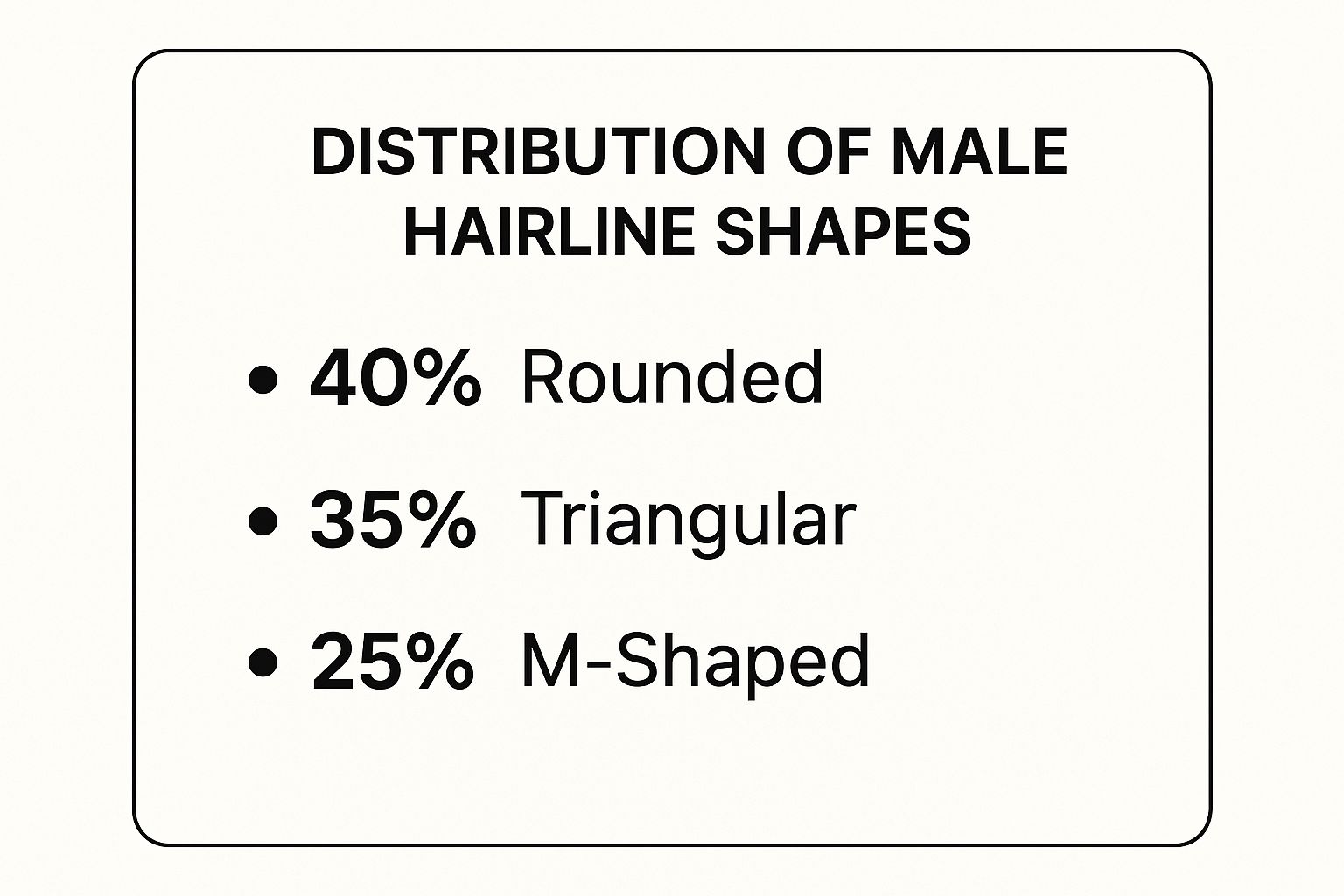
As you can see, there's no single "correct" shape.
- Rounded or Straight: The most common at 40%, often seen as the classic hairline.
- Triangular or "Widow's Peak": A close second at 35%, where the hairline forms a V-shape.
- M-Shaped: Found in 25% of men, this shape features more pronounced recession at the temples.
All of these are completely normal variations.
How to Tell a Mature Hairline from a Receding One
The big question for most guys is: when does a normal change cross the line into hair loss? This is where we need to talk about male pattern baldness, or what doctors call androgenetic alopecia.
Unlike a mature hairline that settles into a new, stable position, male pattern baldness is progressive. It doesn't stop on its own. It's also incredibly common, affecting a huge number of men as they get older.
In fact, studies show that about 20% of men see some degree of male pattern baldness by their 20s. That number climbs to 30% in their 30s and hits 50% by the time they're 50 years old.
Knowing these numbers helps put things in perspective. It’s a very common experience. The key difference lies in the pattern and the speed of the hair loss.
To make it easier to distinguish, here’s a quick comparison.
Mature Hairline vs. Receding Hairline at a Glance
| Characteristic | Mature Hairline (Normal) | Receding Hairline (Hair Loss) |
|---|---|---|
| Age of Onset | Typically late teens to late 20s. | Can start anytime after puberty, but often becomes noticeable in 20s, 30s, or 40s. |
| Recession Pattern | Moves back evenly, about 0.5 to 1 inch from the juvenile hairline. | Often uneven, with temples receding much faster than the center, creating a pronounced 'M' shape. |
| Speed of Change | Occurs gradually over several years and then stops. The new hairline is stable. | The loss is progressive and continuous. It doesn't stabilize on its own and may lead to thinning at the crown. |
| Hair Quality | Hair along the new hairline remains healthy and dense. | Hair along the receding edge often becomes finer, thinner, and weaker (miniaturization). |
Hopefully, this table gives you a clearer picture of what to look for. While a mature hairline is a one-time adjustment, a receding hairline is an ongoing process that you'll want to monitor. For more information, you can learn more about how male pattern baldness affects men and its global prevalence.
Common Hairline Shapes and Patterns
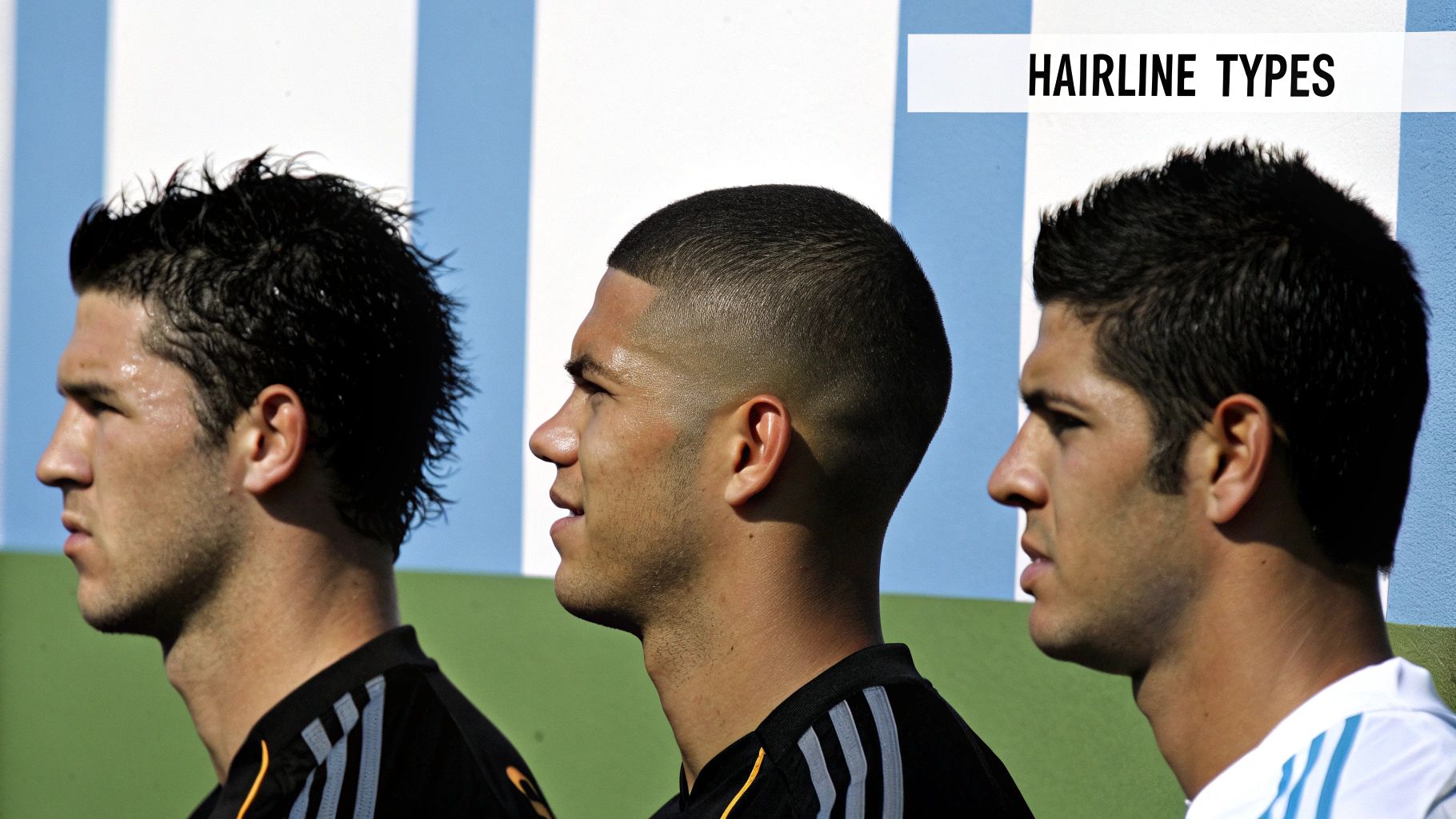
Long before you ever gave it a second thought, your genetics were busy sketching out the blueprint for your hairline. There really isn't a single "normal hairline for men" but rather a wide spectrum of shapes and starting points. Getting familiar with your own unique pattern is the first real step in understanding what's normal for you.
The simplest way to categorize a hairline is by how high or low it sits on the forehead.
- Low Hairline: This type starts closer to the eyebrows, making the forehead appear shorter. It’s pretty common when you're younger and often naturally moves up into a middle hairline with age.
- Middle Hairline: This is what most people would consider "average" for an adult man. It sits squarely in the middle of the forehead, creating a sense of balance with your other facial features.
- High Hairline: Some guys just naturally have a hairline that starts higher up, which gives the impression of a larger forehead. This is purely genetic and doesn't automatically mean you're losing hair.
The main thing to remember is that your hairline's starting position—low, middle, or high—is all about your DNA. It's only something to watch if you see it actively creeping higher over time.
Distinct Hairline Shapes
Beyond its starting point, the actual shape of your hairline is what defines its character. Most men have a blend of features, but we can generally group them into a few distinct categories. It's important to know that every one of these is a completely normal variation.
A rounded or bell-shaped hairline is just what it sounds like. It sweeps across the forehead in a smooth, gentle curve, without any sharp corners at the temples. This shape tends to create a softer frame for the face.
Then there's the M-shaped hairline, which many people know as a widow's peak. This classic pattern has a V-shaped point of hair dipping down in the center, while the hair at the temples sits a bit higher. An M-shape can simply be a mature hairline, but it can also be an early sign of recession if you notice those temples continuing to pull back.
How to Measure Your Hairline and Track Changes

Watching your hairline can feel like a bit of a guessing game, but it really doesn't have to be. By turning those vague observations into concrete data, you can swap that nagging anxiety for genuine clarity. Instead of just wondering if your hairline has moved, you'll know for sure.
The trick is to establish a solid baseline at home using simple, practical methods. This isn't about getting one perfect, hyper-precise measurement. It's about creating a consistent benchmark you can check back against over the coming months and years.
At-Home Measurement Techniques
You don’t need any fancy gadgets to get started. These two easy methods will give you a reliable starting point for monitoring what's normal for your hairline.
-
The Two-Finger Method: This is a classic for a reason—it’s quick and easy. Just raise your eyebrows to create wrinkles on your forehead. A mature, adult hairline usually sits about two fingers' width above that highest wrinkle. If you find your hairline is quite a bit higher than that, it’s something to keep an eye on.
-
The Forehead Wrinkle Benchmark: For a slightly more detailed measurement, raise your eyebrows again and find that top wrinkle. Your childhood or teenage hairline probably began right at or just below this line. A normal mature hairline tends to settle about 0.5 to 1 inch above this wrinkle. Think of this as your personal landmark.
The most powerful tool you have isn't a ruler—it's your smartphone camera. A single measurement only tells you where your hairline is today. A series of photos tells you its story over time.
How to Create a Visual Log
Honestly, tracking the change over time is far more valuable than any one-off measurement. A visual log is the best way to see if your hairline is stable or if it's actively receding.
-
Find Consistent Lighting: Stand in the exact same spot with the same overhead lighting every time you take a photo. You want to avoid harsh shadows or bright glares that can either hide or exaggerate your hairline's appearance.
-
Use a Consistent Angle: Hold your phone at the same height and angle for every shot. Make sure to get pictures from the front, both sides (to see the temples), and even from above to check on your crown.
-
Take Photos Periodically: There's no need to obsess over this daily. Snapping photos once every 1-2 months is more than enough to spot a real trend without driving yourself crazy with worry.
Following this process turns those fuzzy concerns into solid evidence. After a few months, you'll have a clear visual record showing whether your normal hairline is truly changing or just staying put. This kind of information is priceless if you ever decide to talk to a professional about hair loss solutions, like those you can learn about on PRPforhairloss.com.
Here is the rewritten section, designed to sound completely human-written and natural.
Why Do Hairlines Look Different Around the World?
If you’re staring in the mirror, worried about whether your hairline is "normal," it helps to take a step back and look at the bigger picture. Hair loss is a global experience, but your chances of seeing it are surprisingly different depending on where you live.
A changing hairline isn't some kind of personal flaw. It's a biological reality for millions of men, and understanding the global patterns can completely reframe how you see it. What feels like an isolating issue is actually a shared journey, especially in certain parts of the world.
A Quick Tour of Global Hair Loss Rates
Genetics and ethnicity are the biggest players in determining who experiences male pattern baldness. While it can happen to anyone, research has consistently shown that Caucasian men tend to experience it at higher rates. This simple fact explains why so many Western countries lead the world in hair loss statistics.
Take a look at the 2024 data, for example. Some European countries have the highest rates on the planet. Spain comes in at the top with about 44.5% of men showing noticeable hair loss. Italy is right behind at 44.37%, with France following at 44.25%.
This pattern holds true across other Western nations, too. In the United States, the figure is 42.68%, while Germany and Canada report 41.51% and 40.94% respectively. You can dive deeper into these numbers by checking out the global hair loss statistics on WorldPopulationReview.com.
When you realize that nearly half the guys in many developed countries are dealing with the exact same thing, it takes a lot of the pressure off. The conversation can shift from, "What's wrong with my hairline?" to "Okay, this is just a normal part of life for a lot of men."
This broader context is so important. It reminds you that your hairline’s future is largely written in your genes—factors that are common across huge populations. It really is a normal part of the male experience.
The Key Factors That Influence Your Hairline

While your DNA draws the initial blueprint for your hairline, it doesn't tell the whole story. Think of genetics as the main architect, but several other factors act as subcontractors, capable of influencing the final structure over time. Your hair's future is really a combination of predetermined biology and the lifestyle choices you make every day.
At the very heart of male pattern baldness are two powerful forces: genetics and hormones. Your genes dictate how sensitive your hair follicles are to a specific hormone called dihydrotestosterone, or DHT. If you inherited a high sensitivity, DHT can cause those follicles to shrink, which leads to the classic signs of a receding hairline and thinning crown.
How Lifestyle Choices Come into Play
Beyond the genetic lottery, your daily habits can definitely play a supporting role. These elements typically don't cause male pattern baldness all by themselves, but they can absolutely impact your overall hair health and potentially speed up a process that was already in the cards.
Some key lifestyle factors to keep in mind include:
- Chronic Stress: High, ongoing stress can prematurely push more of your hair into the shedding phase of its growth cycle. This condition, known as telogen effluvium, can cause noticeable thinning.
- Poor Nutrition: Your hair needs the right fuel to grow strong. A diet that’s lacking in essential building blocks like protein, iron, and zinc can lead to weaker, more brittle hair strands.
- Traction Alopecia: This is hair loss from physical stress. Constantly wearing tight hairstyles, like cornrows or a man bun, can pull on the hair follicles and cause permanent damage and loss right at the hairline.
The way these factors interact is complex. The start and speed of male pattern baldness are shaped by more than just your family tree. Globally, about one in four men begins to see hair loss around age 25, and that number jumps to 50% of men by age 50.
Understanding the basic biology behind hair, including things like facial hair growth and common misconceptions, gives you a much clearer picture. When you recognize that both built-in and manageable factors are at play, you can get a better handle on what defines a normal hairline for you and focus on the things you can actually control.
Your Top Questions About Male Hairlines Answered
https://www.youtube.com/embed/G3GfP-Q1G1I
Even after learning the basics, you probably still have a few specific questions bouncing around in your head. Let's tackle the most common ones head-on, giving you the clear, straightforward answers you need to understand what's happening on your own scalp.
Is an M-Shaped Hairline Always a Sign of Balding?
Not necessarily. In fact, an M-shaped hairline—what many people call a widow's peak—is just a normal genetic trait for a lot of guys. You can be born with it and have it your whole life without it ever being a problem.
The real tell is change. It only crosses over into "sign of balding" territory if that "M" shape starts getting deeper and more obvious over time. If you see the corners of your hairline pulling back month after month, that’s when you’re looking at recession, not just your natural hairline.
How Can I Tell if My Hairline Is Maturing or Receding?
This is the big question for most men, and it all comes down to one thing: does it stop?
A mature hairline is a natural, subtle shift. It typically moves back about an inch, a process that happens and then stabilizes. Think of it as a one-and-done adjustment that finds its new, permanent spot.
A receding hairline from male pattern baldness, on the other hand, is a continuous retreat. It doesn't stop. This type of recession is usually more aggressive and is often joined by other signs, like thinning hair at the crown. The absolute best way to know for sure is to take pictures every few months to see if the hairline is still on the move.
A mature hairline usually makes its appearance sometime between the ages of 17 and 29. Seeing this change during your late teens or twenties is a completely standard part of growing up and isn't typically something to worry about.
Can Stress Cause My Hairline to Recede?
Yes, but it's a bit more complicated than that. A major shock to your system, whether physical or emotional, can trigger a condition called telogen effluvium. This causes widespread hair shedding all over your head, which can certainly make your hairline look thinner for a while.
The good news is that this kind of hair loss is usually temporary. While long-term, chronic stress might speed up genetic hair loss that was already programmed to happen, it isn't the direct cause of male pattern baldness. That still comes down to your genes and hormones. Knowing the difference helps you focus on the real issue.
If you're noticing changes that look more like progressive hair loss, it's smart to start exploring your options. At PRP For HairLoss, we offer a wealth of information on treatments like PRP therapy to help you find the right path forward. You can learn more by visiting our site at https://prpforhairloss.com.

 PRP For Hairloss
Leave a comment