Beyond Basic Hair Loss: Understanding the Real Pattern
Thinking of male pattern baldness as just hair shedding is like looking at the tip of an iceberg. What you see on the surface is only a small sign of a much larger, more complex process happening underneath. The real symptoms of male pattern baldness follow a predictable biological blueprint, one that's written in your DNA and activated by hormones. This condition, known medically as androgenetic alopecia, isn't about hair suddenly falling out; it's a gradual transformation.
This process is fundamentally different from temporary hair loss you might experience from stress or illness, where hair growth typically returns to normal. Instead, androgenetic alopecia unfolds according to a specific script. The main characters in this story are your genetics and a powerful hormone called dihydrotestosterone (DHT). If you've inherited certain genes, your hair follicles, especially at the temples and crown, are highly sensitive to DHT.
The Science Behind the Pattern
Imagine your scalp is a garden. DHT acts like a very specific weed killer that only targets certain plants. The "gardens" at the front and top of your head are genetically vulnerable, while the ones on the sides and back are naturally resistant. This is precisely why hair loss almost always follows that classic M-shaped or U-shaped pattern.
When DHT latches onto these sensitive follicles, it kicks off a process called miniaturization. With each new hair growth cycle, the follicle shrinks and the cycle itself gets shorter. This has two major effects:
- The hair that grows back becomes progressively thinner, shorter, and less pigmented.
- The time hair spends in its active growing phase (the anagen phase) is significantly reduced.
Eventually, the follicle becomes so tiny that it can no longer produce a visible hair, resulting in the characteristic baldness pattern. This isn't just bad luck; it’s a targeted genetic response unfolding over time.
How Common Is This Journey?
This genetic tendency is incredibly widespread. Male androgenetic alopecia is the most common form of hair loss in men. Statistics show that 30% to 50% of men will experience it by the time they reach age 50. The journey typically begins with a receding hairline at the temples and a slow thinning at the very top of the head, known as the vertex.
These initial signs gradually expand, often merging into larger, more noticeable areas of baldness. You can explore more about the clinical progression in medical resources covering androgenetic alopecia's prevalence and patterns. Recognizing this mechanism is key to telling the difference between normal daily hair shedding and the true start of male pattern baldness.
Catching the Whispers Before They Become Shouts
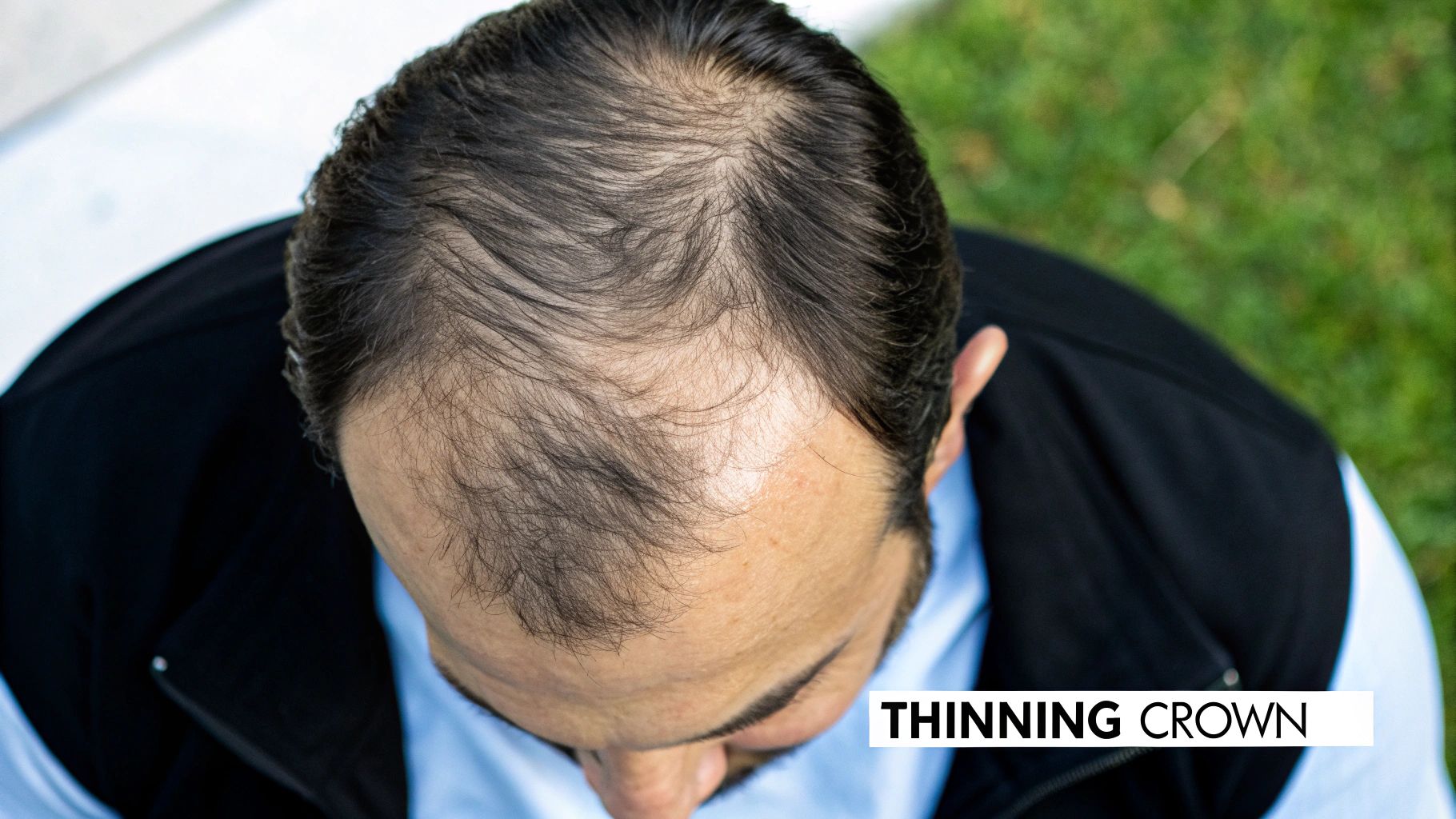
The earliest symptoms of male pattern baldness are often masters of disguise. They don't arrive with a dramatic announcement, like handfuls of shed hair. Instead, they appear as subtle whispers—changes so gradual you might easily dismiss them. Many men first sense these signals not by seeing less hair, but by feeling a difference, such as a change in texture where hair feels finer or less dense than it used to. It's a quiet evolution that can begin months or even years before thinning becomes obvious.
This process is a slow march, not a sudden retreat. The hairline doesn’t typically jump back overnight. Instead, it might recede by just millimeters at a time, creating a slightly higher "M" shape that only you might notice in the mirror. This slow creep is a classic sign, yet it's frequently explained away as a "maturing" hairline.
Decoding the Early Warning Signs
To catch these initial clues, you need to become an active observer of your own hair. Think of it like watching the tide come in; you don't see the water rush forward in a single wave, but you notice the waterline has shifted over time. Here are some practical ways to watch for the earliest symptoms of male pattern baldness:
- The Pillow & Shower Test: Losing 50-100 hairs per day is normal, but a consistent and noticeable increase in shedding on your pillow, in the shower drain, or on your brush is a red flag. This can signal that your hair's natural growth cycle is shortening.
- A Change in Styling: Do you find yourself needing more product to get the same look? Or does your hair part differently, showing more scalp than before? These styling adjustments are often unconscious compensations for reduced hair density.
- The Light Test: Stand under bright, direct overhead lighting. This is the ultimate truth-teller for hair density. If your scalp is much more visible under these conditions, it’s a strong indicator that thinning has started.
Your Genetic Blueprint and Timeline
Your family history offers a valuable, though not perfect, roadmap. If your father or maternal grandfather experienced hair loss, your genetic predisposition is higher. This genetic connection is a key reason why androgenetic alopecia is so widespread.
Male pattern baldness affects a large portion of the male population, with rates increasing sharply with age. By age 25, roughly 25% of men are already dealing with some degree of hair loss. This figure jumps to 50% by age 50 and continues to rise throughout life. You can see more data on these trends by exploring this world baldness map.
Understanding these statistics alongside your personal genetic risk helps you see subtle signs not as random events, but as potential first steps on a well-known path.
The Telltale Pattern: Why Your Temples and Crown Go First
Have you ever noticed that male pattern baldness seems to follow a predictable roadmap? The classic M-shaped recession at the temples and the thinning patch on the crown aren't just a coincidence. This specific pattern is one of the most reliable symptoms of male pattern baldness, and it’s all down to biology.
Think of the hair follicles across your scalp as having different genetic instructions. For men who are predisposed to hair loss, the follicles at the temples and crown are uniquely sensitive to the hormone DHT (dihydrotestosterone). In contrast, the follicles on the sides and back of the head are largely resistant to its effects.
This sensitivity means that when DHT circulates, it signals these vulnerable follicles to shrink. This process, known as miniaturization, causes the hair in these areas to grow back finer, shorter, and weaker with each new growth cycle. Eventually, the follicles shrink so much that they stop producing hair altogether. The resilience of the hair on the back and sides of the head is precisely why it’s often used for hair transplants—it’s simply programmed to last.
Recognizing Your Unique Pattern
While the temples and crown are the classic hotspots, the progression of hair loss isn't identical for everyone. Some men first notice a rapid recession at the temples, which carves out a distinct “widow’s peak” that deepens over time. For others, the initial sign is a subtle loss of density at the crown, something that might only be visible under bright lights or when their hair is wet. Understanding your specific pattern is the first step in tracking its progression.
It's also crucial to distinguish this patterned thinning from normal, everyday shedding. Everyone loses hair daily, but the amount and location can signal a problem. This infographic outlines the different levels of hair shedding to help you determine what’s typical.
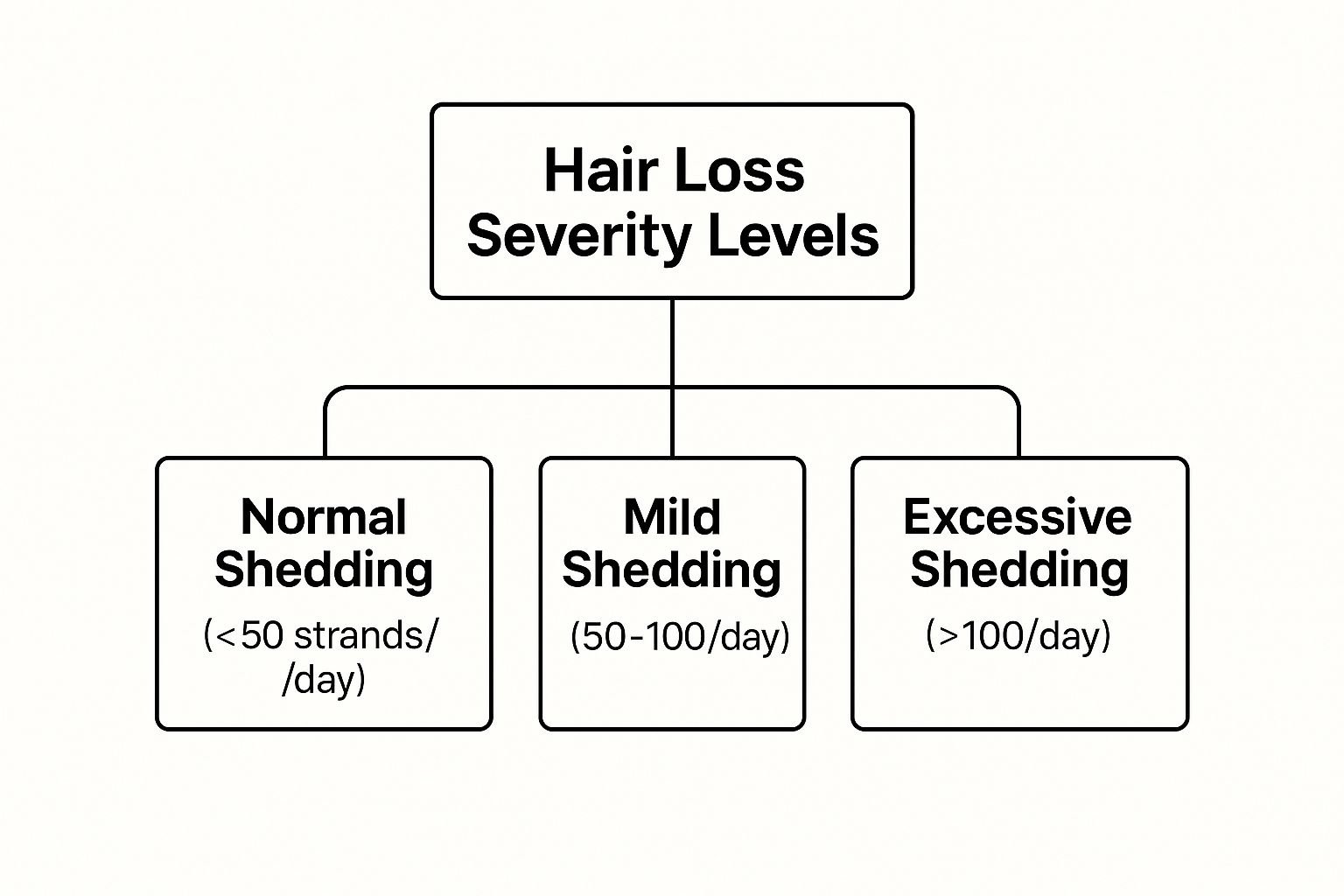
If you consistently find your hair loss falls into the "Excessive Shedding" category, especially if it’s concentrated in the classic M-shape or crown areas, it’s a strong indicator of androgenetic alopecia. A practical next step is to monitor these zones, perhaps by taking monthly photos, to create a clear visual record of any changes. This documentation can be incredibly valuable if you decide to discuss treatment options, like PRP therapy, with a specialist. Your hair loss journey has a unique script, and recognizing it is the key to understanding what comes next.
The Hidden Signs Everyone Misses
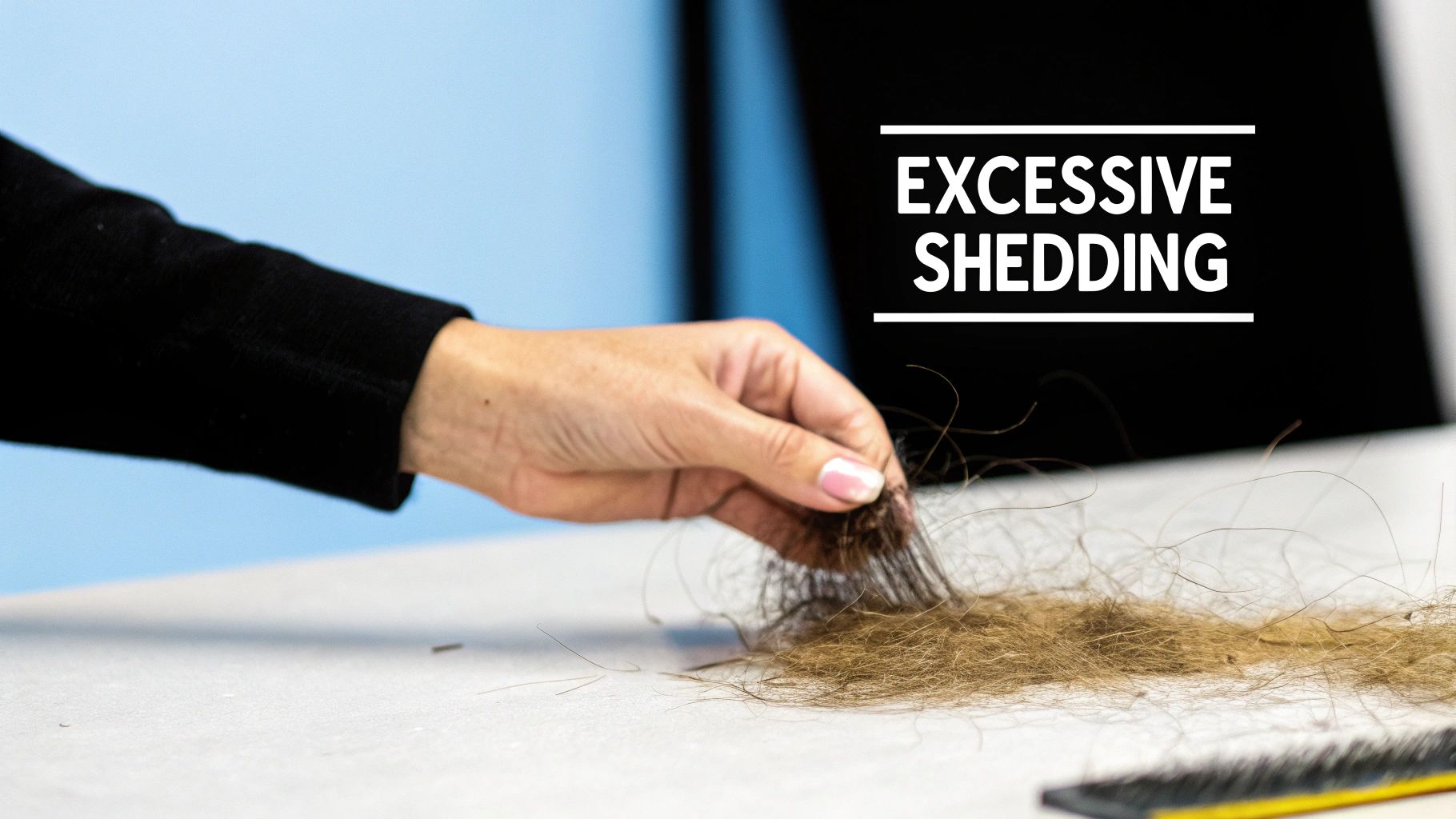
Most people assume the first sign of hair loss is a dramatic change in the mirror, like a noticeably receding hairline. However, the most telling symptoms of male pattern baldness are often much quieter. These are the subtle shifts that happen so gradually that even you or your barber might not connect the dots at first. The reality is that long before any widespread thinning becomes obvious, the fundamental biology of your hair has already started to change.
One of the earliest and most frequently overlooked signs involves a change not in the amount of hair you have, but in its quality. This is a direct result of miniaturization, a process where the hormone DHT causes hair strands to shrink over successive growth cycles. The hair in sensitive areas, typically the temples and crown, starts to feel finer and less dense to the touch. It’s a change you can feel before you can see it.
Beyond Hair Texture: Lesser-Known Clues
Aside from the physical feel of your hair, other subtle clues can signal the onset of male pattern baldness. Many men dismiss these signs or attribute them to other factors, but they can be crucial early indicators of androgenetic alopecia.
Keep an eye out for these often-missed signs:
- Changes in Your Part or Cowlick: If your part line appears to be widening over time, or if a cowlick suddenly looks more pronounced and "open," it could point to a decrease in hair density in that specific spot.
- Increased Scalp Visibility in Certain Lighting: You might catch a glimpse of your reflection under harsh office lights or in direct sunlight and notice your scalp seems more visible than before. This isn't because you lost a clump of hair overnight; it's because the thinning has reached a point where it can no longer effectively block light.
- Scalp Sensitivity or Itching: While not everyone experiences this, some men report a persistent, low-level itch or a feeling of sensitivity in the areas where thinning later becomes prominent. This can be related to the low-grade inflammation that sometimes accompanies the miniaturization of hair follicles.
Recognizing these overlooked symptoms gives you a more accurate understanding of how male pattern baldness truly begins. It helps you differentiate between normal hair shedding and the start of a persistent pattern. This awareness is the crucial first step toward making informed decisions about monitoring your hair's health and considering potential actions, from lifestyle adjustments to proven treatments.
The Decade-by-Decade Journey: What to Expect When
Male pattern baldness doesn’t work like a clock, but its progression often follows noticeable patterns related to age. Knowing what might happen during different decades of your life can help you understand your own experience and see if it’s typical. For some men, the journey starts early and progresses quickly, while for others, it's a slow burn over many years.
This timeline is deeply personal, shaped by your unique mix of genetics, lifestyle, and general health. Things like ongoing stress, poor nutrition, or other health issues can press the fast-forward button on hair loss. On the flip side, a healthy lifestyle might help keep the process slow and steady. Recognizing these patterns helps in setting realistic expectations.
In Your Twenties: The Shock of Early Onset
Finding the first symptoms of male pattern baldness in your twenties can be a real shock. At this age, hair loss often shows up as a slight recession at the temples or a subtle thinning at the crown. Because it’s so gradual, many young men pass it off as just a "mature hairline." In reality, this is often the very first sign of androgenetic alopecia. The mental effect can be substantial, as hair loss isn't something society usually connects with youth.
While genes are the main driver, this is also a time when lifestyle choices can really impact your hair's health. The stress from college, starting a career, or having an inconsistent diet can worsen a genetic tendency for hair loss. It’s a key time to take note of your hair's condition and watch for any rapid changes.
In Your Thirties and Forties: Navigating Visible Changes
By the time men hit their thirties, any hair loss that had started earlier often becomes more obvious. The classic "M" shape at the hairline might become sharper, and the thinning spot on the crown can grow. In your forties, these two areas may begin to connect, forming a more noticeable bald area on top of the head. While this is a common path, the speed at which it happens varies a lot. Some men see big changes in just a few years, while others have a very slow, predictable thinning.
Interestingly, your location might also play a role in the likelihood of experiencing baldness. The following table highlights prevalence rates across various regions, showing that Western countries often report higher numbers.
| Country | Baldness Rate (%) | Region | Age Group Most Affected |
|---|---|---|---|
| Spain | 44.50% | Europe | 45-55 |
| Italy | 44.37% | Europe | 45-55 |
| France | 44.25% | Europe | 45-55 |
| United States | 42.68% | North America | 40-59 |
| Germany | 41.51% | Europe | 45-55 |
| United Kingdom | 41.23% | Europe | 40-59 |
| Canada | 37.42% | North America | 40-59 |
For example, Spain leads with 44.5% of its male population affected, with Italy close behind at 44.37%, and the United States at 42.68%. You can explore more detailed data on male baldness rates worldwide to see how different countries compare.
Viewing hair loss through the lens of age and geography helps put your own journey into perspective. It allows you to see if your experience fits with common patterns or if it might be something to discuss with a professional.
When Things Speed Up: Recognizing Acceleration Triggers
Sometimes, the slow, predictable progression of male pattern baldness shifts into a higher gear. The gradual thinning you’ve been monitoring might suddenly seem to accelerate, a change that can be alarming. Recognizing these periods of faster hair loss is essential, as they often point to specific triggers beyond your baseline genetics. This isn't just in your head; your hair loss timeline can be influenced by various internal and external factors.
Think of your underlying genetic predisposition as a slow-moving river. Certain events can act like a sudden downpour, causing the river to swell and flow much faster for a period. These triggers don't necessarily cause male pattern baldness on their own, but they can significantly speed up the process that was already underway.
Identifying the Warning Signs of Acceleration
When your hair loss progression accelerates, the symptoms of male pattern baldness become more pronounced and appear more quickly. Instead of a slow creep over years, you might notice more dramatic changes in a matter of months. Key warning signs include:
- A sudden, sharp increase in daily shedding: You might find noticeably more hair on your pillow, in the shower drain, or on your clothes than what has become your normal.
- Rapid changes at the hairline: The "M" shape at your temples might deepen significantly over just a few months, rather than years.
- Visible thinning in a short timeframe: Areas like the crown might go from having decent coverage to showing much more scalp in a surprisingly brief period.
Common Triggers That Can Hit the Gas
So, what causes this sudden shift? Several factors can put stress on your body and, in turn, your hair follicles. Major life stressors, such as a difficult job change, personal loss, or significant emotional distress, are well-known culprits. The stress hormone cortisol can interfere with the normal hair growth cycle.
Additionally, certain health-related events can trigger an acceleration of underlying hair loss. These include:
| Trigger Category | Specific Examples | Impact on Hair Loss |
|---|---|---|
| Dietary Changes | Crash diets, rapid weight loss, nutritional deficiencies (e.g., iron, zinc) | Deprives follicles of the essential nutrients needed for healthy growth. |
| Health Events | Major surgery, high fever, severe illness | Can cause telogen effluvium, a temporary but dramatic shedding that unmasks underlying MPB. |
| Hormonal Shifts | Changes in thyroid function, other endocrine imbalances | Disrupts the hormonal balance that regulates the hair growth cycle. |
| Medications | Certain drugs for blood pressure, depression, or other conditions | Can have hair loss as a side effect, worsening an existing pattern. |
Distinguishing between a temporary shedding event and a permanent acceleration of your male pattern baldness is key. This knowledge helps you identify when lifestyle adjustments might be beneficial or when it's time to seek a professional evaluation to discuss your options.
From Recognition to Action: Your Next Steps
Recognizing the subtle symptoms of male pattern baldness is a significant first step, but the real power comes from turning that awareness into purposeful action. This doesn’t always mean jumping into aggressive treatments. It’s about creating a clear, logical plan that helps you move forward with confidence, whether that involves careful monitoring, lifestyle adjustments, or a professional consultation. Overcoming denial or uncertainty is often the biggest hurdle, but having a practical roadmap can make all the difference.
Moving forward starts with creating a clear record of your hair's current state. This simple, proactive step transforms vague concerns into concrete data that a healthcare provider can actually use.
Documenting Your Symptoms Effectively
Creating a reliable visual log is easier than you might think, and you don’t need any professional photography skills—just consistency. This method allows you to track changes objectively over time, cutting through the guesswork.
- Establish a Baseline: Start today by taking clear, well-lit photos of your hairline, crown, and the top of your head. This will be your starting point for all future comparisons.
- Be Consistent: For every photo session, use the same lighting (bright, indirect light is best), angle, and location. Wetting your hair can make thinning more apparent, so decide if you want to track it wet, dry, or both, and stick with that choice.
- Set a Schedule: Repeat this process every 3 to 6 months. Taking pictures too often can create unnecessary anxiety, while a consistent, longer interval reveals true, meaningful changes.
This simple tracking method provides an invaluable timeline. When you do decide to speak with a professional, you won’t just be describing your concerns—you'll be showing them.
Preparing for a Professional Consultation
Walking into a dermatologist's office armed with your photo log and thoughtful questions will lead to a much more productive conversation. You’re not just a patient; you are an informed partner in your own healthcare. Knowing what to ask helps you understand your options and set realistic goals.
Consider asking these key questions:
- Based on my pattern and progression, what stage of hair loss am I in?
- Are there any lifestyle or dietary factors you recommend I address?
- What are the pros and cons of different treatment approaches for someone at my stage?
- What kind of results can I realistically expect from each option, and on what timeline?
Honest conversations with dermatologists often show that different treatment approaches are better suited for different symptom patterns. For example, some men may respond well to topical solutions, while others might explore procedures designed to improve hair density and thickness. The goal is to align the right strategy with your specific symptoms and expectations. Taking action is about gaining control and moving forward with clarity, no matter which path you choose.
If you are exploring non-surgical options to improve hair density, learning more about treatments like PRP for hair loss can provide valuable insights into modern approaches supported by ongoing research.

 PRP For Hairloss
Leave a comment