Understanding When Hair Follicles Actually Die
The question of reviving dead hair follicles hinges on one key factor: are the follicles truly dead, or simply dormant? This distinction significantly impacts treatment options and the potential for future hair growth. Let's delve into the science behind follicle death and dormancy.
Dormant vs. Dead Follicles: A Critical Difference
Dormant follicles are much like sleeping seeds. They've temporarily paused hair production, but the underlying root structure remains intact. Several factors can contribute to dormancy, including hormonal fluctuations, poor circulation, and stress. With proper stimulation, these follicles can be reactivated and resume hair growth. It's similar to a plant entering winter dormancy – seemingly lifeless, yet still capable of springtime revival.
Dead follicles, on the other hand, have sustained irreversible damage. Their structure has deteriorated, often due to scarring, conditions like cicatricial alopecia, or prolonged neglect. Like a plucked flower, a dead follicle lacks the necessary biological components for hair production. Stimulating a dead follicle won’t result in regrowth because the essential mechanisms are gone.
Recognizing the Signs of Follicle Death
Several factors contribute to true follicle death. DHT sensitivity, a major factor in male and female pattern baldness, can gradually shrink follicles until they cease functioning. Inflammation, often linked to various scalp conditions, can also inflict irreparable damage. Furthermore, prolonged neglect, where hair loss remains unaddressed for extended periods, can lead to irreversible damage. Recognizing these warning signs is crucial for timely intervention and maximizing hair restoration potential.
Why Some Follicles Revive, While Others Don't
A follicle's ability to be revived depends heavily on the extent of the damage. Early intervention in cases of hair thinning, before substantial follicle miniaturization, often produces the best results with treatments aimed at stimulating regrowth. However, in cases of advanced hair loss where follicles have atrophied significantly or scarring has occurred, the chances of revival decrease considerably.
This underscores the importance of understanding your individual hair loss situation and seeking professional guidance. This allows you to explore realistic treatment options and avoid unrealistic promises of reviving follicles that are truly beyond repair. Addressing hair loss concerns early offers the greatest potential for preserving and potentially reviving dormant follicles.
What Current Treatments Can Actually Accomplish

Many popular hair loss treatments concentrate on maintaining existing hair rather than bringing back follicles that have completely stopped working. While these treatments can be effective, understanding their limitations is essential for having realistic goals. Let’s take a closer look at what these treatments can do.
Minoxidil: Encouraging Growth
Minoxidil, a widely used topical treatment, mainly increases blood flow to the scalp and extends the anagen phase (the active growth period of the hair cycle). For some people, this can result in thicker, fuller-looking hair. However, minoxidil’s effect on completely dormant follicles is minimal.
Minoxidil is a common treatment for hair loss that can stimulate growth in existing hair follicles. It achieves this by improving blood circulation in the scalp and lengthening the anagen phase of hair growth. While studies have shown that minoxidil can improve hair density and create the appearance of thickness, it's not very effective at reviving inactive follicles. For example, research on linear hair growth rates demonstrated that reactivated grafts treated with minoxidil achieved barely 50% of their original growth rates. This suggests that minoxidil, while beneficial for existing hair, doesn't fully restore non-functioning follicles. Learn more about this research here.
Finasteride: DHT Management
Finasteride, an oral medication, works by blocking dihydrotestosterone (DHT), a hormone linked to male pattern baldness. By lowering DHT levels, finasteride can slow or even stop hair loss progression. It is most effective in the early stages of hair loss, when follicles are still active but shrinking.
Like minoxidil, however, finasteride cannot revive follicles that have already ceased to function. This underscores the importance of starting hair loss treatment early.
Topical Therapies: Scalp Health and Support
Other topical treatments, such as ketoconazole shampoo and various peptide serums, can enhance scalp health. This helps create an environment more conducive to hair growth. These treatments frequently complement minoxidil and finasteride by targeting issues like inflammation and boosting nutrient delivery to the follicles.
Their ability to revive dead follicles, though, remains limited. Their primary benefit is in supporting existing hair and working in conjunction with other treatments.
Combining Treatments and Managing Expectations
Many individuals find success by combining different hair loss therapies. Using minoxidil and finasteride together, for instance, can create a synergistic effect, maximizing their individual benefits.
Furthermore, incorporating topical therapies and lifestyle adjustments, such as a balanced diet and stress reduction techniques, can further enhance hair health.
It's crucial to remember that even with the most advanced current treatments, completely restoring dead follicles is a difficult task. Maintaining realistic expectations is essential for a positive experience and helps to avoid disappointment.
Hair Transplants: Your Most Reliable Option For Dead Zones
While many hair loss treatments promise renewed growth, the truth is that a truly dead follicle can't be revived. For those stubborn areas of the scalp where follicles have ceased to function, what’s the best solution? Hair transplantation offers a reliable, if indirect, answer. It doesn't bring dead follicles back to life, but it does relocate healthy, active ones.
Understanding Hair Transplantation
Hair transplantation works by taking healthy hair follicles from a donor area, often the back or sides of the head, and transplanting them to the recipient area affected by hair loss. This technique takes advantage of the natural resistance of these donor follicles to dihydrotestosterone (DHT), the hormone primarily responsible for male pattern baldness. There are two main methods: Follicular Unit Transplantation (FUT) and Follicular Unit Extraction (FUE).
FUT involves removing a strip of scalp from the donor area and carefully dissecting the follicular units for transplantation. FUE, conversely, extracts individual follicles directly from the donor area using a specialized punch tool. Both methods aim for a natural appearance by replicating the normal distribution of hair.
Success Rates and Realistic Expectations
Although transplants don't revive dead follicles, they achieve impressive success rates with experienced surgeons. FUE procedures typically have graft survival rates between 90% and 100%. This high success rate means most transplanted hairs grow normally. It's common for transplanted hair to initially shed within a few weeks, which is a normal part of the process before new growth begins. While hair transplants won't fix the underlying cause of dead follicles, they provide a cosmetic solution by relocating healthy hair. For example, a study showed a 95% hair graft survival rate in female patients after FUE transplants. More detailed statistics can be found here.
It's also important to have realistic expectations about density and coverage. The donor area limits the number of transplantable grafts. While full restoration isn't always achievable, skilled surgeons can significantly improve density and coverage.
To help understand the different techniques, let's look at a comparison:
To help you compare different techniques and their effectiveness, we’ve compiled the following table:
Hair Transplant Success Rates by Technique
| Technique | Success Rate | Recovery Time | Best For |
|---|---|---|---|
| FUT | 90-95% | 2-3 weeks | Larger areas, maximizing graft numbers |
| FUE | 90-100% | 1-2 weeks | Smaller areas, minimizing scarring |
As this table shows, both FUT and FUE offer excellent success rates. The best technique for you will depend on your specific needs and the surgeon’s recommendations.
Choosing the Right Surgeon and Post-Procedure Care
Choosing a qualified, experienced surgeon is crucial for a successful hair transplant. Research potential surgeons thoroughly, looking at their credentials, experience, and before-and-after photos. Consultations with multiple surgeons are highly recommended to understand different approaches and find the best fit for your individual needs.
Post-procedure care is essential for maximizing transplant success. Following your surgeon’s instructions on wound care, medication, and activity restrictions is crucial for optimal healing and minimizing complications. Expect some swelling and scabbing initially, which typically subsides over several weeks. Most people return to normal activities within a few days, but full recovery takes several months.
Figuring Out Your Personal Hair Loss Situation
Understanding your unique hair loss situation is crucial for effective treatment. Hair loss isn't always due to dead follicles, and various factors influence its progression. Age, genetics, hormonal fluctuations, and underlying health conditions all play a role. Identifying these factors helps determine if your hair follicles are still capable of responding to treatment.
Recognizing Different Types of Hair Loss
Androgenetic alopecia, commonly known as male or female pattern baldness, is a prevalent form of hair loss. This type typically follows a distinct pattern, receding at the temples and crown in men and causing diffuse thinning in women. Alopecia areata, an autoimmune disorder, results in patchy hair loss. These different types affect follicle viability in varying ways. Androgenetic alopecia often involves gradual follicle miniaturization, while alopecia areata can cause temporary dormancy.
Working with a Dermatologist or Hair Specialist
Consulting a dermatologist or a hair specialist is essential for accurate diagnosis. They will examine your scalp, analyze your hair loss pattern, and may perform a scalp biopsy to determine the underlying cause and assess follicle health. Distinguishing between truly dead follicles and dormant ones with the potential for revival is key.
Hair loss is a widespread concern, affecting a significant portion of the population. Studies show that 6% of women under 50 and 30–40% of women over 70 experience hair loss. While treatments like minoxidil and hair transplants can manage hair loss, they don't revive dead follicles. Current therapies primarily focus on preserving existing hair and redistributing it. Ongoing research into follicle biology offers hope for future treatments capable of reviving dormant follicles or regenerating new ones. You can explore this research further here.
Tracking Your Hair Loss Progression
Monitoring your hair loss progress is vital for informed treatment decisions. Regularly photographing your scalp helps visualize changes over time. Maintaining a hair loss journal, where you document shedding patterns, hair texture, and scalp health, provides valuable data. Combining these observations with professional guidance offers personalized insights into your hair loss journey and improves the chances of finding effective, tailored solutions.
Breakthrough Technologies That Might Change Everything
While hair transplants offer a solution for areas with dead follicles, they rely on redistributing existing hair. This naturally leads to the question: can dead follicles be revived? Exciting advancements in regenerative medicine offer a glimmer of hope, with emerging technologies exploring true follicle regeneration.
Stem Cell Therapy: The Regenerative Potential
Stem cell therapy holds immense promise for a variety of medical applications, including hair restoration. Stem cells have the unique ability to differentiate into specialized cell types, and theoretically, they could be used to generate new hair follicles. The process involves extracting stem cells, typically from the patient's own fat tissue or bone marrow, and injecting them into the scalp.
While still in its early stages, research on stem cell therapy for hair loss is yielding encouraging results in pre-clinical trials. However, significant challenges remain before this therapy becomes a mainstream treatment.
Controlling the differentiation of stem cells into functional hair follicles is a complex undertaking. Ensuring the long-term survival and integration of these newly generated follicles presents further obstacles.
Platelet-Rich Plasma (PRP) Therapy: Boosting Follicle Activity
Platelet-rich plasma (PRP) therapy is another emerging treatment gaining popularity. This involves extracting a small amount of the patient's blood, processing it to concentrate platelets, and then injecting the PRP back into the scalp. Platelets contain growth factors that may stimulate dormant follicles and promote hair growth.
PRP is currently being investigated as a treatment for various hair loss conditions, including androgenetic alopecia. While PRP shows some promise, more robust clinical trials are needed to fully determine its effectiveness, particularly in reviving dead follicles.
Results can vary significantly between individuals, and the optimal PRP preparation and injection protocols are still being refined. It's essential to consult with a qualified medical professional to discuss the potential benefits and limitations of PRP for your individual situation. You can learn more about PRP therapy for hair loss on our site, PRP for Hairloss.
Tissue Engineering: Building New Follicles
Tissue engineering is a field focused on creating functional tissues and organs in the lab. In the context of hair loss, tissue engineering aims to create new hair follicles from scratch. This involves combining cells, biomaterials, and growth factors to create a follicle-like structure that can be implanted into the scalp.
While this technology is still largely experimental, it has the potential to overcome the limitations of existing treatments and address the root cause of hair loss. Researchers are exploring ways to bioengineer hair follicle germs, the key structures responsible for hair growth.
These engineered germs, when implanted, could theoretically generate new, fully functional follicles. This approach could revolutionize hair restoration by providing an unlimited supply of hair follicles, regardless of the availability of donor hair.
The Future of Follicle Revival
These breakthrough technologies hold incredible potential, but they also come with limitations. Many are still in the experimental phase, and more research is needed to fully understand their effectiveness, safety, and long-term implications.
However, these developments offer hope that reviving dead follicles might one day become a reality. This means individuals experiencing significant hair loss may have more effective treatment options available to them in the future. Staying informed about these emerging treatments and consulting with qualified professionals can help you make informed decisions about your hair restoration journey. This includes being open to new options and managing expectations based on current scientific understanding.
Making Smart Treatment Decisions For Your Situation
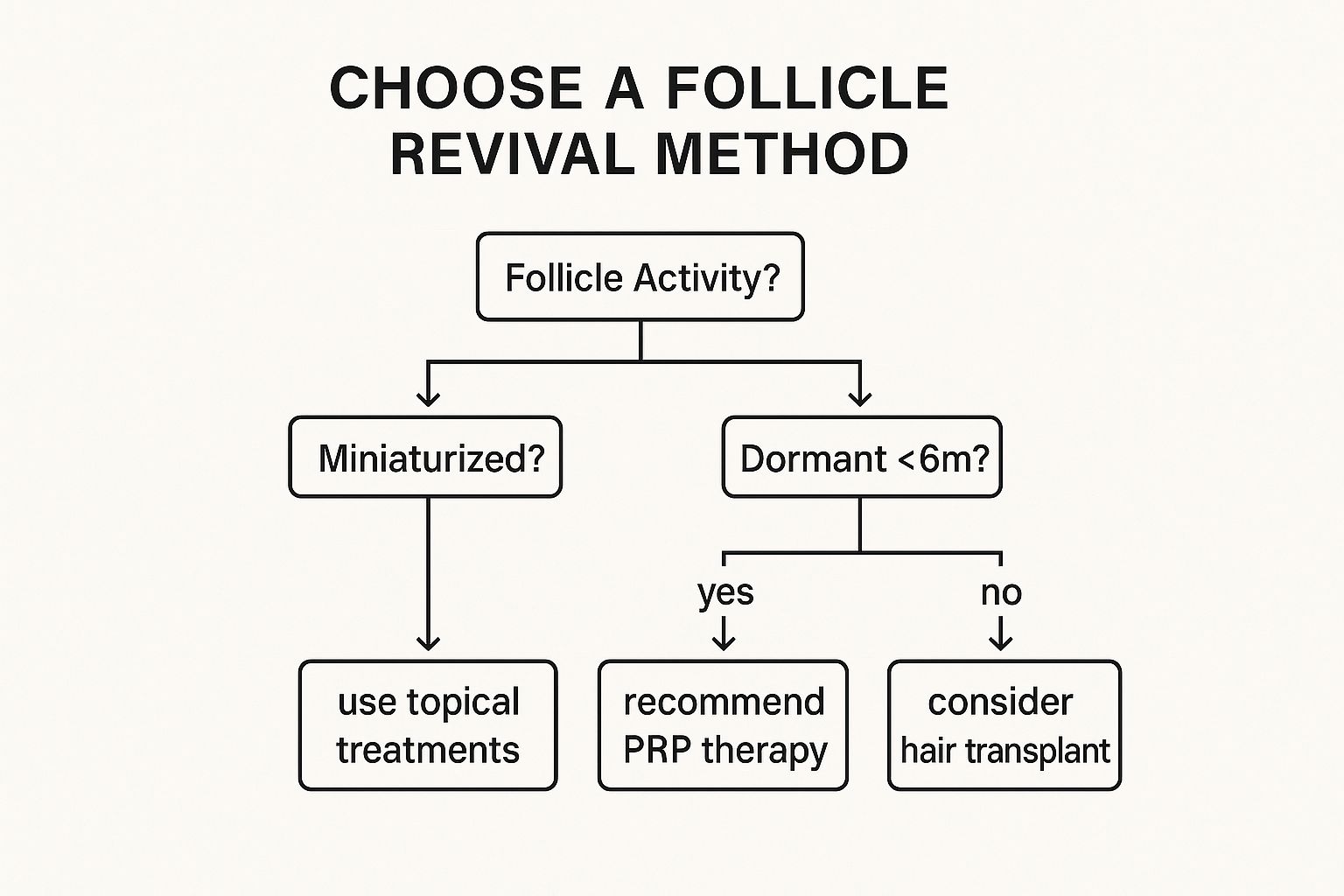
This decision tree helps visualize the process of choosing the right follicle revival method. It’s based on the activity level of your hair follicles. The infographic considers whether follicles are miniaturized, dormant for less than six months, or dormant for more than six months. Different levels of follicle inactivity require different treatment approaches. These can range from topical solutions for miniaturized follicles to PRP therapy for more recent dormancy and hair transplants for prolonged dormancy.
Making informed decisions about hair loss treatments requires careful evaluation. You should consider your personal circumstances, financial resources, and desired outcomes. Navigating the various options, from topical medications to surgical procedures, can be overwhelming. This section provides practical guidance for making smart choices aligned with your individual needs.
Evaluating Treatment Options Based on Your Individual Needs
Consider your hair loss pattern, age, lifestyle, and budget when evaluating treatments. For instance, someone experiencing early-stage thinning might find topical minoxidil beneficial. For someone with more significant hair loss, a hair transplant could be a better solution.
Your age also influences treatment choices, as certain procedures might be more suitable for younger individuals. Lifestyle factors, such as limited time and willingness to undergo surgery, will help you narrow down the options. Ultimately, your budget plays a vital role in determining which treatments are realistically feasible.
Decision-Making Frameworks and Asking the Right Questions
Patients who see positive results often employ a systematic approach to their treatment decisions. Start by thoroughly researching all available options. Be sure you understand both the realistic benefits and limitations of each. Ask your healthcare provider crucial questions. These should cover success rates, potential side effects, recovery timelines, and long-term maintenance.
Don’t hesitate to seek second opinions to gain a comprehensive perspective. For those considering experimental therapies like PRP (Platelet-Rich Plasma) therapy, understanding its role in follicle stimulation is vital. While PRP can be effective, it’s crucial to consult with a specialist. They can determine if it’s a viable option in your particular case. More information is available at PRP for Hairloss.
To help you evaluate your treatment options, we've compiled a comparison table:
Treatment Options Effectiveness Matrix:
Comprehensive comparison of different treatments for dead follicles including cost, effectiveness, and time commitment.
| Treatment | Effectiveness | Cost Range | Time to Results | Suitable For |
|---|---|---|---|---|
| Topical Minoxidil | Moderate | $20-$50/month | 3-6 months | Early stage hair loss |
| Finasteride (oral) | Moderate to High | $25-$75/month | 6-12 months | Male pattern baldness |
| Hair Transplant | High | $4,000-$15,000+ | 6-12 months | Significant hair loss |
| PRP Therapy | Variable | $300-$1,000 per session | 6-12 months | Thinning hair, early stages of hair loss |
| Low-Level Laser Therapy (LLLT) | Low to Moderate | $200-$600+ for device | 6-12 months | Stimulating hair growth, thinning hair |
This table highlights the varying effectiveness, cost, and time commitment associated with each treatment, allowing you to compare options and make an informed choice based on your individual needs and resources. Remember to discuss these options with your healthcare professional for personalized recommendations.
Backup Plans and Combination Therapies
Develop backup plans in case your initial treatment doesn't produce the desired results. This might involve exploring alternative therapies or combining treatments. Some patients combine minoxidil with finasteride, leveraging the unique benefits of each.
Be prepared to adjust your approach based on your progress and the feedback from your healthcare provider. By remaining adaptable, you can navigate the challenges of hair restoration more effectively.
Avoiding Common Mistakes in Treatment Selection
Avoid common decision-making pitfalls such as falling for unrealistic promises or making impulsive choices based on anecdotal evidence. Rely on scientific data, expert advice, and realistic timelines.
Be wary of quick fixes, and prioritize sustainable solutions that directly address your specific type of hair loss. Taking a proactive, informed approach empowers you to make smart decisions. These informed decisions will maximize your chances of achieving your hair restoration goals.
Your Personal Action Plan For Hair Restoration Success
Armed with a deeper understanding of dead versus dormant hair follicles, you can create a personalized action plan for hair restoration success. This involves not only choosing a treatment but also finding the right practitioners, managing expectations, and maintaining long-term hair health.
Finding Qualified Practitioners
Begin your journey by researching qualified dermatologists or hair restoration specialists. Look for practitioners with board certification and experience in treating various hair loss conditions. Check online reviews and testimonials from previous patients.
Consultations are crucial. They provide an opportunity to discuss your specific needs, assess the practitioner's expertise, and ask essential questions about treatment options and realistic outcomes.
Preparing For Consultations
Before your consultation, gather relevant information about your hair loss history. This includes family history, any medical conditions, and current medications. Photos documenting your hair loss progression can be helpful.
Prepare a list of questions covering treatment options, potential side effects, costs, and expected timelines for results. This preparation ensures you maximize your consultation time and gather the information needed to make informed decisions.
Setting Realistic Expectations and Tracking Progress
It's important to set realistic expectations for hair restoration. No treatment offers guaranteed results, and the success of any intervention depends on individual factors. Your practitioner should explain the potential benefits and limitations of each treatment option and discuss realistic timelines for seeing results.
Documenting your progress with photos and a hair loss journal is essential for monitoring treatment effectiveness. Tracking changes in shedding, hair texture, and overall scalp health provides valuable data to share with your practitioner. This allows for necessary adjustments along the way.
Maintaining Long-Term Hair Health
Long-term hair health requires ongoing maintenance. This includes adhering to your chosen treatment plan, adopting a healthy lifestyle that supports hair growth, and staying informed about new developments in hair restoration.
A balanced diet rich in essential nutrients, stress management techniques, and proper scalp care contribute to a healthy environment for hair growth. This can involve using specialized shampoos, conditioners, and topical treatments recommended by your practitioner.
Lifestyle Factors and Emerging Treatments
Several lifestyle factors can contribute to hair health. A nutritious diet, regular exercise, stress management, and adequate sleep all play a role in supporting hair growth. Stay informed about emerging treatments that might be relevant to your situation. As research progresses, new technologies and therapies may offer additional options for reviving dormant follicles or stimulating new growth.
For example, PRP (Platelet Rich Plasma) therapy utilizes your body's own growth factors to potentially stimulate dormant hair follicles. To learn more about PRP therapy and its potential benefits, visit PRP for Hairloss.

 PRP For Hairloss
Leave a comment