Is Your Hairline Telling You Something?
Worried about male pattern baldness? This article highlights six early signs you should know. Recognizing these indicators empowers you to explore solutions like PRP therapy before significant hair loss occurs. Early detection matters because it can significantly impact the effectiveness of treatment. Learn to identify receding hairlines, crown thinning, miniaturization of hair follicles, excessive shedding, decreased density, and changes in hair texture, all key indicators of early signs male pattern baldness. Don't wait; take control of your hair today.
1. Receding Hairline
A receding hairline is often the first and most noticeable sign of male pattern baldness (MPB), also known as androgenetic alopecia. This classic indicator of MPB typically begins with gradual hair thinning and loss at the temples, creating a distinctive M-shaped hairline. This pattern develops due to the increased sensitivity of hair follicles in these areas to dihydrotestosterone (DHT). DHT, a hormone derived from testosterone, plays a significant role in MPB by causing follicle miniaturization. This miniaturization process shortens the hair's growth cycle, leading to progressively finer, shorter hairs until eventually, the follicle ceases to produce new hair altogether.
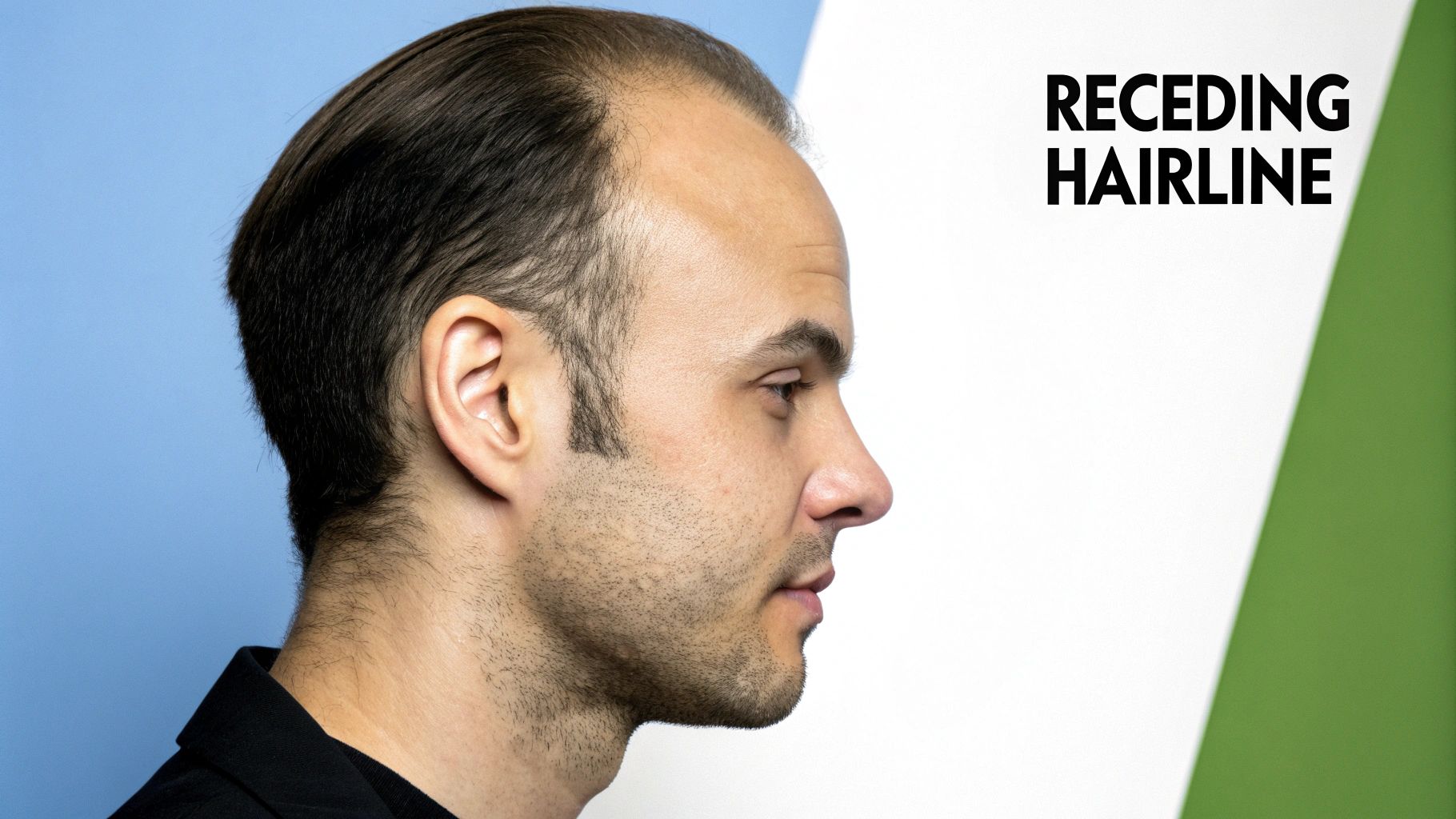
The characteristic M-shape isn't the only way a receding hairline might present itself. Asymmetrical recession, where one temple recedes faster or further back than the other, is also common. This uneven hair loss is a strong indicator of MPB. While a receding hairline can begin as early as the late teens or early twenties, it's important to differentiate between a naturally maturing hairline and the onset of MPB. A mature hairline, often established in the late teens or early twenties, usually represents a slight and even recession across the hairline, maintaining a relatively straight shape across the forehead.
This sign deserves its place at the top of the list of early signs of male pattern baldness due to its high visibility and the potential for early intervention. The sooner MPB is addressed, the more effective treatments are likely to be.
Features of a Receding Hairline indicative of MPB:
- M-shaped hairline pattern: The classic sign of a receding hairline.
- Gradual recession at the temples: Thinning and loss of hair starting at the temples.
- Asymmetrical recession: Uneven recession where one temple is more affected than the other.
- Often the first noticeable sign of MPB: Making it a crucial indicator for early diagnosis.
- Can begin as early as late teens to early twenties: Highlighting the importance of monitoring hairline changes during this period.
Pros of Early Detection:
- Early detection allows for timely intervention: Treatments are generally more effective in the earlier stages of MPB.
- Relatively easy to identify through comparison with previous photos: Self-monitoring can be a useful tool.
- Responds better to treatments when addressed early: Maximizing the potential for hair preservation.
Cons of a Receding Hairline:
- Not always indicative of MPB (could be a mature hairline): Professional evaluation is necessary for accurate diagnosis.
- Psychological impact on self-image: Hair loss can affect self-esteem and confidence.
- Once established, difficult to fully restore without surgical intervention: Early treatment is crucial for preventing significant hair loss.
Examples of Receding Hairlines:
Celebrities like Prince William, Jude Law, and Matthew McConaughey have all experienced varying degrees of hairline recession, providing visible examples of this common sign of MPB. While Matthew McConaughey has reportedly undergone treatment, the progression observed in others like Prince William and Jude Law illustrates the typical course of a receding hairline.
Tips for Monitoring Your Hairline:
- Take regular photos of your hairline to track changes over time: This allows for objective comparison and early detection of recession.
- Compare your hairline to photos from 2-3 years ago: Noticeable changes over this period warrant further investigation.
- Look for asymmetrical recession, which is more indicative of MPB than a uniform, slight recession: Asymmetry is a key differentiator between a maturing hairline and MPB.
- Consult a dermatologist for professional evaluation: A dermatologist can confirm the diagnosis and recommend appropriate treatment options.
2. Crown Thinning (Vertex Baldness)
Crown thinning, also known as vertex baldness, is a common and telling sign of male pattern baldness. This form of hair loss manifests as a gradual reduction in hair density at the crown, the top back portion of the scalp. It's driven by the same underlying mechanism as a receding hairline: dihydrotestosterone (DHT). DHT affects susceptible hair follicles, causing them to shrink and produce progressively finer, shorter hairs until they eventually cease production altogether. This process often begins with a small, circular patch of thinning that can expand over time. Importantly, crown thinning can occur independently of a receding hairline, meaning you might notice thinning at the crown before your hairline begins to retreat, or vice-versa. Both, or even just one, can be early signs male pattern baldness.
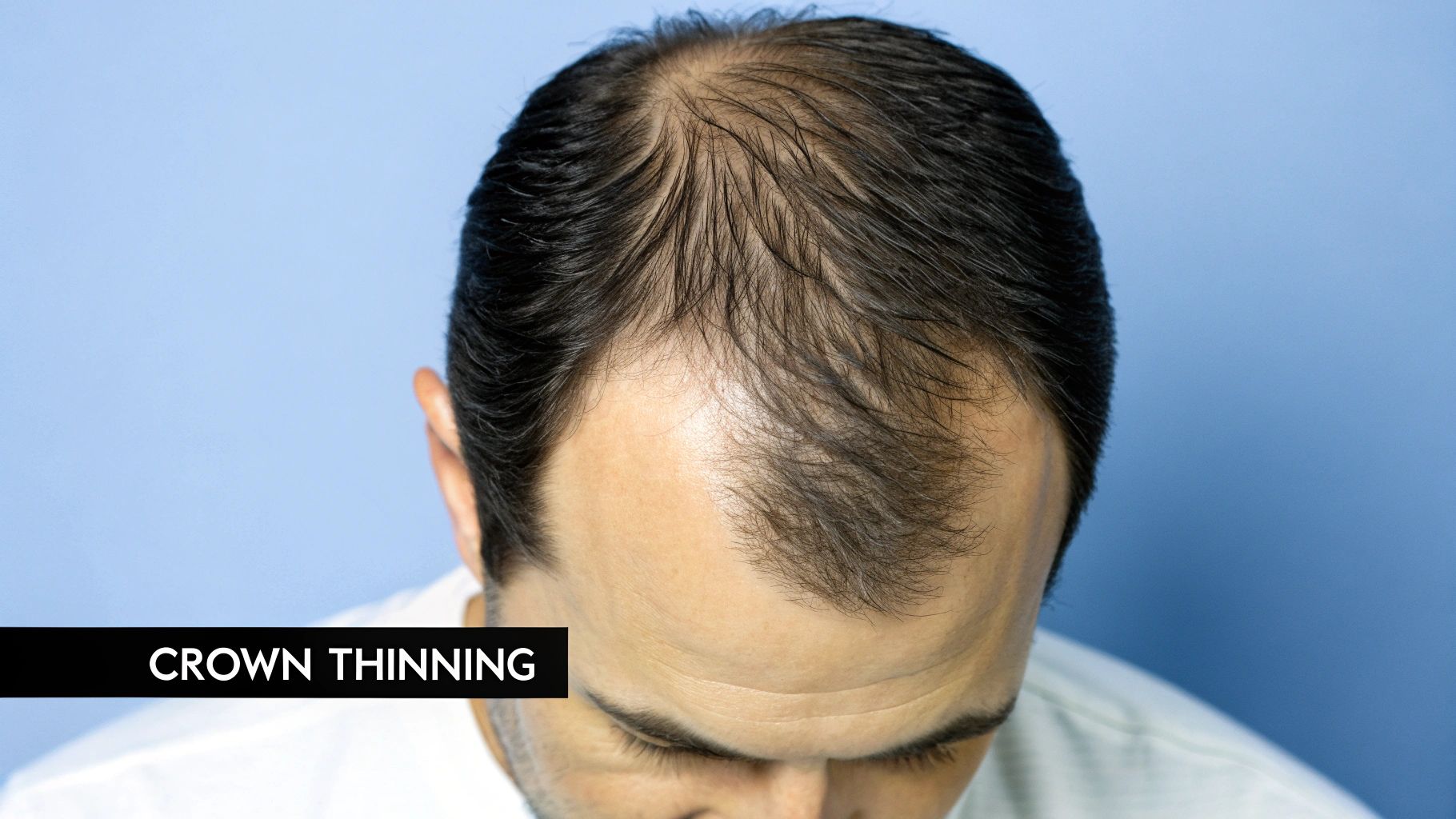
This type of hair loss deserves a prominent place on the list of early signs male pattern baldness because it's frequently one of the first areas to be affected. While a receding hairline is often more readily apparent in the mirror, crown thinning can be subtle and easily overlooked, especially in its initial stages. Key features include a gradual loss of hair at the crown, often starting as a small circular patch. When viewed from above, the hair appears less dense in the affected area. Unfortunately, this thinning can be hard to self-detect without the use of mirrors or photographs.
The good news is that crown thinning, when caught early, often responds well to treatment. Medications like minoxidil can help stimulate hair regrowth, and in the early phases, strategic hairstyling can effectively conceal the thinning. Examples of varying degrees of crown thinning include the characteristic thinning seen in Prince Charles, the more progressed hair loss of Woody Harrelson, and the well-known crown balding pattern of Jason Alexander. These examples illustrate how crown thinning can progress if left untreated, highlighting the importance of early intervention.
However, there are drawbacks. The primary challenge is the difficulty in self-detection, often requiring assistance or specific techniques to identify the early stages. If left untreated, crown thinning will progress, and more advanced cases may require more aggressive and potentially more expensive treatment approaches like hair transplantation.
To monitor your crown for signs of thinning, use a handheld mirror or take photos regularly, looking for areas where the scalp is becoming more visible. Styling your hair away from the crown can also help reveal thinning areas. If you suspect you’re experiencing crown thinning, consult with a dermatologist or a hair loss specialist. They can provide a professional diagnosis and recommend appropriate treatments and interventions based on the stage of your hair loss. Early detection and action are key to managing crown thinning and maintaining a full head of hair.
3. Miniaturization of Hair Follicles
Miniaturization of hair follicles is a key biological process underlying male pattern baldness, making it one of the earliest and most reliable signs of this condition. Driven by the hormone dihydrotestosterone (DHT), susceptible hair follicles progressively shrink, leading to thinner, shorter, and lighter hairs. This process transforms thick, pigmented terminal hairs into fine, wispy vellus-like hairs, eventually culminating in the follicle ceasing hair production altogether. Crucially, this miniaturization begins microscopically long before any visible hair loss becomes apparent. This is why understanding this process is crucial for early detection and proactive treatment.
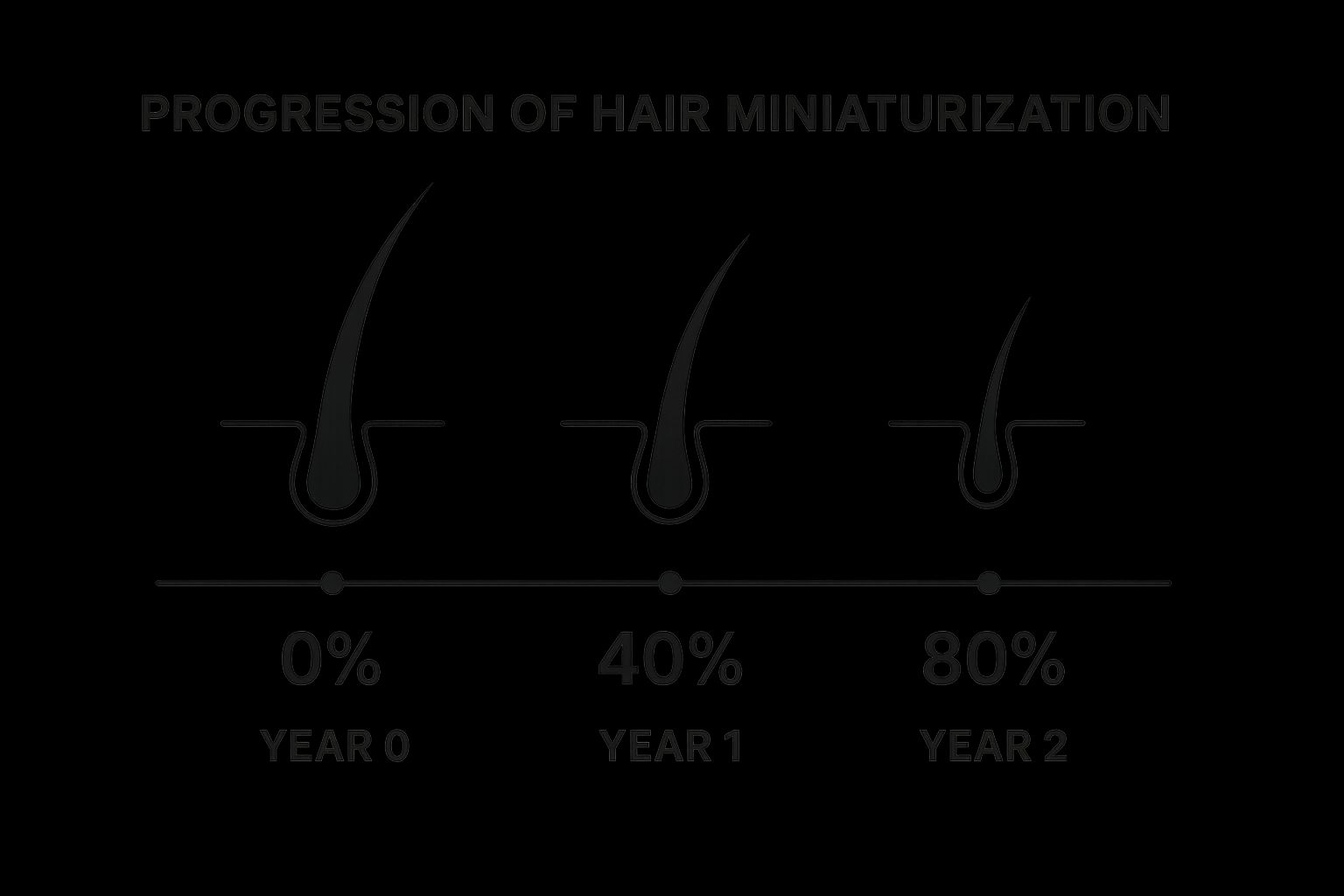
The infographic above illustrates the timeline of hair follicle miniaturization. Let's break down the stages:
-
Normal Hair Follicle: A healthy hair follicle produces thick, pigmented terminal hairs with a long growth phase.
-
Early Miniaturization: DHT begins to affect the follicle, shortening the growth phase and producing slightly thinner hairs. This stage is often invisible to the naked eye.
-
Intermediate Miniaturization: The follicle shrinks further, producing noticeably thinner, shorter, and less pigmented hairs. Vellus hairs begin to replace terminal hairs.
-
Advanced Miniaturization: The follicle is significantly reduced in size, producing only very fine, barely visible vellus hairs.
-
Follicle Inactivity: The follicle becomes dormant and ceases hair production entirely, resulting in visible baldness.
As this timeline demonstrates, the progression from a healthy follicle to complete inactivity is gradual, emphasizing the importance of early detection.
Progressive thinning of individual hair shafts is a hallmark of miniaturization. You might notice hairs that don't grow as long as they used to or a decrease in overall hair thickness. Celebrities like Bruce Willis, Elton John, and LeBron James have publicly demonstrated different stages of this process, from gradual thinning to seeking treatment for hair loss. Their experiences highlight the progressive nature of male pattern baldness and the potential for intervention.
Pros of Early Detection of Miniaturization:
- Early Diagnosis: Miniaturization can be detected early through microscopic examination by a dermatologist using tools like a trichoscope.
- Proactive Treatment: Early identification allows for proactive treatment to slow down or potentially reverse the process.
- Predictive Value: It's the most reliable indicator of future baldness patterns.
Cons of Miniaturization:
- Invisible in Early Stages: Not visible to the naked eye initially, requiring professional diagnosis.
- Requires Professional Assessment: Needs a dermatologist or trichologist with specialized equipment.
- Difficult to Reverse when Advanced: Progression is difficult to reverse in later stages.
Tips for Monitoring Potential Miniaturization:
- Professional Scalp Examination: Schedule a scalp examination with a dermatologist or trichologist.
- Self-Monitoring: Look for areas where hair appears finer than surrounding hair and monitor for shorter hair growth cycles.
- Track Hair Thickness: Pay attention to the overall thickness of your hair while styling.
Miniaturization deserves a prominent place on this list of early signs of male pattern baldness because it is the fundamental process driving the condition. Recognizing the subtle signs of miniaturization empowers men to seek professional help and explore treatment options early, potentially mitigating the effects of male pattern baldness.
4. Excessive Hair Shedding
One of the most noticeable early signs of male pattern baldness (MPB) is excessive hair shedding. While losing some hair daily is entirely normal (50-100 hairs on average), a significant increase in shedding can be a red flag. This occurs because, in MPB, the affected hair follicles have shorter growth cycles and prolonged shedding phases. The result is more hairs being shed before they reach their full potential length and thickness. This excessive shedding often precedes visible thinning and can be observed in various places like pillows, shower drains, and hairbrushes.
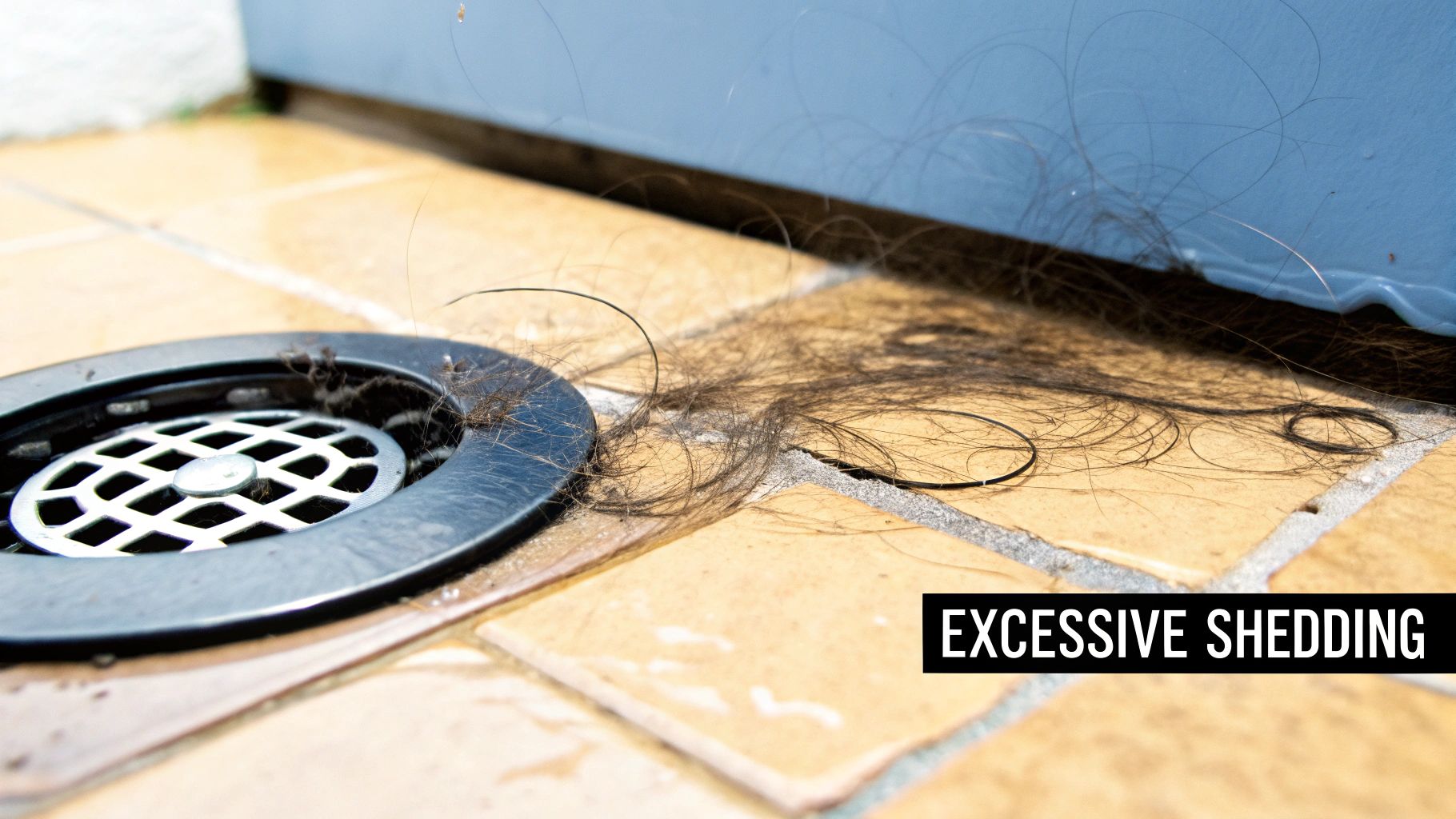
This sign deserves a place on this list because it's often one of the earliest and easiest to self-detect. Features of MPB-related shedding include a noticeable increase in daily hair fall, finding more hairs on pillows or in the shower drain, and hair seeming to fall out more readily when styling. The shedding may occur in phases or continuously and often precedes visible thinning by several months. Even celebrities like Ashton Kutcher, Prince Harry, and Dwayne "The Rock" Johnson have reportedly experienced increased shedding, with The Rock ultimately choosing to shave his head.
The benefit of recognizing this early sign is the potential for early intervention. Increased shedding can prompt a medical consultation and potentially lead to treatments like anti-androgens or growth stimulants, which may be more effective in the early stages of MPB. Self-monitoring is relatively straightforward, making it easy to stay vigilant.
However, it’s important to acknowledge the downsides. Increased shedding can be triggered by factors other than MPB, such as stress, dietary deficiencies, or certain medications. This ambiguity can cause anxiety, potentially exacerbating the issue. Additionally, accurately quantifying hair loss without a professional assessment can be challenging.
Actionable Tips for Monitoring Hair Shedding:
- Establish a Baseline: Count shed hairs periodically (e.g., weekly) to establish a baseline for your normal shedding rate.
- Track Changes: Take note if shedding increases substantially over several weeks or months compared to your baseline.
- Visual Documentation: Photograph areas of concern and compare them over time to visually track changes in hair density.
- Consult a Dermatologist: If you notice significant or persistent shedding, consult a dermatologist to rule out other causes of hair loss and discuss potential treatment options. This professional guidance can provide an accurate diagnosis and help alleviate anxiety.
By understanding the significance of excessive hair shedding and implementing these monitoring tips, men can take proactive steps toward addressing potential hair loss concerns and exploring appropriate treatments if necessary.
5. Decreased Hair Density and Volume
Decreased hair density and volume is a crucial early sign of male pattern baldness (MPB), often subtly creeping in before more obvious signs like a receding hairline or bald spot appear. This thinning process is a direct result of miniaturization, where genetically susceptible hair follicles shrink, producing progressively finer, shorter, and lighter hairs. While individual hairs might not disappear completely in the initial stages, the overall effect is a noticeable reduction in hair fullness and volume. This makes the scalp more visible, even without distinct bald patches, and can significantly impact how hair sits and styles. Understanding this process is critical for catching MPB in its early stages and exploring treatment options.
This sign deserves its place on the list of early indicators because it’s often the first perceptible change, preceding more dramatic hair loss. It’s a foundational shift that underpins the progression of MPB, making it essential to recognize.
Features of decreased hair density and volume:
- Overall reduction in hair fullness: Hair feels thinner and less substantial overall.
- Increased scalp visibility: The scalp becomes more noticeable, particularly under bright lights, even without defined bald spots.
- Flatter, less voluminous hair: Hair appears limp and lacks its previous body, even after styling.
- Styling challenges: Maintaining desired hairstyles becomes more difficult, requiring more product and effort.
- Diffuse thinning: This typically affects the entire top of the scalp, rather than being localized to specific areas initially.
Pros of recognizing this early sign:
- Responsiveness to treatment: Early intervention with treatments like minoxidil (topical solution) or finasteride (oral medication) can be highly effective in slowing down or even reversing miniaturization.
- Styling solutions: Clever hairstyling techniques, such as using volumizing products or adopting a shorter haircut, can help camouflage the thinning and boost confidence.
- Subtlety allows for proactive measures: Because the changes are initially subtle, you can address the issue before it becomes glaringly obvious to others.
Cons of overlooking this sign:
- Dismissal as normal aging: Many men mistakenly attribute decreased density to the natural aging process, delaying diagnosis and treatment.
- Gradual nature delays treatment: The slow progression of thinning can lead to a delayed realization of the problem, resulting in missed opportunities for early intervention.
- Psychological impact: Even subtle thinning can negatively impact self-image and confidence.
Examples in the public eye:
While not confirmed diagnoses, the apparent hair transformations of celebrities like Ryan Reynolds (reportedly using hair loss treatments), Bradley Cooper (observed changes in hair density over his career), and Hugh Laurie (noticeable volume reduction over time) highlight how this sign can manifest.
Actionable Tips:
- Photographic comparison: Compare recent photos with pictures from 2-5 years ago. Look for noticeable differences in hair fullness and volume.
- Styling product assessment: Pay attention to how much styling product you now use compared to the past. An increase might indicate you’re compensating for thinning hair.
- Drying and styling time: Notice if your hair takes less time to dry or style. Thinner hair generally dries faster.
- Consult a long-term hairstylist: A stylist who has been cutting your hair for years can offer valuable insights into changes in your hair density and texture.
By understanding and recognizing the significance of decreased hair density and volume, you can take proactive steps to manage male pattern baldness and maintain a healthy head of hair for as long as possible. Early intervention is key to maximizing the effectiveness of available treatments.
6. Changes in Hair Texture and Manageability
One of the earliest signs of male pattern baldness (MPB), often preceding visible thinning by months or even years, is a noticeable shift in hair texture and manageability. This subtle yet crucial change often goes unnoticed or is attributed to other factors, making it a critical indicator to be aware of. Understanding these changes can empower you to take early action against hair loss.
This shift occurs due to the miniaturization of hair follicles, a process driven by dihydrotestosterone (DHT). DHT, a hormone derived from testosterone, gradually shrinks affected follicles, resulting in progressively finer, weaker hairs. While outright hair loss is the eventual outcome, the initial impact manifests as changes in texture and manageability.
Features of Texture Change in Early MPB:
- Finer, More Brittle Hair Quality: Hair strands become thinner and more prone to breakage, often lacking their previous strength and resilience.
- Loss of Natural Texture: Men with naturally wavy or curly hair might observe a gradual straightening. This is due to the diminished diameter of the hair shaft, impacting its ability to maintain its natural curl pattern.
- Increased Difficulty Styling: Achieving and maintaining desired hairstyles becomes progressively harder. Hair loses its body and volume, making it less responsive to styling products.
- Changes in Product Response: You might find yourself needing more styling product than usual to achieve the same results, or noticing that your hair doesn't hold styles as well as it once did.
- Faster-Growing But Thinner-Looking Hair: Ironically, despite the miniaturization process, hair might seem to grow faster. This is because the thinner hairs are lighter and thus more easily lifted from the scalp, creating an illusion of faster growth.
Pros of Recognizing Texture Changes:
- Earliest Detectable Change: Texture changes often occur before any visible thinning, providing a crucial early warning sign.
- Prompts Early Investigation: Recognizing these changes can encourage you to seek professional advice and explore treatment options sooner.
- May Respond to Early Intervention: Starting anti-DHT treatments early, when miniaturization is just beginning, can be more effective than intervening after significant hair loss has already occurred.
Cons of Relying Solely on Texture Changes:
- Easily Mistaken for Normal Aging or Environmental Damage: Hair naturally becomes finer with age, and environmental factors like sun exposure can also impact hair quality.
- Can be Confused with Effects of Styling Products or Heat Damage: Excessive use of styling products or heat styling tools can also cause hair to become dry, brittle, and difficult to manage.
- Often Overlooked as a Sign of Impending Baldness: Due to its subtle nature, this early sign is frequently dismissed or attributed to other causes.
Examples:
Think of John Travolta's transition from his signature thick, wavy hair to a noticeably finer texture before his hair loss became more apparent. Similar changes can be seen in the hair evolution of Nicolas Cage. Matthew McConaughey has also reportedly mentioned noticing texture changes before actively addressing his hair loss.
Actionable Tips:
- Note Changes in Product Usage: Pay attention to whether you're using significantly more styling product than you used to.
- Observe Natural Texture Changes: Monitor if previously wavy or curly hair begins to straighten naturally.
- Check for Increased Breakage: Be mindful of whether your hair is breaking more easily than before.
- Compare to Your Younger Self: Compare your current hair texture to photos of yourself in your late teens or early twenties to identify any significant changes.
By paying close attention to these often subtle shifts in hair texture and manageability, you can potentially identify male pattern baldness in its earliest stages and take proactive steps to manage its progression. Early intervention is key to achieving the best possible outcomes in combating hair loss.
6 Early Signs of Male Pattern Baldness Comparison
| Early Sign | Implementation Complexity 🔄 | Resource Requirements 💡 | Expected Outcomes ⭐📊 | Ideal Use Cases ⚡ | Key Advantages 💡 |
|---|---|---|---|---|---|
| Receding Hairline | Low – visual self-assessment | Minimal – photos, occasional expert consultation | Moderate – early detection enables timely intervention | Early MPB detection, visual monitoring | Easy to identify early, responds better if treated early |
| Crown Thinning (Vertex Baldness) | Medium – requires mirror/photos | Moderate – possible dermatologist visits, meds | High – often responds well to early medication | Detecting balding in less visible crown area | Treatable in early stages, easy to conceal initially |
| Miniaturization of Hair Follicles | High – requires microscopic exam | High – professional tools like trichoscope | Very High – most reliable early indicator | Diagnosing underlying follicle health & pattern | Enables early, proactive treatment before visible loss |
| Excessive Hair Shedding | Low – self-monitoring by observation | Minimal – regular hair counts & photos | Moderate – may prompt early consultation | Spotting abnormal shedding patterns | Easy to monitor, prompts early medical review |
| Decreased Hair Density and Volume | Medium – comparison of photos/styles | Low to moderate – photos, styling tools | Moderate to High – responds well to early treatment | General thinning without distinct bald spots | Subtle changes noticed before bald patches |
| Changes in Hair Texture and Manageability | Medium – subjective, ongoing | Low – observation, hair care products | Moderate – early sign, may improve with treatment | Early follicle function change detection | Usually earliest detectable change, prompts preemptive care |
Take the Next Step: PRP and Other Treatments
Recognizing the early signs of male pattern baldness, such as a receding hairline, crown thinning, miniaturization of hair follicles, excessive shedding, decreased hair density, and changes in hair texture, is the first step towards effectively addressing the issue. Understanding these indicators empowers you to take proactive measures and explore available solutions before significant hair loss progresses. The sooner you address these early signs of male pattern baldness, the more likely you are to preserve and potentially restore your hair.
Mastering the ability to identify these early signs is invaluable because it allows you to explore treatment options while your hair follicles are still active. Early intervention can significantly impact the long-term health and appearance of your hair, boosting your confidence and self-esteem. Don't let hair loss define you; take control and explore the possibilities.
PRP therapy, as discussed on PRP For HairLoss, offers a promising approach for those experiencing the early signs of male pattern baldness by stimulating hair follicle rejuvenation and promoting natural hair growth. If you're concerned about hair loss or have noticed any of the early signs of male pattern baldness discussed, take proactive steps today. Visit PRP For HairLoss to learn more about how PRP therapy can help address hair loss in its early stages and discover if it's the right solution for you. Taking action now can make a significant difference in preserving your hair for years to come.

 PRP For Hairloss
Leave a comment