Understanding The Norwood Scale: Your Hair Loss Roadmap
Have you ever noticed doctors using numbers to describe receding hairlines? They're likely referring to the Norwood Scale, a standardized system for classifying male pattern baldness. This scale acts as a visual guide for both patients and physicians, charting the typical progression of hair loss. Understanding the Norwood Scale can help you better understand your own hair loss journey.
The Norwood Scale, originally developed by Dr. James Hamilton in the 1950s and later refined by Dr. O'Tar Norwood in the 1970s, categorizes hair loss into seven distinct stages. These stages range from a minimal recession at the temples (Stage I) to significant balding across the crown and hairline (Stage VII). Knowing these stages can help individuals manage their hair loss. For example, men in earlier stages (Stages I-III) might consider medications like minoxidil or finasteride, while those in later stages (Stages IV-VII) may explore surgical options like hair transplants. Learn more from the American Hair Loss Association.
Why The Norwood Scale Matters
The Norwood Scale offers a standardized approach to evaluating hair loss, providing clarity for both diagnosis and treatment planning.
-
Accurate Diagnosis: The scale allows physicians to pinpoint a patient’s specific stage of hair loss, much like a map helps determine a precise location. This precise identification is key for effective communication and treatment.
-
Effective Treatment Planning: Understanding a patient’s Norwood stage enables doctors to tailor treatment recommendations. This could range from suggesting non-surgical interventions like medication or PRP therapy for earlier stages to considering surgical hair restoration for more advanced hair loss.
Tracking Progression Over Time
The Norwood Scale isn't a one-time assessment; it’s a valuable tool for monitoring hair loss over time. This longitudinal perspective is essential for evaluating the efficacy of treatments and informing future decisions. For instance, regular assessments can reveal whether a medication is effectively slowing or halting progression. This dynamic monitoring allows adjustments to treatment strategies as needed.
Empowering Informed Decisions
Understanding the Norwood Scale empowers individuals to actively participate in their hair loss management.
-
Understanding Current Situation: The scale provides a clear picture of your current degree of hair loss.
-
Anticipating Future Progression: It allows for realistic expectations about potential future hair loss, aiding in proactive planning.
-
Making Informed Decisions About Treatment Options: This knowledge equips individuals to have informed conversations with their doctors and make the best decisions for their specific needs. This understanding can also provide emotional support and reduce anxiety related to hair loss.
The 7 Stages of Norwood Scale Hair Loss Decoded
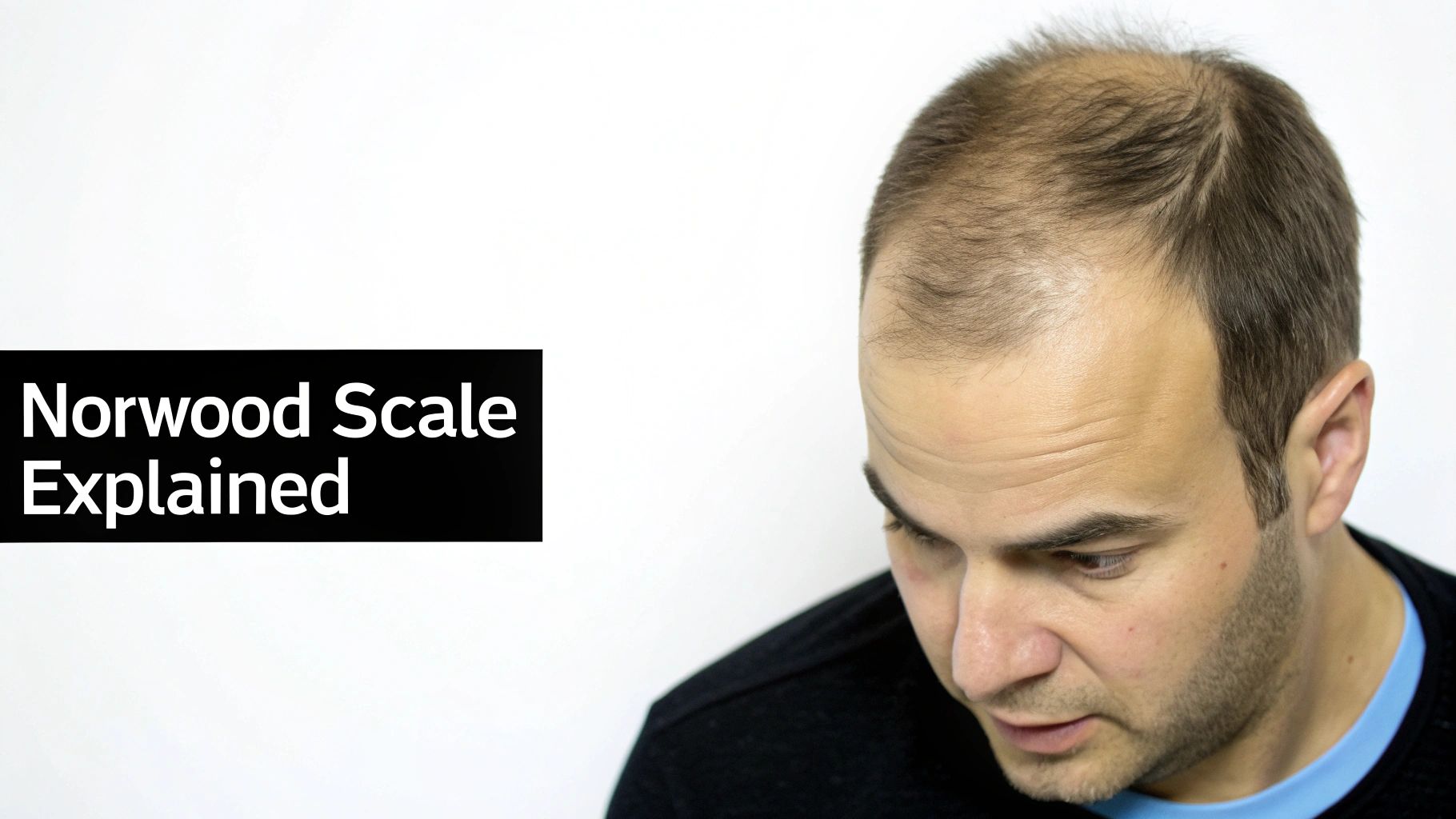
Let's explore each stage of the Norwood Scale, from subtle changes to more significant hair loss. This detailed examination will help you understand your hair loss and make informed choices about treatment.
Stage 1: Minimal Recession
This stage often goes unnoticed. The hairline remains mostly unchanged, with maybe a slight recession at the temples. Many men keep a youthful hairline and don't progress past this stage.
This is considered a normal variation and typically doesn't require treatment.
Stage 2: Receding Temples
The temple recession becomes more obvious in Stage 2, often looking like a mild "widow's peak" or an "M" shape. This is frequently when people first notice changes and start to think about treatment options.
Some men may start to explore non-surgical options at this point.
Stage 3: Significant Recession
Stage 3 is a major change. The hairline recedes more deeply at the temples, and sometimes the crown starts to thin. This is often when intervention is key, as treatments like medication or PRP (Platelet-Rich Plasma) can be very effective. Norwood Stage 3 is often seen as an ideal stage for a hair transplant, with high satisfaction rates. At this stage, between 2000 to 3000 grafts might be needed for the best results.
This is the stage where more active treatment is often recommended.
Stage 4: Increasing Hair Loss
Stage 4 shows more hairline recession and a more visible balding spot on the crown. The balding areas at the temples and crown are more separate, with a band of hair between them. Combination treatments, like medication and other therapies, might be suggested.
Hair loss becomes more noticeable to others at this stage.
Stage 5: Larger Balding Areas
The band of hair separating the temple recession and crown balding gets thinner and less dense in Stage 5. The areas of hair loss keep growing, covering more of the scalp.
Treatment options at this stage may vary depending on the individual.
Stage 6: Merging Balding Areas
The hair separating the temples and crown almost entirely disappears in Stage 6. The balding areas join, forming a horseshoe shape of hair around the sides and back of the head. Surgery, such as a hair transplant, is often a consideration at this stage.
Significant hair loss is evident at this stage.
Stage 7: Extensive Hair Loss
This final stage is the most advanced hair loss on the Norwood Scale. Only a thin strip of hair remains around the sides and back of the head. While treatments may still help, getting a full head of hair back becomes more difficult. Knowing the stage of hair loss directly affects how many grafts are needed for a transplant, influencing the total cost.
This stage represents the most advanced form of male pattern baldness.
To better understand the characteristics of each Norwood Scale stage, refer to the following table:
Norwood Scale Stages Overview: A comprehensive breakdown of all 7 Norwood scale stages with their distinctive characteristics and visual indicators
| Stage | Description | Affected Areas | Visual Indicators |
|---|---|---|---|
| 1 | Minimal Recession | Temples | Slight recession at the temples, often barely noticeable |
| 2 | Receding Temples | Temples | Noticeable recession at the temples, forming a widow's peak or "M" shape |
| 3 | Significant Recession | Temples, Crown | Deep recession at the temples, possible thinning at the crown |
| 4 | Increasing Hair Loss | Temples, Crown | Further hairline recession, pronounced balding on the crown, separated by a band of hair |
| 5 | Larger Balding Areas | Temples, Crown | Thinning and less dense band of hair separating the temple and crown balding areas |
| 6 | Merging Balding Areas | Temples, Crown | Near-complete disappearance of the hair separating the temple and crown, forming a horseshoe shape |
| 7 | Extensive Hair Loss | Top and front of scalp | Only a narrow band of hair remains on the sides and back of the head |
This table summarizes the key visual indicators for each stage, aiding in self-assessment. However, professional consultation is always recommended.
This overview of the Norwood Scale helps understand how male pattern baldness usually progresses. But individual experiences differ. Talking to a qualified hair restoration specialist is essential for a personalized assessment and treatment plan. They can give expert advice based on your hair loss pattern and what you want to achieve.
Pinpointing Your Position on the Norwood Scale
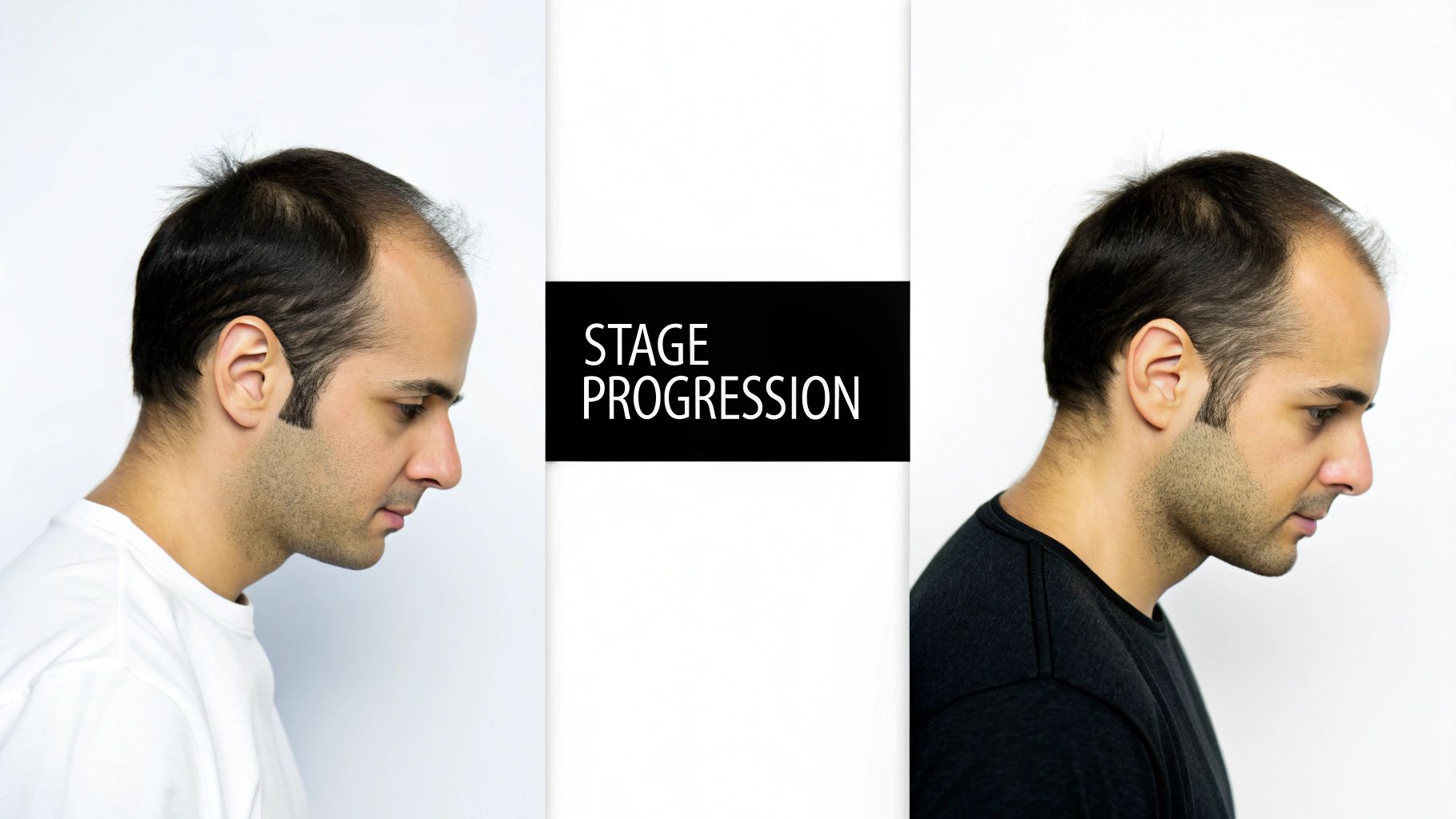
Accurately assessing your hair loss is the first step towards effective treatment. This section provides a practical guide for determining your place on the Norwood Scale.
Mastering the Art of Hair Loss Photography
Clear, consistent photographs are essential for tracking hair loss progression. They provide a visual record, allowing you to monitor changes over time. For accurate self-assessment, consider these key factors:
-
Consistent Lighting: Use natural, diffused lighting. Avoid harsh shadows, which can distort the appearance of thinning. This ensures accurate representation of your hair density.
-
Standardized Angles: Photograph your hairline and crown from the front, top, and sides. Maintain the same angles for each photo session to allow for accurate comparisons over time.
-
Comparison Techniques: Compare recent photos with older ones. This helps identify subtle changes you might miss otherwise. Consistent photographic documentation is key.
Avoiding Common Misclassification Pitfalls
Several factors can lead to inaccurate self-diagnosis. Understanding these pitfalls can improve the accuracy of your self-assessment.
-
Diffuse Thinning: Some men experience diffuse thinning, a more widespread hair loss pattern. It doesn't strictly follow the Norwood Scale, making it harder to pinpoint a specific stage.
-
Early Stages: The subtle changes in the early stages (Norwood 1 and 2) can be difficult to distinguish. Consistent photographic documentation is especially important during these stages.
-
Variant Patterns: Variations within the Norwood Scale (like Type A) further complicate self-assessment. Distinguishing these nuances often requires a trained eye.
Utilizing Digital Tools and Professional Evaluation
Several digital tools, including apps and online resources, can enhance assessment accuracy. These tools can provide a more objective analysis than visual self-assessment alone. However, a professional evaluation is crucial for confirming your self-assessment and developing a personalized treatment plan.
The Norwood Scale, while helpful, has limitations. It's a visual classification, subject to interpretation. Despite this, it remains a crucial tool for assessing male pattern baldness progression and guiding treatment choices.
The Power of Progression Tracking
Consistently documenting your hair loss provides invaluable insights for treatment timing and strategy.
-
Early Intervention: Tracking progression allows for timely intervention. This is particularly important for maximizing the effectiveness of non-surgical treatments.
-
Treatment Response: Regular photos document how your hair responds to treatments. This documentation enables adjustments to your strategy as needed.
-
Informed Decisions: Detailed documentation empowers you to make informed decisions about when to consider surgical options like hair transplantation.
By understanding your position on the Norwood Scale and documenting its progression, you take control of your hair loss journey. This knowledge empowers you to make proactive, informed decisions about your treatment options.
Targeted Treatments for Every Norwood Scale Stage

Your Norwood scale stage provides a personalized roadmap for addressing hair loss. This staging system helps determine the most effective treatment approach, impacting decisions about medication, therapies, and even surgical options. Understanding your specific stage and the corresponding interventions can significantly influence your results.
Early Intervention: Norwood Stages 1-3
Men in the early stages of hair loss (Norwood 1-3) have a broader range of non-surgical options available. This is the ideal time to consider preventative measures and explore therapies that can slow or stop hair loss progression. Pharmacological interventions, like Minoxidil and Finasteride, can be especially effective during these initial stages.
Additionally, therapies such as Platelet-Rich Plasma (PRP) injections can stimulate hair follicle activity and encourage growth. The Norwood Scale plays a vital role in assessing eligibility and planning for potential hair transplantation. By Stage 3, hair loss becomes more noticeable, particularly on the crown and above the temples.
Stage 3 is often viewed as the optimal time for a hair transplant, with patient satisfaction rates often reaching 98%. This high success rate is due to the less severe balding, requiring fewer grafts (typically between 2000 and 3000). Early intervention at this stage can effectively halt further progression. For more detailed information about Norwood 3 and hair transplants, visit this resource: Norwood Scale 3 Hair Transplant.
Middle Stages: Norwood Stages 4-5
As hair loss advances to the middle stages (Norwood 4-5), combination therapies frequently offer the most promising outcomes. This could involve combining medication with PRP injections or other non-surgical approaches. The treatment goal shifts from halting progression to maintaining existing hair and potentially encouraging regrowth in thinning areas.
Realistic expectations are paramount at these stages. While complete restoration might not be feasible, significant enhancements in hair density and coverage are often achievable.
Advanced Stages: Norwood Stages 6-7
In the advanced Norwood stages (6-7), surgical interventions such as Follicular Unit Extraction (FUE) and Follicular Unit Transplantation (FUT) become primary treatment options. The focus shifts to restoring hair in areas with significant balding.
Donor area assessment is critical at these stages. The availability of healthy hair follicles directly impacts the extent of possible restoration. Surgical procedures can achieve substantial cosmetic improvements, rebuilding the hairline and filling thinning areas. However, understanding the limitations and potential risks associated with these procedures is essential.
Treatment Timelines and Maintenance
Regardless of your Norwood stage, understanding treatment timelines and maintenance requirements is vital for long-term success. Non-surgical treatments such as minoxidil and finasteride require consistent use to maintain their effectiveness. PRP injections are generally administered in a series of sessions, followed by maintenance treatments to sustain the achieved results.
Hair transplantation requires a healing period of several months before the full impact is visible. Post-transplant care, including proper hygiene and activity restrictions, is essential for successful graft integration.
To help understand the varying treatment approaches based on Norwood stage, let's look at the following table:
Treatment Recommendations by Norwood Stage: Comparison of effective treatment options and their success rates across different Norwood scale stages
| Norwood Stage | Recommended Treatments | Expected Results | Timeline |
|---|---|---|---|
| 1-2 | Minoxidil, Finasteride, PRP | Slow or halt progression | Ongoing medication, PRP typically requires multiple sessions |
| 3 | Minoxidil, Finasteride, PRP, Hair Transplant | Halt progression, Significant restoration with transplant (up to 98% satisfaction) | Ongoing medication, PRP typically requires multiple sessions, Transplant results visible after several months |
| 4-5 | Combination therapies (medication + PRP), potentially hair transplant | Maintain existing hair, stimulate regrowth in thinning areas | Ongoing medication, PRP requires multiple sessions, Transplant results visible after several months |
| 6-7 | FUE or FUT hair transplant | Restoration in areas with significant balding | Transplant results visible after several months |
This table summarizes the typical treatment recommendations and expected outcomes for each Norwood stage. Note that individual results may vary, and consulting with a hair restoration specialist is crucial for personalized guidance.
This individualized approach ensures that the selected treatment aligns with the specific needs and goals of each individual, optimizing the chances of achieving satisfying, long-term results. Consulting with a qualified hair restoration specialist is crucial for personalized guidance and the development of a comprehensive treatment plan.
The Emotional Journey Through Norwood Scale Progression
Hair loss, particularly when charted against the Norwood scale, represents more than a mere physical alteration; it's a deeply personal emotional journey. This experience significantly impacts self-esteem, body image, and overall psychological well-being. This section delves into the psychological effects of Norwood scale progression, drawing upon insights from psychologists and the lived experiences of men facing hair loss.
The Psychological Impact of Stages 2 and 3
The progression from Norwood Stage 1 to Stages 2 and 3 often signifies a crucial psychological shift. This phase is when hair loss becomes increasingly visible, both to the individual and to those around them. The emergence of a receding hairline or thinning crown, for example, can trigger feelings of self-consciousness and anxiety. This can subsequently lead to alterations in social behavior, such as avoiding social gatherings or frequently checking one's appearance in mirrors.
Furthermore, these stages frequently coincide with a man's prime years, potentially affecting both his career trajectory and personal relationships. The perceived loss of youth and attractiveness can be especially difficult. Seeking support from friends, family, or mental health professionals during this period can be incredibly valuable.
Finding Emotional Relief in Later Stages
While the initial stages of hair loss often bring significant emotional distress, it's noteworthy that later stages can sometimes paradoxically provide a sense of relief. This might seem unexpected, but several factors can contribute to this shift. Accepting the reality of hair loss, for instance, can lessen the emotional burden of constantly trying to combat it. This acceptance can free up mental energy, allowing individuals to refocus on other important aspects of their lives.
This is not to suggest that later stages are devoid of emotional challenges. However, the intensity of emotional distress commonly decreases as individuals adapt and discover coping strategies for their altered appearance. This adjustment process might involve exploring new hairstyles, embracing baldness, or considering hair restoration options.
Cognitive Strategies for Maintaining Confidence
Men who successfully navigate the emotional complexities of hair loss often utilize specific cognitive strategies. Reframing negative thoughts is a key technique. This involves challenging and replacing negative self-perceptions with more positive and realistic ones. For example, instead of dwelling on societal pressures regarding hair, individuals can choose to focus on their personal achievements and inner qualities.
Concentrating on controllable factors is another beneficial strategy. While genetics are largely beyond our control, lifestyle choices like diet and exercise can significantly impact overall well-being. This focus on controllable aspects of life can be empowering and boost self-esteem. Connecting with others who share similar experiences can also offer invaluable validation and practical coping mechanisms.
Seeking Professional Support
Although many men effectively manage the emotional challenges of hair loss independently, professional mental health support can be extremely helpful. A therapist specializing in body image and self-esteem can provide expert guidance and support in navigating the emotional intricacies of hair loss. They can assist individuals in developing effective coping mechanisms and building resilience. Therapy can also address any underlying anxiety or depression that may be intensified by hair loss. This professional support can be particularly beneficial during the initial stages of hair loss when emotional distress is often most acute. Seeking help is a sign of strength, so don't hesitate to reach out if you're struggling with the emotional impact of Norwood scale progression.
Beyond Norwood: Alternative Hair Loss Classification Systems
While the Norwood scale is widely used for assessing male pattern baldness, it's not the only system available. Other scales and emerging technologies provide valuable perspectives, particularly for different hair loss types and a more precise, personalized treatment approach.
The Ludwig and Sinclair Scales for Female Hair Loss
The Norwood scale primarily focuses on male pattern baldness. For women, the Ludwig Scale and the Sinclair Scale offer more relevant classifications. These scales categorize female hair loss patterns, which differ significantly from male patterns. The Ludwig scale, for example, focuses on the widening of the part and thinning at the crown. The Sinclair scale assesses frontal hairline recession and thinning. This differentiation allows for more targeted treatment strategies for women.
Addressing Hair Loss Beyond Norwood Classifications
Some types of hair loss, like alopecia areata (patchy hair loss) or traction alopecia (caused by tight hairstyles), don't fit neatly into the Norwood framework. These conditions require different assessment methods. Dermatologists often rely on visual examination, pull tests (gently tugging on hair to see how easily it detaches), and sometimes scalp biopsies to diagnose and categorize these conditions.
The Rise of AI-Driven Assessment
The future of hair loss classification is evolving with the advent of AI-powered technologies. These tools offer greater precision in measuring hair density, follicle miniaturization, and other key indicators. This detail surpasses traditional visual assessments, potentially changing how we diagnose and monitor hair loss. AI-driven systems can also identify subtle changes that might be missed by the human eye, enabling earlier intervention and potentially more effective treatment. This allows treatment plans to be customized to each patient's unique hair loss profile, maximizing results.
Complementary Systems for a Comprehensive View
Different hair loss classification systems often complement each other. For example, while the Norwood scale provides a general overview of male pattern baldness progression, AI imaging can provide precise data on hair density and follicle health, refining treatment planning. Combining these systems provides a deeper understanding of an individual's hair loss condition. This more holistic approach is crucial for tailoring treatments to individual needs and achieving better outcomes. Future advancements in imaging and AI will likely lead to even more personalized and effective hair loss solutions.
Ready to explore PRP therapy for hair loss? Discover how PRP can revitalize your hair follicles and stimulate growth. Visit PRP for Hairloss to learn more and schedule a consultation.

 PRP For Hairloss
Leave a comment