The Seven Stages of Male Pattern Baldness
Hair loss is an experience millions of men go through, often causing stress and lowered self-esteem. Known medically as androgenetic alopecia, male pattern baldness affects a large percentage of men at some point in their lives. The good news is that modern medicine has made significant progress in understanding and treating this condition, giving men more options than ever before.
Identifying which stage of hair loss you're experiencing is essential for finding the right solution. Like any medical condition, male pattern baldness progresses through distinct phases that require different approaches. While past generations had limited treatment choices, today's men can choose from various scientifically-proven options – from medications to advanced surgical techniques.
This practical guide will help you understand male pattern baldness by breaking down its seven distinct stages. You'll learn how to:
- Identify the key signs at each stage of hair loss
- Track the typical progression patterns
- Understand your current position in the process
- Learn about treatment options appropriate for your stage
- Take practical steps to manage hair loss effectively
Whether you've just noticed slight thinning or are dealing with advanced hair loss, having accurate information helps you make informed decisions about treatment. Knowledge is power when it comes to managing male pattern baldness proactively rather than reactively.
1. Stage 1 – No Hair Loss / Baseline
Stage 1 represents what every man starts with – a full head of hair with no signs of hair loss. At this stage, you have a complete, dense head of hair and a natural hairline that typically forms an "M" shape. This baseline stage is essential since it serves as the reference point for measuring any future hair loss.

Key Features of Stage 1:
- Complete hair coverage: Thick, full hair across the entire scalp
- Original hairline position: No signs of recession or movement
- Classic "M" shaped hairline: The natural hairline shape seen in young adults
- Uniform density: Even hair thickness throughout all areas
Main Benefits:
- Maximum styling flexibility: Freedom to try any hairstyle without restrictions
- Natural appearance: No visible signs of thinning or balding
- Prevention opportunity: Ideal time to start treatments if family history exists
Real Example: Consider a 22-year-old man with thick, even hair density who can confidently wear any style – from short and neat to long and flowing. This perfectly illustrates Stage 1.
The medical community developed standardized scales like the Norwood Scale to help track hair loss progression. This has made it easier for both patients and doctors to discuss and address hair loss concerns openly.
Essential Tips for Stage 1:
- Take reference photos: Capture clear images of your hairline from multiple angles to track any future changes
- Start good hair care habits: Use gentle products and maintain a healthy diet to protect your hair
- Know your family history: Understanding genetic patterns helps with early prevention
Stage 1 is the starting point that helps men recognize what "normal" looks like. This awareness is key for spotting early changes and taking action when needed. Having this baseline knowledge allows for better decisions about hair health management.
2. Stage 2 – Slight Recession of Hairline
At Stage 2, men begin to notice the first clear signs of male pattern baldness. While the changes are subtle, they often prompt concern and action. Understanding this stage is essential for taking early steps to address hair loss.

This stage is crucial because taking action now tends to be most effective. Treatment options work best when started early, before significant hair follicle damage occurs.
Key Features of Stage 2:
- Temple recession: The hairline starts pulling back at the temples, creating an "M" shape or more defined widow's peak. The recession usually happens evenly on both sides.
- Higher hairline: The overall hairline may sit slightly higher than before, deepening the "M" pattern.
- Widow's peak development: Some men notice their widow's peak becoming more prominent, even if it wasn't very noticeable before.
- Minimal crown changes: While the main changes happen at the hairline, some men may see slight thinning at the crown area.
Understanding Stage 2 Hair Loss
Research has shown that male pattern baldness stems from genetics and hormones, specifically DHT (dihydrotestosterone). This knowledge has led to treatments that target DHT and support hair growth. By identifying different stages like Stage 2, doctors can suggest more specific treatment plans.
Real-World Examples
Early career Jude Law and Prince William in his late 20s show classic Stage 2 patterns – both had clear temple recession while maintaining good overall hair density.
Challenges at Stage 2:
- Hairstyle limitations: Some styles that need a strong hairline become harder to maintain
- Emotional impact: Noticing hair loss can cause worry about future progression
- Treatment timing: Early action is important for keeping existing hair
Practical Steps:
- See a hair specialist: A dermatologist can properly diagnose your case and suggest personal treatment options
- Use DHT-blocking products: Special shampoos can help limit DHT's effects on hair follicles
- Consider minoxidil: This FDA-approved treatment can help maintain and regrow hair when used properly
Taking action during Stage 2 gives you the best chance to maintain your hair and slow further loss. With proper care and treatment, many men can effectively manage their hair loss at this stage.
3. Stage 3 – First Signs of Clinical Baldness
At Stage 3, male pattern baldness becomes visibly noticeable to others for the first time. The hairline shows more pronounced recession at the temples, creating a distinct M, U, or V shape. While the crown may begin thinning, the most obvious change occurs at the front hairline. This stage often forces men to confront the reality of their hair loss.
This stage is significant because it marks the transition from early thinning to clinically diagnosable baldness. For many men, this is when denial gives way to acceptance and they begin considering treatment options.
Key Features of Stage 3:
- More significant temple recession: The hairline continues receding, forming a clear M, U, or V pattern
- Early crown thinning: The vertex area may start showing signs of hair loss
- Distinct pattern formation: The characteristic M, U, or V shape becomes clearly visible
- Increased scalp visibility: Thinning areas allow more scalp to show through, especially under bright lights
Major Challenges:
- Limited styling options: Many previous hairstyles no longer effectively hide thinning areas
- Emotional impact: Self-consciousness and confidence issues often peak during this stage
- Treatment complexity: More intensive approaches are needed, though treatment remains possible
Management Strategies:
- Start treatment promptly: Consult a hair loss specialist to discuss medical options – early action can significantly impact results
- Consider FDA-approved medications: Medications like finasteride can help slow progression and potentially regrow hair
- Adjust hairstyling: Shorter cuts and specific styling techniques can help minimize the appearance of thinning
Celebrity Examples: Early-career Jason Statham and late-1980s Bruce Willis both displayed typical Stage 3 characteristics. Their cases show how this degree of hair loss can become part of someone's signature look.
Public perception of Stage 3 baldness has shifted notably. What was once seen primarily as a sign of aging is now often viewed as a distinguished feature, particularly as more public figures openly embrace their receding hairlines.
Understanding Stage 3 helps men make informed decisions about their hair loss journey. Whether choosing treatment, changing hairstyles, or accepting the change, recognizing this stage's features allows for better-planned responses.
4. Stage 4 – Severe Hair Loss
Stage 4 male pattern baldness represents a notable advancement in hair loss progression. The hair thinning becomes much more visible during this phase, extending beyond a receding hairline to significantly impact the crown area. While not complete baldness, this stage brings new challenges for hair care and styling approaches.
The characteristic "horseshoe" pattern starts becoming evident at this point. There is substantial recession at the temples, while the thinning crown area expands into a more defined bald spot. A band of hair still connects the sides of the head – a key feature that distinguishes Stage 4 from later stages. Picture the classic male pattern baldness look: hair remaining on the sides and back forming a "wreath" shape, with noticeable hair loss on top and at the front.
The progression to Stage 4 typically happens over several years. While timing varies between individuals based on genetics and lifestyle, it builds upon the gradual hair follicle miniaturization that began in earlier stages, resulting in the more extensive hair loss seen at this point.
Key Features of Stage 4:
- Deep temporal recession and crown thinning: Significant hair loss at temples and crown creating obvious bald areas
- Clearly defined bald spots: Crown thinning develops into a distinct circular bald patch
- Preserved connecting hair band: Hair still links the sides of the head – a crucial difference from Stage 5
- Increased scalp visibility: Skin becomes more visible through remaining hair, especially on top
Advantages:
- Treatment options available: Many interventions like minoxidil, finasteride, and hair transplants remain viable options
- Clear pattern for planning: The established loss pattern helps guide treatment and styling decisions
Disadvantages:
- Limited styling choices: Harder to conceal thinning areas with remaining hair
- Reduced treatment effectiveness: While treatments can help, regrowth potential is lower than earlier stages
- Higher treatment costs: Larger affected areas mean more expensive intervention options
Management Tips:
- Consider restoration options: Explore hair systems or transplantation with qualified specialists
- Choose shorter styles: Opt for buzz cuts or crew cuts to minimize contrast between areas
- Try cosmetic solutions: Hair fibers and scalp concealers can help disguise thinning
Stage 4 represents an important milestone in male pattern baldness that requires acknowledging the progression and evaluating available options. Understanding this stage helps men make informed choices about managing their hair loss while maintaining confidence.
5. Stage 5 – Advanced Hair Loss
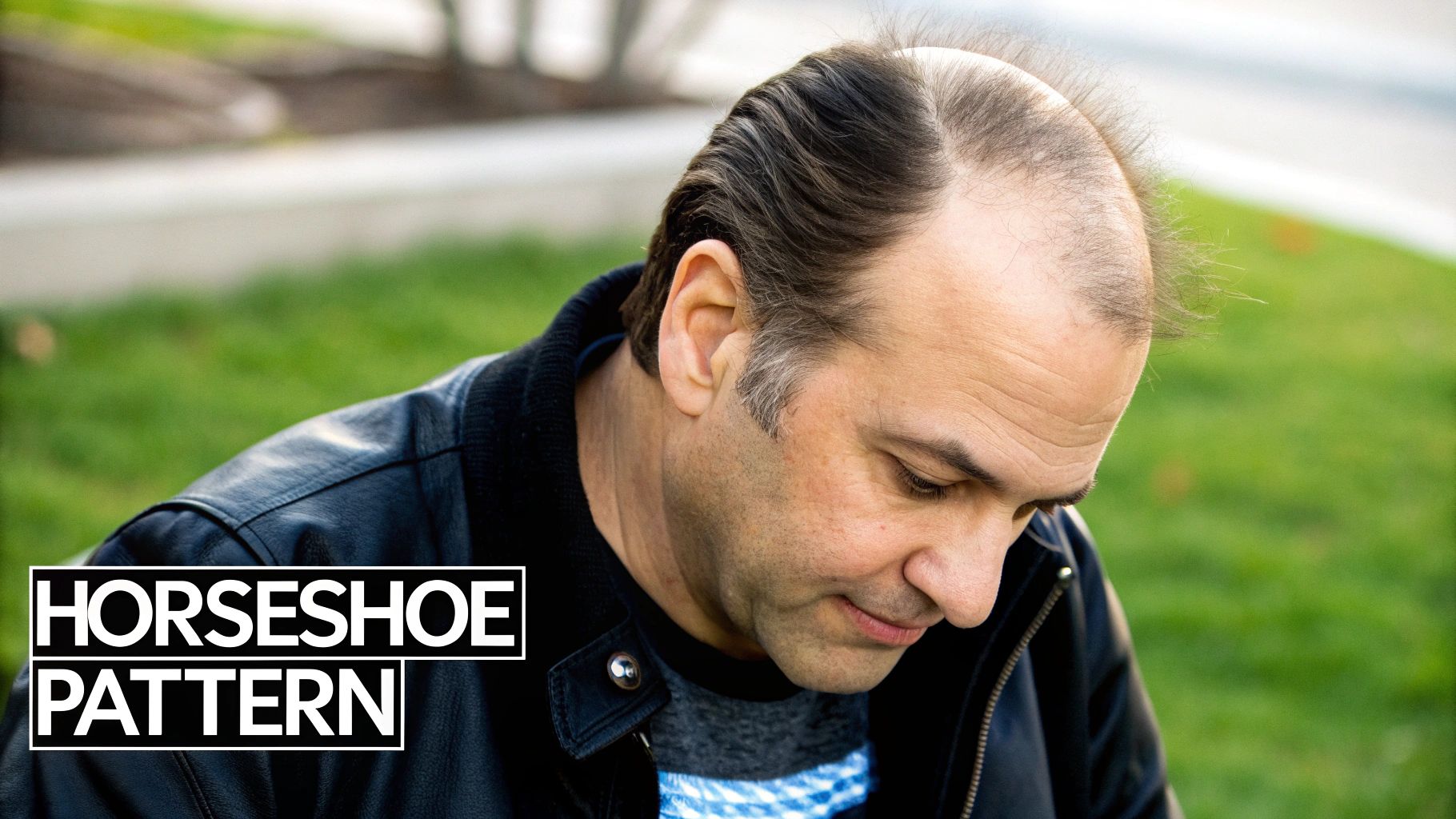
At Stage 5, male pattern baldness progresses significantly. The receding hairline meets the thinning crown area, leaving only a thin strip of hair across the head's top. This creates a distinct horseshoe or "U" shape around the sides and back.
This advanced stage requires a different approach to hair management. Knowing what to expect helps make better decisions about treatment options and styling choices.
Key Features of Stage 5:
- Extensive U-shaped hair loss pattern covering most of the top and front scalp
- Major crown balding that connects with the receding hairline
- Thin remaining hair band between the sides and crown
- Classic horseshoe shape forms around the sides and back
Why Stage 5 Matters:
Stage 5 is a key milestone in hair loss progression. At this point, treatment possibilities change significantly. Standard medications that work well in earlier stages become less effective, making it important to adjust expectations and consider alternative approaches.
Main Challenges:
- Treatment limitations: Most common hair loss medications show reduced effectiveness
- Higher restoration costs: Hair transplant surgery becomes a primary option but requires significant investment
- Styling restrictions: Fewer options for natural-looking hairstyles with remaining hair
Managing Stage 5 Hair Loss:
- Consider hair transplants: This surgical option can restore hair in bald areas. Research qualified surgeons and discuss realistic outcomes.
- Try the bald look: Many men find confidence by completely shaving their head. Think of respected figures like Patrick Stewart and Sean Connery who showed how embracing baldness can look distinguished and masculine.
- Care for your scalp: Good scalp health remains essential. Use mild hair products and protect your scalp from sun exposure.
Understanding Stage 5 helps men make confident choices about their hair loss journey. Whether choosing surgery, embracing baldness, or focusing on scalp care, taking action helps maintain self-assurance and comfort with your appearance.
6. Stage 6 – Large Continuous Area of Hair Loss
In stage 6 male pattern baldness, the characteristic horseshoe pattern has fully developed. The hair bridge that used to connect the sides across the top is now gone or very thin, creating one large bald area. The sides and back maintain hair coverage while the top shows significant hair loss.
This advanced stage indicates that DHT hormone has been affecting hair follicles for a considerable time. The once-thick hair on top has thinned dramatically, with only fine, barely visible hairs remaining in many cases.
Key Features:
- Top hair loss is extensive: The main sign of Stage 6 is minimal terminal hair remaining on the crown and top
- Side hair stays thick: Hair on the sides and back usually keeps its density since DHT affects it less
- Clear horseshoe shape: Hair loss from crown and temples has merged, forming the distinctive horseshoe pattern
- Thin hairs may persist: While thick pigmented hairs are mostly gone, some fine vellus hairs often remain
Main Challenges:
- Limited treatment options: At this point, medicines like Finasteride or Minoxidil mainly help maintain existing hair rather than regrow lost hair
- Multiple transplant sessions needed: The large bald area often requires several hair transplant procedures for adequate coverage
- More intensive hair care: Remaining hair needs careful maintenance with specialized products and treatments
Public Examples: Well-known figures like Larry David and Danny DeVito confidently showcase Stage 6 baldness, proving that hair loss doesn't define personal style.
Helpful Tips:
- Guard remaining hair: Use products designed to strengthen and maintain side and back hair
- Consider full shaving: Many men find that completely shaving creates a clean look and easier grooming
- Care for scalp health: Regular gentle cleansing and exfoliation helps maintain good scalp condition and circulation
This stage marks a crucial point in male pattern baldness progression. Understanding Stage 6 characteristics helps men make informed choices about their hair loss journey. While it brings certain challenges, it also opens doors to exploring new looks and styles with confidence.
7. Stage 7 – Final Stage
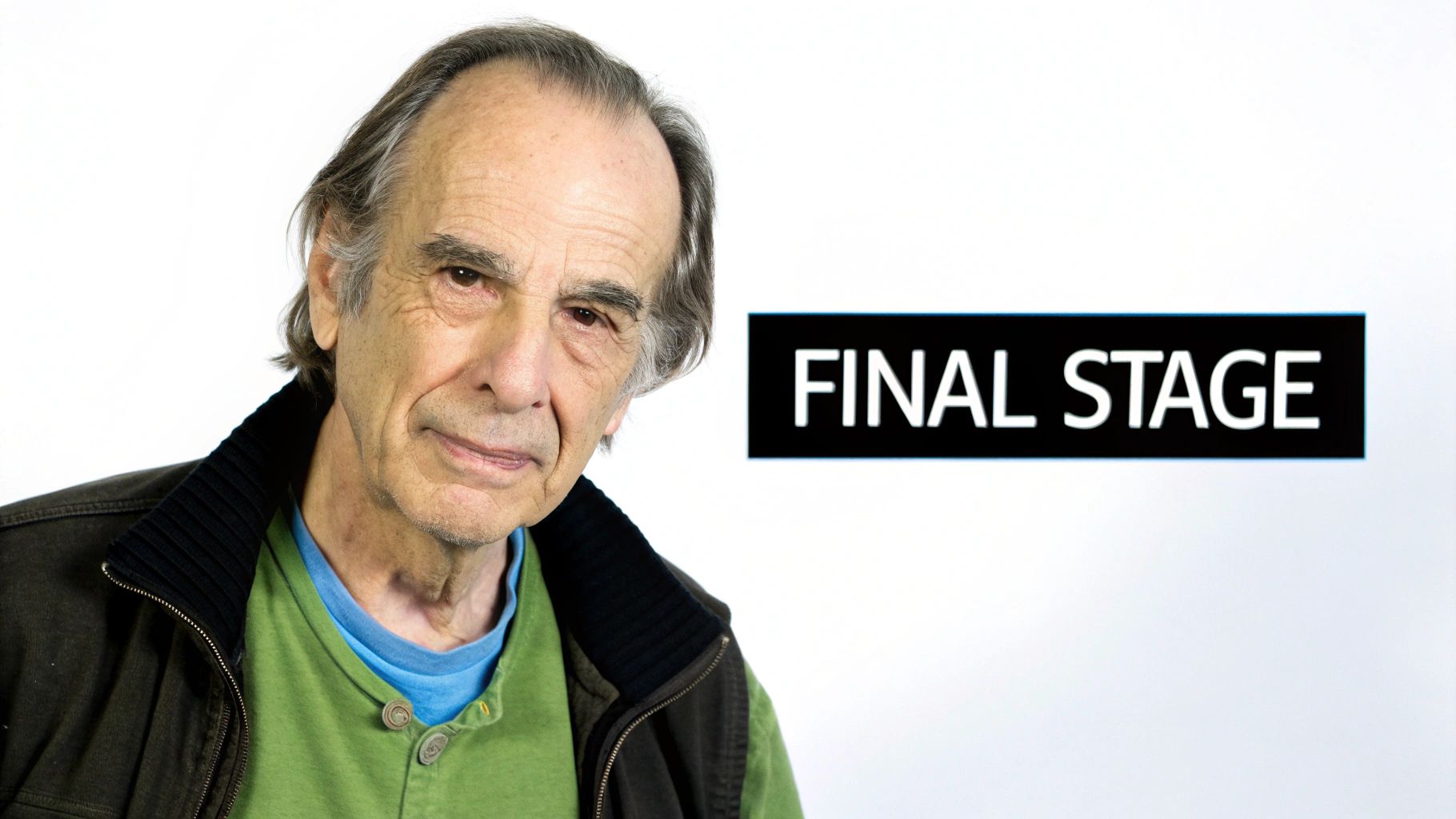
Stage 7 marks the endpoint of male pattern baldness progression. The remaining hair forms a distinct horseshoe pattern around the sides and back of the head, while the top is completely bald. Any remaining hair tends to be thinner and more delicate compared to earlier stages.
This final stage provides clear direction for hair care and styling choices. While treatment options become limited, many men successfully adapt their look and embrace this stage with confidence.
Key Characteristics:
- Classic horseshoe pattern wrapping around sides and back
- Complete hair loss on the crown and top
- Thinner remaining hair that may continue to weaken
- More sensitive scalp due to increased exposure
Benefits:
- Simple maintenance for those who embrace it
- Clear styling direction with well-defined options
- Distinctive appearance when properly maintained – similar to well-known figures like Patrick Stewart
Common Challenges:
- Limited treatment possibilities at this advanced stage
- Increased sun sensitivity requiring consistent protection
- Temperature sensitivity affecting comfort
Management Tips:
- Use high-SPF sunscreen made for scalps and wear protective hats
- Choose gentle hair products designed for thinning hair
- Consider fully shaving remaining hair for a clean, uniform look
Cultural Impact:
The horseshoe pattern has gained wider acceptance through public figures who confidently display this look. Notable examples include actors like Patrick Stewart and athletes like Terry Bradshaw, who have helped show that this hair pattern can project confidence and sophistication.
Understanding this final stage helps men make informed decisions about their appearance and hair care routine. While it represents the endpoint of hair loss progression, proper management and styling can help maintain a polished, self-assured look.
Male Pattern Baldness: 7-Stage Comparison
| Stage | 🔄 Implementation Complexity | ⚡ Resource Requirements | 📊 Expected Outcomes | 💡 Ideal Use Cases | ⭐ Key Advantages |
|---|---|---|---|---|---|
| Stage 1 – No Hair Loss / Baseline | Minimal – easy upkeep | Basic preventative care; low cost | Full head of hair; stable M-shaped hairline | Establishing baseline; early monitoring & prevention | Full styling options; proactive treatment potential |
| Stage 2 – Slight Recession of Hairline | Moderate – early process adjustments | OTC treatments; DHT-blockers suffice | Minor recession at temples; subtle M-shape change | Early intervention; dermatologist consult; routine care | Opportunity to delay progression; natural look maintained |
| Stage 3 – First Signs of Clinical Baldness | Elevated – requires prompt action | Prescription meds (e.g., finasteride) | Noticeable deep recession with emerging M, U, or V patterns | Transition to clinical treatments; adjust styling | Early identification aids treatment planning |
| Stage 4 – Severe Hair Loss | High – complex treatment planning | Expensive treatments; possible transplants | Pronounced temple and crown loss with residual hair band | Considering hair systems, transplants, or cosmetic concealers | Well-defined loss pattern for targeted interventions |
| Stage 5 – Advanced Hair Loss | Very High – intricate, costly approach | Extensive interventions; high financial input | Distinct horseshoe pattern; large U-shaped alopecia | Evaluating permanent solutions; embracing bald options | Clear pattern assists in planning definitive solutions |
| Stage 6 – Large Continuous Area of Hair Loss | High – limited, challenging options | Multiple sessions; high maintenance efforts | Large bald area on top; robust side hair remains | Opting for complete shaving; focus on scalp protection | Clear aesthetic direction; stable side density |
| Stage 7 – Final Stage | Minimal – maintenance-focused | Minimal interventions; emphasis on care | Only a delicate wreath of hair remains; sensitive scalp | Embracing unique look; prioritizing sun protection and care | Low-maintenance; distinctive, polished appearance |
Navigating Your Hair Loss Journey
When you understand the seven stages of male pattern baldness – from a baseline of no hair loss to the final stage – you can make better choices about your hair care approach. Knowing where you are in this progression lets you decide whether to work with your natural look, seek treatment, or take preventive steps. Remember that MPB typically advances gradually and is shaped by both genetic factors and hormone levels.
The first step is an honest assessment of your current hair loss stage. From there, you can explore your options and talk with hair specialists. Managing hair loss is a gradual process that may involve different solutions at different stages. For example, you might use specific styling methods to maximize coverage early on, then consider FDA-approved treatments like finasteride or minoxidil as things progress. Basic health practices matter too – good nutrition, exercise, and stress management all support healthier hair.
Hair loss treatment continues to advance through medical research and new techniques. Notable developments include PRP (Platelet Rich Plasma) therapy, refined hair transplant procedures, and studies of potential new medications. Following these advances helps you find the most current solutions for your situation.
Key Takeaways:
- Male pattern baldness follows seven distinct stages of progression
- Early awareness and understanding of your stage helps guide treatment choices
- Multiple approaches including treatments and lifestyle changes can help manage hair loss
- Professional medical advice is important for best results
- Stay informed about new treatment options as they develop
Want to learn more about managing hair loss and treatments like PRP therapy? Visit PRP For HairLoss for detailed information about male pattern baldness and PRP treatment options. Their resources can help you determine if PRP therapy matches your needs.

 PRP For Hairloss
Leave a comment